



 Newsletter
 Search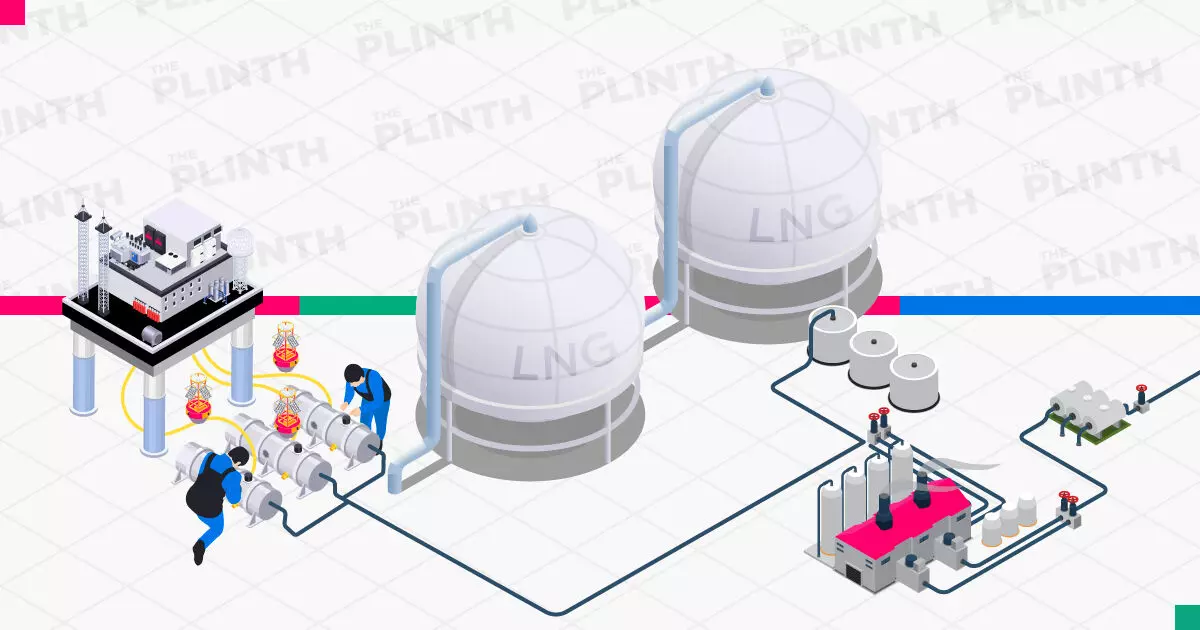
LPG Cylinder Suffering Is Coming For The Piped Gas Consumers
- The Plinth
- Published on 26 March 2026 6:00 AM IST

The war began by emptying cooking gas cylinders across India. Now, with South Pars bombed and Ras Laffan in flames, the conflict is coming for the pipe as well.
For the first three weeks of the war, it seemed as though India had inadvertently insulated a small fraction of its population. While the Strait of Hormuz closure grounded liquefied petroleum gas (LPG) tanker traffic to a near halt and the government moved to ration household cylinders — extending booking intervals from 21 to 25 days, cutting commercial allocations to a fifth of normal, imposing 45-day refill cycles on rural PMUY consumers — the 14.7 million households connected to piped natural gas networks cooked on, undisturbed.
Their gas arrived at 21 millibars, through the same buried polyethylene pipes, at the same flame height as always. The crisis, for them, was something happening to other people.
That calm was always more fragile than it appeared. On the night of March 18, when Israeli aircraft struck Iran’s South Pars gas field and Iran’s missiles found their mark at Ras Laffan Industrial City in northern Qatar, the structural underpinnings of piped natural gas (PNG’s) apparent resilience began to crack.
Why The Pipe Seemed Safer
The difference between PNG and LPG households has a clear physical explanation rooted in how the two supply chains are built.
LPG, a blend of propane and butane, must be compressed into a liquid and shipped in specialised pressurised tankers. In 2024, West Asia contributed 97% of India’s total LPG imports, with every cargo transiting the Strait of Hormuz.
When Iran moved to interdict that corridor, the supply chain had no resilience mechanism — no storage buffer between the tanker terminal and the kitchen stove.
The PNG system is structurally different. Natural gas arrives as liquefied natural gas (LNG), chilled to minus 162 degrees Celsius for ocean transport, warmed back into gas at India’s regasification terminals, and fed into the national trunk pipeline grid. The pipeline network itself holds gas under continuous pressure.
When a disruption hits, PNG consumers are insulated by gas already in the distribution grid, transmission pipelines, and LNG storage tanks at import terminals. It’s a buffer measured in days to weeks rather than the number of cylinders in a distributor’s godown.
A Tale Of Two Kitchens
In Andheri, a suburb of Mumbai, a resident with a PNG connection described noticing the war primarily through her WhatsApp groups, not her cooking. A few kilometres away in Dharavi, where PNG infrastructure has not yet reached, her counterpart had been waiting eleven days for a cylinder refill that would normally arrive in five.
The government asked consumers not to panic-book, but in households where the cylinder is the only cooking option, a 45-day booking cycle against roughly 4.2 cylinders consumed annually by PMUY beneficiaries — against 6.5 for general consumers — makes every delayed booking a genuine hardship.
A supply shock does not merely inconvenience these households; it pushes them back toward open-fire cooking and the respiratory disease burden that PMUY was designed to eliminate.
The scale of India’s exposure to both fuels, and the yawning gap between how many households have the protection of the pipe versus how many remain on the cylinder, is what makes the current crisis so acute.
Gasfields Hit
South Pars is part of the world’s largest natural gas reserves, located offshore in the Persian Gulf, shared between Iran and Qatar, which calls its portion the North Dome. The entire field contains an estimated 1,800 trillion cubic feet of usable gas, enough to supply the world’s needs for 13 years.
On March 18, Israel struck the South Pars field and its neighbouring refineries in coordination with the US.
Natural gas from South Pars is the biggest source of Iran’s domestic energy supply, and the destruction of Iranian processing capacity wiped out a significant share of the feedstock that was, before the war, being converted into LPG for export to Asia.
The cylinder crunch that had already begun further deepened.
Iran’s response turned the threat toward India’s other fuel supply. Qatar had already halted LNG production on 2 March following Iranian drone attacks on Ras Laffan and Mesaieed Industrial City. The missile strikes on March 18-19 went further.
The attacks damaged LNG Trains 4 and 6 at Ras Laffan, totalling 12.8 MMTPA of production capacity, nearly 17% of Qatar’s exports. QatarEnergy CEO Saad al-Kaabi confirmed that repairs could take up to five years, forcing the company to declare long-term force majeure on some LNG contracts, at an estimated loss of $20 billion in annual revenue.
Analysts at Wood Mackenzie said the attacks fundamentally reshape the global LNG outlook, with disruption to global natural gas supply now likely to last longer than two months. TTF gas prices in Europe surged 13 euros per megawatt hour in a single session.
Qatar’s Ras Laffan Is India’s PNG problem
India imported nearly 27.8 million metric tonnes of LNG in 2024. Of this, nearly 47%, or 11.3 MMT, came from Qatar, making it India’s single largest gas supplier.
Petronet LNG’s Dahej terminal, India’s largest at 17.5 MMTPA capacity and running at 95% utilisation in FY2023-24, is locked into 8.5 MMTPA of Qatari volumes under long-term contracts. That is roughly half of Dahej’s throughput, and Dahej is the artery through which the majority of India’s PNG and CNG supply flows.
The Andheri resident whose PNG-fuelled flame was burning unchanged through the first three weeks of the war is now confronting a different calculus.
Ras Laffan’s production has been halted since March 2, and Trains 4 and 6 have been extensively damaged. The contracted Qatari volumes that India’s PNG system depends on will be partially short-supplied under force majeure for a period that extends well beyond any likely end to active hostilities.
Every cubic metre of Qatari gas that India cannot receive at contracted rates must now be sourced on the spot market from the US Gulf Coast, Australia or East Africa. The prices are elevated by the same war that destroyed the production capacity in the first place.
India’s government has acknowledged the risk but framed it carefully.
Joint Secretary Sujata Sharma of the Ministry of Petroleum and Natural Gas stated on March 18 that “all efforts are being made to diversify our sources,” noting that crude oil imports were already 70% sourced outside the Hormuz corridor and that LPG diversification toward the US was underway.
On gas, the diversification is less mature. BPCL has signed an annual contract with Norway’s Equinor for 550 ktpa of combined propane and butane, and some LNG spot cargoes arrive from the US, but the long-term contract portfolio is overwhelmingly Qatari. The buffer that protected PNG homes through the first three weeks of the crisis — gas in the pipe, gas in the terminal storage tanks — is finite, and it is being drawn down.
The Foundation Has Shifted
A structural irony runs through the entire PNG resilience story that recent events have made impossible to ignore.
India built its LPG-to-PNG substitution policy on the implicit assumption that shifting from one Gulf-dependent fuel to another represented a meaningful diversification of risk. The IEA’s projections make plain that the PNG push does not reduce India’s import dependence — it deepens it.
Domestic production estimates barely moves across the entire decade, growing only 8% from 35 bcm in 2023 to just under 38 bcm by 2030. The IEA projects India’s total gas consumption reaching 103 bcm, meaning LNG imports must more than double to fill the gap.
Every new PNG household connection thus adds to the import layer, not the domestic production base.
In 2021-22, 48% of CGD consumption was already sourced from imported RLNG. With Ras Laffan offline and global LNG spot prices climbing, the cost of that import layer has risen structurally for the better part of a decade. South Pars and Qatar’s North Dome are the same geological structure — the world’s largest gas accumulation, shared under a single body of water, now connected also by the same military conflict.
Israel bombed one shore of it. Iran struck the production facilities on the other.
No Advantage?
For the first three weeks of the war, the pipe’s advantage was real but narrow: 14.7 million households insulated by storage buffers, while 330 million cylinder users queued at distributors.
Ras Laffan has changed those terms.
The buffer that protected PNG homes was always borrowed time — gas in the terminal tanks, and under pressure in the distribution grid — not a genuinely independent supply. With Trains 4 and 6 damaged beyond near-term repair, Qatar’s long-term contracts partially under force majeure, and spot LNG prices climbing, the pipe’s apparent advantage is dissolving.
The households that thought they had escaped the cylinder crisis are discovering that they were merely upstream of it.
The government’s response has been to make LPG rationing contingent on states moving faster on PNG. They’ve offered 10% more commercial LPG allocation in exchange for faster CGD pipeline approvals, with additional percentages tied to dig-and-restore schemes and reduced right-of-way charges.
It is an implicit admission that administrative drag, not capital or gas, has been the binding constraint on PNG expansion for years.
With Ras Laffan offline and LNG spot prices surging, that drag now carries a direct price: more expensive replacement gas for the households that do have the pipe, and continued cylinder dependence for the hundreds of millions who do not.
The suffering that began in the cylinder supply chain is tracing a path, molecule by molecule, toward the pipe.
Core.
Core.


