



 Newsletter
 Search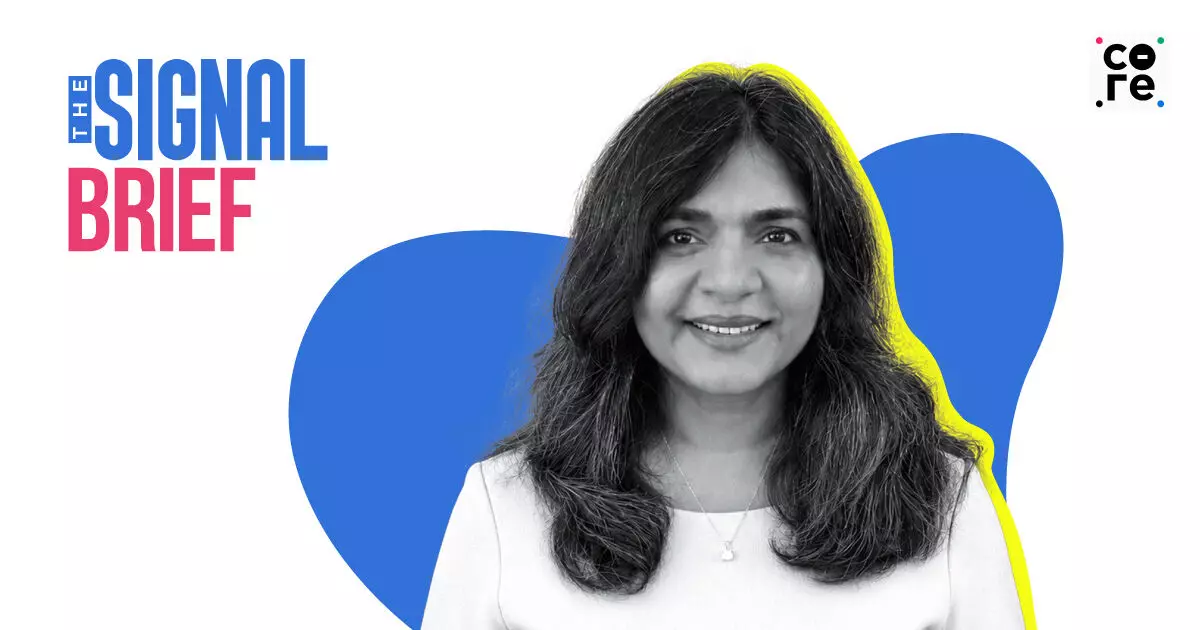
Tuesday Special: Richa Dwivedi On The Future Of Jobs In The AI Age
- Podcasts
- Published on 25 Aug 2026 7:30 AM IST
How is AI changing careers? And what can young people should do to stay ahead of the curve?
In The Signal Brief's Tuesday special, we interview experts from across industries.
Our focus remains the same: helping you understand the trends shaping India. We're simply bringing you more of the conversations behind those stories.
Today's guest is Richa Dwivedi Saklani. She just published a book titled ‘Jobs 2.0: The Ultimate Guide To AI Proof Your Career’.
She’s also had a career in banking and equity research. After that she founded Inomi Learning, a self-discovery based career and college guidance firm.
Richa and I spoke about how AI is changing careers and what young people should do to stay ahead of the curve.
The Core produces The Signal Brief. Follow us wherever you get your favourite podcasts.
NOTE: A machine transcribed this episode. A human has looked at this text but there might still be errors. Please refer to the audio above, if you need to clarify something. If you want to give us feedback, please write to us at feedback@thecore.in.
TRANSCRIPT:
Kudrat (Host): So, my first question for you, Richa, is, you know, everyone tells young people to learn AI to stay relevant.
But what does that actually mean? And if you were advising a college student graduating today, as I'm sure you do, where would you tell them to begin?
Richa: Right. So I think that learning AI is not a structured activity that you do. Like, you know, I see a lot of people selling courses about, you know, these are the few AI skills that you need.
On the other hand, I feel that AI is simply technology that is built into our lives on a regular way. Right. So, in case you were researching a report or, you know, a lot of my students who are interning, they end up using AI all the time anyways.
So I think that the important thing to learn is that how to use AI effectively. You know, using AI is actually very easy for me to say, "OK, let me do this research in ChatGPT and put this together." But the moment you do that, it limits your thinking to that little bit of research.
It sort of shapes your language. And so how do you use AI as a tool to make your work go faster? You know, like one of my students was doing an internship.
She found that she'd used a lot of data, asked AI to generate a lot of data. And AI was actually imagining up some of that data. Right.
So then she had to figure out how to tell AI, "Stop, never do that." And then redo a lot of the work and say, "So how do I effectively use it so that it doesn't get, it doesn't spoil my work?" So I think the more you use AI, the more you learn how it is to be effective.
So the only one thing I would tell young people is that don't resist AI. A lot of young people I've talked to feel that, you know, I'm anti-AI. You know, I don't want AI to take over the world, so I'm not going to use AI.
So to them, I would just want to say that, you know, it's a wave that swept over all over the world and we can't stop it. What you can do is that how can you use AI to be more effective? So get into it and learn how to use it in an intelligent way to make things more effective for yourself rather than resist it.
That's about it.
Kudrat (Host): OK, interesting. I didn't know that there were young people who were explicitly kind of anti-AI in that sense.
Richa: And I think the fear is that since AI is taking over their jobs, they're like, I reject it, you know.
Kudrat (Host): Yeah, yeah, I understand. And, you know, in your book, you talk a lot about previous technological revolutions or waves and how some of a lot of them have ended up creating more jobs. And in this particular case, you say that before choosing a career, people should understand their signature style.
So, you know, in this AI world that we're all living in, that we're only going to and AI is only going to be more a part of careers, more a part of our lives in the future. Why do you think self-awareness is so important? Also, can you talk a little bit more about your signature styles for our listeners?
Richa: Right. So, you know, signature styles is a tool that I built over the first 10 years of my working in career guidance. Now, it's been about 22 years that I've been doing this work and I've understood that how that framework really works.
So signature styles is really presenting nine skill sets that students have: three in the creative areas, three in the interpersonal areas and three in intellectual or problem-solving areas. Now, typically how the tool works is that you would have a set of three and a certain prioritisation among those three. My number one, number two, number three, that would guide you towards which careers would reward your type of personality the most, where you will be able to have the most fun.
Therefore, you will be able to go beyond the call of duty that you'd be able to do great work. So, to me, that still remains an important framework for me when I'm approaching jobs. Right.
So self-awareness is simply it's not saying that let me not do certain careers. But it's sort of saying that what are the careers that will best leverage the person who I am? And therefore, what I've done, you know, so I've written a book earlier called The Ultimate Guide to 21st Century Careers.
And there I've mapped each of those nine skill sets to many careers. And in this book also, I've kept that framework the same, that I've mapped those signature styles to different careers. So I feel that how much of a technology changes the world, your success still lies in matching the person who you are with the skills that a career really demands.
So therefore, that mapping is still meaningful and understanding yourself and building a career that resonates with you is more important than saying, where are the jobs and running after that. So that's really one of the core messages that I've tried to give in the book itself. Also saying that, you know, just because a lot of new technologies, AI and synthetic biology, mixed reality, what have you, 3D printing, that doesn't mean that only the STEM or the technological fields have a lot of growth.
You know, there is growth in impact communicators. There's a lot of growth in events is so huge. You know, there's a lot of growth in media.
Media is really, really big. Right. Filmmaking is really, really big in the future.
So don't think that you all, we all need to become STEM people now. You know, you can still be yourself, but learn that. What are the new careers that you can really connect with?
Kudrat (Host): OK, understood. So, like, I understand the argument you're making in terms of understanding yourself, understanding what kind of drives you, what are your natural inclinations. But at the same time, there are certain careers that reports show are going to be more affected, like software development and even a lot of writing careers.
So, you know, I mean, in your opinion, what are certain careers that will change a lot versus what are others that maybe won't change as much? And what would your advice be to young people around that?
Richa: Right. So I think that if you see careers that are affected, of course, within computer science, I would say software programming is very hugely affected. Testing is affected.
You know, software testing is strongly affected. You know, within data analytics and data science, I would say a lot of the statisticians and data entry is very highly affected. I would say if you look at sales and marketing, then a lot of customer service is affected and it's taking over.
Right. If you look at design, then a lot of basic graphic design is affected. Right.
So I feel that my advice to people in these areas would be that do not mourn the loss of the careers that are affected, but see what is actually opening up. So if you look at computer science, so one of the things that I pointed out in the book is that we are moving towards a world of ubiquitous AI, where, you know, just like electricity is there in every aspect of our lives today, AI would tomorrow be there in just about every aspect of our life, like a fridge telling us that this is going old, a mirror telling us that, "OK, you wore this last week as well.
Are you sure you want to wear it again this Wednesday?" Right. So, and that demands a whole lot of software designers and developers who are creating interfaces where people can, you know, in a human-safe way, interact with these things that are coming up with ideas of what the software can do.
Right. So rather than saying, "Oh, I cannot code and programme anymore because the, you know, I can do that," but say that what can I do that is more creative with coding and programming? You know, so, like, now with Claude and with Codex and, you know, a lot of coding can just be done.
But the moment you try to build an app that is slightly more complex than saying, you know, come and see these products and choose one to buy. But it's sort of saying that, "OK, this data goes over here and this is how it creates your profile. And then this is how it prompts you."
You need more than an AI to code it. So AI really becomes a tool for you to code it. So I'd encourage students to look beyond those careers that AI is taking over and see what else can happen.
So, you know, I came across a very, very interesting research paper recently by a set of MIT economists led by a gentleman called David Autor. So it's a widely quoted bit of research. Goldman Sachs has quoted it in their AI report.
So what he's really saying is that they looked at jobs between 1940 and 2018 and they found that 80 percent of the jobs were that in 2018 had not existed in 1947, in 1940. So essentially what they are saying is that about 85 percent of the job growth has come from new jobs created by new technology. Right.
So, you know, if in a very basic way, you go back to the caveman and someone tries to tell the caveman that, "Look, you can tomorrow people will be making money out of consulting other people." And they'd be like, "Whoa, what would you consult them about?" Or lawyers, you know, social media, you know, that stuff didn't exist earlier.
Right. So if we look forward and say what is going to be created. Right.
So how can I be, let's say, a sustainability designer for events? Right. How can I be a gender policy and human safety expert in a film set?
Right. How can I be a psychologist who does UX research and makes AI human-safe? How can I be a cognitive scientist that makes human-safe AI as someone who studied psychology as well as computer science?
So if I try and see that, what can I do in the future? Can I be a legal expert on AI policies? Can I look at how companies and countries are designing AI policy?
So I look ahead at what is opening up rather than saying what is closing down. Then I would say that there are a huge number of jobs in every area. And that's what I've tried to highlight in the book, that if you look at every area and every skill set, there are lots of things for you to do.
So look ahead rather than mourn the things that have gone past. That's the key message I'd give.
Kudrat (Host): OK, great. And, you know, of course, a lot of this advice would also apply to people who have spent maybe 5, 10, 20, 30 years in their career. But is there anything else that you would like to say to people who are mid-career?
You know, any, like, advice or message for them?
Richa: Yeah, you know, people who are mid-career are also struggling. You know, just like I would say that, see, there is an enhancement of the struggle for everybody. Kids who are looking for jobs today have to apply to 10 times more jobs than their parents had to before they can land that first break.
Similarly, when you're mid-career, you find that your position can be shaky, that if you move out of one job, then for you to find another one may not be so easy. So I think it's. It demands from us that each one of us really needs to look at what we want to do.
And if you're mid-career, I think you should ask yourself the question that, and you're worried if you're doing well and you're doing great, that's great. But if you're worried and you're saying that, where do I go from here? Then it's time to sort of go back to the drawing board and vision the next 15, 20 years of your life and see what's exciting for you among what's coming up and see if you need reskilling.
If you need a different type of experience, how do you need to make yourself relevant to that future vision that you want to build for yourself? The second thing I would say is that entrepreneurship is very big in this new world. Right.
In this world where there is 3D printing, you can easily print something out. You know, you can easily imagine something. You can easily create new fashion designs.
You know, production is easier. Ideation is easier. The cost of mistakes is a little bit lower.
And therefore, I would feel that entrepreneurship is a very big deal. So people who are mid-career, who have experience in an industry and who really have the confidence to, you know, lead businesses and to get things done. They are really ideally poised to set up something.
Right. So come up with an idea and give it a shot. You know, take that risk.
The cost of risk is a little bit lower. You learn something. And if nothing else, you'll get back into a funded startup that's interested in your entrepreneurial experience.
So that would be my guidance to them.
Kudrat (Host): Absolutely. And then I was also curious. I mean, you mentioned that, you know, some young people are kind of resistant to AI because they're concerned about how it's going to change the world.
And some others feel that they have to do STEM. So are there any other kind of surprising trends or questions that you're seeing among the young people who you work with?
Richa: Give me a second to just think about it, you know, because among people who I work with, I think that, see, this generation is very much a generation whose parents want them to do what what suits the child. Right. We were a generation that was very much pushed into much of the engineering, medicine, MBA sort of roots that were that had been proven to work.
And now there's a whole generation of people where parents are saying that find yourself. So I think that these kids are also more willing to take risks. Right.
So I am finding that a lot that, you know, they, they have, you know, they are able to come up with ideas and take an idea to market much faster. Right. And so they take that risk sooner and they look around for funding, you know, sooner.
They are ready to fail fast. So I think that that's a great gift that the world has given this young generation. So I think that's something that a trend that I really find inspiring.
Another trend I really find inspiring is social responsibility. I feel that this generation really cares about doing something that improves the world in some way. And, you know, also because a lot of college applications demand that you should be doing some sort of social work or, you know, you should be creating community impact in some way.
So they've had some early experiences of community impact and they really want to make a shift and they want to make a change. And that's why I think that they are really a breath of fresh air for the world. And the world is really waiting for them.
Kudrat (Host): Yes, absolutely. And then, you know, you mentioned colleges. And this is my last question.
And I also noticed in your book after every section you had kind of the top colleges for this particular degree or this particular area. I mean, with AI, there's another big question, which is the importance of degrees where you can learn everything on AI. So what do you think about the future of education in this AI-driven world?
Do degrees still have a value? And if yes, like, what would be that value?
Richa: Well, you know, of course, education has value. And I think that learning things of AI is not really going to replace formal education. I think formal education is also about inspiring, structuring, motivating people and, you know, self-study that, you know, I'm just going to learn it off.
AI is ultimately going to be limited because it will be very functional that I learn the skill that I need for this particular thing. And in fact, you know, if you see the Future of Jobs Report with OECD, it's really focused a lot on lifelong learning. And that's sort of what I think the shift in education needs to be.
But I think that education needs to change fundamentally to adapt to this world. Like, you know, schools need to bring in career education and skill-based education at an earlier level so that students can start trying out media, law. And, you know, not just studying, you know, core subjects like a pure science or, you know, history.
And, you know, so not that those are great subjects to study, but instead of being limited to that, but also bring in career education. And in fact, I also feel that education would move a lot towards mid-career education. You know, that someone with 10 years.
In fact, I believe that in the coming years, it will become quite popular for people to take an education break. You know, we all in our generation keep saying, "Oh, I want to go back to college." And I think that would probably be a dream come true that, you know, people in their 30s will take a break to go back to college and, you know, to learn something, to reskill and then to move again, maybe once, maybe twice, because, you know, the lifespan is also going to enhance.
So I feel that education is a huge sector that's not going away in a hurry. In fact, you know, India expects so many new schools to open all over the world. You know, teachers have more learning, more job opportunities.
Tutors have so much growth opportunities and so many short-term certifications and courses are successful. So I feel actually education is booming and it's very much needed in the world today.
Kudrat (Host): OK, that's fair. So that's it from my end. Is there anything else that you'd like to add?
Richa: What would I like to add? So I think that I just want to present the idea to people that look upon this new world as a opening up of opportunity for yourself and try to find that perfect thing that you can do. So really see that.
What do you dream about? What do you think you can do? And then try and do that.
Not that it's going to suddenly happen tomorrow, because even when I'm saying entrepreneurship, there is risk, there is failure, there is understanding the market, there's growing the market. But hang in there and use your 20s, I would say, particularly to make mistakes, to take risks, to learn. And I'm sure there's a lot of opportunities in every area waiting for you.
So believe in the future and it's really there waiting for you. That's what it is.
Kudrat (Host): Thank you so much. That's a great note to end on.
Kudrat (Host): The Core produces The Signal Brief. Follow us wherever you get your favourite podcasts.
To check out the rest of our work, go to www.thecore.in.
If you have feedback, we'd love to hear from you. Write to us at feedback@thecore.in, or you can write to me personally at kudrat@thecore.in.
Thank you for listening.


