



 Newsletter
 Search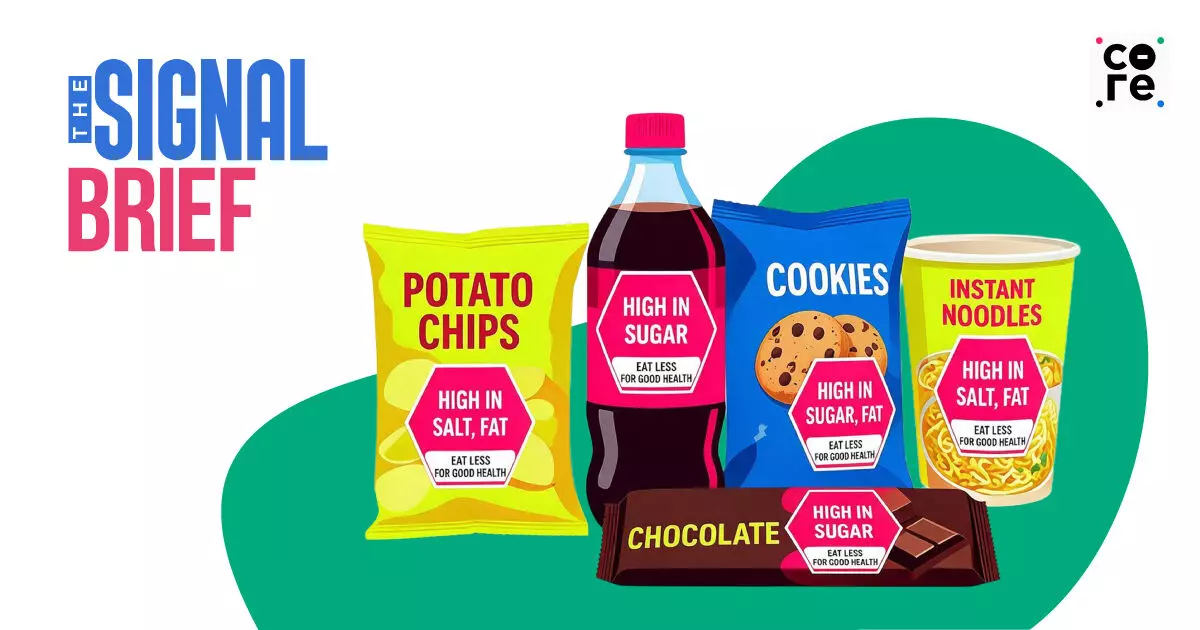
Will A Warning Label Change What You Buy?
- Podcasts
- Published on 11 Sept 2026 7:30 AM IST

What's the public health cost of packaged food? Can the FSSAI's warning label help consumers?
Packaged foods have become a much bigger part of our lives today than they were before. And public health advocates are worried.
For years, they've been advocating for the FSSAI to help make labels simpler.
And now, after the Supreme Court directed it, the food regulator has acted.
It has proposed front-of-the-pack warning labels for foods that are high in sugar, salt or fat.
But here's the catch.
The warning labels only appear on products that are high in two or more of these nutrients.
So can these labels really have an impact?
In the latest episode of The Signal Brief, we learn about the public health cost of packaged and ultra-processed foods, what these labels are meant to fix, and what their impact might be.
The Core produces The Signal Brief. Follow us wherever you get your favourite podcasts.
NOTE: A machine transcribed this episode. A human has looked at this text but there might still be errors. Please refer to the audio above, if you need to clarify something. If you want to give us feedback, please write to us at feedback@thecore.in.
TRANSCRIPT:
Kudrat (Host): When Harmeet, an entrepreneur, reached 93 kgs at age 17, he realised something needed to change.
Harmeet: It was, I think, my brother would send unflattering pictures of me to my sister. And I realized that that's not sustainable.
Kudrat (Host): He says his weight gain likely came from eating too many packaged foods and pizzas, drinking Coke.
When he decided to make the change, he approached a nutritionist at his gym. She walked him through calories and macros.
Today, Harmeet reads labels extensively, including the ingredient list.
Harmeet: I started looking more seriously and carefully at the labels and, you know, how many of the ingredients were produced in a lab, and I can't even pronounce, let alone understand whether they're healthy or not, versus how many of those were produced or grown on the farm.
Kudrat (Host): Harmeet is the kind of consumer who turns the pack around. Most people don’t.
They’ve got just a few seconds in a store, or on Blinkit.
That gap, between the information on the pack versus people’s understanding of it, is what India’s food regulator is now trying to close.
Last month, the FSSAI or the Food Safety Standards Authority of India told the Supreme Court that packaged food high in sugar, salt, or fat may soon carry a red warning on the front of the pack.
So why this, why now, and can a front-of-pack label help Indian consumers?
Kudrat (Host): My name is Kudrat Wadhwa and you’re listening to The Signal Brief.
You’re listening to our Friday episode, where we tell stories about how Indians live, work and spend.
In today’s episode: the public-health cost of packaged food, what the FSSAI’s proposed labels are meant to fix, and whether a red mark on the front can do what the back of the pack never did.
Kudrat (Host): Now, packaged foods can be harmful to our health and eating without being mindful can lead to weight gain, diabetes, and high blood pressure.
Dr Alka Gupta, an obstetrician who specialises in women’s health, told me she has seen that shift in her clinic: more packaged food, more disease including PCOD, the hormone and metabolism disorder you may know as PCOS. Some doctors now call it PMOS.
Dr Alka: There is what you call PCOD. You know, till 2000, I started... I was in the medical school from 1976 to '86, and I started my practice from '87 onwards. PCOD was just a theoretical thing till the '90s. When the consumer boom came, Maruti came, the... You know, we started eating outside. Every corner of our lane had a Samosawala shop. Earlier, we never used to eat outside. Eating once a month was good enough. But now, with that, the PCOD boom started. Why? Because our basic weights increased at the same age. I am 5'6". I used to be 49 kg in my 20s. Now, basic weight I see is 59 or 65 kg at 5'6". That is the difference which has come in society, which has caused a midriff, deposition of fat.
Kudrat (Host): That packaged foods aren’t great is likely not news to you.
Some consumers, like Harmeet, also know that there’s a nutrition table on the back telling us the macros and sugar content of these products.
But when you’ve just a few seconds in a supermarket or on Blinkit, most of us don’t do the due diligence.
Dr Alka: Not even talking of general population, most of us doctors, nobody taught us nutrition labels. I, with my special interest in nutrition, learned how to read a nutrition label. If I ask my colleagues even, they will know, right?
And so general population, ke liye, to do all this calculation of how percentage daily value, how many grams, how many serving, how m-... It's not easy. It's not easy. Nobody has that kind of a time in a supermarket when you enter. Does anybody have that kind of a time to be calculating all of this?
Kudrat (Host): Dr Alka showed me how nutrition tables can be unclear too. In her hand, she held a bag of roasted edamame. The table at the back said 120 calories.
Dr Alka: Now what happens when I see calories 120, I say, "Oh, this pack has 120 calories." That is where the mistake comes. Above that is a small thing written, amount per serving. And how many servings are there in this pack? There are 17 servings in this pack, which means the calories are 120 into 17. So we are talking of a 2,000-plus calorie pack.
Kudrat (Host): That’s the back of the pack. Informative, but potentially confusing and time-consuming too.
And now, the FSSAI is stepping in.
Their solution: a warning on the front.
If a pack is high in two of three things–sugar, salt, fat–it must have a red mark consumers can see without turning the pack over.
And, this isn’t the only idea they’ve sat with.
For years the FSSAI leaned toward a star rating: more stars, “healthier” product.
Experts pushed back. One of them is Dr Arun Gupta.
Dr Arun: I am a pediatrician by training, but since early '90s I've been working on public health areas. And now currently, I am the convener of the Nutrition Advocacy in Public Interest, which is a national think tank of independent experts who work on the food policy.
For example, if you put a... In the chocolate you put in a couple of cashews, right? So they, they will get more stars. So, and more stars means healthier. So by that principle, none of the food products available in the prepackaged form would be declared unhealthy. They will be from least healthy to most healthy. But none of them would be declared unhealthy. So that was the methodology which we challenged, and then this whole battle started of comments from public, comments from industry, and it took years for FSSAI to analyse those comments and then…
Kudrat (Host): After that, the file didn’t move so much as get argued over.
FSSAI put stars in a 2022 draft. Health groups wanted warnings. Industry wanted stars, or a table on the front, or to leave it at educating consumers about portion control.
That draft sat.
FSSAI took public comments, then took years to go through those comments, then set up another committee to look at the comments again.
The star idea never left the building.
The front of the pack label idea didn’t enter it either, until early this year, when a Kerala group called 3S and Our Health Society filed a case in the Supreme Court.
The court then asked FSSAI to make moves.
Dr Arun said that it was thanks to lobbying by packaged food companies that this conversation got so delayed.
The companies’ argument goes like this: if you put a red mark on everything that’s high in sugar, salt or fat, everything goes red.
Dr Arun: So they said the industry will be ruined. So that's, that's, that's something which one of the industry groups also wrote to the health... past health minister, Mr. Mandaviya, that, you know, traditional industry, ethnic food industry, small and medium enterprises, they will be ruined.
And then there are people saying, our sales can go down and this whole thing is a choice of the people to eat. We are, we are offering things of different tastes and all, so where is the need?
Kudrat (Host): Part of why they say “everything will be red” is the Indian pack itself.
Same logo as abroad, but often poorer ingredients in India.
For instance, a can of Fanta in India with three times the sugar of the same-size can in the UK. KitKat here with a sliver of cocoa compared with Kit-Kat in Australia. Maggi made in India for the UK market already prints a red high-salt mark; the pack on the Indian shelf doesn’t have to.
Companies say that’s because Indian consumers want food that is salty and sweet and cheap.
Critics call it what it is: the absence of a front-of-pack law.
Harmeet, the consumer we earlier heard from, doesn’t love that food products in India are objectively worse.
But, he also doesn’t expect companies to fix it on their own.
Harmeet: Because at the end of the day, it's free market capitalism. If we don't buy those products, companies won't produce more of them. And they produce because right now primarily what, sadly, Indian consumer cares about is the price.
Kudrat (Host): According to prior reporting, big food argues that responsibility lies with consumers, and with doctors, to educate them. We did reach industry groups for this episode. No one has come on tape yet.
That is the industry case: the label is too blunt, the threshold is too strict, and that the shopper already has a choice.
But Dr Arun disagrees.
Dr Arun: The environment is created by the industry in which the consumer has... is living, right? So now the industry believes that it's a, it's the consumer's choice. So our analysis shows that the consumer is pushed to make that choice, right? So junk push is, is the work done by the industry. There are two methods of that. One method is the products are produced to be addictive. You can't stop eating, right? Many years back, I remember this, Pringles thing when they started 50, 60 years back. Yeah. Their, their tagline was, "You just can't eat one." That is truth. So... And there is a lot of literature now available, if you just go to scientific literature, that it is known, it has been found by the investigative journalists, that it is a deliberate effort of the industry to create products in such a manner with a dose.
For example, a beverage will have sugar between 10.5 to 11 grams%.
That is a bliss point. Similarly, there is a ratio of how much fat and salt should be there in a product which will hit your brain in such a way you don't stop eating.
So the... Or that dose optimization is done by the industry, not by people.
So, and on top of it is aggressive marketing. Three companies spent $13 billion in, in one year alone on marketing and advertising. The Coke, Pepsi and Mondelez. $13 billion only—In 2024. So how can you say people are not doing their good? It's, it's, it has been created. The demand is created, the need is created that I have to eat this.
Kudrat (Host): The Supreme Court has now stepped in and ended this tug of war between nutrition advocates and big food.
After it asked FSSAI to act, the regulator responded last month with the front of pack label warning.
But here’s the thing: will it change the products that consumers buy?
A LocalCircles poll, which got more than 80,000 responses, found that 94% of consumers said a red mark would help them decide.
There’s also real-life examples from other countries which have tried a similar warning.
Chile put black octagons on packs high in sugar, salt or fat. In the first 18 months, households bought nearly 25 percent less sugary drink. Later studies found still larger drops.
Mexico followed in 2020 with black warning stamps. Overall sales volume of packaged food did not collapse. What changed was the mix: studies found about 15 percent fewer calories sold from those products, and about 25 percent less added sugar, as companies reformulated. Surveys found roughly half of adults said they bought less of the stamped food.
Dr Alka is also hopeful.
Dr Alka: Somewhere it will have a public impact. So food labels, where enforcement has to go strong. But the reason is that the world has moved from fresh food to packaged products, and if the percentage of packaged products being bought are much more, then definitely one must go ahead and do it.
Kudrat (Host): Harmeet, who already turns the pack, is less sure the hexagon alone remakes the aisle.
Harmeet: I think it is a step in the right direction because, uh, it by itself I don't see having a major impact because the consumers who are careful enough, they would have turned to the back and seen anyway.
Kudrat (Host): But Dr Chandrakant Lahariya, a public health advocate, says that the percentage of health-aware consumers in India is miniscule.
Dr Chandrakant: This is a very small group of people who are aware about such kind of harmful effect of ultra-processed food. That's my understanding.
If Indian population was so much aware about health, we would not have been seeing the rise, the rapid rise in diabetes, hypertension, fatty liver, obesity, and especially in the children. We need to remember that India has one of the world's fastest rise in obesity in the children and adolescent. So assuming that people or citizen are health aware is wrong. That's one.
Second, the kind of marketing which is done. So even the literacy or awareness does not work because people might know that ultra-processed food is unhealthy, but then if that package comes that hundred percent natural while that may not be true, or 0% sugar, which may not be true, then it, it defeats the entire purpose. Other part is that the public policy should be formulated for majority of population, not a 2% or 5% of small population. So even if population is aware, that proportion is very small. Government need to work in current environment of rising metabolic diseases and rising sale of ultra-processed food to educate or make every citizen aware.
Kudrat (Host): He told me that he’s hopeful about this policy, that it’s been a long time coming. He also flagged something: right now, the front-of-pack label is red if the product is high in two nutrients. That threshold, he says, can still leave harmful products unmarked.
Dr Chandrakant: Even one food item is harmful. Two, high quantity of one ingredient is harmful. So if this is harmful, let's say it's harmful, why wait for making two ingredient harmful before the label is being put? That is my point.
Kudrat (Host): In fact, the same Kerala group that took FSSAI to court, 3S and Our Health Society, went back to the Supreme Court this week. They asked the bench to review the proposal. In the filing, they call the two-nutrient trigger an “industry-friendly loophole.”
Dr Arun wants more as well.
In his ideal world, ultra-processed foods would not sit on the shelf at all.
Dr Arun: What we are believing is in the ideal world would, would be that these were not available, right?
They were not... When they were introduced, nobody asked people, nobody did scientific research, nobody asked the companies where is the evidence that they are foods. They are not foods, actually. So they are food products. So now since that we have, you know, grabbed them as a part of our life, so the best thing we can do is, like, having accurate information available to people.
Kudrat (Host): His next goal: to prevent companies from making advertisements about them.
Dr Arun: If I had the power, I would not allow any advertisement of such products because of noted harm, what you said. We know now. If we did not care 50 years back, we should care now because we know now.
Outro: That's all for today. You just heard The Signal Brief, your twice-a-week look at the stories shaping how Indians live, work and spend.
The Core produces The Signal Brief. Follow us wherever you get your favourite podcasts.
To check out the rest of our work, go to www.thecore.in.
If you have feedback, we'd love to hear from you. Write to us at feedback@thecore.in or you can write to me personally at kudrat@thecore.in.
Thank you for listening!


