



 Newsletter
 Search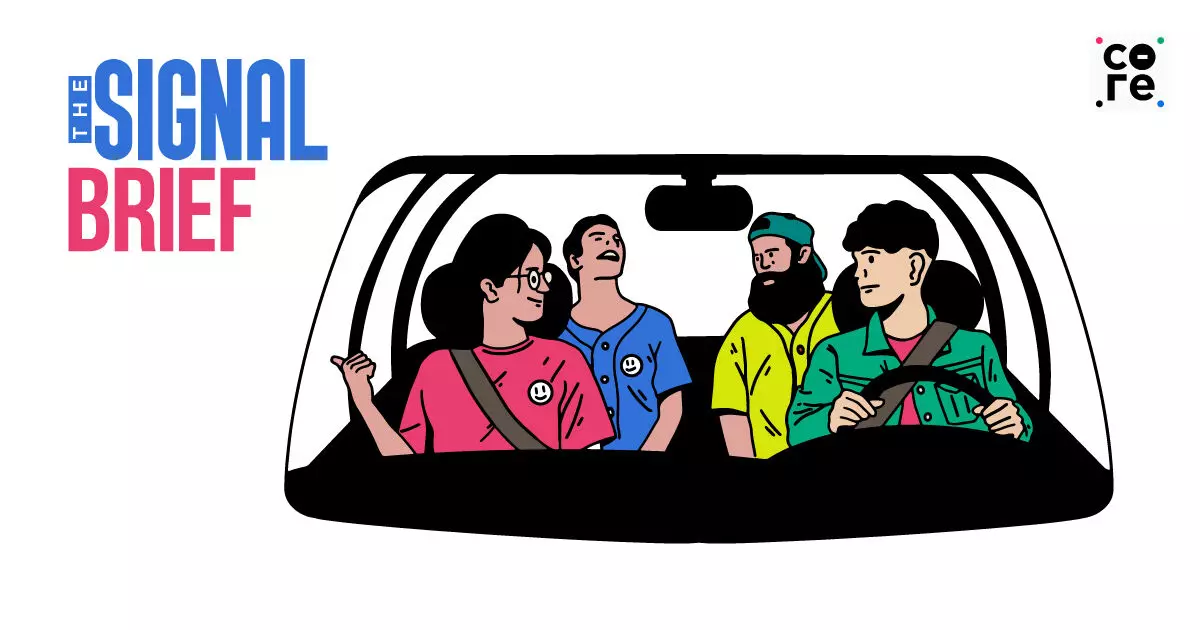
Why Hasn’t Carpooling Taken Off In India?
- Podcasts
- Published on 26 Jun 2026 7:30 AM IST

On paper, it sounds obvious. So why hasn't it become mainstream?
Why don't more Indians carpool?
On paper, it seems obvious. Our cities are congested, fuel prices are volatile and pollution remains a major problem. Yet, despite repeated pushes, carpooling never really took off in India.
As I reported this week's episode of The Signal Brief, I spoke to commuters who loved carpooling, commuters who swore never to do it again, and experts who still believe shared mobility is the future.
So, if carpooling makes so much sense, why don't more Indians do it?
Tune in to this week's episode to find out.
The Core produces The Signal Brief. Follow us wherever you get your favourite podcasts.
NOTE: A machine transcribed this episode. A human has looked at this text but there might still be errors. Please refer to the audio above, if you need to clarify something. If you want to give us feedback, please write to us at feedback@thecore.in.
TRANSCRIPT:
Kudrat (Host): On May 10th 2026, Prime Minister Narendra Modi urged Indians to carpool more.
That was when the West Asia crisis was in full swing, and we in India were feeling the heat.
The PM said that Indians should work from home, use public transport and share car rides to reduce the burden on the country’s fuel supplies.
Clip: PM Modi Urges Citizens|CNBC-TV18
Kudrat (Host): On paper, carpooling sounds obvious.
Our cities are becoming more congested by the day. India is dependent on fuel imports. And we, notoriously, have a pollution problem.
But India has tried carpooling before. In fact, our leaders encourage us to do it anytime there’s a global crisis and fuel prices shoot up in the country.
Even companies like Uber introduced Uber Pool back in 2015, only to dismantle in the pandemic. A French company called BlaBlaCar is gaining ground in India right now. There are even neighbourhood WhatsApp groups doing informal carpools.
Still, carpooling isn’t exactly mainstream. It pops up in our conversation during crises and fades away once things settle.
My name is Kudrat Wadhwa and you’re listening to The Signal Brief. We don’t do hot takes. Instead, we bring you deep dives into the how and why of consumer trends.
In today’s episode: Why hasn’t carpooling taken off despite the repeated pushes?
Kudrat (Host): First, the problem. The Iran war once again reminded us of the perils of our status as a fuel-dependent country.
India imports around 85% of its crude oil.
And when the US attacked Iran and Iran later closed the Strait of Hormuz, global oil prices surged, and even passed $100 per barrel at one point. Petrol and diesel costs shot up at Indian pumps, Inflation climbed. The pain rippled everywhere.
As well, 2025 was one of the worst AQI years on record for Delhi-NCR and many other cities. No safe air days for several months. And, studies show vehicular pollution is a major culprit–in Delhi, vehicles contributed over 50% of PM2.5 emissions during peak winter periods, far ahead of stubble burning.
Kudrat (Host): From a consumer perspective too, our cities are getting more congested by the year.
Bengaluru ranked as the world’s second most congested city in 2025 according to TomTom’s Traffic Index, with commuters losing nearly 168 hours, that’s almost seven full days, stuck in traffic. Delhi, Mumbai, and Pune are not far behind either.
Now, carpooling can be a solid solution to these problems.
It's hardly a new idea either.
Long before smartphone apps, people shared lifts with colleagues, neighbours and friends. Classified sections in newspapers once carried "offering lift" and "wanted lift" advertisements.
When smartphones arrived, these informal arrangements moved online.
WhatsApp groups sprang up across Indian cities. Uber launched Uber Pool in 2015. Ola launched Ola Share. A French ride-sharing company called BlaBlaCar entered the country.
And for some people, it worked remarkably well.
Raja: I am Raja Chatterjee. I am a media professional. I've been working in Mumbai for the last 15 years.
From 2015 and 2016, I started carpooling. My office was in Lower Parel at that point in time. So, how it worked was there were a couple of WhatsApp groups where people who were giving rides used to post the day before or early in the morning, saying, "We are starting at so-and-so time, and this will be our destination. We are starting from here, and we are going here."
Kudrat (Host): Raja told me that carpooling helped him avoid traffic and save money. He paid about 150-300 rupees to the admin of one of these whatsapp groups and would split the costs of fuel and toll with the driver.
Raja: And I've seen the benefits. When I used to do carpooling, Thane—I don't know if you know the location of Thane—there's a check naka that comes when you enter Mulund from Thane. That scenario was very bad. There was a flyover, and every day there was a half-hour jam there. Carpooling helped, I think, in solving that a bit.
Now it is better, but still, carpooling would definitely help the city reduce a lot of pollution and traffic. People also get to know each other, and it helps in building friendships. I made a lot of friends during my carpooling days, and they are still my friends. None of them are in my age group. They are from different age groups and professions, but we still chat. We still meet up sometimes, and it's a great networking opportunity as well.
Kudrat (Host): Soon, Raja stopped. COVID was part of it. But so was the fact that he found a better service.
Raja: After COVID, I entirely stopped carpooling because CityFlo bus services started, and that was much more convenient because you book your rides, you know where you will be picked up and where you will be dropped off. There was no regular hassle of, "I have to find a ride for today. I don't know if anybody is travelling on my route."
Kudrat (Host): The bus service that Raja now uses is actually more expensive than carpooling–but there’s no hassle of planning. And like many consumers, he chose convenience over small savings.
That’s not all, though.
I spoke to Rajeev Arora, founder of Pool India, a platform that connects office commuters for daily shared rides. I wanted to understand other reasons why carpooling didn’t pick up in India in a big way.
Rajeev: See, carpool per se, I'll say that 50% of the people—five zero, 50% of the people—will not do carpooling because some people believe, "My car, my personal time." They want their own space. Because in the office, you don't talk personally, and at home also, you need space. It's your car, you get some space, which is fine.
Kudrat (Host): Another big reason is safety. For women especially, they may not feel comfortable jumping into a stranger’s car.
In fact, Arif, a consumer I spoke to, had several uncomfortable experiences while using BlaBlaCar.
BlaBlaCar, for those who don’t know, is a French platform that matches people for longer inter-city rides where they share the fuel costs.
Drivers list empty seats in a journey they're already planning to make, and passengers contribute toward the cost of fuel and tolls. Unlike a taxi service though, the idea is to share costs rather than generate profit. The platform recommends a fare based on the distance travelled, although drivers ultimately decide what to charge within those limits.
Arif: I booked a car from a small town in UP to Delhi, and the guy was not someone who travelled to Delhi regularly like normal BlaBlaCar drivers do. I thought he was someone who did this as a profession.
What he did was he booked the car for five people, and it was also a smaller car. I had a bag, and I had to stuff it between my knees. Then he somehow pushed four people onto the back seat.
I asked him if I could keep my bag in the luggage space, but he had the CNG cylinder there, so he said, "You have to book another seat for that." So he would have had six seats booked.
He was also making sure that he skipped all the tolls to ensure that he was charged the minimum amount while travelling from UP to Delhi.
After I got down, I realised that he was not even the same guy I had booked the cab with. The car number was the same, but the driver was different. He then asked me to give him more money than what was showing in the app.
Then I tried to reach customer service, and knowing that it's a peer-to-peer sort of service, it was very difficult for me to get through to customer service and resolve the issue.
Kudrat (Host): Arif says he doesn’t recommend the service.
Arif: I won't recommend it unless it's a young boy travelling alone without much luggage. Otherwise, for women and other people, I don't think I would.
Kudrat (Host): The more people I spoke to, the harder it became to pinpoint a single reason carpooling hadn't taken off.
Some people just don't want to share their car.
Others worry about safety.
Many don't want the hassle of coordinating schedules with strangers.
And then there's the legal confusion around private carpooling.
Hardik: I'm Hardik Malik. I am an assistant professor of law, currently pursuing my doctoral research at the Faculty of Law, University of Delhi. My area of interest lies around carbon trading and environmental laws.
Kudrat (Host): Hardik told me that India currently uses a law from 1988, called the Motor Vehicles Act. Commercial carpooling, like taxis and shared taxis, is legal with yellow plates. But when it comes to white-plate private cars, you cannot earn profit from it.
And that's where things get tricky. Most carpooling platforms are built around cost-sharing. But at what point does recovering your costs become making a profit?
Hardik: I cannot drive profit out of this journey. So, if I do that gratuitously, then it's allowed. But if I take some money out of it and make a profit, then it won't be allowed.
My argument here is: how would we define profit? For example, I have to go from Delhi to Jaipur. The fuel cost, all in all, would be around Rs 3,000. I share this journey with three people, asking them for around Rs 1,000 per seat. So effectively, my cost has become nil because I have taken Rs 1,000 per head. So would that be profit?
If not, then we need to have a proper definition of what profit means. The problem here is that because we do not have a proper definition, and because we have left this interpretation to the states, we have different states interpreting this differently.
When I'm talking about Karnataka and Maharashtra, Karnataka does not allow white number plates for carpooling, but Maharashtra does. What if I want to travel from Karnataka to a point in Maharashtra? What would happen in that case?
So, we are arguing that we need central legislation to address this confusion.
Kudrat (Host): In fact, states like Delhi and Karnataka cited a provision in the 1988 law to kill UberPool back in 2020. That and COVID were the causes of its demise, according to reports.
All the reasons I cited before leave regular people stuck between good intentions from the top and messy realities of carpooling on the ground.
But despite challenges, transport experts still see shared mobility as a crucial part of the future.
Ashish: If we have to think about a sustainable and liveable future for our cities through the lens of mobility, then I would say that the future really lies in pushing people towards shared, electric, and active mobility. I repeat: shared, electric, and active mobility.
Kudrat (Host): That was professor Ashish Verma, who teaches transportation systems at IISc in Bengaluru.
At first, that may sound surprising. After all, we've just spent this episode talking about all the reasons carpooling struggles.
So why do mobility experts keep coming back to the idea?
Partly because the upside is enormous. Every additional passenger in a car means one less vehicle on the road. Less traffic. Lower fuel consumption. Lower emissions.
In other words, the benefits extend far beyond the people inside the vehicle.
And that's where the challenge begins.
Carpooling benefits society as a whole, for the individual commuter, the calculation can look totally different.
You save some money. But you may also have to coordinate schedules well in advance. Or wait for other people when you’re already running late to the office. Or be stuck with a co-passenger who’s talking too loudly on the phone or who’s downright creepy and aggressive.
The benefits are collective. But the inconveniences are often personal.
We can look elsewhere for inspiration, though.
In France, they’ve tried giving actual cash incentives or tax breaks to people who carpool regularly. In parts of North America, cars with multiple passengers get to zip through dedicated HOV lanes while everyone else sits in traffic. HOV here means ‘high occupancy vehicle’.
The idea is straightforward: if the whole society gains from fewer cars on the road, then we should make it worth it for the individual too.
Now, whether those kinds of fixes would actually work in our chaotic Indian cities is a different question altogether.
But the truth is that as our cities get more choked, as fuel prices swing wildly, and the pollution refuses to let up, we may not have the luxury of ignoring this solution forever.
Outro: That's all for today. You just heard The Signal Brief. We don't do hot takes. Instead, we bring you deep dives into the how and why of consumer trends. The Core produces The Signal Brief. Follow us wherever you get your favourite podcasts.
To check out the rest of our work, go to www.thecore.in.
If you have feedback, we'd love to hear from you. Write to us at feedback@thecore.in or you can write to me personally at kudrat@thecore.in.
Thank you for listening.


