



 Newsletter
 Search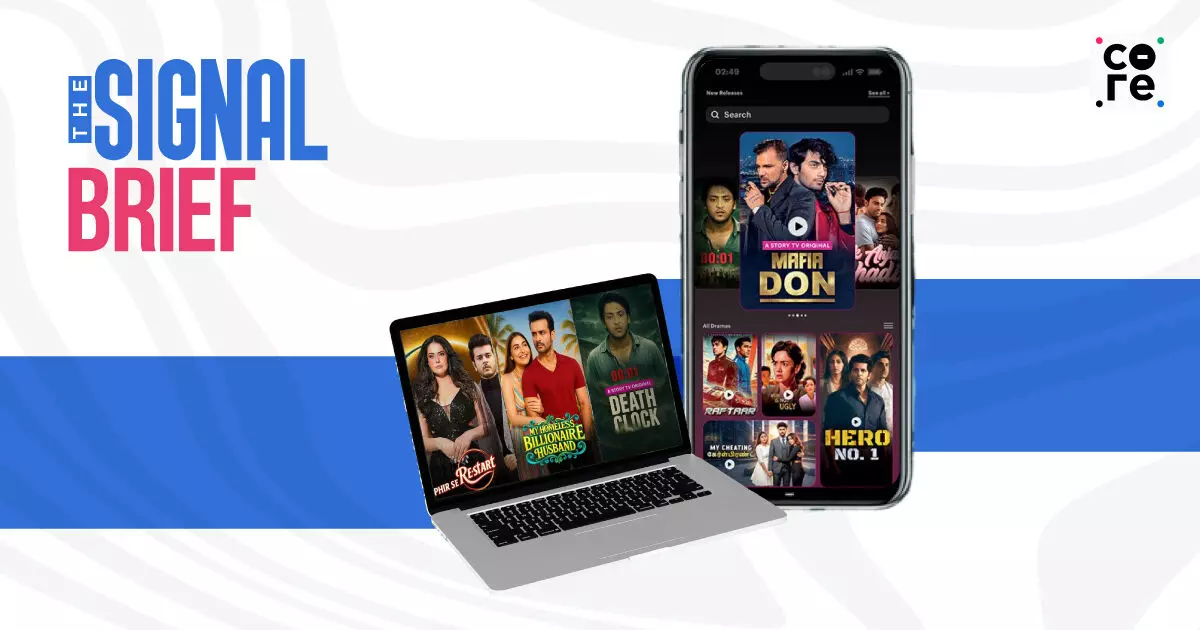
Why Can't We Stop Watching Micro-dramas?
- Podcasts
- Published on 31 Oct 2025 7:00 AM IST

Revenge. Secret millionaires. Justice served.
No, these aren’t 80s Bollywood film plots; they’re India’s newest obsession: micro-dramas.
Investors are betting big. The micro-drama market could reach five billion dollars by 2030, and venture capitalists invested 44 million dollars in the first half of 2025 alone.
But beneath the hype lies a deeper story of attention, aspiration, and everyday fantasies.
So why can’t we stop watching? And what do these bite-sized dramas really tell us about modern India?
Find out in the latest episode of The Signal Brief, featuring psychologists, viewers, and industry insiders.
The Core produces The Signal Brief. Follow us wherever you get your favourite podcasts. To check out the rest of our work, go to www.thecore.in
NOTE: A machine transcribed this episode. A human has looked at this text but there might still be errors. Please refer to the audio above, if you need to clarify something. If you want to give us feedback, please write to us at feedback@thecore.in.
—
TRANSCRIPT
Kudrat (Host): Ranvijay Jindal owns the multibillion-dollar Lumous Group. After two years in the US, he returns to India to propose to his girlfriend Shikha. The catch? He’s been pretending to be “Rahul,” a regular guy. Shikha rejects him, on account of his poverty. But soon, a different, female CEO proposes to him. Later, at a party, she slaps Ranvijay’s ex Shikha and Shikha’s brother, for demeaning Ranvijay.
Clip: https://www.youtube.com/shorts/HuhlrVUwhOc
Kudrat (Host): Eventually, Ranvijay marries that CEO. But he doesn’t reveal his true identity until episode 40. Every time you expect closure, the show throws in another twist. That’s how the micro-drama “Gold Digger Kahin Ki” keeps many bingeing all its 51 episodes.
Kudrat (Host): My name is Kudrat Wadhwa and you’re listening to The Signal Brief. We don’t do hot takes. Instead, we bring you deep dives into the how and why of consumer trends.
In this episode, we’ll learn about the burgeoning micro-drama industry. Why can’t we stop watching them?
Kudrat (Host): Micro-dramas are ultra-short, scripted video stories, usually 30 seconds to 5 minutes long. Makers shoot them vertically for Instagram Reels, YouTube Shorts, and dedicated apps like KukuTV, Flick TV, and ReelSaga.
Most of these micro-drama apps follow a “freemium” model: a few free episodes, then micropayments or ads.
This format exploded in China, where micro-dramas are called duanju. What began as amateur productions soon became professional: studios hired trained actors, filmed multiple dramas on the same set, and wrapped production in weeks. By 2024, the Chinese market hit $7 billion, surpassing even its national box office.
Kudrat (Host): India is following fast. Analysts expect the micro-drama space to touch $5 billion by 2030. In H1 2025, venture capitalists poured about $44 million into Indian micro-drama startups.
Major players include Flick TV, ReelSaga, Chai Bisket, and Bullet, which recently partnered with ZEE5.
Kudrat (Host): Micro-dramas are essentially soap operas for the scrolling age; they pack love triangles, betrayals, and family feuds, all in minutes. They’re short enough to fit into your lunch break but long enough to let you dream.
The Signal Brief spoke to Professor Navin Kumar, who teaches psychology at Delhi University, to understand what makes micro-dramas tick, for viewers.
Navin Kumar: that is called, you know, that people do not have, you know, higher degree of, uh, you know, attention, uh. Maintenance, they cannot do it for long period of time.
So what I understand that in sort, uh, drama, uh, they can, it's very easy to, uh, you know, consume this and the conjunction pattern is very sought. So that is why it, you know, uh, it does not require too much of serious thinking also.
So doing all kinds of work works, it, it, you know, also supports them in getting a break from their monotony and sometimes giving them some insights.
Kudrat (Host): Consumers reiterated this sentiment, of finding joy in bite-sized snackable content.
Tamanna Luna, an 18-year-old college student from Mumbai, says she watches micro-dramas almost every day.
Tamanna: So there are. Two that I, uh, seriously liked. Which one was, uh, accidentally yours. Uh, in that there are two friends, uh, who like, uh, who like the same guy and the guy is helping them to, uh, you know, to make the, their ex feel jealous. It's something like that.
The girls ex. So, and how they fall in love and how there is one love triangle. It is shown very nicely in that. So it's called accidentally yours.
It was a very new genre, I guess like, uh, I have never seen the, this kind of content. It was called a PR coded on the same page. Listen, to be honest, and it, because if we are using, in these days, we are using a lot of ai, like we use them for everything, like for therapy, for daily work, for recording meetings, everything.
So, uh, she, one girl accidentally thinks about. What if I could just code my love? What if I could just code the perfect guy for me? And it comes to life and it, it's all in the imagination. Or is it t It is shown very nicely, uh, PR coded.
Kudrat (Host): Tamanna says she also watches micro-dramas from China, Japan, and South Korea.
But she isn’t the typical viewer, says Sambbhav Khetarpal, Head of Content at Sooper, Hoichoi’s Hindi arm. Hoichoi is a major Bengali OTT platform. He says that right now, most micro-drama viewers in India come from Hindi-speaking states, like Rajasthan, Gujarat and UP.
Sambbhav: I think this format has really tapped into certain tropes, which, um, cater to the, I don't know if that's the right word, but the lowest denominator of this country. Um, uh, like, like the, if it really has a mass appeal to its content, given the kind of stories which this format has sort of come up with, which is, uh, more like rags to riches.
Or stories with secret identities that somebody is a, a delivery boy, but actually is secretly a billionaire, right? So it, it caters to the escapist mindset of the masses of this country. It caters to their mindset really well. And that's also why this format has, um, really flown since it's come in India.
Kudrat (Host): Most of these shows, he added, are male-centric. That’s because their primary audience are men between the ages of 18-30, who earn 15,000 to 20,000 rupees a month.
Sambbhav: Um, young men who aspire to be rich make more money, so it's really catering to a small town aspirational. Male Indian audience, if I had to really, you know, summarise it.
Kudrat (Host): He added that in the past, media companies haven’t catered to this demographic adequately. Traditional soap operas on TV, for instance, were meant for women.
Sambbhav: Not that men don't watch tv. A lot of men watch TV with their wives. In fact, television is a very family, uh, family medium. So at dinner time. Your papa, mummy, da da da, the beta bit. Everybody will watch television together.
Um, if you look at films, um, it is a very, it's, it's a medium. I go with my friends once in a while. Like it's a week, it's maybe a week weekly event or a monthly event. Um, and I can go with my partner, my wife, uh, my girlfriend, my friend, um, and also not many people watch they can afford to watch a film in theaters. In India, uh, television of course has better distribution. It can reach your interiors of your country.
But if you look at, um, look at vertical content right now, it has tapped into a kind of a wide space currently where one, because of the, because of the data penetration, it has great distribution because now everybody has a smartphone.
Kudrat (Host): Thanks to cheap data and smartphones, micro-dramas have reached an audience that television, film and OTT rarely spoke to.
That popularity, though, hasn’t yet translated into profit. Microdramas are still at a nascent stage in India. While these platforms can rack up millions of views, converting free users into paying ones is still difficult.
Abdul Kalam, a 25-year-old photographer from Delhi, downloaded Kuku TV after seeing an Instagram ad, but never paid.
Abdul Kalam: नहीं एक्चुअली पैसे देने वाली बात नहीं है। मैं मेरी नज़र में ये सब चीज़ें ना ये बेस्ट है एपिसोड्स को लेके अगर पैसा वास्ते कर रहे हो तो वो मेरे क्योंकि हमें शौक है ऐसा नहीं है की हम अपना जब फ्री होते हैं तो हम टाइम देखने के लिए वीडियोस वगैरह काफी चीज़ें देखते हैं। तो बट उस चीज़ के लिए पैसा इन्वेस्ट करना मेरी नज़र में कोई वो नहीं रखता।
Kudrat (Host): Abdul told me that he watched all the free episodes of a story about a poor man secretly married into a rich family. It was called ‘Secret Millionaire’.
Abdul Kalam: ये दिखाया गया था उसमें की एक गरीब। था अमीर घर का लड़का लेकिन वो गरीब घर में रह रहा था और उसके बाद वो जिससे शादी करता वो भी अमीर परिवार से था तो वहाँ पे घर जमाई बन के रह रहा था वो। तो वो वहाँ पे उसकी सास और वाइफ उसको पहले स्टार्टिंग में बिल्कुल केयर नहीं करते थे उसके साथ बहुत नौकरों वाला बिहेवियर बिहेव कर रखते थे। जूते पोलिश कराना काफी चीज़ें होती थी वो और उसी बीच में ये क्या कहते है जॉब वगैरह कर रहा था अपने जो उसकी सैलरी तो ना के बराबर ही थी बट उसको निठला बोल के काफी टाइम तक वो करता था। तो एक दिन अचानक से क्या होता है इसका जो।
Kudrat (Host): He recounted the entire story — full of betrayals, class divides, and redemption. Eventually, the secret millionaire’s wife realises her mistake and stands up for him.
Like most micro-dramas, it ends with poetic justice: the wronged man wins.
As Sambbhav said, again this micro-drama too featured a jilted male, who turns out victorious at the end.
Abdul Kalam: मैंने जितना भी एपिसोड देखा है उसमें एक चीज़ मेरे को जो लगी की हाँ भाई आज की डेट में पैसा ही सब कुछ है अगर पैसा है आपके पास तो वाइफ हो, माँ बाप हो कोई भी हो वो आपकी रिस्पेक्ट करेंगे अगर पैसा नहीं है तो कोई रिस्पेक्ट नहीं करता ए दोस्त भी मेरी नज़र में तो दोस्ती भी आजकल पैसे की रह गई है वो वाली दोस्ती नहीं रही क्योंकि कई बार लड़ाईयाँ भी जो होती है ना दोस्तों में वो पैसों को लेके ही होती है। वो episodes देख के पता चला की हाँ भाई लाइफ में ना पैसा बहुत matter रखता है।
Kudrat (Host): Abdul’s takeaway that money equals respect isn’t just his; it captures the aspiration at the heart of India’s micro-drama boom.
Like Tamanna, for many of us, micro-dramas are a playful distraction. But, for their key demographic, they’re a mirror of everything young Indian men long for: success, dignity, justice.
They bring to life their dreams, their fantasies. In these shows, the underdog always wins, the rich get humbled, and everyone gets their happy ending.
Kudrat (Host): That's all for today. You just heard The Signal Brief. We don't do hot takes. Instead, we bring you deep dives into the how and why of consumer trends. The Core produces The Signal Brief. Follow us wherever you get your favourite podcasts.
To check out the rest of our work, go to www.thecore.in.
If you have feedback, we'd love to hear from you. Write to us at feedback@thecore.in or you can write to me personally at kudrat@thecore.in.
Thank you for listening.


