



 Newsletter
 Search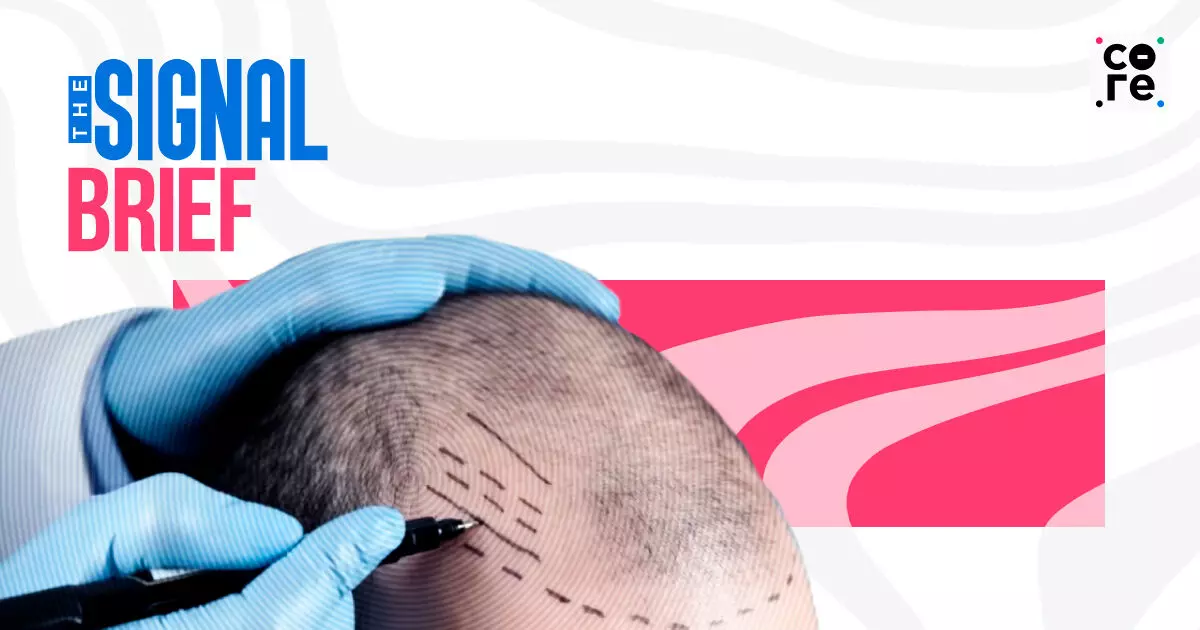
When Hair Becomes Surgery
- Podcasts
- Published on 13 Feb 2026 7:30 AM IST

Have you noticed those hair transplant ads?
They flood Instagram, YouTube and metro billboards. They promise thicker hair and fast transformations.
Behind those ads sits a fast-growing industry.
Nikhil, who The Signal Brief spoke to, started losing his hair at 24. He says it damaged his confidence and changed how he showed up on camera. He tried oils, treatments and medication like Minoxidil, but nothing worked. After months of deliberation, he chose a hair transplant. He paid around Rs three lakh and says he does not regret it.
But the procedure carries real risks. Poorly regulated clinics have caused serious complications and, in some cases, even deaths.
In January, the government proposed stricter rules and plans to treat hair transplants as surgery.
So why are so many people signing up?
To find out, listen to the latest episode of The Signal Brief.
The Core produces The Signal Brief. Follow us wherever you get your favourite podcasts.
Register for India Finance and Innovation Forum 2026
NOTE: A machine transcribed this episode. A human has looked at this text but there might still be errors. Please refer to the audio above, if you need to clarify something. If you want to give us feedback, please write to us at feedback@thecore.in.
—
TRANSCRIPT
Kudrat (Host): On June 24, 2021, Athar Rasheed, a 35-year-old Delhi resident, walked into United Hair Studio in Delhi for a hair transplant.
The clinic charged him around Rs 30,000 for the procedure, according to court records. It took several hours.
Within a day, Athar developed severe pain on his scalp. His face and shoulders began to swell.
His family admitted him to Escorts hospital.
Medical records show he soon suffered septic shock, multi-organ failure and Stevens-Johnson Syndrome, a rare but serious condition in which the skin and mucous membranes blister and peel, it’s often triggered by severe infection or adverse drug reactions.
Soon after, Athar Rasheed died.
Kudrat (Host): Athar’s family approached the Delhi High Court, alleging medical negligence at the salon. What began as a single death soon exposed a much larger problem.
In its observations, the Delhi High Court questioned why non-medical personnel were performing procedures involving anaesthesia.
The judges flagged the absence of clear regulation and asked state authorities and the central government to take action to rein in salons offering these procedures.
Since then, the government has acted.
In January 2026, the Centre proposed strict safety standards that reclassify hair transplants as a surgical procedure requiring qualified medical supervision, meaning only qualified dermatologists and plastic surgeons will be allowed to perform them.
This means that, on paper at least, the government has put an end to salon-based hair transplant procedures.
Kudrat (Host): My name is Kudrat Wadhwa and you’re listening to The Signal Brief. We don’t do hot takes. Instead, we bring you deep dives into the how and why of consumer trends.
Today’s episode looks at India’s hair transplant boom. We delve into the centre’s new rules and ask a deeper question too: why are so many people choosing this procedure in the first place?
Kudrat (Host): Nikhil is 31. He works in marketing. On the side, he’s also a fitness influencer.
He told me he started experiencing male pattern baldness when he was just 24.
Nikhil: Uh, it took a huge hit on my confidence. And, um, one thing is, um, during your twenties is when you, you know, build your life, start your career and everything. And back then I really wanted to, uh, get into the whole modeling scene, like fitness modeling. And because of this, it took a huge hit on my confidence and I started getting rejected everywhere because, yeah, it was obvious.
'Cause your face plays a huge role in that industry.
I suffered for like six years, uh, 24 to 30. Um, I kind of compromised on all my dreams and, uh, you know, took up an office job and I wasn't really feeling good about it.
Kudrat (Host): Nikhil says he tried everything to reverse the hair loss.
Nikhil: I tried almost every possible thing naturally to get it back, like using multiple oils like coconut oil, castor oil, and none of that gave me any sort of, like, none of them gave me the result I wanted.
I started researching more and learned about Minoxidil and Finasteride. Like I got a check from a dermat and they started prescribing me these meds. Uh, I started using that, but then again, it just, I, by the time I started my Minoxidil and Finasteride journey, I ended up at around stage five to six on the Norwood scale, and it was like.
Uh, you know how, how can I say? It was like I was trying to revive a barren wasteland. That's the analogy I can give, like a farmland which is dead. You can't grow crops, but you are trying to get it out. So that ended up failing and it took a huge hit again. My confidence was like completely gone. Because of this, it started spilling over everywhere in my life.
Like my job, I stopped, like, you know, putting myself out there. It took a hit on how I showed up at work. I stopped taking care of myself. I never dressed well. Like, my entire identity got a huge hit.
Dr. Aparna: See, hair is psychologically very important to all of us as human beings, and the high premium and value placed on a thick, silky head of hair, both for men and women.
Kudrat (Host): That was dermatologist Dr. Aparna Santhanam. She’s also the medical head of the popular chain Kaya Skin Clinic.
She told me that hair actually doesn’t have any functionality, from a clinical perspective. Meaning human beings don’t need hair to be healthy.
Dr. Aparna: Having said that, I think the psychological premiumness on hair is very high, and therefore it has always been a very sought-after need in India. As a dermatologist, every patient who comes to me, whether they come for a skin problem or any other problem, if I question them saying, do you have any hair issues, they will usually talk about either hair loss or wanting hair growth.
So from that perspective, it's a very important medical and cultural problem in India.
Kudrat (Host): She added that men tend to be especially concerned with hair issues, more so than they are with any other category of aesthetic dermatology.
Dr. Aparna: So for every 10 patients I get, around five to six will be women, and four to five will be men.
I mean, if I were to just give you a frame of comparison, if you take anti-aging as another universal need, there the skew would be more 70 to 80% women and 30 to 20% men. But in hair, it is almost veering towards 50-50 or at least a 60-40.
Kudrat (Host): Data confirms this too.
Research suggests roughly six out of ten Indian men between 30 and 50 experience male-pattern hair thinning. Large surveys also show many young men under 25 are already seeing hair loss.
Medication can help in earlier stages. But for advanced hair loss, it usually isn’t enough.
Dr. Aparna: Now what happens is when your hair loss grade becomes more and more severe, just doing this will not give you the coverage that you want.
So you may get some new hair growth, but it'll not cover the entire area of your scalp, and that is how transplants were born. So basically, the back of your head, when you have these follicles, which actually are the last to get miniaturized, those follicles are redistributed over the rest of the scalp.
Kudrat (Host): Hair transplants took off in India in the late 1990s and early 2000s.
Back then, doctors treated the procedure as unmistakable surgery. They removed strips of hair-bearing skin and grafted them onto bald areas of the scalp.
Over time, the process changed.
Doctors introduced newer techniques like Follicular Unit Extraction and Direct Hair Implantation. These methods moved individual hair follicles instead of skin strips: that’s what Dr. Aparna was describing.
These new techniques are less invasive. They also reduce visible scarring and shorten recovery time.
As the procedure became simpler, demand rose too.
Clinics and salons too began offering hair transplants aggressively. They lowered prices. They leaned on celebrity marketing and sold the procedure as quick and routine.
But, crucially, regulation did not keep pace.
For years, Indian laws did not clearly specify infrastructure and qualification requirements for standalone transplant centres. Authorities did not specify who could perform the procedure, what qualifications they needed, or what kind of medical setup clinics required.
That regulatory gap allowed many operators to enter the market. Some clinics relied on technicians. Others brought in doctors but only occasionally,
In effect, businesses sold a surgical procedure as a beauty service.
Dr. Aparna: The problem is not the transplant itself, you know. Most people think it's because the skill of the surgeon and the technique that they follow is at fault. That is actually not the problem at all. The problem is the selection of the correct patient, the pre- and post-care that you give, the backup that you have in your OT setup or wherever you're doing the transplant in case things go wrong, the fallout of a reaction to anesthesia, the fallout of excessive bleeding.
These are the problems. So you have to look at it just like you would look at any other surgery and say that if you will not go to remove, you know, your appendix in a fly-by-night operator in a cellar, you should not be going to do your hair transplant in such a place as well.
Kudrat (Host): The consequences of going to clinics without proper infrastructure were serious.
Patients developed infections. Some suffered adverse reactions to anaesthesia, or even went into septic shock.
In rare but extreme cases, including Athar Rasheed’s, those complications proved fatal.
Nikhil told me he knew of these risks when he decided to get a hair transplant.
Nikhil: I knew it was kind of an invasive procedure, and obviously anesthesia, if it's not dosed properly, will harm you.
And I have come across quite a few articles where people have literally died, and then I learned it's because the popularity of hair transplants was so much that clinics started employing dentists to do these, and that's what caused them to, you know, die.
Kudrat (Host): Nikhil didn’t rush into the procedure. He spent months researching clinics, and watching videos, learning. He had extensive conversations with his partner and father-in-law too.
Eventually, he chose a clinic that he trusted.
Nikhil: They marked the whole area. I was pretty happy with it. Four days straight, I went and got it done. Um, it was not as scary and as painful as I thought it would be because once the surgeon injects the anesthesia, it's pretty much done. Like you don't feel any sort of pain.
I was lucky enough to have a doctor who had similar interests, like whatever I like, like anime and stuff. So throughout the entire surgery process, we were just playing music, talking to each other, conversing, and having a good time.
Kudrat (Host): Nikhil said he paid around Rs three lakh in total for the procedure.
Today, he says the hair transplant has changed his life, for the better.
Nikhil: My entire hair transplant journey has been pretty fun. And it was not uncomfortable at all. I started seeing results somewhere around the four- to six-month mark, and it was like I reclaimed.
It really felt like I reclaimed a part of me that was lost because I remember looking at the mirror one fine day and finally liking what I see after, you know, years of avoiding mirrors and avoiding looking at my face. I finally felt good about looking at myself in the mirror.
And, um, thanks to Instagram and me posting about my entire journey, it helped me achieve another dream of mine. What that is, to get a nice online following, become an influencer. And one of the feel-good moments I've had was touching so many people, like helping out so many people and inspiring them to do the same and get a hair transplant and making sure that, you know, they feel good about themselves.
Kudrat (Host): The procedure, clearly, worked for Nikhil. He understands why others consider it, since hair loss severely impacts confidence and identity.
Moreover, after the government released the new safety standards in January 2026, hair transplants are now at least per law, safer than before.
Specifically, draft guidelines from the National Council for Clinical Establishments require clinics to register as medical facilities. They mandate proper infrastructure, emergency care systems and qualified medical staff. They restrict the procedure to trained dermatologists and plastic surgeons.
But regulation takes time to show results on the ground.
In the meantime, Dr. Aparna says consumers should be careful.
Dr Aparna: I would suggest from a patient perspective to do your research properly. You know, even when you go to a doctor and you do a consultation and you decide to go in for a hair transplant, do a, you know, as a patient, as a customer, ask the right questions about who's going to do the transplant.
What are their credentials? You know, why are you a suitable candidate for it? What is the kind of result that you can expect? What is the preparation that you need to do beforehand? What is the postsurgical care that you need to take and what is the medication that you need to be on, both before and after?
So I think this implementation will be a lot better if there's also awareness amongst the patients and the consumers to ask the right questions and to ensure that they do their seeking in the right places.
Outro: That's all for today. You just heard The Signal Brief. We don't do hot takes. Instead, we bring you deep dives into the how and why of consumer trends. The Core produces The Signal Brief. Follow us wherever you get your favourite podcasts.
To check out the rest of our work, go to www.thecore.in.
If you have feedback, we'd love to hear from you. Write to us at feedback@thecore.in or you can write to me personally at kudrat@thecore.in.
Thank you for listening.


