



 Newsletter
 Search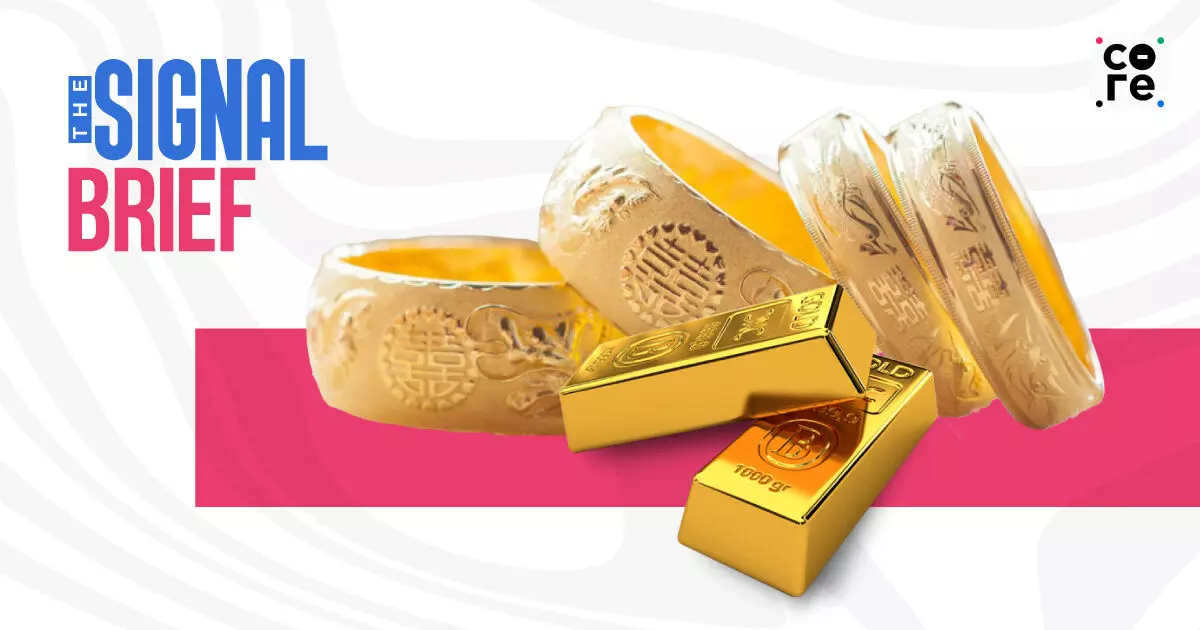
What Does Gold Mean To Young Indians?
- Podcasts
- Published on 7 Nov 2025 7:20 AM IST

Indian households have nearly 11 percent of the world’s gold, most of it in the custodianship of women.
That is more gold than what sits in the official reserves of the United States, Germany, and the International Monetary Fund combined.
For centuries, gold has carried both financial and emotional weight in India. But what does it mean to young Indians today? Is it still sentimental, or is it simply another investment?
And when they do buy gold, are they buying jewellery or digital tokens?
Find out in the latest episode of The Signal Brief, featuring voices from consumers and industry experts.
The Core produces The Signal Brief. Follow us wherever you get your favourite podcasts. To check out the rest of our work, go to www.thecore.in
NOTE: A machine transcribed this episode. A human has looked at this text but there might still be errors. Please refer to the audio above, if you need to clarify something. If you want to give us feedback, please write to us at feedback@thecore.in.
—
TRANSCRIPT
Maheshwari: We all have seen from the very childhood. I have seen my parents, my grandparents, we all used to buy gold, even sell sometimes.
I'm Maheshwari. I am a corporate and commercial lawyer. I, uh, I'm in, uh, Bombay. I also work in the Bombay High Court.
So I would say that since I have started buying gold on my own from the last four to six years I am, I have invested in more of the gold coins and gold biscuits and digital gold. Digital gold is something I have started from the last two years.
It is very handy when it comes to digital gold compared to physical gold because you do, you do not need that much of the security and um, you know, that much of hassle-free work is digital gold actually. Uh, so I think, uh, in my generation, I think investment in terms of gold should be digitally rather than holding the actual gold.
Kudrat (Host): My name is Kudrat Wadhwa and you’re listening to The Signal Brief. We don’t do hot takes. Instead, we bring you deep dives into the how and why of consumer trends.
Indians, particularly Indian women, have had a long standing relationship with gold. But, how do today’s young Indians relate to the metal?
Kudrat (Host): According to the World Gold Council, Indian households have about 11% of the world’s gold, much of which is in the custody of women. That’s more gold than what’s in the official reserves of the US, Germany or the IMF combined.
And, this love has only grown over time. In the early 1990s, India bought a few hundred tonnes of the metal each year. By 2010, that nearly tripled. Since then, demand has stayed high, between 700 and 900 tonnes.
Even the pandemic’s dip in 2020 was short-lived. Purchases bounced back quickly. In value terms, the jump has been sharper, from roughly Rs 1.3 lakh crore in 2010 to over Rs 5.1 lakh crore in 2024.
Kudrat (Host): Beyond being a solid source of investment, gold also has emotional weight in India.
I remember when my grandmother, my naani, gave me her gold ring. She’s no more, but I still wear it. It reminds me of the love our elders leave behind.
I spoke to 40-year-old trader Shikha Pruthi Gupta, who remembers her mother and grandmother buying gold.
Shikha: Jaise hum aaj kal random electronics buy karte hain, my naani, my mom, they used to buy gold. I have those memories, rickshaw par jaana and all.
I recently shipped it to my new house and I lost my bank locker key. I misplaced it. And then we, uh, asked bank, how do, like, you know, now how to open and retrieve everything because my, everything was in that locker.
And, uh, they told us there's a process you need to rake and all, and suddenly. This Diwali just five days, three days before Diwali, we were doing this deep cleaning of the house, and it's been two years since we shifted to this house. We got the key and we went to the locker and I opened around after two and a half years and I was literally crying.
I was not crying because I saw, okay, I have this amount of gold and the value is so much now. I was crying because I was remembering,
So all these were like, you know, in front of me. So. Tomorrow my daughter gets married, or if my sons get married, I will be just passing everything, every single emotion with this asset as it is.
Kudrat (Host): One of the reasons why gold was dear to women in India is because for many, it was the only form of private, portable wealth they controlled. Gold was both inheritance and emergency savings rolled into one.
But today, that’s not the case for women across the board. Our wealth isn’t limited to our inheritance anymore. Many of us work, invest in mutual funds, fixed deposits, even property.
Still, gold remains a popular investment.
Now, that’s true even though prices have been rising. In 2014, ten grams of gold cost about Rs 28,000. By 2024, just ten years later, that number had more than doubled to around Rs 64,000.
Even after adjusting for inflation, gold’s price grew by roughly 33% over the decade.
But why are gold prices so high right now anyway?
The Signal Brief spoke to Varun Fatehpuria of Daulat Finvest, who linked gold’s rising prices to global uncertainty.
Varun Fatehpuria: So one of the major drivers of the runup in gold prices has been this exponential increase in demand from institutional investors. So think of the biggest central banks in the world. Think of the biggest university and endowments, pension funds, ETF investors, right?
All of them have been pumping money into gold in record numbers, and it has to really do with a couple of things. One of them has. Being this persistent geopolitical uncertainty starting from the Russian invasion of Ukraine in 20. And over the last three, three and a half years, we have seen, uh, a lot of that geopolitical uncertainty actually spread across the entire globe.
Kudrat (Host): Big, institutional investors are buying massive quantities of gold, which is in part what’s causing the prices to rise.
But, despite that rise, young Indians still want to put their hard earned money into gold.
The only difference: where Indians once only bought jewellery and physical gold, younger folks are now more drawn to digital gold and to ETFs or exchange-traded funds.
This trend is especially visible among urban investors. 2025 saw a surge in gold-ETF inflows globally, up about 170% in the March quarter. India, too, hit a record $10 billion in ETF assets later in September this year.
Demographically, younger investors and Tier-1 city households show more adoption of these financial forms. You see, there’s cons to buying physical gold–the obvious one is security. What happens if there’s a theft in your house?
But how do digital gold and ETFs work? Here’s Varun explaining them:
Varun: One is a digital gold option right where you go and you can invest as low as 50, a hundred rupees. Where effectively when you buy gold using any of your popular investment apps, you can think of it as the gold being stored in a vault. On your behalf in some warehouse, and you have a ledger entry, which basically represents an ownership in that gold.
Uh, when you want to liquidate, you could probably ask the app to, you know, even deliver that gold to you, uh, to your house, subject to certain making charges. And GSP when I look at the other investment option, something like an ETF or a fund of fund, right, which also invests in 99.9%, 24 carried gold. The only difference compared to a digital gold is the redemption is cash at.
And what? And what do I mean by that is that the time of redemption, you do not get physical gold. You only get the gold, which is mark to market. So depending on where the value of the gold is, you could either be looking at a potential capital gain or a capital loss.
And the third form is sovereign gold bond, which was actually issued by RBA starting in 2015.
But it has now further been discontinued, but SGBs effectively provided you a 2.5% annual interest on every unit of, uh, gold that you bought from RBI and at the end of the majority, which is the eight years, the capital gains was tax split. Since today, there are no further issuances. The only way for you to invest in an SGB is through a second year market transaction.
So just like how you buy and sell a normal stock, you could do an SGB as well. So, so I mean, that are the pros and cons of investing in physical gold compared to, uh, more digital forms of gold.
Kudrat (Host): So digital gold costs the same as physical gold, and you still get the benefit of investing in a safe asset. It’s much more convenient, and that’s why young Indians like Maheshwari, who we heard from earlier in this episode, prefer it.
But, even if other forms are becoming more popular, that doesn’t mean that Indians will stop buying physical gold.
Varun: I mean, there is no two thoughts about that. But again, it is more of an emotional buy when, whether it is a Diwali coming up or any of a particular global, uh uh, or, sorry, a particular life event that you have in an individual's life at that point in time, probably it could be a good, uh, way to go and buy a physical gold from a shop in your neighborhood.
But from a financial asset perspective, you definitely see the rise of ETFs and index funds, uh, to outstrip, uh, physical demand for gold going forward.
Kudrat (Host): That’s also what Sachin Jain, regional CEO of World Gold Council, which tracks gold demand and usage, told me. Physical gold isn’t going anywhere yet.
Sachin: It's not going anywhere. I can tell you that, right?
And to this Indian who's in love with physical gold, who likes to, you know, put it under the bed and say, okay, I feel good that I hold his faith and I can do anything with it, which is a true, um, aspect of gold. The journey for that Indian good say, you know, all my wealth or goal will gonna sit on this thing.
Is a big journey, but what's working there is it's happening. What's working there also is that the Indian investor getting, getting more younger and the relationship of the millennial and Gen Zs and, and, and the other younger people with digitization is a very different relationship. And I see when I look at, uh, what is gonna happen to the future by foresee that these elements around.
Holding assets digitally, not just for gold, but even otherwise is not a trend of sorts. It's something which is reality and is also reflective of how Indian will get, or Indians in general will get more digital natives,
Kudrat (Host): Indeed, Zoyaa, a 20-year old college student, told me that she has mostly bought gold in the form of ETFs. But, she plans on also buying jewellery in the future.
Zoyaa: well, to be honest, I do like jewelry and yeah. I, I will, I am, I'm thinking yeah, in future for sure, I will think.
I will have my own mind to it, but I would like to still keep it a bit, uh, similar to my mother's. Because I'm very close to her, so I would, you know, just feel a bit more connected with her if it's the two of us doing something like this together.
But if you look at, um, look at vertical content right now, it has tapped into a kind of a wide space currently where one, because of the, because of the data penetration, it has great distribution because now everybody has a smartphone.
Kudrat (Host): For Zoyaa, it’s stability. For Shikha, it’s memory. For Maheshwari, it’s convenience. Gold remains what it’s always been—a symbol of safety, trust, and love.
India imported about 770 tonnes of gold in 2024, making it the world’s second-largest consumer after China. Roughly 60% of that was jewellery, 30% bars and coins, and 10% financial instruments like ETFs and digital gold.
Our preferences are changing, but our fascination hasn’t faded. When inflation bites or headlines turn bleak, Indians still turn to gold, whether as bangles or bytes.
Kudrat (Host): That's all for today. You just heard The Signal Brief. We don't do hot takes. Instead, we bring you deep dives into the how and why of consumer trends. The Core produces The Signal Brief. Follow us wherever you get your favourite podcasts.
To check out the rest of our work, go to www.thecore.in.
If you have feedback, we'd love to hear from you. Write to us at feedback@thecore.in or you can write to me personally at kudrat@thecore.in.
Thank you for listening.


