



 Newsletter
 Search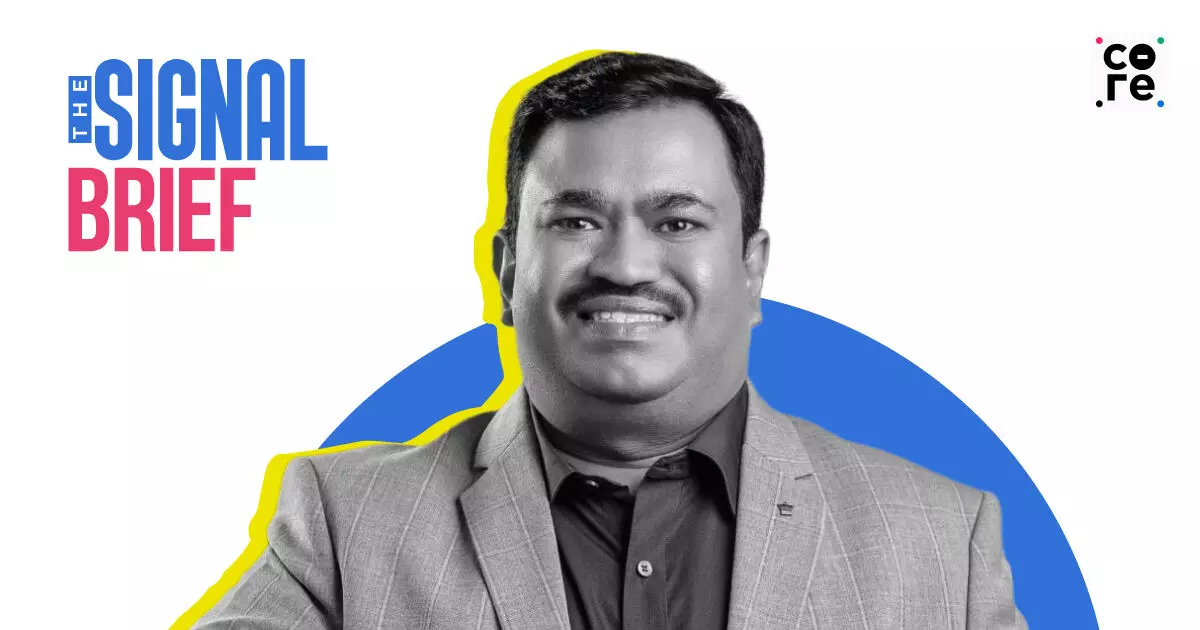
Tuesday Special: Vinay Kumar Swamy On How AI Is Reimagining Entry-Level Jobs
- Podcasts
- Published on 1 Sept 2026 7:30 AM IST

Why learning to learn could become the most important skill in an AI-driven workplace.
In The Signal Brief's Tuesday special, where we feature insider interviews featuring leaders shaping modern consumption.
Today's guest is Vinay Kumar Swamy. He’s the country head at Pearson India.
Pearson is a lifelong learning company. It offers digital content, assessments, qualifications, and data-driven learning solutions.
Pearson published a recent report which showed that AI can already perform 37% of entry level tasks in India–a lot higher than the UK and other Western countries.
So, why’s that?
The Core produces The Signal Brief. Follow us wherever you get your favourite podcasts.
NOTE: A machine transcribed this episode. A human has looked at this text but there might still be errors. Please refer to the audio above, if you need to clarify something. If you want to give us feedback, please write to us at feedback@thecore.in.
TRANSCRIPT:
Vinay: Kudrat, just a little bit of context there. The global average is about 33% of the entry-level jobs are done. But in India, it's mind-boggling that it's 37% of the entry-level jobs are already performed by AI.
Okay, now what we are seeing in the organisations, particularly AI is not anymore a project, right? It's getting embedded into their day-to-day workforce. What we kind of observed in the organisations when we did this research is that entry-level roles are completely being reimagined, and we expect it to continue to evolve over a period of time.
Now the freshers, instead of doing something, are doing a routine execution or a high-volume task. Nowadays, the freshers are being positioned as traffic controllers kind of a thing, right? So they kind of analyse the output of what AI is there and then take it from there.
So nobody has to do data-level or entry-level work, but the outcome of it is being reviewed, and then they make a decision what to do next. So that's how we are seeing the adoption. And India has always been a technology-advanced, technology-adopted country with the diversity that we have.
Right? So that's what we are looking at.
Kudrat (Host): Okay, understood. Thanks for that. So, you know, when you say they're not doing the kind of routine tasks anymore, can you give some examples of that?
And also kind of related to that, like what industries are you looking at?
Vinay: So, we cut across close to about 750, approximately 750 HR professionals with about minimum thousand and all about director level and above, and within organisations which are having thousand-plus employees. And of course, we touched upon three geographies, US, UK and India. So that's the segment that we have taken to do this research.
And to give you some of these examples, right? Let's take an example of an HR professional who's in talent acquisition. No more, they have to sit and go through every resume and try to fit in the resume into the job description that they put. The AI can do this work.
But what an HR professional or even an entry-level HR professional needs to do is not just take the output of it and apply the judgement what AI is not able to do. For example, are there any biases in terms of because AI always goes with some of the keywords of the prompts, and it gets you a set of only because I'm based out of Bangalore, the AI might, and if I uploaded resumes from all over India, it might pick up only those which are from Bangalore. And if I've used the word management, it might pick up only from the B-schools, right? But today, that's not the way it works.
So the HR professional's work now is not filtering or screening the profiles, but actually applying the judgement as to whether there are any biases, is there any ethical and, you know, biases that are coming in. So those are the judgement that we see. As an example, if you were to ask me how the, you know, AI is getting augmented.
Kudrat (Host): Okay, understood. So, you know, one kind of question that comes up often is that when it comes to freshers, often, they will learn by doing by doing some of these so-called boring routine tasks, that's how they were developing that judgement in the first place. So when AI is automating a lot of that, how will freshers learn judgement and how will they, you know, actually get better at the job?
Vinay: It's a very interesting question. I, that there is always a learning when student the early career when they move from their graduation to campus to a career or a corporate, there's always something that they need to learn, but the method of learning is going to change or method of learning, like you said, earlier, everybody used to do for the six months, they would spend time doing a high volume, try to understand the nuts and bolts of the operations, and then kind of get into a strategic level of conversations and so on so forth.
But if you see now with AI doing the most of the work, like I was talking to you, the if it is already screening, if it's already giving me a set of profiles that I need to look at, but what do they learn there, that is nothing but an outcome. And now they will have to figure out what are the new problems that are going to come because of this. And then it's with today no more people, corporates want anybody to solve a problem with the existing tool.
They want the freshers or, you know, the candidates to be able to, how would I put it, able to foresee what are the new challenges and come up with a solution for this. So more than learning from doing now it's going from, you know, navigating through the outcomes and then do a proper judgement of the outcome. Is that a valid judgement, validate those, question AI in terms of know what the outputs are.
So the learning, yes, there is a learning, yeah, there's a shrink in the learning curve. But the way and learning is actually changing the way the freshers would learn in a corporate.
Kudrat (Host): Okay. Okay. So I know that your report and it sounds like you two are more optimistic about the kind of AI future.
But at the same time, do you think that AI will reduce the number of entry-level jobs and what does that mean for young people who are maybe studying who are yet to enter the workforce or someone who's just entered the workforce?
Vinay: See, I would put it slightly different. It's not going to be reduction in the jobs or the reduction in entry-level jobs. But it will be definitely a reimagined entry-level jobs.
It's not going to be no more data-entry-level job. There's nothing that AI can do most of those work. But the majority of the HR professionals who responded to this, you know, the research that we did, agreed that there would, in the next five years, are new new roles that will get emerged in the entry-level.
And what is there might get reimagined, or there will be completely new set of work that will come up. So the graduates who are coming out of the college campus to corporate need to be ready to learn new things. I think that's the key word.
Learning to learn is a super important skill set that we need to look at. And from the learning is not going to just end at a graduate, we all have gone through it, right? So I did my child accountancy, somebody did an MBA, and they said, "Oh, you know what, I finished my learning."
Now, I need to only implement what I've learned. But that's not the way it is. And you need to constantly learn, and we need, and let's also be very honest, right.
So today's learning science says one important thing, which says that 70% of the learning that we do, if I'm not practising, and immediately, it just, we just forget it. And what I mean by that is, whatever these graduates are going to learn, they need to start implementing it. And that's where the things will reimagined or the new entry-level roles will start coming up.
Kudrat (Host): Okay, understood. And, you know, of course, the report focuses on AI and entry-level jobs. But what are your thoughts on people who are more advanced in their career or mid-career?
Like, how is this AI world or the fact that AI is automating some of these routine tasks? How does that affect them? And what do you think they need to know?
Vinay: See, one of the things that we also discovered is, most of the HR professionals agree that mid-level managers are super important for implementation of AI or augmenting AI, right? And we spoke about learning to learn, and that applies, and we need to be inclusive. Let's be very honest, when I say inclusive, it's not gender inclusivity.
But it's about the learner inclusivity. In an organisation, like you mentioned, you have somebody seasoned professionals, somebody who are almost at the verge of their, you know, their career, probably at around 50s. And you also have Gen Zs who have just joined with the entry-level freshers.
The adaptability, the learning speed at which a Gen Z or the way in which they learn is not the same as what our friends who are already, you know, professionals who are already experienced is the way they learn. I think the HR, and there is a gap, let's be very honest, and 60, I think roughly about 67% of them agree that there is a gap in the learning and development that's happening because they're not able to cope up with how the AI is advancing and the learning and development that's happening. So similarly, when they're building the, when the HR professionals are building the learning and development programme, they need to have this inclusivity of, you know, the type of learners who are there and bring them into this.
So one of the key thing, again, I reiterate, from mid-level managers to senior-level management, they need, their support is definitely required, they are the pilots, they are the ones who will have to make sure this augmentation of AI with human is possible only when these two professionals are ready to agree on that part. And they do play a super important role.
Kudrat (Host): Okay, understood. So you mentioned this, you know, lifelong learning and learning to learn and so on. Can you give some examples of like what that looks like at a workplace for maybe like an early-career person for a mid-career person?
Like, what does it mean to learn to learn, is it learning AI skills, is it learning something else? And what kinds of AI skills specifically?
Vinay: When I say learning to learn, it is, see, like, we all agree that, you know, AI is advancing. What's new every, every month, there is a different products that are coming, the workflows are changing. The learning, when I say learning to learn, the employee should be able to learn or adapt to the new technology or the new workflow that's being identified. And not just adapted, but also be able to, also be able to practically use in their day-to-day activities.
Like I was talking to you, initially when AI came in, most of, in some of the organisations, one of the common questions was, it's only going to affect the tech people, we don't have to worry about it. But how do, how do a customer service agent be able to use AI to respond to some of the customer? This one, that is the thing that they need to learn.
How do I advance? How do I find a problem that if, with that output, how do I find a problem? And then for that challenge, how do I solve using AI?
That's the criticality today, right? So technology is going to be there, let's agree to that fact, it's not going to go away, it's not a, it'll, it'll stay there for a very, very long time. And the, and the people have to understand and augment their work with, you know, AI.
People and AI should work together only to bring in the more efficiency. I think that's what I mean by learning to learn, it has to be learned, implemented immediately. And like I said, 70% of the, most of the time, what we learn, if I don't use it in the next two days, I know how to do this, but just give me two minutes, let me go back and click some buttons and do trial and error.
And that's typically what we are seeing, right? So we need to implement it on our day-to-day life.
Kudrat (Host): Okay, got it. So my last question is, you know, I understand you AI plus human is like a lot of efficiency and speed productivity and all that. But for example, in my own work, I sometimes wrote this isn't with other people to exist sort of, you know, with some people, there's a lot of over-reliance on AI.
And that ends up often producing bad work. So like, what is the sort of line between relying on AI to improve your work and still keeping the brain sharp versus just giving away to the technology?
Vinay: Right. So I think the focus should not be automating and automating any workflow, or it should not be the focus should not be just, you know, talking about using an AI and just giving the output as it is. That's where the key thing comes in.
There are a lot of things that AI might not be able to do today. For example, ethical reasoning, or, you know, taking out the biases or doing a problem-solving, it might give you a solution. But is it right for your, this one, it cannot do a communication, two-way communication, it cannot build human connections.
It cannot do a human judgement. That's the most important thing, right? And these skills are human premium skills that we talk about, are super important in where as we start using it, am I using it ethically, or am I able to judge what AI has given me an output, because it keeps giving you, I mean, I can put the same question and ask it, it will give me a conversational, but is it relevant to the conversation that we are having?
Are we or is it with the core or is it with somebody, an employee or is it with a fresh graduate or even if it is my daughter who is 15 year old, is it what is that level we need to identify? I think that human skills are going to be super critical in every organisation and every, most of the respondents have agreed that human skills are the most priority one today. And that's what we need to look at.
Kudrat (Host): Okay, great. So that's all from my end. Is there anything else that you'd like to add?
Vinay: One other thing I just want to tell the graduates who are coming out, fresh graduates are going to come out in the future is that please double down on learning to learn, because your learning is not ending once you get a graduate certificate. Secondly, I think focus on the human skills, human judgement, communication skills, communicating with people, empathy. I think those are some of the key things that today organisations value more than the, you know, in the past.
The last and foremost one, it's no, no, not going to be no more specialisation. Most of the HR professionals who do want interdisciplinary learning. Earlier liberal sciences were never, you know, was not given as importance as it was given.
It's given now. Right. So people have to think slightly broader than their own segments, even though I'm an arts or a commerce graduate or a science graduate, you need to have commercial acumen, you need to have technical skills, or you need to be able to communicate very differently with the different set of personas.
I think those are some of the things that I would say, the anger, the early careers to come focus on or double down.
Kudrat (Host): That’s all for today.
The Core produces The Signal Brief. Follow us wherever you get your favourite podcasts.
To check out the rest of our work, go to www.thecore.in.
If you have feedback, we'd love to hear from you. Write to us at feedback@thecore.in, or you can write to me personally at kudrat@thecore.in.
Thank you for listening.


