



 Newsletter
 Search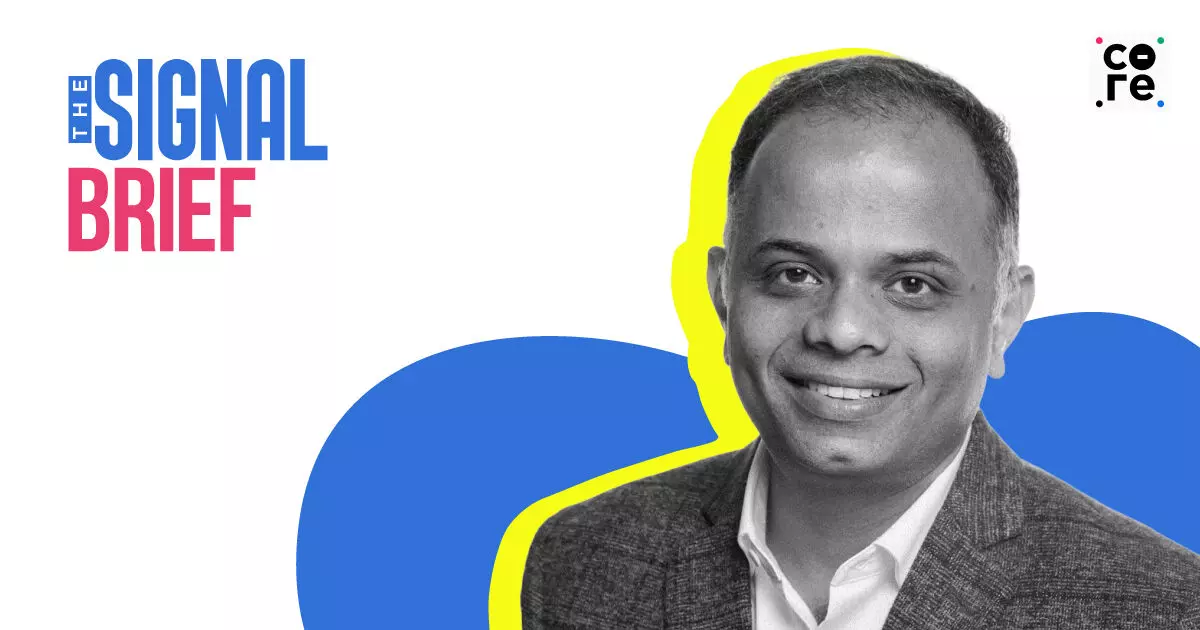
Tuesday Special: Srivatsan Sridhar On Payments Without Borders
- Podcasts
- Published on 15 Sept 2026 7:30 AM IST
Why are cross-border payments so hard? How is Skydo innovating in that space?
In The Signal Brief’s Tuesday special, we feature insider interviews with leaders shaping modern consumption.
Today’s guest is Srivatsan Sridhar. He’s the founder and CEO of Skydo. Skydo was founded in 2022 with a mission to make global transactions as seamless as local ones.
We spoke about why cross-border payments are so hard and how Skydo is innovating in that space.
The Core produces The Signal Brief. Follow us wherever you get your favourite podcasts.
NOTE: A machine transcribed this episode. A human has looked at this text but there might still be errors. Please refer to the audio above, if you need to clarify something. If you want to give us feedback, please write to us at feedback@thecore.in.
TRANSCRIPT:
Kudrat (Host): So, my first question is, if you were explaining what Skydo does to, say, a 10-year-old, how would you explain it in very simple terms?
Srivatsan: Yeah, so, hi Kudrat, great to be here and thanks for having me. I would basically say, if you are a business, you do your work and, you know, Skydo helps you get paid. So, that's the simplest way to say what we are doing.
Kudrat (Host): Okay, wonderful. So, you know, you previously have spoken about your personal story that inspired you to start Skydo. So, if you could talk a little about that.
Srivatsan: Yeah, so, I have worked for a long time in my family-owned business. It's an automotive components manufacturing business and I have been an exporter and importer in that business. So, personally, I have faced the challenge of not understanding what happens to money when it crosses borders and why my payment is delayed, why my payment is stuck, why does my customer say they sent me X amount, whereas I only get, you know, something much lesser than that.
So, all these questions have been personal challenges, both in terms of complexity, time and, you know, inefficiency of the payment process itself. So, yeah, so that's, that's kind of been a very long-term unsolved question in my mind. And when it came to us starting a business together, my co-founder and I, and you know, of course, I can walk you through how we came to solve this exact problem.
But as soon as we thought about solving something in payments, this particular personal experience of mine just would not leave my mind. And, you know, it kind of propelled us to think about this deeper and try and find a way to solve it.
Kudrat (Host): Okay, okay, wonderful. So, let me start by asking you what the problem is right now when it comes to cross-border payments. I mean, I'm sure all our listeners are aware of, you know, why doesn't UPI translate internationally?
Srivatsan: Yeah, no, it's a great question. And I think that kind of gets to the heart of the problem. Because work today is, you know, borderless.
So, somebody sitting in India could be a remote engineer working for a business in the UK. Someone could be writing content and, you know, their client would be in Australia. Another person could be running a marketing agency supporting ads for their customer in the United States, and so on.
So, work has become borderless primarily because over the last couple of decades, at least, step by step from the time, you know, the internet came to be a core part of how we do work. We've been able to send and receive work digitally, right. And that's only accelerated after the cloud revolution, and is now going to further accelerate with the AI revolution.
This is on the services part of, you know, business services and digital goods. Similarly, even on manufactured goods. From really, really long back, like centuries back, human beings have always wanted, you know, some other part of the world.
And that's kind of led to this whole concept of globalisation as we know it today. So, tea is grown in some country, but some other country wants to drink tea. Spices are grown in some country, everybody else wants it.
Somebody wants silk, somebody wants paper, you know, pepper, sugar, everything, right. So, all commodities and products made in one country have been desired by people in another country. So, even before internet and digital revolutions made services work possible globally, manufactured goods have always been anyway crossing borders for centuries.
However, payments are part of banking and banking is not global. Banking is very country-specific, because banking is being controlled by regulators who have jurisdiction only over that particular geography. They do not have jurisdiction over another geography.
So, a State Bank of India is regulated by the Reserve Bank of India in India. And if State Bank of India were to open a branch in, let's say Singapore, then they would actually be regulated by the monetary authority of Singapore and not by the Reserve Bank of India. So, they would have to play by the rules of Singapore.
So, what this does to payments is, the way money is handled, the currency that, you know, is the primary currency of money, rules around what is permitted, not permitted, rules around account opening and closing, rules around checking whether a payment is legitimate or not, are all very geography-dependent based on the regulator of that geography. So, even for a very small payment, let's say I'm a, you know, a designer and I created a website for somebody in my building. It's very straightforward.
I tell them, you know, here is your design and they, you know, make a payment to me on UPI or NAFT or whatever, right? Whereas if that same person now was in Canada, the moment they've completed the work, I've completed the work, they have to make now a payment to a foreign bank account with a different account number, different way of representing that account number code and so on. So, in order to solve for these geographic differences, a common system of messaging between different banks and different countries was created in the 1970s, which is called SWIFT.
A lot of us know what's, you know, might have heard about SWIFT because whenever we send and receive money, there is something called a SWIFT and so on. SWIFT is nothing but the way banks can communicate with each other, banks of different geographies can communicate with each other. And then there are these concept of intermediary banks or these global banks who would have accounts in different currencies.
So, if I were to, if I'm a small bank in Canada and you are a small bank in India, we will not have accounts with each other because that's too difficult for every bank to have account with every other bank. So, in order for you and me to trade with each other, there would need to be a common account that both of us have with an intermediate bank, let's say a Citibank or an HSBC or one of these big global banks who would have accounts with multiple banks. So, I would have an account with Citibank.
Similarly, you would have an account with Citibank. So, both of us would trade with each other through that common account. So, this is how, you know, systems were created.
So, as you can see already, this is quite a complicated thing and now this cannot be solved by a UPI, which is one country's payment protocol.
Kudrat (Host): Okay. So, understood. Thanks for that explanation.
That was definitely very useful. So, I mean, I understand that domestic versus international difference, but then there's, for example, a service like PayPal. So, why, what is different about Skydo that, say, a PayPal doesn't offer?
Srivatsan: Yeah. Again, PayPal is probably the first company that tried to make this problem, you know, go away for small businesses by creating something similar to what we currently do. So, they initially obviously solved this problem for domestic businesses within the US who are beginning to start selling things online in the 1990s.
And then they would basically provide what we currently all know as payment gateway. So, you go on a website, there is a place for you to fill up your credit card number. And then, you know, you click pay and then it asks you for some authentication and then you can confirm it.
And then PayPal in the background checks with the issuing bank whether this payment can be processed and some payment processor in between like Visa or MasterCard is going to authorise that payment. And that's how payment used to pass from somebody buying stuff online to the merchant who is selling online, right? Then PayPal tried to solve this problem internationally as well by bringing the same payment gateway concept.
They also then extended it to something called a wallet, where, you know, you could actually hold a wallet and then somebody could pay money into that wallet. Those wallets belong to PayPal who had this hosted in bank accounts in the background. So, what we are doing is similar, but we are just taking that same concept to the next level, where we are saying instead of, you know, relying on credit cards or wallets, what if we actually were able to give an Indian exporter a bank account in a foreign country without having to open a company in a foreign country or without having to be there, right?
So, this is what is called a virtual bank account. So, we help an Indian exporter make life for themselves and their senders very easy by now giving them international accounts in different countries. So, now going back to that same example of the designer, you know, making a website and selling it to a customer in Canada, instead of telling them that, hey, you have to now make an international payment into my bank account and that person then figuring out how to do an international wire payment and so on.
Now has, you know, I now have a virtual account that Skydo has provided me in Canada itself. So, I raise an invoice, put my Canada account number and give that to my client and the client now looks at that account number and says, hey, this is simple for me now because I can just pay this international person the same way I would pay a local person in Canada. So, they just go to their online banking and make a payment or, you know, their mobile banking and make a payment locally.
So, this is now fast, local and easy. For the receiver, which is me, I don't worry about wires and tracking that payment and so on. I'm just saying Skydo will now do everything to make sure that the money comes into my Canada bank account here in Bangalore.
And I no longer have to worry about everything that happens in between. So, this is what now Skydo does.
Kudrat (Host): Okay, understood. So, you know, when it comes to UPI, for example, the payer and for now even the merchants, for example, like shopkeepers and so on, none of them pay a charge to run the infrastructure. So, when it comes to PayPal, however, I have noticed in my own personal transactions, there's often a charge for international transactions.
So, one, why does that happen? And two, does Skydo also have such charges? And what would it need?
What would it require for payments, international payments to be as seamless as, say, domestic UPI payments?
Srivatsan: Yeah. Our stated aspiration also is to make international payments as easy as sending an email, for example, right? However, we have to, you know, go through a few stages to get there entirely.
The first stage of providing virtual accounts primarily makes international payments as simple as domestic payments. So, that already is a big leap from where we were. In the case of PayPal or Stripe or any other credit-card-based payment gateway, there are a few types of charges that, you know, you incur.
So, you must have observed that there is a platform fee, which is like a big percentage that itself is a 2 percent, 3 percent, something like that. Then what some platforms obviously don't declare upfront, but you will recognise when you see the amount that you receive is that there would also be a markup on the foreign exchange. So, if today, for example, the dollar is 95 Indian rupees, you might have got your money at 92 Indian rupees.
And so, there is a big markup as well charged. In the case of banks, where, you know, somebody wires money directly from their Canadian bank to your Indian bank, the bank might also charge some SWIFT fee or wire fee.
So, so there are these two components, a platform fee and a payment and a forex fee or a forex markup, often not stated upfront clearly. When you don't use a PayPal, but instead you use a bank and the sender sends a wire from their bank to your Indian bank, the banks also charge SWIFT fees, intermediate bank fees and forex markup, right?
So, this means that at the hands of the receiver, there is often anywhere between 1 or 2 percent at the least to almost as high as 8 to 10 percent at the upper end. You know, a big loss from the money that was sent to the money that was received. With Skydo, what we do is we do not charge a forex markup.
So, we say whatever is the forex rate on that day when you receive your payment, that is the exact rate at which we will convert that money to you. And we don't charge a forex markup. We do not charge any platform fee or any other hidden fees that we don't communicate to the customer.
We charge a single transaction fee that is clearly mentioned upfront. So, if you are a receiver, you can already predict even before the money comes to your account that exactly how much am I going to get, right? So, that transparency is the first thing that we have fixed.
Now, answering your question of how will payments eventually become as simple as UPI and completely seamless, there has to be a few more things that need to happen for this. So, either private companies like us have to become so large that we have a network across different markets. And therefore, within the Skydo network, you literally, you know, instantaneously move money by saying, as soon as I receive money in the foreign geography from some other customer, I'm instantly able to settle my payment here in India.
This requires some regulatory change as well as scale for companies like us. Secondly, new ways of money movement can also come where 24-7, you know, cryptocurrencies or stable coins can come in. They have other risks, of course, like the stability of the currency itself is questionable and so on.
But those kind of also overcome some of these restrictions of the banking system. But yeah, we are a few steps into the journey of solving and making the seamless, but there are a few more steps to go.
Kudrat (Host): OK, OK, wonderful. Thanks for that. So, my last question is, in your opinion, what's going to make a service like Skydo particularly valuable in the Indian context in the coming, say, 5, 10, 15, 20 years?
Srivatsan: Yeah, so we are right now in a very interesting, you know, period in the evolution of AI technology. So, just like how the early 2000s was about the Internet technology and the 2010s was about mobile apps, I think the 2020s, especially mid-2020 onwards, is about the growth of AI. Growth of AI is now made possible.
Very small teams or even individuals working with a tonne of agents that they can create to become as large and as productive as probably an entire organisation would be. So, which means that somebody sitting in their home, but with the leverage that, you know, technology can give them, can almost work like a small company and offer the level of products and services that a small company can build. So, we strongly feel at Skydo that this is going to be a period of extraordinarily fast-paced entrepreneurship growth.
So, a lot more people are going to move away from working for large companies to, you know, becoming entrepreneurs, micro-entrepreneurs, small entrepreneurs and work for companies globally. So, that makes it all the more relevant to figure out ways and means of, you know, receiving payments for their work. And I think a few interesting things are going to happen.
Agents are going to pay agents. Humans are going to use agents to pay companies. Like, for example, something as common as paying your rent or electricity bill or credit-card dues.
I don't think you need to log into your app every time and then make that payment because you know that it has to be paid. And as long as the number is the same, as long as, you know, you're going to pay the same amount of rent, there is nothing, you know, that can not be automated in this. So, soon your, you know, domestic agent, you know, or your personal assistant who is an AI agent is going to be capable enough to make those payments.
So, then companies like us have to now evolve to support agentic payments. Agents paying agents, agents paying humans, agents paying companies. Right.
That is one interesting thing. Second is the cost of data is now going to be an important part of every activity. So, like I said, you know, if a single person is going to become a single person plus several agents team, then when they invoice, then they will have to accurately metre how much of tokens or how much of technology costs were incurred in the production of a particular product.
And therefore, companies like us should also be able to, you know, monitor, bill and, you know, measure token costs and also be able to support payments for it. I think these increasingly small but global services businesses will also need banking systems that are not very country-specific but are use-case-specific. So, for example, if I'm an agency who uses tools made all over the world and serve clients from different countries and I also keep travelling to roadshows and technology shows in different parts of the world, then I will need a wallet or a global bank account that allows me to receive payments from anywhere, make payments to anywhere, hold money in a few different currencies, be able to, you know, buy stuff off the Internet, etc.
Today's banking system does not provide it and payment companies like us have to build to that future. So, it's quite interesting the way things are evolving. And I think the need in the market will then force companies like us to innovate and provide these services for the next generation of businesses.
Kudrat (Host): OK, great. So, yeah, that's all from my end. Is there anything else that you'd like to add?
Srivatsan: No, I mean, I think, you know, a few things have to go right for this new world to dawn. But I think people are pushing for this everywhere. And companies like Skydo are also using regulations, existing banking and payment infrastructure, as well as continuously newly innovating payment rates to make life simpler.
And I genuinely feel like we have a great opportunity ahead of us to build the payment system of the future. And, you know, really keen to be part of building that.
Kudrat (Host): So thanks, Srivatsan. It was great to speak with you. Very interesting conversation.
Srivatsan: Thanks a lot, Kudrat. Thanks for having me.
Kudrat (Host): That’s all for today.
The Core produces The Signal Brief. Follow us wherever you get your favourite podcasts.
To check out the rest of our work, go to www.thecore.in.
If you have feedback, we'd love to hear from you. Write to us at feedback@thecore.in, or you can write to me personally at kudrat@thecore.in.
Thank you for listening.


