



 Newsletter
 Search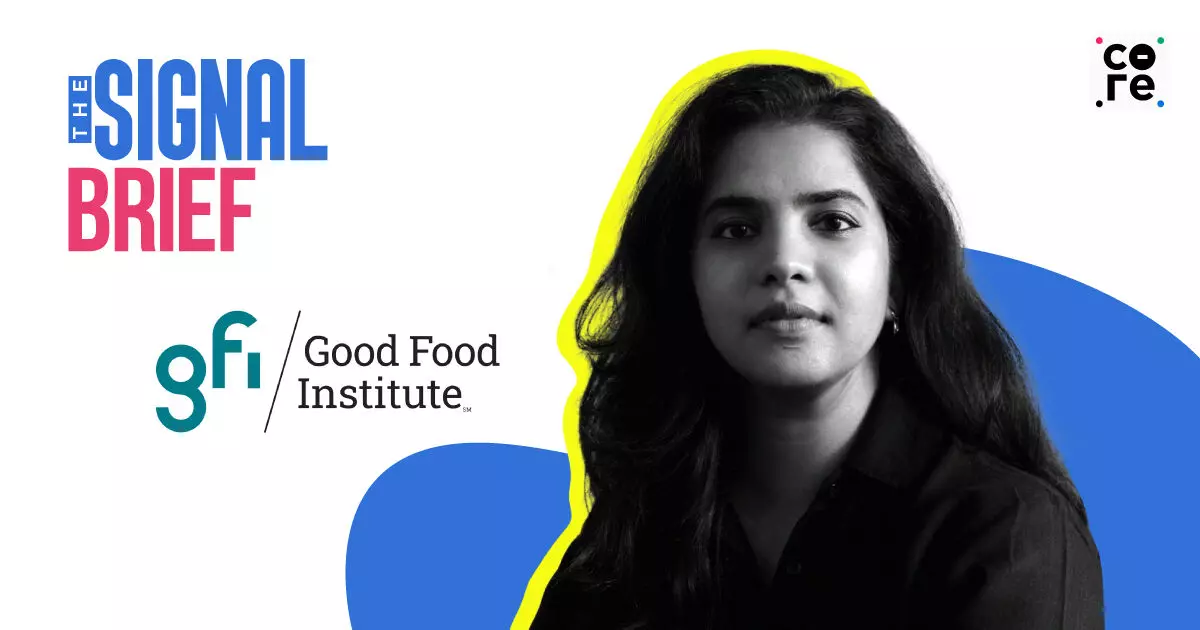
Tuesday Special: Sneha Singh On Fixing India’s Nutrition Problem
- Podcasts
- Published on 11 Aug 2026 7:30 AM IST

How more R&D could unlock India’s forgotten crops.
In The Signal Brief's Tuesday special, I sit down with an expert from across industries.
Our focus remains the same: helping you understand the trends shaping India. We're simply bringing you more of the conversations behind those stories.
Today's guest is Sneha Singh. She's the managing director at The Good Food Institute India.
The Good Food Institute India promotes plant- and cell-based alternatives to animal products, particularly meat, dairy, and eggs.
Sneha and I spoke about a recent research paper by The Good Food Institute India on the importance of doing more R&D on smart proteins and indigenous crops to fulfil India's unmet nutritional needs.
I began by asking her what crop optimisation is and what it really means for consumers.
The Core produces The Signal Brief. Follow us wherever you get your favourite podcasts.
NOTE: A machine transcribed this episode. A human has looked at this text but there might still be errors. Please refer to the audio above, if you need to clarify something. If you want to give us feedback, please write to us at feedback@thecore.in.
TRANSCRIPT:
Kudrat (Host): Hi, I'm Kudrat Wadhwa, and you're listening to the Tuesday special interview on The Signal Brief.
Today's guest is Sneha Singh. She's the managing director at The Good Food Institute India.
The Good Food Institute India promotes plant- and cell-based alternatives to animal products, particularly meat, dairy, and eggs.
Sneha and I spoke about a recent research paper by The Good Food Institute India on the importance of doing more R&D on smart proteins and indigenous crops to fulfil India's unmet nutritional needs.
I began by asking her what crop optimisation is and what it really means for consumers.
Sneha: Let's begin with crop optimisation, right? So I think sometimes crop optimisation can feel quite abstract because it doesn't affect the end consumer. It's supposed to be something that only agricultural scientists or, to some degree, farmers, if their capacity is, they are aware of this.
But research improvements, all of that in the area of crop optimisation, has actually had a huge impact in terms of what makes it to our plate. It starts there, right? So breeding high-yielding crops, for example, there was that, there was a tonne of research years ago, decades ago, that formed the foundation of the Green Revolution.
And that was to address India's food security. So with that as the base to address India's food security, there was a tonne of research done so that there can be high-yielding crops. There was also research on how crop production can be increased for cereals like rice and wheat.
So because it was crucial at a moment in time, a few decades ago, that we have to adequately feed the country. So that's what then links back to the directive or the incentives that are given to farmers in terms of what they should be focussing on in terms of crop growth. And that's what yields them even the best incomes.
The flip side of that, that's happened at whilst the focus on crops like rice and wheat was crucial at one point to feed the country. Over time, the impact it's had is it's led to the reduction or the disappearance of indigenous and nutritionally dense crops, right? So what the government is also now, as you see policy papers, etc., coming out, you see that there is more, they've spotted the need that improved nutrition security is actually something that's called hidden hunger, where you may be getting enough calories through the current diet that we have, but you may not be getting sufficient protein or micronutrients as a result.
So that's something that is now informing the way both crop research happens as well as how policies are being defined to ensure that there is a more holistic approach to the way crops are grown. Also, there is a fact that the focus on cash crops like rice and wheat, they're very resource intensive when it comes to water, land use, but they are not very climate resilient. So if we do want to make sure that whatever future food system we transition to, it should adequately nourish our population.
So it addresses that hidden hunger piece that I was just talking about. And that can be through now redirecting research and development in new crop varieties, or even some of the disappeared indigenous native crop varieties, those were always more environmentally resilient, they were local to where they were grown. So they were adapted to the kind of soil, the kind of water that was available in a particular small region, or in a particular state, for example, they did have more protein, they did have more micronutrients as well naturally.
So it could be more iron, more zinc, vitamin C. So those kinds of micronutrients already existed in some of the indigenous crops. So there is opportunity to do more research on how these crop varieties can be bred.
How can they function better as applications into end products that can be smart protein products that can be better tasting and products that can have high-quality protein that's again, more bioavailable, which is what consumers want? The signalling that we see in the consumer end is now this protein wave that is being, you know, is being jumped on by lots of lots of companies. So rather than just addressing these factors of inadequacy of protein at a processing level, just by inserting some ingredients, if you actually go back to the source, and how crops are grown, and how they're optimised and, and which crop, which crops are bred that can hopefully have the backward linkage to farmers in terms of boosting their incomes.
Kudrat (Host): Understood. And, you know, you also mentioned that the government has also been coming up with a lot of policy on this, this has been happening for a while. But my understanding is that the two things that have not prevented or that have prevented smart protein, some of these indigenous crops are one, scale and two, taste.
So how is it that we can work on increasing both the scale and improving the taste of these products, which will then eventually feed into the plant-based protein products that consumers also want to consume?
Sneha: Yeah, no, absolutely. And I think so I'll come to taste first. If that's okay, a substantial part actually of the taste challenge also does begin at the crop level, right?
So if we look at how crop genetics can actually influence the levels of off-taste or bitterness that crops have, right? Protein composition within the crops itself can also influence bitterness, flavour interactions. A lot of the times when the products are processed and made, manufacturers look to neutralise these off-tastes.
They add other flavours, they put them through other processing techniques. But the sustainable solution is to actually again, going back to the crop level and just developing and breeding crops that have fewer off-flavours to begin with. And that's where breeding strategies come in.
If we can have adequate breeding strategies that are informed by research to reduce these off-flavours to begin with, even before the processing enters the picture, right? So the final texture of these plant-based alternatives are not directly determined at the crop level, but there is a link there. And that's where having the ingredients that we choose that finally make it to the products that we have is really important.
Because they need to be able to perform well, the ingredient itself needs to be able to perform well in terms of functionality, in terms of texturization, all the different processing that it gets put through, extrusion, formulation. But if at a crop level, they don't have the traits to perform adequately at these different pieces of processing, then they won't play their part as well, right? And then the end product is not taste adequate to the consumer.
That's when you need to add the flavourings to make it more palatable. But some of those things can be addressed further before in, you know, in the process itself. Okay.
And what about the scale aspect of it? Yeah. And I think also, I was thinking about, I spoke a bit on the upstream side of things, but there are also gaps for the downstream.
So scaling can be tackled if the processing capacity goes up. So currently, even the, if you think of the amount of infrastructure capacity there is, right, to actually process the plant proteins that we have, it's quite low, because traditionally we've, if you look at again, our diets, if you look at our plate, it is consuming dal and rice and wheat in certain formats. So whilst there is some degree of infrastructure investment in some types of food processing capacities, the kinds that are needed for plant-based processing, the ones that I've been talking about, those don't necessarily exist at scale.
So if there is increased investment towards expanding that processing capacity, right, what we call post-harvest infrastructure. So that is quite underdeveloped and currently orientated towards whole foods. So your whole foods commodities like dal and rice and pulses and lentils, the way we see them and consume them, they are not currently structured for adequate post-harvest processing.
And if that happens, there is then that potential to kind of try, start inching towards scale and cost parity. Okay.
Kudrat (Host): So my next question, one of my last questions is, so, you know, a lot of these sort of alternative cereals like quinoa or even just alternative sources of nutrition like avocado, they're not Indian, they're imported.
And these have an aspirational quality, at least in bigger cities. We've done a story on avocado as well, the avocado wave that's taking over India, urban India at least.
So whereas when it comes to some of these indigenous grains like amaranth, millets, they still don't have that sort of aspirational or that cool quality. So like, why do you think that is? And is this a branding issue?
Or what can be done differently about that?
Sneha: No, absolutely. It's a marketing branding, you know, aspect, I feel like it is important to have the right marketing and branding to create hype that brings in the demand. I feel like that momentum is, however, built with sustained support from policy, from investment to ensure widespread adoption.
So I'll take millets as an example. I mean, I think you and I can both agree maybe even 10 years ago, we were not aware or consuming millets as much in India, right? They were historically known or evolved to become known as the poor man's food until they had this recent rebrand in 2023.
And they've got relabelled as Shri Anna Nutri cereals from the government itself. The recognition of the nutritional capability and climate adaptability that came with millets suddenly got elevated in broader discourse. And it was, there was two things, there was the International Year of Millets in 2023, which was a big part of this.
But then also the inclusion of millets at a very important global summit like G20 in India. Both of them together, something like that changes, shifts public perception, it brings it into main discourse, suddenly you have products on the table that are being served. And people are now curious, that curiosity then builds that push towards demand, right?
So I think that rebrand is not just important at a private sector level where that push can happen. But sometimes there's wonders that can be done through these kind of institutional rebrands, right, that are used as anchors for, for major dialogues, you know, at cross-country levels or multilateral levels, it really, really highlights what can be done. Millets is, I think, an excellent example of that.
And there are also certain indigenous crops that we have, which are very local, hyperlocal almost. So they are cultivated because there is a certain region that, as I was saying earlier, receives more rain or less rain. It's a hilly region, or it's a more tribal region.
There are different agroecologies that you need to take into consideration, right? And a lot of the smallholder farmers grow these crops for their own consumption, or maybe the consumption of a small group of people in a particular rural area, right? It is not to scale, it is not to commercially trade, it is to keep self-sufficiency.
But without adequate R&D advances, right, we don't know how we can scale the production of these crops, because it's very different to grow it in a small acreage versus to then scale it and grow it at a big acreage. Like what is the, what is needed to help even the growing of these indigenous crops to scale in the conditions that these crops need? So that kind of research is really needed to understand what could be better crop varieties of these indigenous crops.
What is institutional level support that is needed from, we have ICAR as the, you know, Institute of Council for Agricultural Research. We have so many institutes, research institutes that are doing crop research, right? We need to have those institutions prioritise this work.
And I think we've seen that, at least in my experience, I've seen that happening over time. So when these changes happen upstream, there is more R&D, and then there is also this institutional support for cultivation. So that's, if you look at it at the R&D and crop breeding at one level, then you have the support for cultivating these crops, incentive to farmers to cultivate them, and then the infrastructure required after the harvest is done.
So that there is value addition and we don't have the off-flavours that I was speaking about. Then we actually look at the whole value chain and have an end product that is, you know, richer in plant protein, doesn't have the taste challenges that you were talking about, but also is optimised for cost at each level of the value chain also. And then I think you were asking about that rebrand.
So as this happens, if there is then a parallel recognition of how the rebranding or the marketing by the institutional players involved in this value chain happens, then we can see the uptake that happened because you're very right, quinoa avocado was never a part of our diets. And there is a potential for crops in India, indigenous crops in India, to very much be able to reach that kind of mainstream adoption. But there are pieces of the puzzle that need to be solved before.
Kudrat (Host): That was a really great overview of everything. So my final question is, you know, looking ahead five to ten years, assuming all of this work has happened, what do you hope an average Indian's plate looks like?
Sneha: Yeah, I love this question because I've actually answered this in a few different forums. And I think for me, I would like to believe or I would like to hope that people rethink what meat itself can be. Right?
I think we will be eating the same things that we eat today, just made in different ways so that they're better for our own health and better for planetary health as well. So if you look at smart protein products, we, I hope that they are made entirely in India, of course, they are made using local ingredients, homegrown ingredients, and that we address this cost parity, you know, through the infrastructure and capacity building that we can, we're actually very capable of doing that in India. We have that agricultural input, we have that manufacturing capacity, we just need to kind of retool it and be able to do it in a way that we are able to produce these end products.
I also want to say that throughout, actually, I've spoken a lot about the plant-based alternatives, we've talked about plant proteins, crops, etc. And I feel like they can be made from indigenous sources because of our climate and agricultural predisposition that we have the food culture we have in India. I also hope that there is novel technologies that can grow in parallel to plant proteins, right.
So we have been seeing fermentation-derived protein really ramp up in not just in India, but in other parts of the world as well. And if you look at agricultural processing, and the side streams that are created from that, a lot of that can be used as substrate for fermentation-derived protein. So that's one thing that is very exciting and can help build circularity into the process of fermentation-derived technology, making it more viable, more climate resilient, but also enabling fermentation-derived protein to make it to our plates.
Another one is cultivated meat, as I was also talking about before, is that there is so much potential in cultivated meat, there's a lot of exciting R&D that's happening. We've seen cultivated meat get approved in a few countries as well, after a lot of regulatory rigour, safety assessment, all of the examining, we are seeing regulatory approvals, which is a strong signal to cultivated meat and its potential. And cultivated meat is just cells grown from animal cells that are grown, they're identical actually to conventional meat.
So that could also, if there is a right R&D push, and the right scale-up push, it could become affordable and available in India. The one thing to note is these three technologies, I speak about them as separate technologies, right, plant-based, fermentation, cultivated, but actually, they can all interact with each other. And that's the beauty of novel technology.
I'd love to see end products in hybrid format. So you could have fermentation technology and plant-based technology used together to then create an end product, which is bioavailable high protein. You can also do the same between plant-based and cultivated and fermentation and cultivated like it's really for us, as we give more room to novel food technologies, we can play with it and see how there is actually the end goal of protein adequacy, protein sufficiency, nutritional sufficiency, how those goals can be met, right.
And as we embrace that, our protein supply is going to become more diverse, it is going to come from different sources, some plant sources, some novel sources, we then open the doors for more nutritious consumption, more sustainable consumption. And there will be a wider variety of choices as a result available to us.
Kudrat (Host): Okay, great. Thank you so much, Sneha. Appreciate it.
Thanks for taking the time to chat with me.
Sneha: No, not at all. I loved it. Thank you so much for making time and having me.
Kudrat (Host): That's all for today. You just heard the Tuesday special of The Signal Brief.
The Core produces The Signal Brief. Follow us wherever you get your favourite podcasts.
To check out the rest of our work, go to www.thecore.in.
If you have feedback, we'd love to hear from you. Write to us at feedback@thecore.in, or you can write to me personally at kudrat@thecore.in.
Thank you for listening.


