



 Newsletter
 Search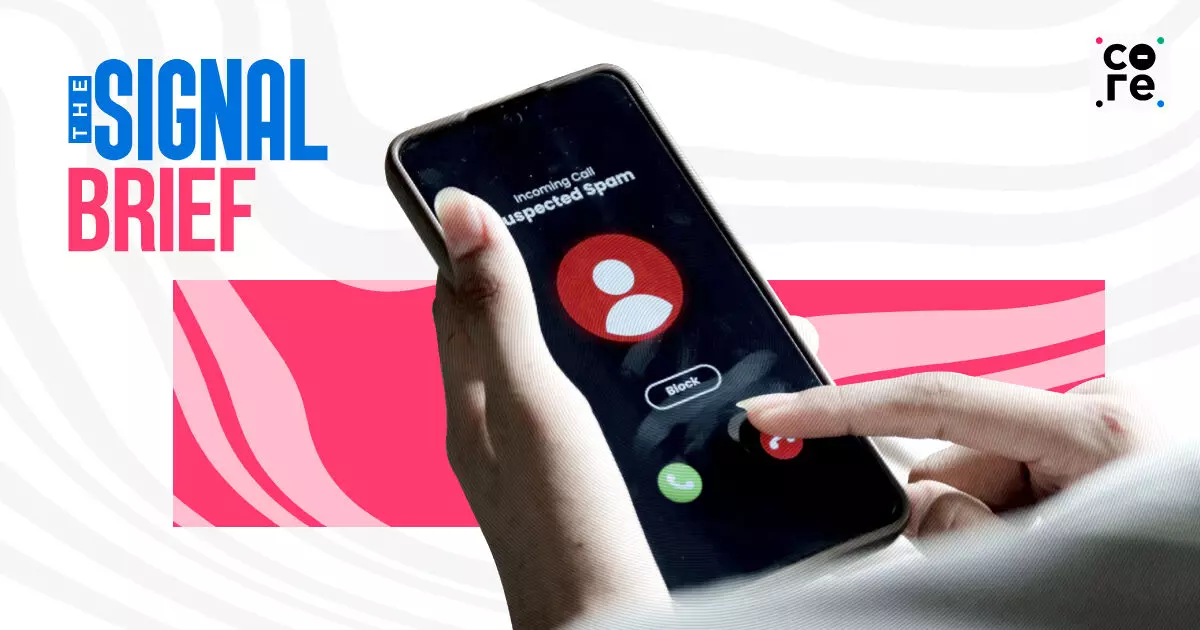
Tring Tring: Inside India’s Spam Call Economy
- Podcasts
- Published on 6 March 2026 7:30 AM IST

If you live in India, you probably get two or three spam calls a day.
A credit card you didn’t apply for. An investment opportunity you’re not interested in.
In fact, Truecaller’s reports have consistently ranked India one of the highest countries for spam.
That’s despite the fact that we actually have regulation to stop spam. In fact, early this year, the TRAI or the Telecom Regulatory Authority of India fined operators Rs 150 crore for failing to curb spam traffic.
And yet, the calls keep coming.
Experts say that now, with AI, consumers could actually see many more spam calls.
So why don’t these calls stop? And what can you actually do about them?
To learn more, check out the latest episode of The Signal Brief.
The Core produces The Signal Brief. Follow us wherever you get your favourite podcasts.
Register for India Finance and Innovation Forum 2026
NOTE: A machine transcribed this episode. A human has looked at this text but there might still be errors. Please refer to the audio above, if you need to clarify something. If you want to give us feedback, please write to us at feedback@thecore.in.
—
TRANSCRIPT
Kudrat (Host): If you live in India, you know this sound all too well.
Someone pitches a credit card you never applied for. A loan you didn’t request. A hot investment tip out of nowhere.
Spam calls plague people everywhere, but India gets hit the hardest.
Truecaller, an app designed to identify unknown calls, publishes yearly reports–and for the past several years, India has consistently ranked among the top countries for spam. In 2025 alone, Indians faced over 4000 crore spam calls.
And the calls don’t just trickle in. A recent LocalCircles survey found that nearly 77% of Indian mobile subscribers receive three or more pestering calls every single day.
Take 22-year-old Shantanu. He just took the CAT exam. Spam calls used to bother him a bit before too. But after he signed up at a coaching centre, they exploded.
Shantanu: Typically mujhe 15-20 calls aate hain. It gets annoying. I even put my phone away in the other room, but they keep calling. It’s so disruptive.
Kudrat (from clip): Have you tried blocking these numbers?
Shantanu: I have blocked them. But they have several numbers. They change their numbers and call me.
Kudrat (Host): My name is Kudrat Wadhwa and you’re listening to The Signal Brief. We don’t do hot takes. Instead, we bring you deep dives into the how and why of consumer trends.
Today we unpack India’s spam call economy. We’ve been getting spam calls for years now. Why do these calls just don’t stop? And what can you actually do?
Kudrat (Host): First–some definitions. Spam refers to unsolicited communication. In most cases, it’s companies marketing products. Spam could refer to email or text too, but in this story, we’re focussing primarily on calls.
Another serious issue in India is scam calls. Spam isn’t the same thing as scam. Spam is annoying. Scams are fraud.
Indians first started receiving telemarketing calls during the call centre boom of the early 2000s. At first, people would get a few promotional calls here and there.
Calling was still relatively expensive, and mobile phones hadn’t fully taken off.
Soon, phones got cheaper. Millions more Indians bought them. Domestic call rates dropped sharply. And eventually, calling someone costed nothing extra.
That changed everything.
Kudrat (Host): People first started complaining about spam calls in the 2000s. In 2007, TRAI–the Telecom Regulatory Authority of India–which, as its name suggests, regulates telecom operators like Airtel and Jio, took action.
It introduced the Do Not Disturb, or DND, registry. If consumers didn’t want promotional calls, they could register their numbers and opt out.
The early system to control spam didn’t work very well, though.
Telemarketers found ways around it. Some ignored the list. Some routed calls differently. Enforcement was slow. Complaints piled up.
So in 2010, TRAI introduced a stronger framework called the Telecom Commercial Communications Customer Preference Regulations.
This time, the regulator tried to formalise the entire ecosystem.
Now, telemarketers had to register themselves. Promotional calls had to use a specific number series—numbers starting with 140—so consumers could identify them. Companies could only call within certain hours, between 9 am and 9 pm. If they violated these rules, they could be liable to pay financial penalties.
On paper, India had built a structured defence against spam.
Yet here we are, almost two decades later, still drowning in spam. Why?
Kazim Rizvi, a tech policy expert, says it boils down to economics.
Telemarketing works. Calling people is cheap.
One agent dials 150 numbers a day. Even a 1% conversion rate means sales—credit cards, loans, insurance. Scale that across thousands of agents and hundreds of firms. The math works.
AI turbocharges it. Bots make thousands of calls cheaply. Volume skyrockets.
Spam persists because the incentives persist.
The fuel behind telemarketing and spam is data.
Every time you fill out a form—for a coaching centre, like Shantanu, a real estate site, a fintech app, or a credit card comparison portal or even certain third-party payment getaways—you leave behind your phone number.
Sometimes companies use it themselves.
Sometimes they pass it on to partners.
Sometimes third-party vendors handle outreach on their behalf.
Your number joins a giant lead pool. More sign-ups, more leaks, more calls.
Kazim Rizvi says the regulatory architecture to control spam exists.
Kazim Rizvi: We have the TCCCPR, which is the Telecom Commercial Communications Customer Preference Regulation 2018. Uh, so here the regulators have tried to strengthen the definition of spam. Uh, then we also have something called unsolicited commercial communication, which is any commercial message which is sent without user consent or against registered user preferences. Uh, TRAI has recently introduced digital consent acquisition, which basically is a mandatory digital consent framework.
There are many technical measures which are being introduced. Uh, we are looking at AI based detection, so telecom service providers are using AI and machine learning to protect, block and monitor spam patterns in real time.
Kudrat (Host): The issue? Scale. Millions of calls flood networks daily. Many spam callers rotate numbers. Many use cloud telephony or third-party vendors.
Enforcement then, stays reactive.
Cybersecurity expert Amit Jaju takes a tougher stance.
Amit Jaju: How is spam still happening in today's age? If they wanted to stop it, they would've stopped it long ago. So it is being allowed and regulations and operators are playing a ping pong game, and we are the ball actually.
Kudrat (Host): Amit argues that telecom operators earn revenue from call volume. And unless incentives change, spam won’t disappear.
And then there’s the data side.
India passed the Digital Personal Data Protection Act in 2023. In theory, it gives consumers rights over how their data is used.
In practice, enforcement is still evolving.
Amit says consent often exists only on paper. Data flows freely between companies and vendors.
Amit Jaju: Data protection is a joke so far. Now, of course we have a law, but there's still time before it'll actually start getting enforced by people. So I had an interesting case where HSBC issued me a card and they misspelled my last name. From Jaju, they misspelled it as Jan Uja. It came to me. I corrected it. And of course the cardboard. But after a few weeks I got a spam call from an insurance company. So I knew exactly where the data came from. Because data gets passed on like nothing. And how do people control it? I have seen it in the industry. It's not controlled. Contact details of customers from organisations get shared. There is no enforcement. There is no penalty.
Kudrat (Host): Amit’s point is simple.
As long as personal data moves easily across the ecosystem, spam will continue to find its way back to you.
Kudrat (Host): I’ll admit it—I’m in the same boat. I get several spam calls daily. I ignore 140 numbers. But many spam callers use personal mobile numbers.
I block them. It works sometimes. And other times, it doesn’t.
My telecom operator is Airtel, and it labels calls as spam–reports say that by January 2026, Airtel had flagged 71 billion calls as spam since 2024, when it began using its AI filter. Again, this method usually works, but not always.
So, I decided to download the DND app.
Ask me in another month if DND worked. Social media users say it helps. We’ll see.
Kudrat (Host): Unlike people online, Amit, the cybersecurity expert, said DND usually isn’t enough. He recommends that consumers beat spammers at their own game. His suggestion: get an AI agent to answer your phone calls.
Now what I have enabled is the AI assistant on another app I use that actually forwards this call to that number and my AI bot talks to that AI bot.
Amit Jaju: So what do you need? Thanks to Truecaller, most of my spam calls have stopped, because I've just said block all calls except those in my phone. And I also use an app which sends an SMS to a number that you call. It says this is Amit’s AI assistant. If you need to connect, please WhatsApp this number. That's it. So 99% of those spam calls stop there itself.
That's it. So 99%, those spam stop there itself.
Kudrat (Host): Amit also suggests that people have multiple phone numbers.
Amit Jaju: So I have three numbers. One number is only for my banks, no other financial institution, only the banks where I have a savings or a current account.
The second SIM card would be a SIM card which I pretty much keep switched off. I only switch it on when I need an OTP, but this is where I give it to all providers, right? Except my savings bank account. All SMS, spam calls, everything will happen on that number because this is a number which will get shared by everybody. Let them share, because it's always switched off. No incoming call. Nothing on it.
The third number is what you share with your family members. On this third number, there is a potential risk of their phone book getting uploaded somewhere to an app and that data getting shared. That risk is there, but it still significantly reduces the spam. On that number you only accept calls from known numbers. For example, there is an option to accept calls only from numbers which are on my phone. So that you can enable there. So in this three SIM card scenario, your incoming spam becomes zero, pretty much.
Kudrat (Host): Extreme? Maybe. Effective? Absolutely. Especially, if spam drives you crazy or worries you about data.
Kudrat (Host): Spam calls persist despite regulation, and continue to frustrate consumers like Shantanu and me.
And now, with AI tools lowering the cost of outreach even further, the volume may only increase.
I have registered on DND. Shantanu told me that he will check it out too.
Whether that works consistently remains to be seen.
If it doesn’t, we may have to resort to Amit’s, rather intense, 3 SIM card and AI agent strategy.
Outro: That's all for today. You just heard The Signal Brief. We don't do hot takes. Instead, we bring you deep dives into the how and why of consumer trends. The Core produces The Signal Brief. Follow us wherever you get your favourite podcasts.
To check out the rest of our work, go to www.thecore.in.
If you have feedback, we'd love to hear from you. Write to us at feedback@thecore.in or you can write to me personally at kudrat@thecore.in.
Thank you for listening.


