



 Newsletter
 Search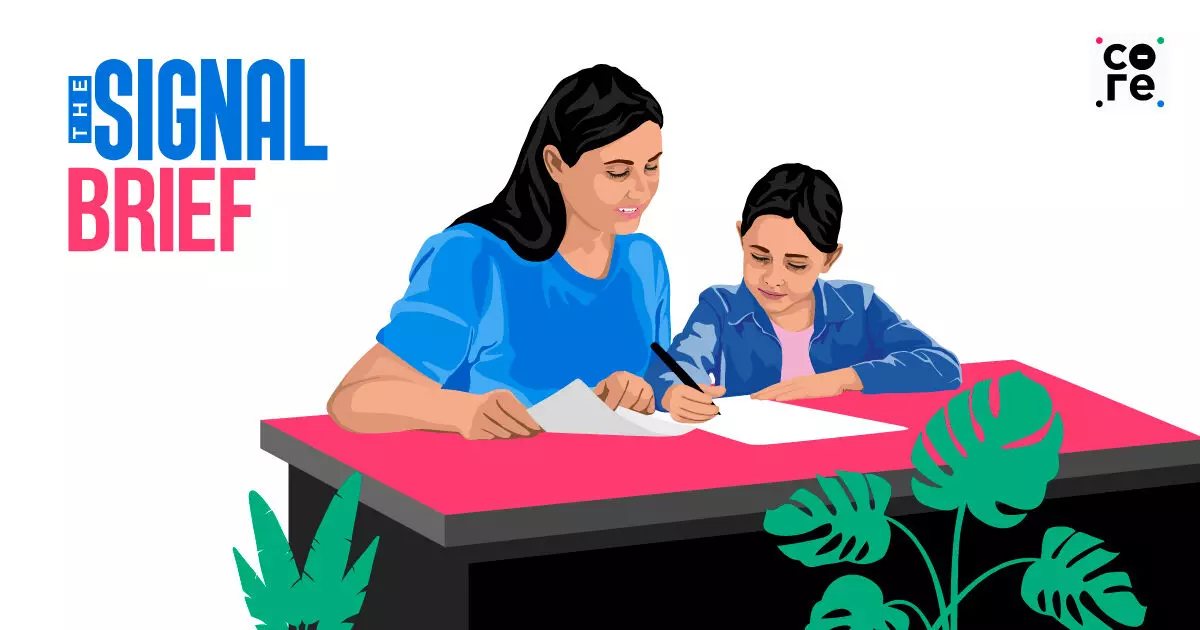
The Rise Of Homeschooling In India
- Podcasts
- Published on 22 May 2026 7:30 AM IST

Why more Indian parents are saying goodbye to traditional schooling–and what it’s really costing them emotionally.
Joseph’s two sons, aged 11 and 9, were doing well in school. Until COVID hit.
Their grades started plummeting. Then, Joseph brought up an unusual idea: homeschooling.
At first, his wife resisted. But the family eventually took the leap.
And Joseph is not alone.
Fed up with India’s high pressure education system, obsessed with marks and grades, more Indian parents are choosing to take charge of their children’s education.
According to the Ministry of Education, 72,000 Indian families homeschooled their children in 2023-24. And that number is only growing.
But homeschooling can come with its own risks.
Can every family do it? What happens to socialisation? And what are the real emotional costs?
To learn more and to hear from experts and homeschooling kids and parents, check out the latest episode of The Signal Brief.
The Core produces The Signal Brief. Follow us wherever you get your favourite podcasts.
NOTE: A machine transcribed this episode. A human has looked at this text but there might still be errors. Please refer to the audio above, if you need to clarify something. If you want to give us feedback, please write to us at feedback@thecore.in.
TRANSCRIPT:
Kudrat (Host): The first time I took tuitions was in the ninth grade. I didn’t need them before, but with board exams looming, everyone said the same thing: “Spend your summer studying.”
I still remember those three brutal months, 9 am to 7 pm, studying Physics, Math, and English. In English class, the teacher handed us her “perfect notes”, ready-made answers for every possible exam question. I remember rote-learning the entire history textbook and vomiting it word-for-word in the exam.
I scored 98 in the subject.
I’m not telling you this to brag. I’m telling you this because we all know the truth, that the Indian education system is seriously lacking.
No child should have to memorise history like a parrot. No one should read a story only after they’ve already read and rote-learned the synopsis and character sketches. To state the obvious, that defeats the entire purpose of learning.
And yet, year after year, millions of young Indians go through the same broken machine.
But now, a new movement is growing, homeschooling. Fed up with a rigid, high-pressure system, more parents are choosing to take charge of their children’s education.
According to the Ministry of Education, over 72,000 children were in home-based education in 2023 to 24. Independent estimates suggest 25,000 to 50,000 families are actively practicing full-time homeschooling across India, and that the numbers are growing fast, especially in metro cities like Bengaluru, Pune, Delhi, and Mumbai.
My name is Kudrat Wadhwa and you’re listening to The Signal Brief. We don’t do hot takes. Instead, we bring you deep dives into the how and why of consumer trends.
In today’s episode: Why more Indian parents are saying goodbye to traditional schooling–and what it’s really costing them emotionally.
Kudrat (Host): Joseph Jude started homeschooling his two boys, now aged 17 and 15, about five years ago.
As a CTO in the IT industry, he had seen firsthand how even top-ranked college graduates struggled in the real world. He was also inspired by studies showing that children are naturally curious, and that sometimes the best thing we can do for their learning is remove the obstacles in their way.
Still, his kids were doing well in school, so he didn’t push the idea. Until COVID hit.
Joseph: But all digital transformations happened during COVID. In our case, it was the same thing. Their ranking started plummeting. They were in the classes of five and seven, so to speak. Their ranks started plummeting, so that is when I brought up the idea of homeschooling.
Kudrat (Host): His sons Josh and Jerry were initially torn–worried, but also curious.
Josh/Jerry: Firstly, it was like, it is extremely risky, right? Homeschooling. If it fails, how will we go back to school? Because it completely relies on you making your own path and your own career, particularly entrepreneurship. So if that fails, how can you go back to school? And that was the main concern, the main issue that we had.
For me, the risky part was there, you know, the same question that we had at the start. But I was also a little curious about homeschooling, because before that I'd never heard of it, and it seemed unique to be able to study at home and not go to school. So, yeah.
Kudrat (Host): Today, they couldn’t be happier. Here’s what a typical day looks like in their homeschooling life.
Josh/Jerry: In the morning, I get up at 6:00 AM, and then after that we read our Bible, and then after that we go exercise. Exercising usually takes about 40 minutes, and then we take a bath, and then we eat breakfast.
At breakfast we usually talk with our father about what we learned the previous day. Or maybe he would have read an interesting article in a newspaper or something.
So we usually like to discuss there, you know, what does this mean? What does a certain economic event mean? We like to discuss that there. And then after that it's usually planning what we're gonna do that day. And then immediately after planning, we go about doing those things.
Generally, in the morning it's our hobbies. We work on our hobbies, guitars and, for me it's guitar and piano generally. And for my brother it's just guitar. After that, we go into our academic thing, which is, for me it's NIOS open schooling since I'm doing that. I usually give about two hours of my time per day to NIOS, and after doing that in the morning, it's lunch, and in the evening we do Coursera and blogging.
So it's a mix of... For me, it's entrance tests, blogging, and any sort of research we want to do in the evening. And then after that in the late evening, we have tuition, right? So Jerry has a Chinese class and a maths class some days, and this is the tuition. And in the evening, it's usually just a discussion between ourselves and as a family about what we did, kind of like a retrospective, and then we close our day.
Kudrat (Host): Though Josh and Jerry’s days are regimented, not every homeschooling family follows a strict schedule.
I spoke to Manasi Malshe, a homeopath who began homeschooling her 17-year old son a few months before COVID struck. She told me that they have an entirely child-centric curriculum, with some general guidelines for what tasks need to get done that week.
In the United States, the people who make up the modern homeschooling movement are primarily Christian conservatives who want to protect their children’s moral and religious upbringing. Today, nearly 3.4 million American children are homeschooled.
In India, the idea is ancient, rooted in the gurukul system and home-based learning traditions.
But the modern wave started gaining quiet momentum after 2010 and exploded during COVID. Many families turned to NIOS (National Institute of Open Schooling), a government-recognised open board established in 1989. NIOS certificates are fully valid for college admissions, competitive exams like JEE/NEET, and are accepted by almost all Indian universities.
While Indian homeschooling advocates often insist anyone can do it, the reality is more complicated.
The families I spoke to were urban, English-speaking and financially stable enough for one parent to spend significant time coordinating learning.
Homeschooling may remove school fees, but it can replace them with other costs: flexible work schedules, online courses, hobby classes, tutors, transport, and most importantly, time.
Many parents also rely on a patchwork ecosystem of private tutors, YouTube, hobby classes, online platforms and homeschooling WhatsApp groups to fill gaps that schools traditionally handle in one place.
In metros especially, finding resources is becoming easier. But accessing them consistently still requires money and time.
For families who make it work, homeschooling often becomes a customised mix of formal academics and skill-building.
Manasi’s son Akshaj, for instance, chose subjects like coding, biology, chemistry, English and data entry through NIOS. Alongside that, he also completed a diploma in digital communication focused on graphic design.
Manasi told me he’s now considering pursuing arts or design in college.
Still, in India, the biggest battle isn’t resources or certification, it’s social pressure, says Joseph.
Joseph: Now, coming to what is the hardest part of dealing with homeschooling in India, it is especially the social pressure. So when I told that to my mom, my mom was dejected, depressed. "You are, you are, like, you know what I mean, spoiling your kids', my grandson's, life. They're not gonna find jobs. They are gonna be spoiled in their life." You know, yada, yada, yada.
Kudrat (Host): The most common criticism? “What about socialisation?”
Joseph: First of all, it is called homeschooling, it is not cave schooling. They are not locked up into a cave and then, you know, never, uh, seeing the world. Even in a regular... I'm assuming, like, I mean, people are living in apartments. They go to, you know... We go to church, they are going to temples. Some people might be going to temples or mosques. They are going to some community events. Uh, they are going to sports, uh, clubs. You know, whatever.
All of these places, there are tons of opportunities for, uh, interaction, social interactions. Uh, so I don't see that as a challenge. In fact, in school, what could happen is if you, if... Like, I mean, at least nowadays, what is happening is the teacher will say, "You can't speak." Like, I mean, "Don't talk." Uh, and then you are only talking to very few people. In fact, what has happened is because I take them to industry visits, uh, they are very comfortable talking to, uh, CEOs, elders, you know, all of those kinds of stuff. They don't have any inhibitions at all, uh, of talking to them and asking questions- And understanding how the business is run and, and so on and so forth. Whereas people who are told only to speak to their peers and not to elders, they have a lot of inhibition talking to el- uh, when they come into job, talking to seniors, talking to clients, and getting their viewpoints across.
Kudrat (Host): For Manasi and Joseph, homeschooling has largely been a positive experience.
But psychologists say the picture is more complicated.
Harshmeet Kaur, a counselling psychologist who works with children and families, told me she has genuinely seen school anxiety and burnout improve after children leave traditional classrooms.
But, she says homeschooling can create entirely new pressures too.
Harshmeet Kaur: When you remove the child from that environment, the nervous system literally exhales. A mother whose son I had been working with for school-related anxiety told me that he started sleeping through the night for the first time in two years. Now, that is not a metaphor for relaxation. What she's trying to explain is basically that that is cortisol regulation restoring normal sleep architecture when he moved back home.
Now, let's also talk about... because if we have certain benefits, we are also having certain risks, and risks are also real here. So school, for all its flaws, teaches children to navigate boredom, authority, disappointment, interpersonal conflict, which are also unavoidable realities of adult life. Now, when it comes to homeschooling, homeschooling becomes an environment entirely tailored to the child's preferences.
We may inadvertently produce a young person who cannot cope when the world stops accommodating him.
Now here, a 17-year-old I saw had been homeschooled in an entirely child-led, unstructured way. So he was intellectually brilliant. First semester at Delhi University was a complete psychological collapse for him. So he had no internal learning or a template for external demands, and he could not handle social friction. So now the absence of any structured frustration during his school years had left him without the emotional muscle to manage ordinary adult challenges.
Kudrat (Host): And sometimes, she says, the pressure shifts from school onto the family.
Harshmeet Kaur: Let me start with an example here. So I worked with a mother from South Delhi, deeply committed to homeschooling with genuine love and a great skill set also, who arrived in my office with full clinical burnout. Emotional exhaustion, irritability, resentment. She was profoundly ashamed of it. She kept saying that, "I chose this. I have no right to feel this way." But I could see that that shame about her own needs was preventing her from seeking support, which was making everything worse. Now, her son was beginning to detect her resentment and responding with guilt, which was manifesting as perfectionist, compulsive academic behavior.
Now, his anxiety had not reduced after leaving school. It had merely changed its object from marks to his mother's wellbeing. So, the impact on family dynamics, if you see, now if a child, even unconsciously, is perceiving that a parent has sacrificed their professional life, personal life, social life, their own identity for the homeschooling project, they internalise it as an obligation to perform. So now their learning stops being about curiosity and becomes about justifying the sacrifice.
Kudrat (Host): In some cases, she says that kids even begin to resent the decision itself.
Harshmeet Kaur: Yes, there is this shame that they feel, that why... And they have also come to me and said, one of them said that, "I feel that it was my parent's dream, which my parent could not achieve when they were growing up, so that's why they tried to homeschool us."
Kudrat (Host): Still, despite the trade-offs and criticisms, the homeschooled kids I spoke to say they’ve had experiences they never would have in a conventional classroom.
Josh/Jerry: My, I guess, favourite experience was basically... It was kind of crazy, but we... The farmer there, the person organising, the entrepreneur, he asked whether I would like to drink milk straight from the cow, and I guess since it's a very new experience, I agreed. And yeah, that's a very insane but fond memory of mine from homeschooling. You know, it really shows how crazy but also interesting homeschooling can be.
For me, I don't really have any crazy memories because when we went there, I backed out of it because I was scared. But recently we went to a factory, a water heater factory, and I've always wanted to go to a factory, see how manufacturing is done, and this was actually quite a big factory. So because of that, I really enjoyed the entire thing, seeing how they manufacture products that you actually use in day-to-day life. Okay.
Kudrat (Host): The boys and Joseph are honest, homeschooling isn’t for everyone.
Josh/Jerry: But if there's one thing I would like to say, it's that homeschooling is very self-motivated. You have to be curious. You have to be passionate about what you're learning. If that isn't there, homeschooling is not really going to work out. And so that might take a while to get into, so it's better you start practising the discipline and responsibility at the start itself.
Secondly, I would say homeschooling is more like a cooperative journey between the parents and the children because they both have roles to play. My father always has created a safe, encouraging place to learn. He gave us so many options to choose from. Coursera has been there. It's been a great experience in finding new things to learn.
One thing that was very good was debates. We used to have debates. He used to encourage critical thinking, systematic thinking, and he used to teach us how exactly to learn efficiently. And on our side, it is the curiosity, that discipline, that responsibility we need to have.
So homeschooling is, in the end, a cooperative journey and both the parents and the child have to play their roles for homeschooling to be very successful.
For me, I would say that as a homeschooler, homeschooling is great. But something like adding on to what he said is that homeschooling is not for everybody because the cooperative journey... A lot of the parents, they are working two jobs or even in the jobs that they have, they're extremely busy. And so they won't have time to take on these extra responsibilities for homeschooling the kids. But if you're interested and the curiosity is there and the parents have the ability to be able to do all these extra things for homeschooling, then I would say it's a great thing to do.
Kudrat (Host): Joseph leaves us with some final wisdom.
Joseph: It is an experiment that I'm running. It works perfectly for us.
So a lot of people came to me to ask about all of these things, and they will start homeschooling, and after about a year or so they will come back to regular schooling. And when I would go talk to them, this is what I found, that this is the first contrarian decision that they took. So they couldn't just sustain it.
They don't know how to support their contrarian decision. So if this is the first contrarian decision you take, probably you will fail. I would encourage you to take some other decisions, live with them, see the results before you decide whether you should do this or not. So can anyone do it? Absolutely anyone can do it. But if this is your first contrarian decision, probably you will fail. So that's all I would say.
Kudrat (Host): Homeschooling promises freedom: freedom from rote learning, rankings and the relentless pressure cooker of Indian education.
But freedom can also mean uncertainty.
For some families, homeschooling creates curious, confident children who thrive outside the classroom.
For others, it can shift the burden of education entirely onto parents, replacing school pressure with a different kind of emotional strain.
When I think back to myself at age 15, memorising long paragraphs from my ICSE history textbook, I still feel angry.
Even then, I knew something was wrong. But there didn’t seem to be another option. Grades mattered. Board exams mattered. You just had to do it.
And honestly, with two busy working parents, homeschooling probably wouldn’t have worked for my family either.
Which points to the bigger problem.
Homeschooling isn’t really fixing India’s education system. It’s an attempt to escape it.
And for now at least, that escape is only available to some families, not all.
Outro: That's all for today. You just heard The Signal Brief. We don't do hot takes. Instead, we bring you deep dives into the how and why of consumer trends. The Core produces The Signal Brief. Follow us wherever you get your favourite podcasts.
To check out the rest of our work, go to www.thecore.in.
If you have feedback, we'd love to hear from you. Write to us at feedback@thecore.in or you can write to me personally at kudrat@thecore.in.
Thank you for listening.


