



 Newsletter
 Search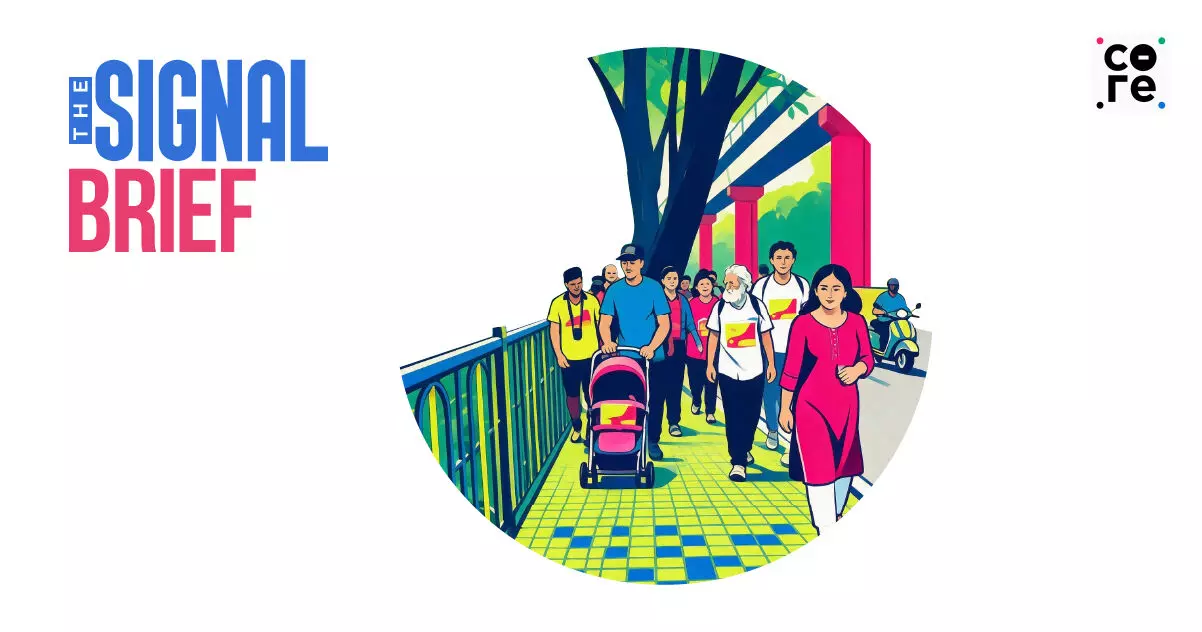
The Great Indian Footpath Problem
- Podcasts
- Published on 4 Sept 2026 7:30 AM IST

The Supreme Court says that walking is a fundamental right. What will it take to make our footpaths walkable?
India is a country of walkers. In many major cities, over 30% of people travel by foot. In Mumbai, that number is above 50%.
And yet, our footpaths are unusable.
But now the Supreme Court has intervened.
In June, it said that the right to walk is a fundamental right.
But walking advocates say that a court ruling won't fix the problem.
After all, the people making the decision rarely walk themselves.
So what's it gonna take for India's footpaths to become usable?
Tune into the latest episode of The Signal Brief, where you'll hear from consumers and walking advocates on this.
The Core produces The Signal Brief. Follow us wherever you get your favourite podcasts.
NOTE: A machine transcribed this episode. A human has looked at this text but there might still be errors. Please refer to the audio above, if you need to clarify something. If you want to give us feedback, please write to us at feedback@thecore.in.
TRANSCRIPT:
Kudrat (Host): A few weeks ago, I met Roma, a yoga instructor who described herself as a ‘third-generation’ Delhiite. She took me on a walk in South Delhi.
Roma: So we are in GK, which is Greater Kailash. Very popular, very posh, quote, unquote, "luxurious" part of Delhi where rich people live. And ironically and sadly, even in rich people's neighbourhood, there is no footpath.
As you can see in front of you, the footpath has been encroached by private property owners. Either they are parking their cars illegally, or they have put planters to push pedestrians away, or there is some construction going on, so they are using it to keep their raw material.
Or as you can see on your left side—there are autos and cars and bikes and whatnot. So footpath is for everything but foot.
Kudrat (Host): Roma has been trying to fix this for years. She has even gone to the authorities.
Roma: I have tried escalating this issue with the local police. I even went so far that I took a day off from my work—went to the police station of GK1, met the SHO, explained him the problem that, hey, I really like to walk, and I would love to walk from my house to my gym every day instead of paying for auto or paying for—
So I escalated this issue with the RWA of my local society. I escalated this issue with the president, with the vice president. Then I escalated this issue with Shikha Roy, who is elected MLA of Greater Kailash. You can see her posters everywhere. You can see her photos everywhere. And the people are so cunning. They are so smart. Whenever the MLA or some politician is supposed to visit, automatically, magically, you see all the Sariya, all the trash, everything disappears. And as soon as the MLA visit is done, then you will see the Sariya, the brick, the trash again back onto footpath. Like, look at this. How dangerous it is. Am I supposed to walk over this Sariya?
Kudrat (Host): But, none of it has had a lasting impact.
And now, in June of this year, the Supreme Court declared that the right to walk on safe, continuous footpaths is a fundamental right for all Indians.
The court said this right has priority over motorised vehicles, and that if a road exists, the authorities have an enforceable duty to provide and maintain a proper footpath.
The judges delivered this ruling in a case where a tanker killed a five-year-old boy while he was walking to school with his father on a road that had no footpath.
The law now recognises the right to walk.
But, the street Roma and I walked on still does not.
Kudrat (Host): My name is Kudrat Wadhwa and you’re listening to The Signal Brief.
You’re listening to our Friday episode, where we tell stories about how Indians live, work and spend.
In today’s episode: The Supreme Court says the right to walk is fundamental. But what will it take for the street to catch up with the law?
Kudrat (Host): Roma remembers a time when things were different.
Roma: When I was a kid, I used to go to school. My school was barely 1.5, 2 kilometres away from my house. Mostly I used to go by walk. In some emergency I'll take a rickshaw or something, or my parents would drop me, but mostly either I would bike or I would go by walk. And footpaths were empty. They were for people to walk back in the '90s or early 2000s.
Kudrat (Host): But, while cities modernised, they prioritised the movement of vehicles over the movement of people on foot. You can see the consequences on almost any street, including the one Roma and I walked on in Greater Kailash.
Roma: If someone wants to go to the school or to their office or to get grocery by foot—it means you are poor, and nobody cares about poor people.
Kudrat (Host): Vedant Mhatre sees the same hierarchy.
He works with The Walking Project, a Mumbai-based advocacy group that has been pushing for better footpaths since 2012 through community walks, street audits, and direct engagement with the municipal corporation.
Vedant: I mean, it's a societal thing, I feel, in India. We have, as a society, aspired to have our own car. It, like, it's one of the markers of success in our society. Like, if you get rich enough, you would need to own a car.
Kudrat (Host): He added that the people who actually decide how streets get built rarely walk on them.
Vedant: The municipal engineers, municipal commissioners, the politicians, all of these people own a car and mostly experience the city through a car. They don't experience it through foot.
But what happens is because our ruling class, administrative class, and upper middle class who have the money, who have political connections, who themselves are politicians, have access to municipalities, municipal budgets, national budgets—उनको दिखता है कि हाँ, इस flyover पे congestion हो रहा है, maybe इस road—यहाँ पे एक और flyover exit होना चाहिए, या फिर यहाँ पे road बहुत congested हो रहा है, तो widen होना चाहिए. So that is how this cycle keeps on continuing, and you kind of have these decisions to prioritise vehicles being taken even when a lot of these decisions are against existing standards that India has.
Kudrat (Host): Those standards are clear. Guidelines set by the Indian Roads Congress (IRC), the body that sets technical guidelines for roads and streets in India, say that a footpath should offer at least 1.8 metres of clear, unobstructed walking space in residential areas, and more in commercial ones. The path must stay continuous and free of parked vehicles, construction material, and private encroachments.
In practice, of course, our streets don’t honour those directives.
And that’s despite the fact that India is actually a country of walkers.
Around 45 million people walk to work every day.
Nearly a third of urban workers travel on foot.
Almost every bus and metro journey begins and ends with a walk.
And yet, the infrastructure for the most common way of moving stays the most neglected.
Vedant says one reason is the lack of design expertise inside municipal corporations.
Vedant: A lot of things are missing in the way we see—there's a lot of lack of expertise in the municipality in terms of road design, road construction, and how to solve a lot of the problems and challenges that we see on our streets.
Like, street vendors is a major challenge on Indian streets. There is, there are laws on how to accommodate them, but it requires a proper designing philosophy and expertise to integrate all of these things properly.
Kudrat (Host): Parked vehicles and street vendors are the two biggest daily obstacles to walking.
And ironically, the law already has provisions for both.
The Street Vendors (Protection of Livelihood and Regulation of Street Vending) Act, 2014, recognises vendors as a legitimate part of the streets and requires cities to accommodate them without blocking pedestrian movement.
On parking, Indian standards and several city-level policies say on-street parking should be managed and charged so it does not eat into footpath space.
In practice, both remain poorly enforced.
That’s in part why Vedant says that he’s only cautiously optimistic about the Supreme Court ruling.
Vedant: I'm not extremely hopeful from it because, for someone who's worked in advocacy for this specific thing, we know the challenges are much deeper.
There are structural flaws in the way our municipalities and other government organizations work, which are going to need solving.
Kudrat (Host): But as Vedant reminds me, change is possible.
Take Amsterdam, for example.
In the early 1970s, the Netherlands was recording more than 3,000 traffic deaths a year.
In 1971 alone, more than 400 of those killed were children.
So, parents and activists organised under the banner Stop de Kindermoord or Stop the Child Murder. They occupied dangerous junctions, closed streets so children could play, and kept pressing the government.
Over the next decades, Dutch cities rebuilt their streets around bikes and people. Amsterdam now has hundreds of kilometres of dedicated cycle paths.
Closer to home, Vedant’s own organisation, ‘The Walking Project’ has managed to move the system a little.
After years of community walks and detailed reports, The Walking Project persuaded the Brihanmumbai Municipal Corporation to allocate Rs 100 crore specifically for improving walkability and footpaths.
Of course, 100 crore isn’t enough, but it’s a start.
Vedant: Definitely not. Like, especially since we see so many more, so much more money gets spent behind one flyover of kilometre-long flyover. It's definitely not enough.
Through this one project, what we wanted to do is we wanted to systemically fix internal processes.
Kudrat (Host): A few hours from Mumbai, in Pune, urban designer and architect Prasanna Desai has spent decades trying to build streets that actually work for people on foot.
His projects, including the Aundh DP Road under the Smart City Mission, show that continuous footpaths and proper junctions can last for years.
Prasanna: I always say that the depth of the democracy is decided by the width of the footpath in a city. One other thing I would also say is that we need to work beyond the boundaries. Particularly professionals like us, architects, planners, landscape architects, engineers, everyone. We have gated communities. ये मेरा boundary है। तो मेरे boundary में मैं सब कुछ कर रहा हूँ। Boundary के बाहर कौन काम कर रहा है? सरकार कर रही है। तो वो सब सरकार है। Streets become सरकार। All the, what is not within our realm. So I think we need to work with the government, and more and more people should only engage with the government.
Kudrat (Host): Both Vedant and Prasanna keep returning to the same point: the system will not correct itself.
Vedant: I feel like, in Indian cities especially, there's a lot more need for people to interact with their municipality and be in the municipal offices, constantly go for meetings, ask their corporator, ask their municipality about smaller things. Like, it doesn't have to be a larger grand thing, "Ki mere pura road achcha karo." Just fix the basic manhole which has been lying open for so a while.
Citizens really need to adopt a better, more systemic approach, progressive approach towards participating and getting things done. It's not that municipal officers are corrupt or, like, they are just corrupt. Uski wajah se nahi hota. Corruption hota hai. Corruption is present in all forms in all countries, China, US, whatever country. But work still gets done because people care about end goal mein humko kya mil raha hai infrastructure through this corruption. That is where, footpath अच्छे से बन रहा है कि नहीं? Is the footpath wide or not? Should it be like this? Why is the vendor on my footpath? Why can't he be properly created a space? So these questions people need to, like, educate themselves also. Like, that is one of, one of, one of the things that we do.
Kudrat (Host): On the footpath in Greater Kailash, Roma’s dreams are bigger.
Roma: If you go to Lutyens, Delhi, right? If you go to India Gate, if you go to Connaught Place, if you go to the really extremely posh area where the president and all the MPs live. Waha dekho na, waha ki footpath kitne sundar hai. They are beautiful. They are well-maintained. They have plants on both sides. Hai na? There are no potholes. They are not broken. They are not damaged. You can easily walk and enjoy the sights.
So why can't we do the same thing all over the city? Why only neta, politicians, rich people—get to enjoy that privilege of clean, beautiful, nice footpath. Hamein bhi milna chahiye na woh. Aapko kyu mil raha hai woh achha footpath? Hamein bhi do. Toh agar aap waha kar sakte ho toh aap yaha bhi kar sakte ho. Hai na? You are—anyway, you are using our money. It's our tax money. It's not your money that you're using. So it's my money, so use it for my convenience. Use it for my benefit first. Then use it for yours.
All the netas and politicians—and all these government officers, they have nice footpaths. They don't even use it. They don't even use it. And people like us who need it—we don't have access to nice footpath. Which is an irony.
Outro: That's all for today. You just heard The Signal Brief, your twice-a-week look at the stories shaping Indian consumers.
The Core produces The Signal Brief. Follow us wherever you get your favourite podcasts.
To check out the rest of our work, go to www.thecore.in.
If you have feedback, we'd love to hear from you. Write to us at feedback@thecore.in or you can write to me personally at kudrat@thecore.in.
Thank you for listening!


