



 Newsletter
 Search
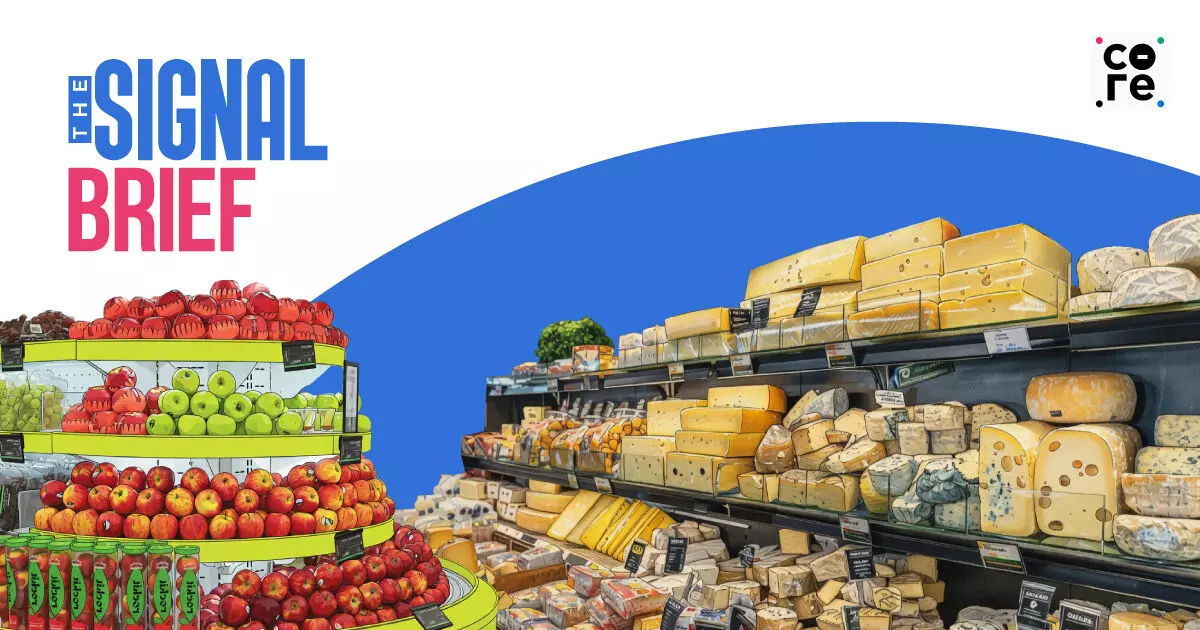
The Battle for India's Gourmet Grocery Shopper
- Podcasts
- Published on 20 Nov 2026 7:30 AM IST

Quick commerce has gone gourmet. Can stores survive?
Let's say you're craving something a little fancy. A nice cheese. Some artisanal sourdough.
Today, you can get most of these delivered to your doorstep in minutes via quick commerce.
So, are gourmet grocery stores losing their relevance?
Tune in!
The Core produces The Signal Brief. Follow us wherever you get your favourite podcasts.
NOTE: A machine transcribed this episode. A human has looked at this text but there might still be errors. Please refer to the audio above, if you need to clarify something. If you want to give us feedback, please write to us at feedback@thecore.in.
TRANSCRIPT:
Kudrat: Asavari Pawar, 61, remembers going to Modern Bazaar regularly from 2015-19.
That was when she worked as the Head of Dance at the Delhi Public School branch in East of Kailash and the store was not too far from the school.
Asavari: I mean, they're always nice things and so well presented and not necessarily expensive. Fish and chicken, and they had many nice things like broiler chicken, and this you can't just get everywhere. It's clean, very clean and well packed. And the biscuits and the crisps and the nachos and the cakes and the creams and the pastries and the tarts and everything, quiche.
Kudrat: She also remembers the impeccable service at these stores.
Asavari: The people were also very friendly. They would come around and, "Madam, ma'am, Madam ji," or, "Yeah, well, we are selling at half price because of the date. So are you cooking something today? Do you need to use something to..." But they would ask you things like that. "Chocolate toh nahi chahiye? Kuch pi lijiye."
Kudrat: That was then.
Today, Asavari and her family rarely visit grocery stores, even the nicer ones.
Her frequent grocery runs have, for the most part, moved to her phone.
We all know how consumers have shifted to ordering essentials like milk, bread, eggs from quick commerce apps like Blinkit.
And now, consumers like Asavari have moved beyond that too–they’re even ordering artisanal cheeses, sourdough bread, imported chocolates on their phones.
Products that earlier would have required a visit to premium grocers like Le Marche, Modern Bazaar or Nature's Basket.
Physical retailers too are feeling the heat.
In September, Mint reported that Modern Bazaar halved its store count–from 27 to 12. And, Modern Bazaar isn’t the only one.
So, what happens when the stores that once introduced us to gourmet products begin competing with India’s favourite on-demand apps?
Kudrat: My name is Kudrat Wadhwa and you’re listening to The Signal Brief.
You’re listening to our Friday episode, where we tell stories about how Indians live, work and spend.
Today, we’re looking at what happens when quick commerce starts selling the same things the gourmet stores do.
Kudrat: Blinkit and Zepto started off by delivering everyday essentials.
But over the last few months, their food offerings have expanded too.
You can now find everything from specialty sauces and spreads to even imported ingredients on these apps.
So, why are they moving into gourmet?
Ravi Kapoor, who’s a partner at PwC, says that gourmet products mean a larger AOV or average order value for these apps.
Ravi: Better AOVs, more stickiness, more comfort with digital channels, so better economics. So all of these factors, better stickiness, all of these are reasons why this seems like an attractive category.
And hence, gourmet categories, products really give you the opportunity to discover and satisfy your impulsive urges, which are manifested mostly via food categories.
Kudrat: There's a consumer side to this, too.
We've become so used to ordering things on quick commerce that we're increasingly willing to pay extra for the added convenience.
Satish: It's not that if a delivery fee is charged or a packaging fee is charged, customers have kind of adopted that, you know, "I can pay for this 10-minute convenience, which is coming to my house." My basket fulfilment rates are almost 100%, so it's not that I'm ordering 10 items and I'm getting eight. So that's something which is already set as a norm by quick commerce players.
Kudrat: Satish Meena of Datum Intelligence, who we just heard from, also added that this is happening alongside a growing interest in the food we eat.
Satish: Everyone is looking for clean products, less of chemicals and everything. And they are willing to spend more.
And if you see, there are around 15 million households in India which can be a target market for the gourmet category, and they are willing to spend for better products, better quality and everything.
Kudrat: Apeksha Jain is the founder of The Gourmet Jar. That’s a brand that makes clean-label sauces and spreads.
She told me that she has seen this change in her own customer base.
Earlier her customers were largely people like Asavari–affluent people living in metros and Tier one cities. People who were already familiar with these kinds of clean-label and premium products.
But now, that’s changing.
Apeksha: But I think with quick commerce, it's not just the urban consumer, but even now, I think the health awareness and the desire to eat better products is there even in smaller towns.
So you have obviously consumers even in, let's say, Raipur or Bhopal or these kind of places where they want better products as well, and they're willing... They have the money and they're willing to pay the price for it.
So now, sometimes when we do events and exhibitions, we have people who cannot speak proper English, but then they are aware that they want to eat better and they want to, especially for their mothers, for their children, feed them better and clean-label products, so they're willing to pay that price.
Kudrat: For brands like The Gourmet Jar, quick commerce has opened up access to customers who may not have had a gourmet supermarket in their neighbourhood.
And it's changed where the business is coming from too.
Apeksha: Offline retail was, for me, before COVID, 70% of our business. And in those years, when Food Hall was there, Food Hall was one of our biggest stores that did very well for our kind of brand.
So we were seeing a lot of growth offline, but with quick commerce, of course, consumer behaviour has changed completely. But the years, like 2018 to 2020, there was significant growth happening in the offline stores.
Kudrat: Apeksha says that in the last couple years, growth in offline retail has been largely stagnant.
Online, meanwhile, has grown several times over.
Apeksha: But I would say offline we've not really seen a lot of growth except maybe some retailers. Mostly it's been kind of stagnant and some have also been shutting down, so there's been a lot of degrowth there as well.
But for online, definitely there's been a lot of growth. Like, I think with Blinkit, Swiggy, etc. With Blinkit especially, we've seen multifold growth. In the past two years, we've probably grown 3X with Blinkit.
And Swiggy is a little slower right now, but initially they were doing... Zepto is doing well as well. So with all of these, we've definitely seen multifold growth in the last couple of years. And since the beginning, of course, there's a huge difference. We onboarded on Blinkit from the very beginning when they launched and I would say from that time to now, obviously there's been a 40, 50X kind of growth since then.
Kudrat: Apeksha is right. We all know of quick commerce’s massive impact on kiranas.
A 2026 survey by Grant Thornton Bharat, which more than 1,600 consumers across India participated in, found that 51% had reduced their reliance on kirana stores over the preceding 12 months.
And now, the competition is moving upmarket, toward premium grocery stores.
Foodhall shut in 2023. Nature’s Basket saw a fall in sales to Rs 272 crore in FY26 from Rs 296 crore in FY24, according to Mint.
Modern Bazaar has sharply cut down the number of stores too—from 27 until about a year ago to just 12 now.
Kudrat: Now, it would be inaccurate to say that quick commerce alone contributed to the challenges faced by premium grocers. There were internal challenges unique to each company and issues around scaling while maintaining unit economics.
But, Satish says there are two ways in which quick commerce is changing the market for physical gourmet stores.
First, existing customers are moving some of their purchases online.
Think of someone who has been shopping at Le Marche or Modern Bazaar for years, someone like Asavari.
They might discover a new cheese, sauce or speciality food product while browsing the shelves. But if they can find the same product on Blinkit, they might not make a separate trip to buy it again.
Over time, more of those purchases could move online.
Second, there are consumers discovering these products directly through quick-commerce apps, without ever visiting a gourmet supermarket.
Satish: The second thing is the customer who is not going to Le Marche or who's not going to this premium store. And with quick commerce, since he or she can discover these items here, the willingness to go to Le Marche or the store is anyway going to be on the lower side because for them, this is how premium grocery works, and this is our discovery and delivery. So it hurts both ways.
Kudrat: There are business reasons why quick commerce has an advantage here, too.
Running a physical supermarket requires a much bigger investment.
A store also needs a large enough assortment to attract customers. Quick-commerce platforms, on the other hand, can test demand with much smaller quantities.
Satish: A dark store, you can still run that.
You know, I sell 10 boxes of gourmet curd, I can keep 10.
But in a store, you can't keep 10. You need to have a bigger assortment, otherwise customers will not come. So that's the inventory cost, that's the real estate cost and everything, and you need a certain scale, certain investment which quick commerce can do without. They can slowly do that. I'm selling 10 this week.
There's demand, I can keep 20. Slowly we can build, and ultimately it will be again limited to that, maybe that two to five kilometres. And you may still not be able to sell hundreds of them, but you know that in this area, I sell 50, and I can keep selling 50 to this customer. So it makes it much easier for it to grow.
Kudrat: For brands too, getting onto these platforms can also be easier, and cheaper, than getting shelf space in a traditional supermarket.
Apeksha: Physically, you need a lot of listing fees, so whether it's a Nature's Basket or whether it's a Food Square or even Modern Bazaar or whatever, because there are so many SKUs, typically they will charge like 5 to 10,000 per SKU per store, and then they have 20, 30 stores and, if you have 5, 10 SKUs, the amount is very high.
And then once you get into stores, you also have to make sure that it moves, otherwise...
I mean, that's the same thing with quick commerce also, but quick commerce entry, the entry barrier is much easier, I would say. They do charge some amount, but it's much easier to get in on quick commerce than in offline stores. You have to have a lot of capital to get into offline stores.
Kudrat: Quick commerce has its own costs too. Brands still have to spend on advertising and offers to get visibility on these platforms, and margins can be low, Apeksha told me.
But for a brand trying to reach more consumers, the opportunity is hard to ignore.
And that leaves traditional gourmet stores with a tough question: if consumers can get the same products delivered to their homes, does that mean that they’ve become redundant?
Here’s Satish of Datum Intelligence again.
Satish: Not fully. I think they will still visit that store for some items. So it's not that it's fully cut down, but you will slowly see some decline in their spending. And there will be some customers who will not opt for quick commerce for this. So that customer will always be there, but you would not see incremental customer growth or incremental customer spending. That is going to impact.
Kudrat: Apeksha is more hopeful.
Apeksha: See, in the next five years, I think definitely quick commerce is going to be one of the biggest drivers for growth in India, for sure. And offline, I see it coming back maybe after a couple of years, when it should kind of start increasing again.
I mean, touch and feel is always something that works, and the Indian consumer has always been a touch-and-feel consumer.
So online, you get convenience for sure, but I think today's world, everything is becoming about experiences. Even Gen Z, everybody wants to spend money on experiences and get out there, and people are kind of now tired of the online world, I would say.
Kudrat: And now, some premium grocery retailers are trying to give customers a reason to come in.
They're adding cafés, bakeries, tasting counters, pasta bars and even, beverage stations.
I spoke to Mayank Gupta, co-founder of FoodSquare, one of few premium grocery stores that’s aggressively expanding right now.
Mayank: You just press a few clicks and then you get a product, whereas here you get to sample, you get to taste, you get to smell, you get to experience, you get to learn.
We hold a lot of upskilling, cooking and understanding workshops because we are also introducing a lot of new food types to consumers. And food is so personal, food is so intimate, food is so covert to a lot of people. You've got to be slow when you're sort of introducing it to them.
So experience is a large part of our business. It will continue to be so. And if you look at, say, the best gourmet chains around the world, whether it's Erewhon in Los Angeles, whether it's Trader Joe's in America, Whole Foods in America, a bunch of chains in London or in China or in Korea, you'll always understand that.
And that is something that can never be taken off by quick commerce onto their app.
Kudrat: FoodSquare's numbers suggest that there’s still a market for this kind of physical retail.
Mayank: And the proof is in the pudding, right? My same-store sales growth is close to 25, 30%.
Our average order value is close to Rs 3,000. It's leaps and bounds above what quick commerce has, which is fair in the high five hundreds, six hundreds today. We have frequency of our frequent customers.
They come in almost three times a month. So then the lifetime value or the average amount spent inside my business compared to a quick commerce business, it's a large delta and separation.
Kudrat: But here’s the thing: even FoodSquare hasn’t restricted itself to brick and mortar stores.
It has both physical stores as well as an online presence. It has even tied up with Swiggy Instamart.
But the numbers, for now, skew toward brick and mortar. The former contributes to 85% of FoodSquare’s business and the latter two channels contribute 15%.
Mayank is hopeful that there’s a place for physical retailers like his, provided they give experiential value to consumers which quick commerce of course cannot.
Kudrat: Which brings us back to Asavari.
The supermarket she remembers was somewhere she could spend an afternoon. A place to browse, discover new things and interact with people.
Today, she can get most of what she needs without leaving home.
But she says she misses the human connection. The conversations with staff, their recommendations, the little interactions that came with a visit.
Quick commerce might have made grocery shopping more convenient.
But for Asavari, at least, something has gotten lost along the way.
Kudrat: That's all for today. You just heard The Signal Brief, your once-a-week look at the stories shaping how Indians live, work and spend.
The Core produces The Signal Brief. Follow us wherever you get your favourite podcasts.
To check out the rest of our work, go to www.thecore.in.
If you have feedback, we'd love to hear from you. Write to us at feedback@thecore.in or you can write to me personally at kudrat@thecore.in.
Thank you for listening!


