



 Newsletter
 Search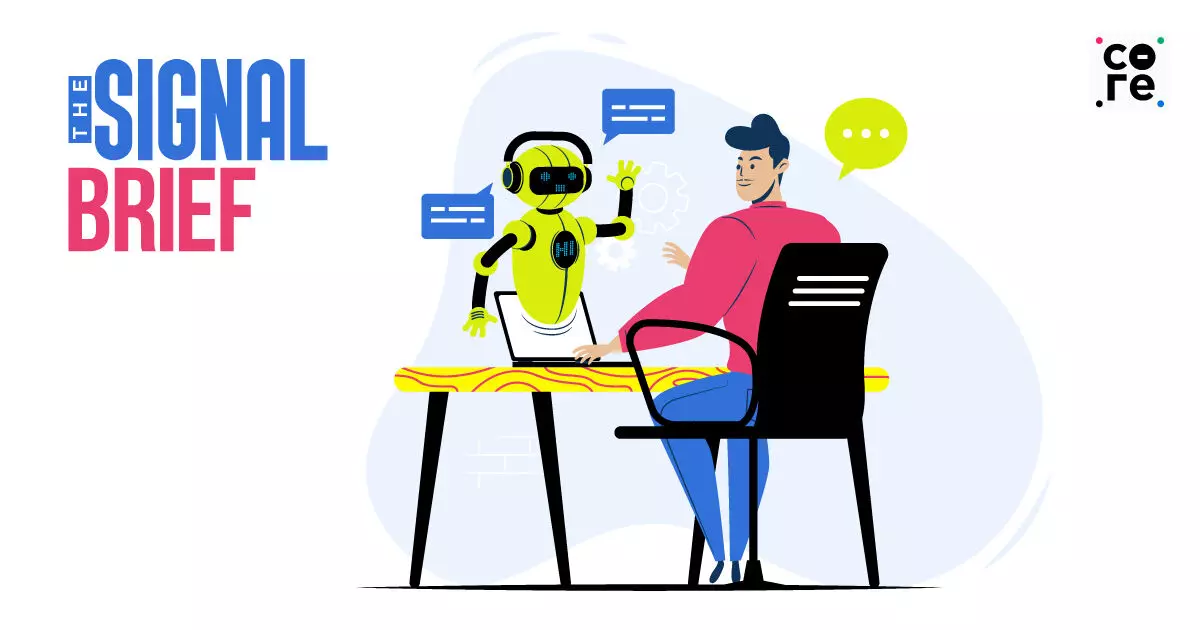
Meet Your New Recruiter: AI
- Podcasts
- Published on 10 July 2026 7:30 AM IST

If both recruiters and candidates are using AI, how has that changed hiring?
A, a 25-year-old job seeker told me that she has an elaborate AI system to apply to jobs.
One AI agent finds openings. The other rewrites her resume. And a third writes her cover letters.
Now, candidates like A are not the only ones using AI.
Recruiters are using it too. To go through applications, to rank candidates as well as to conduct interviews using AI avatars.
So, if both recruiters and candidates are using AI, how has that changed hiring?
To hear from recruiters and candidates on this, tune in to the latest episode of The Signal Brief.
The Core produces The Signal Brief. Follow us wherever you get your favourite podcasts.
NOTE: A machine transcribed this episode. A human has looked at this text but there might still be errors. Please refer to the audio above, if you need to clarify something. If you want to give us feedback, please write to us at feedback@thecore.in.
TRANSCRIPT:
Kudrat (Host): A is 25. She recently moved back to India after studying, and later working, in the UK.
The first time she started applying for internships, back in 2021, AI wasn't really a part of the process.
Every application meant starting from scratch.
A: So it was a very rigorous and time-taking process while you're also studying and while you have so many assignments and deadlines to do. So you're doing... I was managing both where my first half of the day is just going, studying, studying, studying, and then I have to also apply for jobs where I'm applying for like 10 jobs a day, where I have to research about the company, then I have to tailor my CV according to the job, then I have to write a cover letter, which is like a whole A4 sheet, about the company and all these different things. So it was very time-consuming while you're also studying, so it's a lot of pressure.
Kudrat (Host): Fast forward a few years. By the time A entered the job market in 2024, things had begun shifting.
Job seekers were using AI to write cover letters and polish résumés.
And companies were using it too, to scan thousands of applications.
Today, A has taken it a step further.
A: Now you have Claude and you have ChatGPT. You can get more advanced models. Prompting has become easier. You can create AI agentic LLMs. You can have your own agent. You can train it from the beginning. So I would rather spend time learning all these extra things, training a model to exactly do what I need and what the job market requires, and then just having it take out 100 to 200 cover letters and CVs for me whenever I need. Because then it's just apply, apply, apply, apply button, and you're sending it in.
Kudrat (Host): A isn’t unusual.
Recent studies show that about two-thirds of job candidates globally are using AI for applications.
Recruiters are adopting it just as quickly. They’re now using AI for everything from sourcing candidates and screening résumés to scheduling and even conducting interviews using eerie humanoid AI voices.
CLIP: Can You Still Get Hired In The Age Of AI?
So, if candidates are using AI...and recruiters are using AI...how has hiring actually changed?
My name is Kudrat Wadhwa and you’re listening to The Signal Brief. We don’t do hot takes. Instead, we bring you deep dives into the how and why of consumer trends.
In today’s episode, we look at how AI has changed recruitment in India.
Kudrat (Host): Let's start with candidates.
The appeal is pretty obvious.
It would take you hours to research a company, to tweak your resume and write a fresh cover letter for each application. But AI can do most of that in seconds.
Which means you can apply for a lot more jobs.
From the perspective of recruiters, AI has been a massive help too.
Especially at large companies, a single vacancy can attract hundreds, sometimes thousands, of applications.
Reading every single resumé is just not realistic.
I spoke to Neeti Sharma, CEO of TeamLease Digital, a recruitment and staffing firm, on how AI has changed the game for recruiters.
Neeti: Traditionally, when there were hundreds and thousands of people applying for jobs, the recruiters would have to scan through the profiles, through the resumes, and then look at what is a probable match and who is not a probable match. Obviously, that would take many man-hours.
Let's say, for example, for a position... let me take a case in point, say a position with five years of experience for a full-stack developer. One position would get about 1,000-odd profiles, and for the recruiter to skim through all of that and then figure out which one would probably go to the next phase would take at least a week or so, right?
Kudrat (Host): Before AI, recruiters used Applicant Tracking Systems, or ATS, for years. Those mostly searched for keywords.
AI goes much further. It understands context around those keywords too. It can screen candidates, rank them and help recruiters decide who to speak to first.
Here’s Harjoth Sudan, who works in Talent Acquisition, talking about this.
Harjoth: Right now, with the help of AI, it has given that customization, that personalized conversations which you can do with a candidate, and you can automate that. So that is there. And then some AI ATS brings AI screening also. So they tell you, they rank the candidates, which candidate you should be connecting with first, which candidate you should be connecting with in the second place, so that you can connect with the top talent in your funnel or in your pool.
Kudrat (Host): Here’s Neeti again.
Neeti: But with AI, with the kind of questions that you can put in, the kind of workflows and prompts that you can put in, the same thousand profiles can be passed, can be skimmed, can be shortlisted in less than about an hour's time. So that's the productivity and the efficiency upside.
Also, the percentile match that AI platforms can give is very close to near-human perfection, at least by reading a resume against the job description that companies put in.
Kudrat (Host): Companies, of course, love this efficiency.
But there’s costs too. The shift has made hiring even more faceless.
Candidates like A often have no idea why they were rejected or whether a human ever even saw their application.
And because these systems run at massive scale, small flaws or biases in the algorithm can shut out thousands of people without anyone noticing.
Neeti: I'll give you a classic example. We were hiring for a certain profile, and incidentally, three people who got hired for that profile were from IIT Chennai. So after that, the AI model or the dataset thought, "Oh, this is the best profile, so any other IIT, just reject."
And this is a real case, right?
Then we were wondering, why are we only getting shortlists from IIT Chennai, and what's so ideal there and what's not ideal in other IITs? Then you realize it was basically AI deciding, saying this is the right thing to do.
So the need for us, as organizations, as users of AI, is to keep training it with multiple datasets. If you train it, and obviously it's so intuitive and it's so good that it starts training itself. So the teams, a large part of the team's job is to keep also looking at those nuances, right?
And seeing that, okay, where is it? If there's a certain trend that we are seeing, and for us, we kind of monitor this almost on a weekly basis, because if you drop the ball on governance, hallucination is real. It's not like it's just language people are talking about. AI hallucination is definitely real, and the bias also kicks in.
Kudrat (Host): Proponents of AI say that it actually removes human bias. Things like recruiters liking candidates who come from their region or who went to their B-school.
But critics say human bias is easier to understand.
Because AI companies don’t have to reveal their algorithms, even recruiting firms deploying these tools aren’t always aware of why the algorithm makes the decisions that it does.
And then, there’s the volume issue. Because candidates can now also apply so easily with AI, companies are seeing many more applications flooding in.
And, recruiters say they’re skeptical of résumés that sound too perfect.
Neeti: The profiles or the resumes are also created using AI. So whether we like it or not, a large part of it is a 100% match. Right?
And that's where the challenges kick in, because while there is a 100% match on paper, it's definitely not 100% fitment in real life.
But most recruiters would prefer that as against 100% fitment, because the moment you throw in a prompt saying, "This is my job description, this is what my skill sets are, create the best profile or the best resume," I think it's seen now. Okay? And we've all realized in the last one year, too much of a JD and an AI resume match is not the right thing. Because when we start hiring the candidate and we get them to work, we realize that actually we've not done a good job in hiring.
Kudrat (Host): But, candidates, Neeti says, are a step ahead.
Neeti: Absolutely. I think there is a lot of innovation happening, both for the good and the bad.
Like I called out, candidates initially just threw the JDs, write a prompt saying, "My skill set is the best fit." They also now are aware that the best fit is not getting shortlisted, so they try and create some errors. They kind of put a prompt saying, "Create some errors."
So I guess as technology evolves, all of us learn to use it or misuse it in whatever shape and form. We've burnt our hands early on where we realized that anyone who was showing the best fit, even after an AI recruiter assessment, was not the right person to do the job.
Kudrat (Host): Now, Neeti told me, another shift is underway.
Companies are bringing humans back.
They use AI for about 80% of the process to shortlist people. But then, they rely on humans, and conduct things like in-person technical interviews in the last 20% of the process.
Neeti: On the tech and the domain skill sets, very clearly, like I called out, we give them cases which are on our cloud, and we ask them to resolve it thereon. There's very little time for them to flip screens, to ask ChatGPT or ask GitHub, saying, "Give me these codes."
Because a software engineer who can write lines of code will become a very good software reviewer, and that's what companies are looking for.
But if somebody doesn't understand how to write code, that is a wrong fitment, right? So on the domain side, use our cloud, use real cases, ask questions which are very, very technical in nature, which is immediate, and that our human recruiters will also do. And then you can gauge basis body language, face, expressions, and all those things.
But what AI cannot do, and which is where we reiterate a lot of in-person, is really the cultural fitment.
What is an individual's career aspirations? How does one negotiate? Because today employers are not looking for just, let's say, in the software industry, not just a technical person. They're looking for somebody who builds teams, who is focusing on outcomes, who also will eventually understand business over a period of time. What are their ethics?
Do their career goals match the organization's career goals?
So I think those are things that AI cannot do, and you do still need human intervention there.
Kudrat (Host): Neeti’s advice to candidates is this.
Neeti: Don't use it for the sake of using it and showing that I'm using AI, because I don't think that's going to work in the long run at all. I think it's all fancy, but don't use AI because there's FOMO. That's very clear.
But use it effectively, learn to use the right prompts, learn to make good decisions, read about it and analyze, from a candidate point of view, analyze the organization, the industry, get as much information as you want.
Kudrat (Host): It’s sensible advice.
Know how to use AI tools. But don’t use them blindly.
A knows this too. Despite her elaborate framework consisting of AI agents, she says she’s actually pretty cautious about using it.
A: Because every time that even I'm using AI, I do feel this guilt inside me where I feel like I spent so many years studying so hard, trying to do well. I built myself up to only now automate everything and make it easier, and I really feel like it affects my brain, my thinking capacity.
Kudrat (Host): She said that on the occasions that she doesn't use AI, and spends hours writing an application herself putting her career aspirations and dreams on paper, it can feel pointless.
After all, there's a good chance it's an AI system reading it anyway.
A: And from a recruiter point of view as well, for some jobs where I'm really very passionate, and a cover letter where you're really talking about your dreams and aspirations for the job and how you can change it, and when I genuinely have ideas for a brand or for a company, I don't use AI because it can't take those aspirations, your dreams, out on paper.
And when I'm spending the time writing it and it doesn't get a response, it feels really bad because, again, that passion is not seen because from the other side there's a bot reading it, and bots don't understand emotions yet. So it's sad, but there's so many people and there's so much competition. If you don't use it in today's date, you are going to be left behind. So you're just stuck. It's a catch-22.
Kudrat (Host): A catch-22.
That’s how A described job hunting today. And after speaking to recruiters and candidates, it’s hard to disagree.
Outro: That's all for today. You just heard The Signal Brief. We don't do hot takes. Instead, we bring you deep dives into the how and why of consumer trends. The Core produces The Signal Brief. Follow us wherever you get your favourite podcasts.
To check out the rest of our work, go to www.thecore.in.
If you have feedback, we'd love to hear from you. Write to us at feedback@thecore.in or you can write to me personally at kudrat@thecore.in.
Thank you for listening.


