



 Newsletter
 Search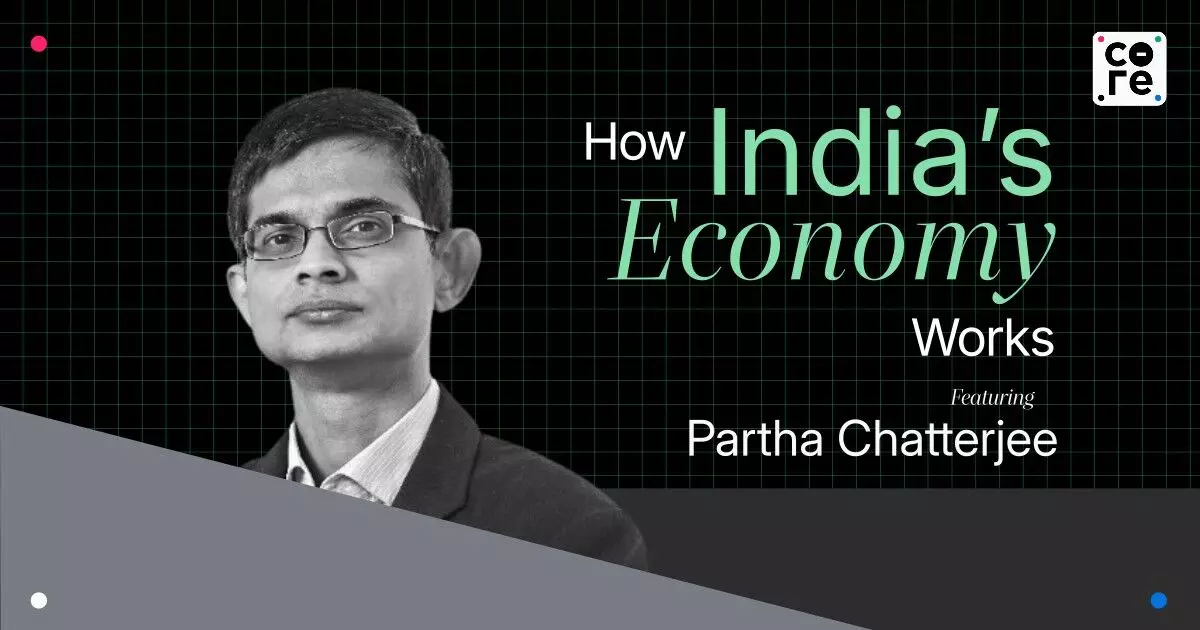
Why India's GDP Growth Isn't Resulting in Prosperity
- Podcasts
- Published on 5 Aug 2026 5:00 PM IST

Tune in for insights on why sustained economic growth alone cannot deliver widespread prosperity
India has been one of the world's fastest-growing major economies for years. Yet for millions of Indians, rising GDP has not translated into rising household prosperity, better jobs, or greater economic security.
In this episode of How India's Economy Works, Puja Mehra speaks with economist Professor Partha Chatterjee, Dean of Academics and Professor of Economics at Shiv Nadar University, about the structural reasons behind this disconnect. They explore why India's "missing middle"—the absence of enough productive, mid-sized firms and middle-income jobs—has become one of the country's biggest economic challenges. The conversation examines why firms struggle to scale, how policy incentives often encourage businesses to stay small, and why investment in education, health, finance, land, and judicial reforms is just as important as building physical infrastructure.
The discussion also covers innovation, productivity, labour market opportunities for women, industrial policy, self-reliance, global supply chains, and why creating an ecosystem where firms can grow may be far more important than simply backing a handful of national champions.
Tune in for insights on why sustained economic growth alone cannot deliver widespread prosperity—and what India must do to ensure that growth creates better jobs, stronger businesses, and rising living standards for millions.
—
TRANSCRIPT
NOTE: This transcript is done by a machine. Human eyes have gone through the script but there might still be errors in some of the text, so please refer to the audio in case you need to clarify any part. If you want to get in touch regarding any feedback, you can drop us a message on feedback@thecore.in.
Puja Mehra: Professor Partha Chatterjee, thank you so much for coming to the show.
Partha Chatterjee: Thank you, Puja, for having me. It's a pleasure always.
Puja Mehra: We're recording this episode against the backdrop of a very, very large number of students protesting in Delhi. The specific reason is, of course, leaks in exam papers. But as you and I were before we started recording, I think it reflects a whole lot of anxiety about their economic future.
And that anxiety sort of ties in with what we plan to speak about in today's episode, which is that the Indian economy has been growing pretty well for a fairly long time now. But we've not been very successful in getting towards household prosperity. So a lot of people have been looking at different parts of this question in a piecemeal way.
But you have a very broad and a very wholesome view of this issue. So I wanted you to help our listeners understand why is it that although the Indian economy grows fast, there isn't that much household prosperity?
Partha Chatterjee: Right. So I think, I mean, not only the youth, but all of us in this country are very anxious about our economic future. For listeners to get the context, of course, that we have to understand, we have about two decades after which we lose the demographic advantage that we have now.
So it's a short period within which we have to achieve certain goals and milestones. And not only in terms of growth in an aggregate sense, but in the sense of well-being of people. So that's the big question, that can we do that?
And one of the critical issues in this process has been that what I can call missing middle, right? That there has been growth in the country, both at the firm side of things, as well as in the job side of the things. But if you see what's happening is that we do not have enough number of firms which are middle-sized, or opportunities which allow people to have income mobility be very strongly in the middle-income group.
And that's part of the anxiety, that sure, country has been growing at a reasonably good rate, even if not at 8% or so, which we would want. But has that growth been translated into well-being of people? Whether there is the opportunity to move up the ladder in terms of income mobility, in terms of social mobility, in terms of other opportunities, and become very strongly launched within this group, which can then have a decent life.
Puja Mehra: So what is the process through which this tends to happen, and why is it not happening? The transformation of growth into household prosperity, why is it not happening in India's case?
Partha Chatterjee: So I think let's start with, because you brought up the anxiety that's there, and obviously the part of the anxiety that comes from is the labour market, because particularly the young who are in school and colleges, they are looking to start their career. So what they are looking at is, are there enough number of jobs being created, but also the quality of the jobs. So that's something that, let's talk about that.
But in that, the first point is that labour market is in some sense the reflection of the whole economy. The labour market is not necessarily the cause of it. It's what we see as an effect of all the rest of the things that's happening.
And in that mirror, we can do certain cosmetic changes, we can polish the mirror, but that won't change the basic facts as such. So to understand why this is not happening, I think we need to look at both the labour markets, but also the firm side of the things, and in between the scaffolding that's needed to transmit that. So on the firm side, what happens is that firms generate jobs, and firms generate jobs when they become productive, and firms generate better jobs when they become more productive, and the wage rates increase, and there is a mobility, both working within the firm as well as if you're moving across firms and things like that.
So that's something that's not happening in India. We don't see a lot of firms which are in the middle. There are some which are large and producing formal jobs, but there are a whole bunch of firms which are very small.
And here I think we kind of romanticise small a little bit and sometimes confuse between small and young, because young firms are needed, new entrepreneurs, because that brings in a lot of energy, ideas, and things like that. But they have to grow. So if you look at the US economy, for example, in a few years, a firm which is starting, they grow seven-fourths, whereas in India, the average firm hardly grows twice its size.
So that's not happening. So I think that's the thing, because if that's not happening, then that means that layer of jobs which would allow people to generate more income by scaling themselves, by growing into these roles that these kinds of firms would generate, that's not happening. That's one of the critical challenges.
And that also brings us to this scaffolding of a layer that could allow things to happen. One is, of course, the policy. And we can have another podcast on why firm sizes stay small in terms of policy prescriptions and things like that.
But one critical policy aspect is that we always think about policies as cliffs, that after certain things, there's a cutoff. After 10, you can't do this, or you will be subject to this, and so on and so forth, rather than creating slopes. How do you create different kinds of slopes as you gradually increase what changes for you?
So what that means is that in India now, it might be easier to do business when you're very small. It might be easier to get finance when you're very small. And on the other end, of course, if you're very big, then you have the power, market power, status, brand name.
So it's also easier to access funds, generate resources, and things like that. But for the middle, it's very difficult. Firms, therefore, often choose to stay small.
That's the challenge, right? The second thing is what we need is not only policies to help firms, but also a whole set of other things that allows individuals to tap into all of these things. So investment in education is absolutely critical, right?
And then that's one of the things that these recent protests are also talking about, which is very important for this group of people. Because without the investment in education, again, what kind of jobs can they get into? So both from the supply side, because we are not generating enough, but also from supply of job site and as well as demand of job site, because if you're not getting enough education or enough skills, then you're not going to tap into high paying jobs.
And what we have seen in case of India, we have been looking at firm entries and exits and things like that. And the standard economic theory would say that firms which are very low in productivity should exit and very high productive firms should come in. And as a result, the productivity goes up, the high paying jobs increase, and so on and so forth.
But in India, that doesn't really happen. The exits happen all across. And therefore, its exit is not happening because of productivity and things like that.
So there's a lot of, not a lot, but there's market churn, but there's no selection. That is a big challenge. So with education, what happens is that firms are able to produce kind of innovation that's missing in the economy.
So right now, if you look at what's happening in the economy, we see a lot of imitation. Imitation is kind of, the ladder is already there. You are going up the ladder a little bit.
But to create a new rung in the ladder, we need innovation. And that's not happening. If we invest in education, if we create the right incentives for firms to innovate, then that's something that will happen.
And that can allow far higher mobility, both in terms of the economic growth, as well as individual aspirations and things like that. So those are some of the things why we are not seeing the prosperity to percolate to a broader set of things. And the third is also the misallocation that a lot of people have already talked about, but misallocation in all kinds of margins, both in capital, but also human capital, and also that we talked about.
So there has been a lot of issues. And the flip side of that is that when you don't see these happening, then demand for education will also fall. Because if you see that, okay, after college graduation, I get into a delivery, food delivery or a logistics supply company job, the kind of skills that allows me to get into, I might as well join after high school, why do I want to spend time getting into a college or degree?
So in fact, this is the first year we have seen somewhat drop in college enrolment across the country. So that's also something that's kind of preventing the prosperity to spread across a larger mass of people. So we really need policy, we need the scaffolding of social investment in education, health.
Again, I did not talk about that, but health is also very important because health risks are very real. One hospitalisation really wipes out whatever savings at the margin people had, and that brings them back to a very difficult situation. So investment in all of that allows people to move up gradually and build on whatever they have rather than being stagnant and moving laterally at that level.
So again, the third thing that I talked about is kind of a misallocation, that where are the resources going? Are they going into the things that will actually allow us to? So again, we can also talk about whether or not we need certain kinds of subsidies versus investment in education and things like that.
So those kinds of misallocations are also there. So all of that means that the bunch of different things, which is keeping people and keeping firms at the two ends of the distribution, either very small or very poor versus very big or very rich, and the middle is thin in that sense.
Puja Mehra: How is it that firms that are not very productive and not very innovative, they manage to stay in business? By remaining small, yes, but how is it that they manage to stay in business?
Partha Chatterjee: So, I mean, one of the things is, of course, that the kind of competition that would allow these kind of firms to be weaned out of the economy is probably not there in certain sectors and certain things. And this could be because of policy, but this could be because of other inherent lobbying and things like that, that still exist in the economy. The 1991 reforms really opened up the economy.
It allowed entry and we did see that, but it's very hard to expect of one set of reforms is that it allowed entry, but it did not allow a lot of movement in terms of increasing productivity, higher competition in across the sectors and things like that. So a firm which is already there has a lobbying power, a firm which is not there, which hasn't entered, does not have a lobbying power. So those kind of asymmetries is essentially allowing some of these firms and again, the kind of subsidies that we have maybe in certain sectors like fertiliser production or some things like that, where it does not necessarily favour a lot of productivity increase and a lot of competition from outside.
Those are some of reasons why these firms, and again, as I said, the other thing that is happening a lot is that we see a lot of imitation. So once certain things are there, we see a bunch of other firms which are coming in with that kind of technology or that kind of know-how. So the know-how is spreading, but it's the same know-how, no new know-how is happening.
So that's why these firms are continuing to exist. It's not that they're feeling a lot of pressure from very new incumbents, which are very productive.
Puja Mehra: Partly it must be also because of tariff protection, so they don't have to compete with imports.
Partha Chatterjee: Correct. I mean, India, again in 1991, that's one of the greatest things that happened was India opened up a lot to the rest of the world too, right? And the competition increased because earlier that was one of the things when the lot been written about and talked about, so I'm not getting into that.
Over the last few years, we have seen these protections creep in again a lot more. So instead of moving towards more higher competition, both internally as well as opening up to the rest of the world so that our firms become competitive, we have not been able to do that, right? And it's probably instructive to look at a little bit about how the growth processes happened in the rest of Asia and things like that, right?
And in that, initially firms have been protected internally, there's no questions about that, both in Korea and China and so on and so forth, but they were always exposed to the rest of the world and they had to compete in the rest of the world. And that's been the thing that you first imitated, like in India we are doing, but you create that capability so that you can produce for the world. And in producing for the world, you are competing with the rest of the world.
And in India, that's sorely missing, right? I don't think we have any brand or any firm as such, which are leaders across the globe, which are pushing the boundary across the globe, like the current set of firms are doing in China or in EV, for example, or clean energy and things like that, or semiconductors and things like that in Taiwan and Korea, right? So, that's something that we definitely are missing and some of these tariff protections, some of these non-tariff barriers and protections for firms within the country, they are definitely keeping our firms in that range, in that zone.
Puja Mehra: And you're saying this is primarily a political economy problem, because there is tremendous lobbying power and interest groups who sort of hold on to their market share by lobbying with government for keeping competition levels low.
Partha Chatterjee: Political economy is the overarching thing, but also as I said, misallocation and things like that are definitely there, but what is the root cause of it? Some of it is definitely the political economy. And again, I mean, you have to understand that it's not only one way thing.
It's because we have these bimodal things that there are very big firms and who have a lot of lobbying powers and who have also market power, whereas we don't have that middle. That's also a reason why there is no push to change things a lot, right? So, the political economy works in both ways in that because there are these kind of intense interests which are there, but these intense interests are not changing also because of the structure that's already there, right?
So, I think both ways it kind of points to the same thing.
Puja Mehra: I think there have been recent attempts perhaps to address this structure. We've seen, for instance, a lot of investments in physical infrastructure, roads, etc. We've seen a lot of efforts for more and more credit to become available, especially to small firms, small businesses, but that's not enough, you're saying.
There is more for better allocation of resources that's required. Land, for instance, I would imagine is something that must be a huge constraint which only large firms manage to get access to and small firms don't have that kind of ability to access land.
Partha Chatterjee: Correct. So, physical infrastructure is also needed. I mean, there is no denying that, right?
If a firmer is producing something, she or he has to get it to the market. So, we need roads, we need business people to move between cities. So, all of that is absolutely needed and investment in that is also needed, but that's also the very visible part, right?
And therefore, it gets a lot of attraction and probably more investment than the rest of the things. So, it's not enough that we build roads. If somebody wants to find a job, they also need that kind of an education and a skill, right?
Without which, just having the road that connects their village to the city is not enough. They will come and get that low-paying job which does not allow any other further movement in their lives. So, we do need other kinds of investments where we complement these physical infrastructure with this and not only on individuals, but also on other things.
For example, financial system where, again, access to credit. What we see is access to credit is somewhat easier when you're very small and very big, but what about the middle? Where do they get their credit from, right?
Judicial system. If that's not working, then it's very difficult to see why people would take the risk and invest because anything that causes conflict and we in an imperfect world, conflict is a natural thing to have, would result in huge losses without capping the downside, right? Land, again, if you're a really big firm, state governments are opening your doors and laying out the red carpet for you, but what about these middle firms or even the smaller firms for that matter, right?
But the smaller firms probably don't need that much land, but if you want to build a workshop of 100 people, you do need some amount of land. So, where is that available? So, all these constraints mean that just investing in the physical infrastructure isn't enough.
We need to build all of this and I don't think there's one single solution to this. We need to look at a bunch of different things to get it all right.
Puja Mehra: And innovation is high risk, high reward and if firms are not confident that they'll be able to grow to mid-size for these various factors that you've described, they're less likely to invest in innovation. It is investment intensive.
Partha Chatterjee: Correct, absolutely and also risky, right? So, the rewards have to be commensurately high when it happens. Think about individuals investing, if they want to invest in a stock market versus a fixed deposit, the returns that they expect has to be high, may actually end up being lower, which is the whole point of risk, but the potential rewards have to be higher, right?
So, similarly in innovation, that has to be true and that cannot be true if we don't have a legal system which backs them up, way to market the innovations, the way to monetise those, find people to scale, right? I mean, maybe you can find a solution, but if you don't have enough number of skilled people to scale, then it's pointless, right? So, all of that means that it's risky, but probably the resources that's needed and the expected return that they're getting is not enough in terms of innovation.
And also, let's translate that in terms of a worker side of it, right? So, if you build a workshop, a carpentry workshop or something like that of 10 people, and you do exactly the same thing again for 40 years, 50 years, then the firm is not moving, but also the workers are not moving. They get the same, their salaries might be increasing incrementally over the years, but there is no real path to a different life that they could have achieved, whereas a firm that is innovating, they're investing in new technologies, they're also investing in upskilling their workers, they're learning new skills, they're getting into a very different job profile, you know, all of that is happening. So, once firms are innovative, once firms are increasing in size, that really helps these workers, and that's exactly what's not happening right now in the economy.
Puja Mehra: And not only are firms not increasing in size, not scaling, they're also remaining not very productive.
Partha Chatterjee: Not very, the productivity is in India, of course, at an aggregate level, it's lower, lower than most developing countries also. And even if you look at, I'm not saying that there are no productive firms, of course, there are some which are very productive, but if you look at an average firm, it's not increasing productivity very much, it's still lower productivity than most other countries.
Puja Mehra: And I know there can't possibly be any silver bullets to address the situation so that growth process becomes also a prosperity supporting process, but still, is there anything you think that must be looked at and must be done to address this, you know, so that we can have a strategy, a growth strategy, which not only produces economic growth, but also produces household prosperity?
Partha Chatterjee: You know, that's what we've been talking about throughout this, that there's not one single thing, but there are a bunch of different things that we need to do. We need to figure out how to get that middle, both in terms of individual or job side, as well as in the firm side, because as I think we have been trying to establish is that those are very connected things. So how do you go about doing that?
And we talked about a few already, that one is this kind of a policy, which is basically cliffs, rather than having cliffs, you kind of build slopes. And you look at how do you incentivise firms to grow rather than incentivise to keep small, being small always, right? So what does it take?
That's one of the set of policies that we can think of. The second set of policies or second set of investment that we can think of is what complements the physical infrastructure, which is essentially, you know, the education, health and other social infrastructure, you know, and we haven't really talked about women per se, how do we enable women, right? Because in India, the labour force participation of women is very low.
And that's something that we have to worry about that, given that we have a large base, but if 50% of the population is out of labour force, that means we're losing out on the potential workforce for that, right? And of course, those people who are out of labour force, they also lose out on the opportunity to improve their lives through productive work. So that's also something that we need to look at that, how can we enable women to get into labour force?
And here, I did not talk about that. But what we find is a large part of the story is not only about the social structure and household structure that a lot of people have talked about, but exactly the thing that we talked about that the labour market is too risky for them. The number of jobs that's being generated for women are very low, and the possibility of losing a job for a woman is very high.
And it changes also with whether they're married or not, whether they have children or not, and so on and so forth. In fact, when we looked at just the married couples, the probability of getting a job for husbands is many folds than that of the wife, right? So what will change that, that's also something that we need to look at.
Other reforms that we talked about is, for example, judicial reforms and things like that, land reforms, where judicial reforms is absolutely critical, because if there is no sense that you will be able to mitigate conflict and risks related to that in a reasonable cost and time, then you'd probably not even try to get into business, right? So we're losing out a lot of on investment and business opportunities because of that. And that's also true, for example, for investments that we could attract from outside the country, right?
I mean, why would someone take such enormous risk without the commensurate gains? Also the land reforms, because for anything that we do, we need land. And particularly, again, as we have been talking about growing, right?
It's not only just building a five-people firm or, you know, 10-people firm, it's about growing to 100 or maybe 700. So how do we do that? We need the land and financing, again, for the middle firm, where do they get their financing to expand rather than just stay small and access subsidised credits and things like that, right?
So those are a few of the things that, you know, we need to look at.
Puja Mehra: We also hear that the economic policy approach is of building self-reliance. There are geopolitical reasons that are given for it and all kinds of other reasons that are given for it. So if the focus is on building national champions, then does that leave enough scope for doing the kind of thing that we are discussing?
If you're going to strengthen competition, market competition in the economy, will that run against the other goal that has been set of having national champions, of having self-reliance and industrial policy?
Partha Chatterjee: Not really. I mean, first of all, we need to examine this idea of national champion, right? While today there has been some setbacks for globalisation and things like that, but we still live in a world which is probably more global than ever before.
And more importantly, a supply chain that is very fragmented in spite of all the talks that we have had. Now to create a firm which is entirely dependent only in a country is very, very difficult at this point of time. So there will be reliance on others.
So the idea should not be that you build a firm which does from, you know, Activity 1 to Activity 10, everything, but becomes so good in Activity 6 or Activity whatever, that you are world leader in that. And therefore, you become critical part of this global economy. And that's the kind of security we need, right?
And that gives us more power than trying to say that, okay, we build something that is entirely only for the country and contained in the country. We build something which is needed by the world, where we are the leaders for the world, where we are the critical part of that whole chain in the whole world. If we can become that, that I think will give us far more security and bargaining power than building firms which are just contained within the country.
Puja Mehra: And if we are going to concentrate to take your example on, say, the chain link level six in the global supply chain, that doesn't necessarily mean that we have large firms occupy that space. It's all right if small, very highly productive firms, which are growing in size over time, also get to do that. Our policy seems to focus on larger firms.
Partha Chatterjee: Yeah, it's not necessarily very large firms, but it has to be something that is scalable, because you're going to produce for the world, right? Now, the whole idea of if you are going to focus on not even industrial policy has made a revival, but at the same time, we know the risks of industrial policy. We have seen in India very closely that it can actually be very counterproductive.
So you might actually end up choosing the wrong ones, right? So it's more than that. It's allowing the market, allowing the incentives of the individuals to build something, right?
That will work. But we need to create that ecosystem where they first can start imagining, start building, but then also scaling, right? So they have to be able to scale.
It's not necessarily that we champion an existing huge firm who have some resources, but we create an ecosystem where this scaling is possible, entering as well as scaling is possible.
Puja Mehra: So I think what you're saying is very important. What you're saying is that even the whole concept of self-reliance that we are chasing will work only if we do what you're saying, which is build an ecosystem that allows small firms to scale up and become productive and innovative. And that's when, if you want to experiment with industrial policy, once again, that is a better chance at Berkeley.
Partha Chatterjee: Yes, indeed. I mean, we can't keep relying on, and particularly for an economy of size like India, right? We can't rely on two or three firms that will not work.
And that is highly risky. And also, again, if we translate from the firms to the jobs to individuals, that will generate the kind of inequality that we have been noticing, right? And that missing middle layer will be even more prominent, right?
So we have to create an ecosystem rather than trying to focus on individual firms building the national champions.
Puja Mehra: I hope this conceptual clarity that you brought to this discourse will find resonance in the policy side. Thank you. Thank you so much, Professor Chatterjee, for this conversation.
Partha Chatterjee: I hope so too. And thanks, Puja. Thanks for having me. It was a pleasure talking to you.


