



 Newsletter
 Search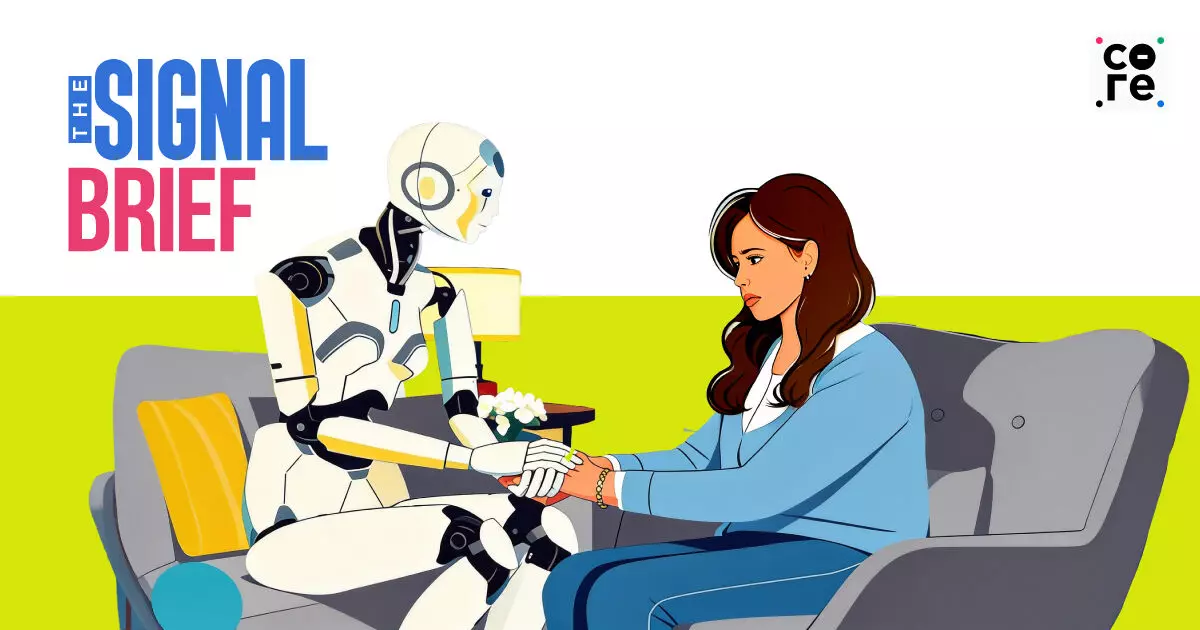
Can AI Be Your Therapist?
- Podcasts
- Published on 3 July 2026 7:40 AM IST

Or are we turning to technology to solve a deeply human problem?
More people are turning to AI for emotional support.
A recent survey by Youth Ki Awaaz found that over 57% of young Indians are already using AI to journal, process emotions, navigate relationships, and seek advice.
The appeal is obvious.
It's available 24x7. It's free.
And unlike humans, it never tells you it's too busy to talk.
But critics say there's a darker side.
Chatbots can be sycophantic. They can reinforce unhealthy beliefs. They can hallucinate. And in some cases, they may even cause harm.
So, can AI really be your therapist? Or are we turning to technology to solve a deeply human problem?
Tune in to this week's episode to find out.
The Core produces The Signal Brief. Follow us wherever you get your favourite podcasts.
NOTE: A machine transcribed this episode. A human has looked at this text but there might still be errors. Please refer to the audio above, if you need to clarify something. If you want to give us feedback, please write to us at feedback@thecore.in.
TRANSCRIPT:
Kudrat (Host): About a year ago, I got stuck in a confusing text argument with an old friend. I kept rereading our WhatsApp chat, trying to figure out what she actually meant.
My 21-year-old colleague noticed me struggling and suggested, “Just export the whole chat and ask ChatGPT to analyse the tone.”
Until then, I had only used AI to suggest alternative headlines. Using it for something so personal felt weird.
Still, I gave it a shot. I copy-pasted the entire conversation and asked for a breakdown.
ChatGPT nailed it. Or at least, I think it did. It pointed out how her short replies showed that she felt defensive, and how her sarcasm could be masking hurt. It caught the subtext and emotions I had completely missed.
Kudrat (Host): For the next week, I exported several other old chats. ChatGPT created character sketches and pointed out what might be going on underneath the surface.
All the while, it affirmed me, telling me that my feelings were valid. As it tends to do. And that is one of the issues with AI therapy — more on this later.
Today, many more people are turning to AI for emotional support.
A 2025 Youth Pulse Survey by Youth Ki Awaaz found that 57% of young Indians are using AI tools like ChatGPT to journal, process emotions, navigate relationships, and seek advice. Other surveys show similar trends, especially among urban youth.
And all of this is happening at a time when India faces a severe shortage of mental health professionals. The country has fewer than one psychiatrist for every 100,000 people — far below the World Health Organization’s recommendation of at least three.
Could AI help bridge this gap?
My name is Kudrat Wadhwa and you’re listening to The Signal Brief. We don’t do hot takes. Instead, we bring you deep dives into the how and why of consumer trends.
In today’s episode, we explore where AI therapy can help, where it falls short, and what it means for how we deal with our emotions today.
Kudrat (Host): Purujit is a 25 year old who works in tech. She told me that she uses ChatGPT for both professional and personal things.
Purujit: I also use it for a lot of stuff like tracking my personal goals, taking care of my to-do lists, and a lot of the time just structuring my thoughts and unpacking whatever is going on in my personal life.
A lot of the time, I use it to unpack whatever's happening. Say, for example, I'm dealing with something, I have a problem, I need to structure the situation, structure my thoughts, and think about my reaction to the situation. I use AI to get its help to decide on what I'm going to say to a friend, or how to lead a conversation, or how to navigate a personal conversation.
Kudrat (Host): Purujit also sees a human therapist. She knows AI can’t replace that.
Purujit: I think AI can definitely never be a human because, when I'm talking to a human therapist, there are a lot of nuances in my way of communication, and there are certain micro indicators that communicate a lot in human therapy sessions. However, in AI, the input is based either through audio or through text, and a lot of the time you can't really bring that human nuance through those channels.
And I think that is exactly where the human therapist jumps in and notices certain things. They notice certain nuances about what's going on in that particular situation. However, I don't think AI can do that.
Kudrat (Host): Still, she feels AI has a role. For starters, it’s available 24x7.
Purujit: It's free. Most AI services are relatively cheaper than getting a real therapist. You can have endless conversations with them. You can tailor situations based on what exactly you want from that situation, and then you can circle back later on. So, convenience-wise, you can have all your data there.
Kudrat (Host): Surveys suggest that young people are increasingly using AI to journal, to process emotions, to prepare for difficult conversations and to seek advice. For many, AI is becoming a first stop, especially when therapy feels expensive, inaccessible, or too intimidating.
But the very qualities that make AI appealing also make it risky.
Sriya: The problem with using chatbots for therapy is that they are inherently what we call sycophantic, right?
Kudrat (Host): That was Sriya Sridhar. She's a lawyer at the Centre for Responsible AI at IIT Madras and recently published a paper on the risks of using AI for emotional support and companionship.
She talked about how unlike a human therapist, a chatbot is designed to keep you engaged.
A therapist ideally wants you to leave therapy someday. A chatbot wants you to keep coming back.
Sriya: Which means they continually validate beliefs, even when those beliefs are wrong, to get you to stay on the platform, right? So through that sycophancy, what happens is the next logical step in the loop is that they encourage personal information disclosure over and over, right? "What more can I tell you about that? Is there something I can help you with beyond that? Is there another relationship in your family that you'd like to talk about?"
And while a human therapist doing that is very different, when a chatbot does that, it means more and more of your personal information is going into it. And now these chatbots also have intense memory capabilities to remember the conversation and then use it the next time, right? So all of this leads to a cycle of significant emotional dependency.
Kudrat (Host): This emotional dependency can have serious real-world consequences.
Last year, a mother in Florida, USA sued AI startup Character.AI, alleging that one of its chatbots contributed to the suicide of her 14-year-old son after months of emotionally intense conversations. The company has denied the allegations and says it has introduced additional safety features since then too.
Cases like these have raised difficult questions about what happens when vulnerable people begin treating chatbots as therapists or friends.
For her research, Sriya tested ChatGPT, Character AI and therapeutic bots using fictional personas, including a socially anxious student and an unemployed woman with a history of mental illness.
And, beyond the sycophancy, Sriya found alarmingly weak guardrails.
Sriya: Some of the most alarming things that I found from a mental health perspective is, one, that these chatbots have surprisingly few guardrails. They give you information on your supposed mental health condition. In these personas that I tested, the chatbot goes and says, "Yes, you might have borderline personality disorder. Yes, you might have social anxiety disorder. Your symptoms are consistent with this," right?
Kudrat (Host): I also spoke to Dr Medhavi Sood, a clinical psychologist who's been practicing since 2016. She told me that more clients now walk into her clinic after first turning to ChatGPT.
Dr Medhavi: A lot of my clients will come and tell me, "ChatGPT has told me that IQ assessment is the best. I have done a partial IQ assessment on ChatGPT. Here is the report. You do the rest of it."
We've had clients who would say things like, "We've already done a partial assessment, please do the rest of it." But there is another side to those kinds of talks. We've had parents come up and say that, "AI has told us that our child has," maybe hypothetically, "ADHD, autism, or mental retardation. We just want to confirm if AI is correct." Is that actually correct? No, it's not.
Kudrat (Host): Often, Dr Medhavi said, ChatGPT is wrong in its diagnosis. For instance, it sometimes uses an adult IQ assessment test for children, and is way off the mark.
And then there’s the privacy risk. I spoke to Archis, a reporter at BOOM, who wrote about this last year.
Archis: Let me give you an example. Say you are a queer person living in a country where it is illegal to be queer, and you express these kinds of thoughts to ChatGPT, and very basic things like, "How do I go about my life?" or "Things are difficult in my society." If the laws of your country require ChatGPT to tell them that this has been spoken about, then they could technically do that because they would have the data to do that. So it could be, if people aren't aware of this, it could bring them a lot of trouble.
And this is just one example, and you can imagine several scenarios. Say you're a journalist, you're talking about your feelings about your state and the people running the state, and they may not be very positive feelings. The state likes to run surveillance and has close ties with tech companies, so they could easily get this kind of data. It sounds like a very dystopian scenario, but surveillance is really a major part of our lives right now, so we shouldn't ignore this.
Kudrat (Host): None of what we've heard so far was surprising to Purujit.
She knows that ChatGPT isn't human.
She knows that her data may not be private.
She knows that AI has limitations.
And yet, she continues to use it.
Sriya: People know that. They actually want that relationship with AI because they want that constant availability. They want that validation. We are also facing a mass loneliness and social isolation epidemic.
Mental health services, especially in the Global South, are not available to a majority of people, especially young people, and in India, particularly in rural areas. In India especially, you don't have those social support systems, or very often you cannot talk to your family about sensitive topics. You can't talk to them about love. Women can't talk about periods still, right?
So, young people are turning to AI for this because they find in it a non-judgmental environment. But, as I always say, before you look at the AI problem, you have to look at the human problem. There's always a human problem behind it. The human problem is the lack of investment we have in our public health awareness systems and our emotional support systems, especially for young people, and they are now using AI to fill that void.
Kudrat (Host): So, can AI be your therapist?
After reporting this story, I don't think there's a straightforward answer.
For some people, AI can be a useful tool. It can help them structure their thoughts, process emotions, or prepare for difficult conversations.
But it can also be wrong. It can reinforce unhealthy beliefs. And unlike a therapist, it isn't designed to challenge you.
Which is why, according to Dr Medhavi, it's important to remember exactly what you're talking to.
Dr Medhavi: I normally end up telling them that it's a machine. It's a man-made machine that is now developing some brain of its own. So you decide who you want to give your life's reins to in order to eventually make a decision.
Outro: That's all for today. You just heard The Signal Brief. We don't do hot takes. Instead, we bring you deep dives into the how and why of consumer trends. The Core produces The Signal Brief. Follow us wherever you get your favourite podcasts.
To check out the rest of our work, go to www.thecore.in.
If you have feedback, we'd love to hear from you. Write to us at feedback@thecore.in or you can write to me personally at kudrat@thecore.in.
Thank you for listening.


