



 Newsletter
 Search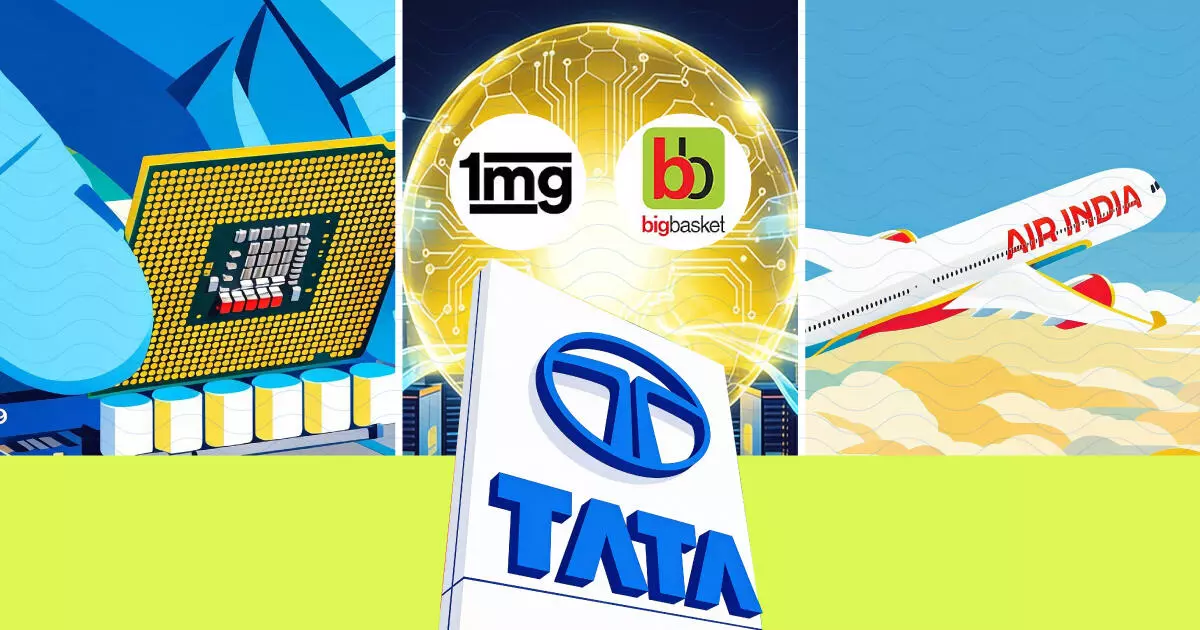
Tata’s Mega Investments Raise Stakes in Boardroom Battle
- The Take
- Published on 21 Sept 2026 12:17 PM IST

As Tata Sons chases national ambitions in semiconductors, a boardroom battle over disclosure and control is intensifying.
The Gist
- New Delhi encourages Tata Sons to invest in critical sectors like semiconductors, leveraging their institutional knowledge.
- However, the massive financial stakes and unclear commercial outcomes pose risks to shareholders and the group's stability.
- As Tata Sons navigates losses from Air India and other ventures, balancing political interests with commercial viability remains a complex challenge.
In 2024, Tata Electronics announced plans to build a state-of-the-art semiconductor assembly and test facility in Jagiroad, Assam, a Rs 27,000 crore ($3.2 billion) outlay projected to generate 27,000 direct and indirect jobs in the region.
A neat "27 for 27."
In the same year came an even grander gamble: a mega semiconductor fabrication facility in Dholera, Gujarat, in partnership with Taiwan’s Powerchip Semiconductor Manufacturing Corporation, carrying a total price tag of roughly Rs 91,000 crore, or $10 billion.
Complementing these mega-projects, Tata Electronics and its subsidiaries have executed a string of aggressive alliances, acquiring the Indian manufacturing operations of Wistron and Pegatron to anchor its iPhone assembly and consumer electronics supply chains.
And that brings us to the point, so to speak.
Inside The Friction
These high-tech bets sit at the very center of what is shaping up to be a bitter battle for control atop one of India’s oldest conglomerates.
Tata Electronics, alongside the loss-making revival of Air India and the e-commerce venture Tata Digital, has emerged as a primary capital sink for group holding company Tata Sons.
It is also a fully owned subsidiary of Tata Sons.
As is Tata Digital, owner of BigBasket and 1mg which has swallowed Rs 26,000 crore in capital while piling up over Rs 17,000 crore in losses.
The present boardroom clash between Tata Sons Chairman N Chandrasekaran and Noel Tata, who represents the 66% controlling stake held by the historic Tata Trusts, is linked in good part to these massive balance-sheet drains.
As sources tell us, the core grievance is not merely that these investments were made, but that Noel Tata was denied the depth of information he requested, with major strategic moves presented instead as a fait accompli.
Boardroom eyebrows have inevitably been raised over why capital was partly directed to remote Assam over established industrial ecosystems in Gujarat or Karnataka.
There are two distinct trains of thought surrounding the friction in the boardroom.
Critics of "Chandra" within the Noel camp readily acknowledge his hard work and extraordinary track record at Tata Consultancy Services (TCS), where as CEO he lived on the road courting global enterprise clients.
Yet they legitimately question whether he possesses the same instinct for volatile, consumer-facing businesses like Air India or digital retail.
The late Ratan Tata, who appointed Chandra, likely reasoned that a group chairman is not meant to be a hands-on functional CEO of individual units.
Except, of course, these current mega-investments sit directly on the Tata Sons balance sheet.
The Commercial Conundrum
In retrospect, one might ask why TCS, the group's prodigal cash cow, did not simply run these digital and electronic forays. The answer is obvious: public shareholders would have baulked and sold off their shares in the IT giant.
The second and more important train of thought concerns the geopolitical imperative driving the electronics outlay.
New Delhi wants national champions like the Tatas to weigh in on critical, capital-intensive sectors like semiconductors.
The Tatas undeniably possess the institutional knowledge, technical ambition, and balance-sheet capacity to take on the challenge.
But the bets are exceedingly large, as we have discussed, and the commercial outcomes remain far from clear.
Moreover, even when shareholders are conceptually aligned with the national interest, they may not all be on the same page regarding execution and disclosure.
Even as Tata Sons struggles with Air India, matching Rs 22,000 crore of fresh investments with Rs 22,000 crore in losses, the government elsewhere has reportedly been nudging other domestic business groups to start airlines to address industry capacity shortages.
This creates a fraught tension between political mandates and commercial realities.
Steering Tata Sons, now or in future, will remain a precarious balancing act for precisely these reasons.
Core.
Core.


