



 Newsletter
 Search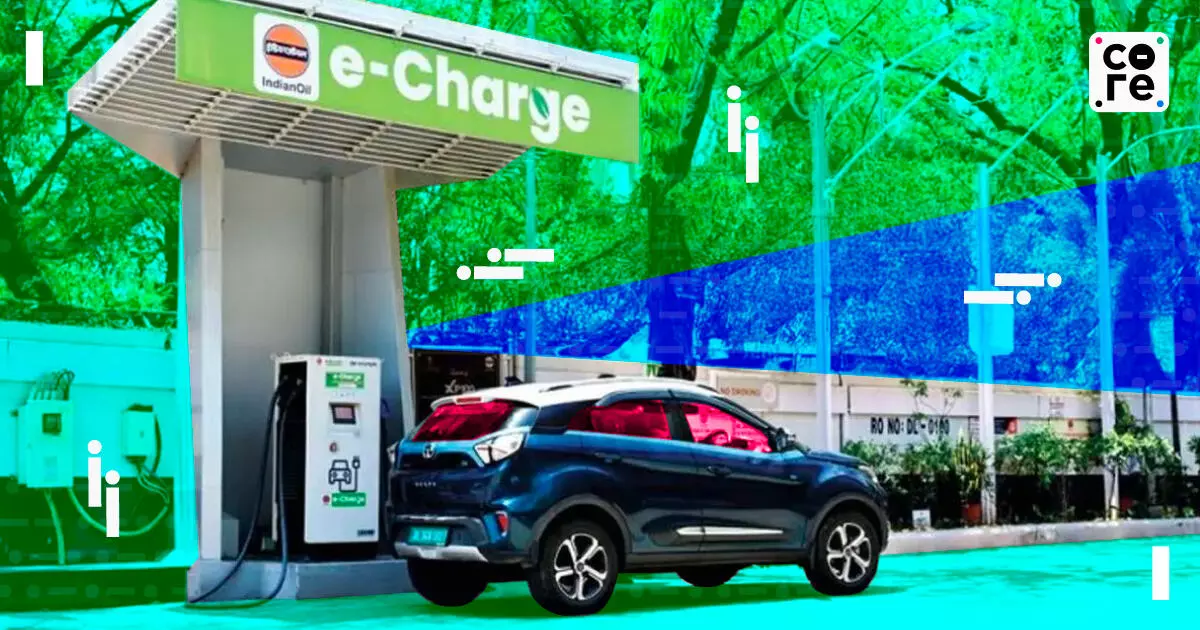
Indian Oil Reimagines Outlets As Energy Hubs With EVs, Batteries & More
 By Katya Naidu
- Business
- Published on 22 Jan 2026 11:41 AM IST

The company’s large format retail outlets are now being reimaged as ‘energy hubs’ that offer petrol, diesel, CNG, as well as electric charging stations.
The Gist
Indian Oil is transforming its strategy to adapt to greener fuels, focusing on electric vehicles and renewable energy sources.
- The company is rebranding its retail outlets as 'energy hubs' offering diverse fuel options, including EV charging.
- Indian Oil aims to integrate into the EV value chain by exploring battery manufacturing and critical mineral refining.
- It is also investing in biowaste conversion technologies and plans to produce sustainable aviation fuel from used cooking oil.
India’s largest fuel marketing company Indian Oil, is adapting, researching and reshuffling its strategy in the era of greener and cleaner fuels. The 65-year-old company, which sells around 100 million tonnes of fuel per annum, is now setting sights on electric vehicle (EV) charging options, battery swaps and even ‘non-fuel’ businesses, Arvinder Singh Sahney, the company’s chairman, told The Core in an interview as part of the India Energy Week.
The company’s large format retail outlets are now being reimaged as ‘energy hubs’ that offer petrol, diesel, CNG, as well as electric charging stations. It’s also future-ready and aims to include more fuels as the future unfolds in the energy-transportation sector.
“In future also if some hydrogen comes, that too will be part of these large format stores. Several charging stations also have swappable batteries, where we are offering a different model of electrical mobility, wherein I am giving the battery on a rental basis. The condition is that you have to keep on exchanging at my retail outlet,” said Sahney.
To this extent, it formed a joint venture named Indofast with Sun Mobility of Singapore. A fourth of Indian Oil’s 40,000 outlets now have EV charging — one in every four of its outlets.
EVs Zoom Ahead
Buoyed by novelty, government push and more electric vehicles have reached 8-9% market penetration as per Electrify 30 report by Praxis Global Alliance. With the current demand growth in petrol and diesel, even if in lower single digits, is yet to make any dent in fuel demand growth and thereby refiners and marketers like Indian Oil.
Yet, the balance could shift in the near future rather than later, changing the traditional base of oil marketing companies. The Praxis report predicts that India is likely to approach around 23% EV penetration by FY30, driven by fleets, three-wheelers, buses, and last-mile delivery—the most fuel-intensive segments.
“At the current around 8–9% EV penetration, EV growth already offsets incremental ICE (internal combustion engine) growth, causing fuel demand to plateau rather than decline. At 15–20% penetration, EV additions exceed ICE additions and a visible dent emerges, particularly in petrol and light diesel. At around 25–30% penetration, EVs replace most new ICE vehicles, leading to structural fuel displacement,” said Ram Soni, partner of mobility energy and transportation at Praxis Global Alliance.
Where Is The E-Value?
While entering into new-age fuel dispensation might seem an obvious expansion for oil majors, the economics behind it might be a tad more complicated. In traditional fuels, oil marketing companies import, refine and then sell them at retail outlets, giving them solid control over the margins and costs.
In terms of EV charging, they are not producers of electricity, making their margins in the business wafer-thin. As per analysts, EV charging, on its own, is a low-to-moderate return, utility-like business and is not inherently value accretive at low utilisation. Even with multi-energy stations offering liquid fuels, CNG/LNG, biofuels, along with EV, returns are sensitive to utilisation, uptime, and retail monetisation. Added to that, Indian Oil isn’t present through the value chain either.
“Charging stations are not a very big revenue model for me because I do not have a very big stake in the total value chain, which starts from the production of electricity to transmission of electricity and then charging. On the other side, it starts from minerals, battery manufacturing. So from both sides, I don't get that value out of that value chain, as I do in my fossil business. My endeavour is that we have to be more present in that value chain,” said Sahney.
Analysts believe that EV charging and other allied industries are a key part of the EV value chain, but also believe it could be a precarious business for oil marketing companies to enter into. As per Soni, EV charging hubs work for OMCs only if three operating thresholds are met — utilisation of ≥20–25%, uptime of ≥95%, and non-fuel monetisation contributing around 25–30% of site economics.
“Where these conditions are achieved, chargers can deliver ~8–15% returns with breakeven by FY26–27. Where they are not, capital remains locked, and payback stretches materially. EV charging, therefore, future-proofs customer relevance rather than replacing petrol or diesel volumes in the near term,” Soni added.
To improve footfalls, Indian Oil is stepping up its non-fuel business as well. It claims to be present in half of the wayside amenities coming up on new highways.
From Waste To Value
Indian Oil is also working on backward integration by setting up renewable energy (RE) capacities in a big way. The company has around 247 megawatts of RE capacity, consisting of wind and solar. It also has a stake in RE projects in joint ventures with NTPC Green Energy. But it intends to expand in a way that can aid its EV retailing ambitions, which serves dual purposes of value chain expansion as well as its own Net Zero ambitions.
It’s also eyeing battery manufacturing as well as critical mineral refining areas, in which India is looking to attain self-sufficiency. The Indian OIl has long-term plans for the same as well, that too in areas which match its competencies.
While exploration of minerals is the tipping point, the company, which has never done E&P (exploration and production), does not believe it to be its core business. Processing or refining the value chain of critical minerals is where it can make a significant dent.
“It is very much akin to what my workforce is trained to do is continuous processing of minerals or chemicals. Instead of processing the crude oil, I can always go for processing of these critical minerals, said Sahney.
One area it’s exploring is the extraction of critical minerals from e-waste. “If you take e-waste, convert it back into critical minerals, put it through a processing plant and then extract, that is called urban mining. That’s the space probably where I think that we have a stake or we have a chance of doing something,” Sahney said.
BioWaste To Energy
It’s also eyeing biowaste and is investing in R&D and more to look at different pathways to convert biowaste into Hydrogen, compressed bio gas (CBG) or even ethanol.
In these three to four areas, we are looking to go beyond converting biowaste into biochemicals. More than one-fourth of my initiatives of R&D are going towards bio, which is a very big thing,” said Sahney.
It has already received clearance from international authorities and a licence to produce sustainable aviation fuel. It is looking to be ready to dispense SAF to airlines within the next three months.
“We are in talks with other stakeholders also for ready-to-use SAF. This sustainable aviation fuel is coming from used cooking oil as of now. But at the next step, again it has to come from bio-sources,” added Sahney.
Core.
Core.


