



 Newsletter
 Search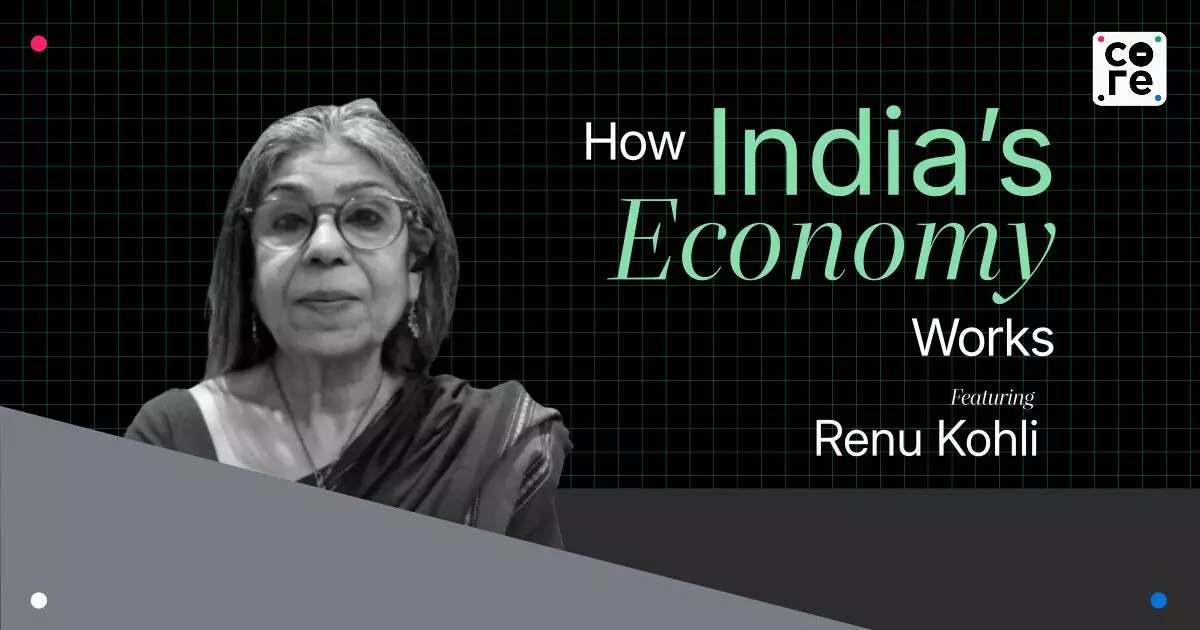
Why the RBI's Defence of the Rupee Is Becoming Unsustainable
- Podcasts
- Published on 14 Oct 2026 5:00 PM IST

Insights on the rupee's depreciation, the RBI's foreign exchange strategy, India's balance of payments
The Reserve Bank of India has stepped up its efforts to defend the rupee through foreign exchange market intervention, measures to mobilise foreign currency deposits and tighter restrictions on dollar demand. But despite these interventions, pressure on the rupee has persisted, raising questions about the sustainability of the RBI's strategy and the underlying weaknesses in India's external accounts.
In this episode of How India's Economy Works, journalist and author Puja Mehra speaks with economist Renu Kohli, formerly at the Reserve Bank of India and the IMF and currently senior fellow at the Centre for Social and Economic Progress (CSEP), about why the rupee continues to face depreciation pressure, even as India's economic growth remains strong and inflation relatively low. Kohli argues that the problem goes beyond oil prices and global uncertainty, pointing instead to persistent weakness in the capital account and India's difficulty in attracting and retaining foreign capital. She explains the costs of defending the rupee, the future liabilities created by foreign currency borrowings, and the risks that further monetary tightening could pose to consumption and growth.
The conversation also examines the lessons from India's 2013 currency crisis, whether the RBI needs to allow a more orderly adjustment in the exchange rate, and why policymakers must address the structural reasons behind weak capital inflows rather than rely on temporary interventions.
Tune in for insights on the rupee's depreciation, the RBI's foreign exchange strategy, India's balance of payments and the policy choices that could shape the country's economic outlook.
CHAPTERS
(00:00) RBI Defense of Rupee Introduction
(00:30) Unsustainable Interventions and Depleted Reserves
(02:00) Capital Account Versus Current Account
(03:55) Long-Term Repayment and Economic Costs
(06:05) Short-Term Tools and Foreign Exchange
(08:00) Emerging Balance of Payments Crisis
(10:45) Rate Hikes and Growth Risks
(12:45) Monetary Policy Committee Hiking Dilemma
(14:35) Comparing Taper Tantrum With Today
(18:40) Attracting Foreign Capital for Stability
—
TRANSCRIPT
NOTE: This transcript is done by a machine. Human eyes have gone through the script but there might still be errors in some of the text, so please refer to the audio in case you need to clarify any part. If you want to get in touch regarding any feedback, you can drop us a message on feedback@thecore.in.
Puja Mehra: Dr. Renu Kohli, thank you so much for coming to the show.
Renu Kohli: Pleasure to be here.
Puja Mehra: Just like last time, this time again, I want to speak with you about the RBI's defence of the rupee. The RBI has just announced a new set of measures in its defence of the rupee which follow the FCNRB deposits that had been raised by banks, a huge amount of forex was raised, some other swap schemes were also announced, a lot of money, dollars were inflows came through those measures. Why has RBI had to then follow up with these new measures now and official data shows that they have blown up a huge amount of the money that they raised, dollars that they raised already in their defence of the rupee.
So, what's really going on? What is happening with India's BOP? What's happening with the rupee?
Many questions, please help us understand.
Renu Kohli: Okay, so to go back from or let's rewind a bit from the latest measures of October 10. It actually continues a series of measures starting from March 2036 with the heavy-handed clampdown on derivatives position, etc. Then the launch of the FCNRB scheme.
All this has gone hand-in-hand with a lot of heavy intervention. As you rightly pointed out, the erosion of results have been steep. 50% or nearly of the mobilised FCNR deposits has been already consumed.
Now, clearly this is not sustainable. It is seemingly so. The exchange rate depreciation expectations do not seem to have reversed.
And in my understanding, the market increasingly perceives that none of these temporary measures are being able to arrest the trade and they are not working. Now, if that is the market expectations, beliefs and perceptions, then obviously it's a tough task. And the consistent heavy intervention isn't really sustainable, as I already said.
I think if we rewind back even further on the intervention side to October 24, this has been going on for a long time. And there is need to recognise that this is not helping out. And from my understanding, it is very clear that there is an issue with the balance of payments, which is appearing to be more than cyclical or temporary.
Certainly, the global conditions, etc., and the global environment, including that of the oil prices, are not the simple explanatory variables out here. It is true they have aggregated and aggravated and exacerbated the current account and the pressure upon exchange rate pressure. At the same time, it is only an aggravation.
So there is a lasting solution. And FCNRB in that context or all these capital control measures are to be seen as something temporary just to motivate and not reverse the trend.
Puja Mehra: Before I ask you to help us understand what really is the root cause of what we're seeing in the forex market and the RBI's responses to it, before we get to that, I want to ask you that last week in the Post Monetary Policy Review press conference, the RBI governor commented, in fact, upon what is going on in the forex market. He said that the markets are being irrational. Whereas several analysts and macroeconomists have said that the RBI's defence of the rupee is irrational.
What is your view? Is the RBI being irrational or is the market irrational?
Renu Kohli: Well, I think we should just look at the facts and the counterfactual. Let's just ask ourselves the simple question that after mobilising close to 146-147 billion of FCNR, come other OFCBs, has the trend in the rupee, what was the behaviour of rupee? We could just see a marginal stabilisation somewhat.
It didn't plateau out and then the exchange rate pressure returned. So market versus the value or whatever, it's not possible for our speculation to have gone on for so long. And certainly, therefore, the appraisal or the fair value of the rupee needs to be reexamined because typically we tend to look at the current account deficit and we say if this is small, then that appreciation on the rupee is not justified.
And if it is larger than the exchange rate depreciation pressure seems okay to us. Now, the question is that should the fair value of the rupee, the equilibrium value continue to be determined or guided from the central bank's perspective from the current account side alone? So it is the capital account and increasingly that is coming into play and that has a bearing on the equilibrium value of the rupee as well.
If a current account deficit is barely 0.5 or under 1% of GDP or even 1, which is eminently sustainable as long years of research and experience show us, the point is that the capital account has always consistently been able to meet the gap or more than meet the gap also, which is not happening now. It's not happening for the last 2-3 years. So clearly, we need to reexamine the equilibrium value of the rupee in Mar-V.
Puja Mehra: So you're saying that the RBI may want to revisit its view on the equilibrium value of the rupee from the point of view that is this a speculative attack on the rupee in the forex markets? Is it due to the global uncertainties that we are seeing? Or if there's something else as you're suggesting on the capital side that they need to look at?
Renu Kohli: I would rephrase that Puja slightly, which is to say that speculative positions are building up to reflect beliefs, expectations, and perceptions of the market participants. And therefore, there has been a lot of intervention and certainly on the other side, there are buyers and sellers. There's even been a forward market long position over one month forward, which is unprecedented.
It hasn't happened in the past. So clearly, these factors have been coming into play because there are different views or there is a divergence of views between that of the central bank and that of the market and what the central bank is trying to achieve through its intervention. Number one.
Number two, the external conditions are there. As I said, they have aggravated no doubt. But if we go back to rewind, the rupee depreciation pressures have been going on since October 24 and intervention that is irrational defence of the rupee.
Let me put it that way. An irrational defence of the rupee has rarely worked. Number three, if the view of the central bank is that it's undervalued and therefore it should be strengthening, then from the current account perspective, I would say, I'm just trying to decode what the thinking is.
From the current account perspective, that may be correct. But clearly, there is a capital and from that point of view, this very rapid intervention in the last one month to be able to consume 50 percent of the mobilisation has left the central bank with very little tools now. And increasingly, it seems that that is not proving sustainable.
Puja Mehra: No, I will again come to the BOP to understand what is actually happening on the BOP, which is triggering all of this. But before I come to that, I want you to also help us understand the costs of the measures that the RBI has been taking, because at the press conference, the RBI governor said that the costs are all right if it helps the economy. So there are many layers there.
The question that was put to him was only about the costs to the central bank. But clearly, there are costs to the rest of the economy, there are costs to banks, there are costs to borrowers, there's costs to everybody. So what are those costs?
And you already said this is irrational defence. So at what point should the RBI really revisit what they're doing?
Renu Kohli: I'll just answer the last bit first. I think the market knowledge or I'm just an external observer and a keen observer, that's about all. So at what point I think that there's need to reckon about the sustainability and what the intervention is achieving, the change in the outflow from the central bank's mobilisation of FCNRP, and the change in the exchange rate pressure.
Because if we rewind to 2013, then only 30-34 billion was able to do the job, and it arrested the slide in the rupee with a much bigger deficit, with much worse fiscal deficit, much higher inflation rates, and so on. So what is it now that with a far narrower current account, inflation is so low that it's below target, even at least the core side of it. So it's not a demand issue.
The fiscal deficit very well behaved and an 8% growth. What is it? Why is it that this pressure is continuing?
It isn't entirely explained by external conditions, because from 2024 to now, we cannot take that plea. Second is the issue of signalling. With all these healthy and robust signs, macroeconomic indicators, and signs of resilience and strength, the central bank has to go to the market and issue these fostery deposits.
So what is the signalling to the markets and to general? Position of such strength has nonetheless driven the central bank to mobilisation, and a healthy reserves position, by the way. Let's just compare 270 billion odd in 2013 now with more than double that amount to start with initial conditions.
So there is a signalling aspect out there that the central bank is still having to mobilise. So obviously, the signal is contradictory, and that is something that I think participants and market may have reckoned with. Now, the cost of it, I think I would agree with the governor in the sense that the cost to the economy in terms of insuring against instability and abrupt collapses in asset prices, including the exchange rate, which is the most important price in any economy, is always to be upfront for a policymaker.
There are costs associated for the huge liabilities of close to 246 billion that have to be repaid in three years' time. So there is this issue, the pressure to mobilise that much amount, given the fact that much of the reserves are not even earned reserves. They have not come from current account surpluses.
They've come from capital account borrowings, and these are future liabilities. So there is a serious concern or worry, I would say, over the next three years to mobilise this to almost $250 billion for repayments. Having said that, there is no guidance or there is no prognosis.
We cannot have a view on what the foreign portfolio investment flows are likely to be in the next three years, what the FDI actually should be a greater certainty, because it is what you would call a policy variable. And therefore, it is entirely in the government's hands to work on this aspect of the capital account. So that cost, I mean, we accept the fact that there is an insurance that is being bought through this to save the economy and or to preserve macroeconomic stability, which is fine, absolutely.
The cost of in that context, the larger, broader cost-benefit gains have to be viewed in that context. I agree with that as well. But at the same time, there is a need for what you would call a structural improvement.
And if need be, then if the capital account doesn't work out, then the current account would have to be compressed further than what it already is, which means that hard choices and harder macroeconomic policy choices will come down to that kind of defence ahead.
Puja Mehra: Are you suggesting something that will reduce imports?
Renu Kohli: Yes, fiscal compression. I mean, that is inevitable if this latest round of measures essentially should help. Today, the rupee has opened and it has strengthened remarkably.
It's ranging and the last I checked was about it opened at 95.6 and then hit 95.9 and then went down. So it's in that range. So that's like 0.8, 0.9% appreciation. The foreign exchange reserves, the FERR that the central bank has used for the first time, it's an additional tool in its exchange rate management toolkit. And it is coming from China. China has been using it since 2015 and with a fair amount of success.
And it has a zero to 20% ban and it lowers it or increases it as the pressure on the renminbi waxes and wanes. However, China's capital account is far less open than ours. India's capital account is far more open than China's.
And also the Chinese experience shows that it arrests the slide but does not reverse the strike. So I don't think that the authorities would be uncomfortable with that because as long as oil prices are going up and there is a need for adjustment. So that orderly adjustment is certainly something what the central bank does and ought to do.
Any policymaker ought to do that. So I would have little disagreement with that. But the trend would be of depreciation.
So certainly these measures should help. And we need to see for how long does this persist. These are, however, again, I would say that they buy time.
And any of these capital account management measures, including intervention, by the way, are essentially short term because after some time they start having negative externalities and counterproductive effects, for example, pushing up short term interest rates in the case of intervention. And so there are many other things. And then agents work around them and leakages happen.
Also, these are very severe because essentially what they're doing is squeezing dollar demand and helping this sector be. So I do think that the adjustment will be orderly and it will continue in that direction. And that's the right strategy.
Puja Mehra: You're saying that the RBI is yet to recognise the structural changes and measures that are needed. Perhaps they recognise what is needed, but there may be some constraints they are operating under. Are you in a position to second guess why they are not able to come up with something or get the government to come up with something that will address the root cause, the structural cause, and why they're just coming up with palliatives?
Renu Kohli: I'm sure that these parlays are happening. As I said, that FDI, long term capital, is a policy variable and it is a policy variable that the central bank does not control. And it's not in the hands of the central bank.
What the central bank can do is have an orderly adjustment and manage the exchange rate through whatever the array of instruments that it has, which also includes intervention. However, to have a very restrictive intervention, like what we saw in the last almost one month, is a kind of a determination as to not allow the rupee to go below 96 and keep it in the range of that. And that was a kind of a flaw that was observed.
So that can be irrational depending on the exchange pressure and the intensification thereof. Certainly taking out the dollar demand for the oil companies will also help alleviate the pressure. So some bit of this will work.
And the dollar demand actually for the oil companies, the oil demand, is something that can help and can stay in place for a longer period. I'm a bit surprised as to why it wasn't done earlier. It could have been done in March as well.
In March, there were reports that this was happening, but there was no press release by the central bank. And therefore, I don't think it was done.
Puja Mehra: So is the BOP at risk of getting into a crisis if this unsustainable approach continues without a change in strategy?
Renu Kohli: In my view, I think we have been in a crisis for the last six months and we're coasting from one to the other quite significantly. And as I said at the very outset, that if you rewind to March 26, then the clampdown on open positions, derivatives market, and so on, then two months of heavy intervention. The intervention has been continuous.
Then the launch of the FCNRB scheme. And it's less than, it's not even a month since the mobilisation occurred that the rapid reserves erosion of 50% of those mobilisation has been followed on October 10 by such a huge array of strict measures. And if we use these as a gauge, then certainly these are indicators of some kind of gravity or the severity of the situation.
Now, whether we want to call it a crisis or not, there is no apparent trigger. In 2013, for example, the trigger was definitely the US Fed Reserve Chairman's remarks on rolling back its QE. And likewise in 2008 and 2009, it was the global financial crisis that was the trigger.
So here you cannot, it is hard to see that oil at 117 or ranging between $100 to $120 per barrel is a trigger for a crisis. It's not. Second is that the buildup is coming from for over two years now.
And that buildup testifies to the weakness of the balance of payments and the fact that the alertness, alerting to the deficit in foreign capital perhaps could have been taken with greater deal of urgency. Were we sanguine that the foreign portfolio inflows would resume and would not be out for Indian markets? Hoping for such a situation is not a good strategy because it essentially comes down to that saying that we often come across as hope is not a strategy or a policy strategy.
So short answer to your question, if there is a crisis or not, I think the situation is very grave and severe enough. One more thing I wish to add to this is that the risk to growth, because any kind of tightening of macroeconomic policy tightening that might be compelled would be coming atop or reversing all the remarkable policy stimulation that was given last year, TST tax cuts and 120 BPS of easing, 25 BPS of monetary easing, that actually has revived a lot of this consumption spurt that we see now. The playout is still happening and it has continued into the second quarter.
In the first quarter also we could see the consumption arrival there. So it would obviously, the signalling effect of, for example, let me just elaborate upon that, an interest rate increase, dampened sentiment enormously, more than 60% of the loans are benchmarked to the external EBLR and where the transmission is immediate. And that definitely hurts spending and borrowing to the extent that much of the purchases of vehicles are financed through borrowings and banks and NBFC loans.
So there is a serious risk out there of depressing those sentiments and overturning or basically reversing all that was achieved, which was policy induced consumption spurt and you reverse it. So I think that is a serious risk.
Puja Mehra: And how does this relate to the RBI's Forex policy or strategy?
Renu Kohli: How does this relate to Forex strategy? Simply that they're trying to stabilise the exchange rate through their measures and not trying to have an orderly adjustment perhaps. In that sense, if the measures become more needed, if they do not succeed in that kind of stabilisation and if the measures required are stricter or sterner or more lasting ones than what we have seen so far, for example, steeper interest rate increases.
I mean, at least at last round, maybe as recently as 10 days ago, the broad expectations of interest rates increases in this tightening cycle was that there wouldn't be too much of it and it might be just a shadow rate cycle, maybe one or two. But in the last two, three days, at least one or two of the analysts have come out with saying that at least 50 or more BPS increases may be required. And I think that is reflective of what the situation may be morphing, evolving into.
That's how it links actually to the growth concerns. I think a lot of the household demand is sensitive to interest rates now.
Puja Mehra: Are you suggesting that the policy rate hike announced last week by the MPC, did the inflation scenario require a policy rate hike or did the MPC take the view that they must also take the exchange rate into their consideration for this decision?
Renu Kohli: The MPC's limit is very simple. It's inflation and growth. You could argue it both ways.
It is true that there are upside risks to inflation. And given that monetary policy is forward looking, then you do take note of the fact that food prices have been rising, the oil price assumptions underlying the inflation forecasts have been raised. And both inflation projections and growth projections, in fact, growth projections have been raised very heftily.
So from that standpoint, certainly, there was an argument or there is a case for a change in policy and not a kind of a preemptive tightening of 25 BPS. But if you see the demand watch and the demand side pressures, we can see about 7.8% growth in the first quarter. At the same time, you see the core inflation under 3%.
And that tells you that it's not reflecting, there's no such demand spillovers as so far. So certainly, you know, if the environment has reversed and the stance is changed to calibrate it tightly, that does have an impact upon sentiment and through that upon spending intentions and actual spending.
Puja Mehra: And this follows years of slack in the economy. So if you were in the MPC, you would have voted for a pause, isn't it?
Renu Kohli: See, as far as I said, I think there was no case. If you just look at the core side and the spillovers, one could have waited for two more months. But the depreciation is definitely inflationary and that would come through there.
And if your exchange rate is continuously depreciating and from a financial stability perspective, which is not the limit of the MPC, then definitely the differential was too narrow with the rest of the world, with the US primarily. I mean, against a historical, I think 400 BPS, it's down to 190 under 200. And there were reports that corporates were even borrowing in rupees and then swapping them for dollars, which means that there was additional demand, you know, exchange rate pressures occurring in the market from those sources.
So perhaps the circumstances would have impelled. And even though the remedy is just inflation and growth, sometimes when you look ahead and you say, okay, so there's equal justification for a pause as well. As I said, it could be argued either way.
Puja Mehra: The risk then seems to be that if the depreciation of the rupee continues and that might be inflationary, then the MPC may be forced to announce further rate hikes. And that would sort of stamp out the green shoots we are seeing on private investments and growth, which has come after so much stimulation through policy announcements of last year, both monetary and fiscal. If that is what it is, then I see a lack of coherence in the different policymakers' positions over here.
Renu Kohli: See, two of the members have voted for a no change in stance, right? That tells us that ahead, any kind of consideration of rate increases is not going to be straightforward. This might be a tie.
And a tied decision does affect markets, market perceptions, whichever way it is. The impact upon sentiment is undoubtedly true. I mean, it happens.
And it happens in, as we can see, that both consumer confidence and inflation expectations have moved inversely. Expectations are up in the 10% region and consumer confidence has declined, both urban as well as rural. So, given that these are largely shaped by food and fuel, so it's mostly food.
Fuel has not yet been transmitted to consumers. Retail prices for quite some time, although LPG prices have been revised. So, there is an issue about a pinch to consumers, especially those whose consumption at the bottom income quintiles, whose consumption basket is more exposed to these kinds of changes to food and fuel prices.
So, yeah, yes, that is correct. There is a serious concern about that.
Puja Mehra: I do want to ask you that I see the discourse this time relative to how it was in 2013, very appreciative of the RBI largely, despite what we have discussed and that shows that things are not as easy going on the ground. I'm not seeing, barring a few experts such as you, saying that some of these measures that are being announced are not sustainable and don't measure up to what needs to be done. Compared to this, when Dr. Raghuram Rajan was RBI governor at the time of the Taper Tantrum in 2013, that was a very noisy discourse and I'm not asking for a noisy discourse, but would you say that if there were more searching questions in the discourse, the RBI would act slightly differently?
Does that become a factor for a central bank?
Renu Kohli: To the extent that commentary by analysts, by keen observers and so on constitutes a viewpoint and an opinion and it reflects perceptions and beliefs, yes, it should form as a kind of, because you know that's what central bank communication and signalling is all about. I mean, there are signals from both sides and there is communication from either side, so it's a two-way street and if the commentary, for example, hypothetically, so I'm just giving an example here, I'm not saying that's the truth or there is no reflection of the commentary in that sense. I would say that if the commentary was saying that there is serious concern, whatever, as I said in the last four days, I saw that some of the analysts upped their expectations for interest rate increases.
Obviously, we could see that where it is coming from, they do expect a further weakening of the exchange rate and to that extent, it does constitute a signal to the central bank as well that these are market expectations or these are analyst views, do they filter through to the market and if they do, then the market behaviour is aligned accordingly. There is need to recognise that sometimes, which is not always the case, it is sometimes the case that the market fears or beliefs are unfounded, so the central bank will also always intervene and try and align in the red sand. In 2013, what had happened was certainly there was a downward spiral that had built up, I think it was early one or two weeks of August and that needed to be arrested, so there was a very sharp hike in short-term interest rates.
It was like I think 25, 50 and 75 basis points altogether between the span of August and September, if I remember correctly. Now, that was a very big signal and then this was backed by the FCNRB. Both those arrested this time and they were effective but before that, what had happened was that the current account itself had compressed very, very sharply and that was due to the gold duty increases.
It was a huge hefty increase, I mean I think they started with probably 6% and eventually ended up with up to 12% and in particular in the first six months of 2013, I think the increase in excise duty upon gold was as much as four to five percentage points and that was extremely effective because within a quarter, the current account swung up very, very sharply and it was down to 3% and that fact was known to policy makers. So, that helped a lot because the trigger was the current account was serious gold imports and less of oil prices or high inflation or any such thing.
So, that worked. So, that was a series of measures that worked and the commentary, I think it was adverse to the point that there was no reserves. The reserves were very few but if I rewind back even to that, my memory of history, macro history and commentary tells me that nearly everybody backed the move of within the trinity or macroeconomic trilemma about letting the exchange rate adjust and no need for costly reserve accumulations because they were very costly and etc.
etc. So, the reserve accumulation, if you see the intervention in those days, the purchasers had come to a virtual halt in 2011-2012 and the rupee was appreciated. So, that was the build-up to that.
So, it was a policy, it was a deliberate policy of non-reserve accumulation of the kind that we had before that. So, it was accumulation of that. So, I think the commentary was in that direction and it was directed all towards the fiscal side, the gold imports and why agents were importing gold because of high inflation as a hedge against that and so on.
So, the fragility of the reserves of having just very little reserves, very little cover, I think the import cover was down to 6 or 7 months at that time, was reinforced and driven home to the central bank thereafter and after that, I mean, I think they never looked back. They never looked back in the sense that even in the adoption of inflation targeting, it is very clearly laid out that we will use intervention and we will accumulate reserves, that's part of our policy. So, that has been the stated policy explicitly and they have never made that mistake again or if at all we call it a mistake.
So, the commentary was guided by then at the time with this on this. Here, I would say that the commentary has been quite late in waking up to the fact that the pressure is coming from the capital account and not from the current account. There has been commentary in the last two years about why is the central bank averting and avoiding a depreciation and intervening to avert a depreciation and reasons have been proffered by different commentators on thereof, whether it is because the ECB exposure is very high and or it is detrimental to manufacturing by not allowing it to depreciate and find its own level as it were, etc.
But I think the alerting to the fact that the capital account is the root cause and it's not the current account has come about only in the last, I would say, less than a year.
Puja Mehra: In fact, I recall in early 2014, March, April, I was in Washington for the World Bank annual meetings and everybody over there was talking about how the RBI and the RBI governor were a rock star and how from being a fragile five economy, India had become such an outperformer in that grouping, except for inflation, everything else had been brought under control and inflation was expected to be brought under control because work on inflation targeting had already started from designing the policy side.
This time, I find it is the RBI, earlier this year, was itself patting itself on the back saying we've brought the economy into a Goldilocks situation. I detect, I'm saying this, I detect a certain bias in the commentary in favour of governors who are sent from Delhi, I feel, and that may be a handicap, perhaps.
Renu Kohli: I have nothing to say on that, no comment. I'm not going to comment on all this.
Puja Mehra: No, I know, I know. But is there anything that I have not asked you about and I should have or have we covered everything?
Renu Kohli: I'd just like to add, Puja, that these measures are all par for the course and they're required given the situation, I guess, but I think there is need for policy makers, a hard look as to why a country growing at such high growth rate and is not being able to attract and retain foreign capital. We understand that there are reasons why the short-term portfolio capital in equity is not attracted, but there has been a lot of liberalisation of debt and all these measures, but apparently they are not working. So, there is need to reckon and take a hard look as to what are the kind of, why are the reforms not leading to investment opportunities from the standpoint of foreign participants?
And that is the need of the hour and that is very important to take a look at that while these measures do buy time and help allow an orderly adjustment. I have no doubt that the central bank and the government would be talking or thinking in this direction, but there is an urgency or an emergency to it and that's what we cannot just assume that capital will come to India no matter what.
Puja Mehra: Thank you. Thank you, Dr. Renu Kohli.
Renu Kohli: Thanks.


