



 Newsletter
 Search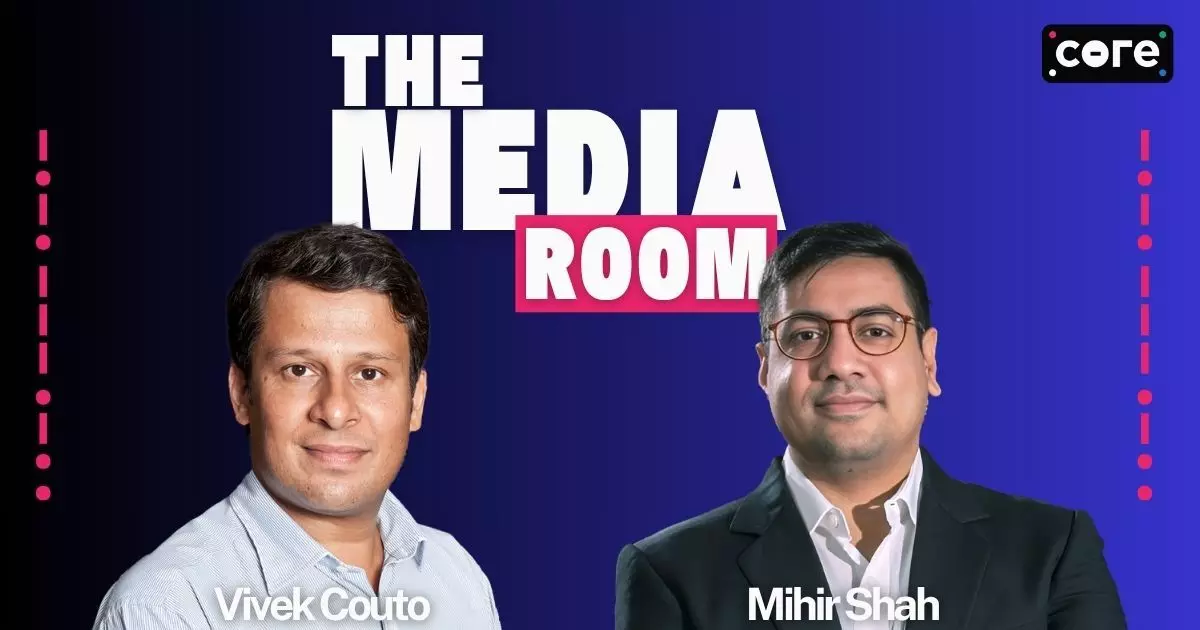
Vivek Couto And Mihir Shah On India’s $3.1 Billion Retail Media Boom, CTV & AI
- Podcasts
- Published on 7 Oct 2026 6:00 PM IST

India’s advertising market has doubled to $16 billion in five years, with retail media now worth $3.1 billion
Is India’s advertising market entering a new phase driven by retail media, connected TV and AI?
In this episode of The Media Room, Vanita Kohli-Khandekar speaks with Vivek Couto, Co-founder and CEO of Media Partners Asia, and Mihir Shah, Vice President at Media Partners Asia, about the biggest shifts reshaping advertising across India and the Asia-Pacific region.
India’s advertising market has doubled from $8 billion to $16 billion over the last five years. But the composition of that market is changing rapidly. Retail media has emerged as one of the biggest growth areas, with the Indian market now worth around $3.1 billion and growing rapidly across e-commerce, quick commerce, food delivery and fintech platforms.
The conversation explores why Amazon and Flipkart are no longer the only players in retail media, how platforms such as Zepto, Blinkit and Swiggy are attracting advertisers, and why first-party data and measurable conversions are changing the way brands spend their advertising budgets.
Vivek Couto and Mihir Shah also discuss the rise of Connected TV, which is bringing together television's brand-building power with digital measurement. They look at India's 55 million active CTV homes, the growth of CTV advertising and why the market could reach $2 billion in the coming years.
The discussion also looks at AI and the future of search, the growing concentration of advertising among major platforms, the importance of IPL and other mass-media moments, and whether traditional display advertising could be squeezed between retail media and video.
They also examine the future of professional content as UGC, social video, microdramas and AI reshape the economics of content production — and why premium content may have to compete on emotion and memory rather than volume.
NOTE: This transcript is done by a machine. Human eyes have gone through the script but there might still be errors in some of the text, so please refer to the audio in case you need to clarify any part. If you want to get in touch regarding any feedback, you can drop us a message on feedback@thecore.in.
TRANSCRIPT
Vanita Kohli-Khandekar: Hello and welcome to the Media Room. Today I have with me Vivek Couto, who is the Co- Founder and CEO of Media Partners Asia. It's a media consulting firm based out of Singapore.
And Mihir Shah, who's the Vice President for Media Partners Asia. They've just come out with a report on the APAC advertising business with projections till 2031. And there are some two, three trends in that which I'd like them to highlight.
Okay. Vivek, welcome to the Media Room. And first of all, just unpack the major highlights from the Asia-Pacific Advertising Industry Report.
Vivek Couto: Thanks, Vanita. It's great to join you today again. And look, I think the ad market across Asia-Pacific, you know, 14 markets, we expect to be around $276 billion net this year.
It's up around 5.2, 5.3 percent from last year, which is the lowest in a few years, heading to around $335 billion by 2031. It's outgrowing the region's economies, but the real story, or there's three stories. One is the composition is changing much faster than the total, right?
So three things are standing out. The first is retail media, which is more than $75 billion in 2026. And it's the largest pool, incremental pool.
And the reason it's come to my attention and media's attention, it's done a lot of great work on it in India, is because it's twice of, you know, linear TV. Already 1.5 times online video. Online video is growing, but retail media is going faster.
And it's five times the sort of premium AVOD segment that we talk about, you know, which people like, I guess, Jio Hotstars, E5, and Netflix now when it does its ad tier, and Amazon, of course, Occupy. So that point of purchase has become the big point of persuasion that advertisers and investors are focused on. The second you already know, you know, digital is no longer a segment, right?
It's a massive market. It's $206 billion. It's 75% of all spent today.
It's 80% in five years. And that growth is now rotating away from the sort of classic search and display. And I think you've been writing about this, Vinita, a lot.
Moving towards commerce, video, and social. And then, of course, the concentration. The concentration of spend is the big headline.
Meta is huge. Bytance is huge. Google is huge.
They take off, you know, close to 45% of ad spend. And the top 20 or so media owners across the region, a lot of them are Chinese. One is Indian and has broadcast back DNA, and we'll talk about that, I'm sure.
Those top 20 owners take more than 80%. So the middle of the market is being hollowed out. And if you want a fourth one, I'll give you one, just a quick one.
The only traditional medium growing today is out of home, across the region. It's $20 billion in 2026, up in 11 of the 14 markets. So I hope that sort of gives you an opening view.
Vanita Kohli-Khandekar: Fabulous. Mihir, I want you to come in here first to give me the same sort of overview of the Indian market. And then I want both of you to jump in and define retail media for me and what is driving it in APAC and what is driving it in India.
So first, Mihir, you want to give the same overview of India.
Mihir Shah: Sure, sure, sure. No, yeah, thanks Vanita for having us. And see, I'll just kind of give a slightly more macro view on the India media entertainment ad landscape.
If you just rewind back a bit and you see how the ad market has evolved since the pandemic. The overall ad market since the last five years in India has doubled. It's doubled its size from $8 billion to $16 billion.
Your television and digital is still the largest segment, about close to 85% of the overall ad axe. See, at the start, since the pandemic, one would have assumed that video as a format of advertising at that point was one of the fastest growing. You know, you had, naturally, because people were confined to their homes, you had the kind of investment going behind originals.
And, you know, generally you'd seen a good uptick in terms of online streamers, and overall video ad share was expected to be much higher. Fast forward to where we stand today, video as a format of advertising has seen a decline in its share. Its share has actually declined from about 45% around pandemic to about 37% as of end last year.
So that's one part of the story. The other part of the story is that, you know, obviously, you know, the market has expanded, you have doubled the size. So while video, you know, video share of total advertising has declined, the non-video digital segment has really driven a larger part of the growth.
More than 70% of this incremental ad dollars has come from the non-video, your search and display segment. And year in, again, a large part of this growth is powered by retail media. So Asian media today has taken away more than 40% share of your traditional search and display market.
It has also impacted incumbents like Google and Meta in terms of their market share. As we stand today, the market is more than $3 billion and has grown tenfold since the pandemic. It accounts for about 30% of the total digital ad spends in the media entertainment market, in the ad market in India today.
So that's the kind of impact retail media has had in the overall advertising landscape since the last five years. No, no, the overall video advertising market has seen a decline in its share and a large part of this decline is attributed to television. Television in the last two to three years has seen a sharp double-digit decline.
Your overall AVOD, your online video has grown, but net-net, you know, the share has declined. But in parallel, we have seen a sharp increase in retail media advertising.
Vivek Couto: I think the headline that Mir alludes to is what I was saying in Asia is that online video is growing, full stop, as a category. That includes YouTube in India or outside of India, YouTube and TikTok and Meta and so forth, right? The premium AVOD segment, which are broadcasters, Jio Hotstars, E5, Sony Live, players like that, that is also growing.
But what's happened in the last three years, and Mir, correct me if I'm wrong, is that retail media is growing much faster. So its share of the pie is growing faster. Does that make sense, Mir?
Yeah. Yeah, no, absolutely. Absolutely.
Yeah. And on the definitions, sorry, do you want me to talk about it?
Vanita Kohli-Khandekar: Yeah, yeah, that's the definition.
Vivek Couto: The definitions, look, it's interesting, and Mir, chime in on this because, you know, I mean, at a high level, I guess it's advertising sold by retailers and commerce platforms on their apps, on their storefronts, sponsored listings, display, off-site audiences, and it's built a lot on first-party transaction data, right? Because a lot of brands, you know, want to see business outcomes around it, right? So that weapon that they have is the closed-loop measurement, right?
So you have a platform that serves the ad, it's the same platform. It closes the sale, reports the receipt, and brands, you know, they didn't necessarily fall in love suddenly with retailers, but they just fell in love with the proof, right? You've got first-party purchasing data, you've got attribution, right?
And you've got sort of money that always existed below the line, but it's now moving into auction platforms and sort of being counted as advertising for the first time. We've started reporting it in the last two or three years. Brands and buyers have been talking to us about this for five or six years, right?
It's not new money, it's sort of old trade money that's kind of coming up the funnel, and it's being measured, right? Now, the scale that we put it at is 75 billion, 75 plus plus in, you know, in 26, going up quite significantly, and it's going to be around 36, 37% of digital on average, right? And we can talk about the trends outside Asia in a minute, but Mihir, did you, outside India, but Mihir, do you agree with that sort of definition?
Mihir Shah: Yeah, no, absolutely. And Vanita, to your point, a large part of the advertising formats on retail media are either search or display. Video is a very, very, very small element in it.
And we are seeing this changing, and I think as a part of our discussion, we'll kind of see how video players can participate in this boom that we are seeing in retail media.
Vanita Kohli-Khandekar: No, but in India, what media are we looking at? Because there's no Bytedance.
Mihir Shah: Yeah, it's subsumed under search and display advertising.
Vanita Kohli-Khandekar: No, no, no. My point is the brands. Are we looking at what are the brands, what are the platforms?
So what are the platforms which are driving this in APAC, in India, you know, some sense of the brands which are driving this?
Mihir Shah: Sure. So I think if you see the retail media market has evolved, you know, from your marketplaces like Amazon and Flipkart, right? This was pre-pandemic.
Since then, you know, we have seen the market evolve because you've seen many new categories coming in. We've seen quick commerce players, you've seen the expansion of networks of food delivery platforms, you've seen FinTech players. So all of these platforms since the pandemic have gained in a scale and users and users transacting much more frequently.
And these are the ones which are also now attracting a lot of ads. The kind of advertisers which come on these platforms also depend upon the kind of product they are hosting, product and services that they are selling on their platform. And that's how, you know, over the years, you've seen different categories of advertisers coming on the retail media bandwagon.
Vivek Couto: And in Asia, I think China is obviously the most advanced, right? Commerce platforms are almost the ad market. Nine Chinese platforms, if you look at it, of the spend, take 45% of regional spend.
They are, some of them examples are Alibaba, Douyin, which is owned by ByteDance, JD, Metawan. And I think the key is they've made commerce and media just go into one machine. In Korea, you have the equivalent of Amazon, a company called Coupang, which also has a streaming service, which is big, like Prime Video, Coupang Play.
Then you have the Chinese brands around us in Southeast Asia, Shopee, TikTok Shop. And you have the Japanese with Rakuten and Amazon. And it's interesting, right?
Because there are different markets at different stage. Japan is still managing that transition. So, you know, maybe similar to India, but slightly, I would say slightly unlike India, linear TV is interesting in Japan, Vinita, because it's sort of, it's falling 2 to 3% a year.
It's a managed decline, not a collapse, because I would argue that the broadcasters have built sort of collaborative lifeboats. You know, there's a company, there's a platform there called TVER, T-V-E-R, which has, you know, reasonable 25% share of VOD viewership, premium VOD viewership. And it's growing.
And it's owned by the five big broadcasters in Japan equally, right? And Dentsu's coming in as well on that side. So it shows that a legacy industry can sort of manage this transition without failing.
Korea, it's much tougher, because TV is down there 10.4%, 10.5%. It's probably one amongst the steepest falls in the region. Thailand's a bit worse. And Australia has gone full on into, you know, e-commerce.
Southeast Asia is also getting very strong on commerce-led brands with Shopee, TikTok shop, Lazada, all of that stuff that's taking monies away from free-to-air television.
Vanita Kohli-Khandekar: But just quickly, the Japan phenomenon is also to do with the demographic. Japan has a greater proportion of ageing population than many of these other economies. Does that make a difference?
Vivek Couto:
Yes, it does. And as you know...
Vanita Kohli-Khandekar: Is it more wedded to linear or more wedded to TV as a medium? Yeah.
Vivek Couto: Look, nothing ever dies in Japan, right? Even DVDs are popular still, believe it or not. So, and even books.
There, I say, Japan reveres books and people read, you know, around that. There's still a lot of bookshops. It's a lot of vinyl as well.
But yes, the ageing population does make a difference. But you also have a thriving youth population as well. But yes, the ageing population does make a difference.
But in Korea, it's also ageing rapidly, Vinita. You know that, right? Not many people have written about it.
Korea is kind of sharp ageing in the last three to four years. But their industry is in a far worse position than Japan. If you look at the balance sheets of the five broadcasters in Japan, and the top eight to 10 media and entertainment companies, they're in very healthy shape, very good shape.
Of course, they're slow to change and do different things slowly and so forth. So it's a very different market as well. It's also about how you manage your business, and how you react to change, you know, so different markets.
Vanita Kohli-Khandekar: Mihir, I want you to come in on India here, because we talked about retail. But if you get, you know, one of the things you mentioned, which I, we are talking about a 17.5 billion market in India right now, totally.
Mihir Shah: Yeah, you should close this out about that.
Vanita Kohli-Khandekar: Yeah. And retail would be what of this retail media?
Mihir Shah: I think retail media this year, we should be at about $3.1 billion. Yeah, you mentioned your total market. Yeah.
Okay.
Vanita Kohli-Khandekar: And are there like 123? I mean, I always think of Amazon when I think of commerce, because possibly I'm an Amazon shopper. Yeah.
But are there other brands because I see a lot of commerce happening on Insta, I see a lot of commerce happening on other platforms. So are we seeing a more sort of wider variety of brands coming in or just seeing brands which are driving it across APAC?
Mihir Shah: Yeah, so, so let me first explain, you know, how this entire retail media market grew, right, especially in the last four, five years, what has happened is, since the pandemic, the total addressable market for retail media has expanded. The target audience for retail media is essentially online shoppers, right. And they've grown from, let's say, they actually doubled in size from about 140 million online shoppers to now, more than 300 million online shoppers.
Then again, there's still ample headroom for growth, because in a connected market of a billion, you know, you have 300 million. So it's just one in every three connected consumers transacting online just shows the scale that the overall commerce has in India. So that's, that's one thing.
But also what has happened is in the last four, five years, the number of use cases for consumers to transact online has changed. So let's say, you know, around pandemic or pre-pandemic, large part of online shopping was on your marketplaces like Amazon, Flipkart. Fast forward two, three years out, you know, we've seen, especially in the last few years, we've seen the coming of quick commerce, we've seen the coming of, you know, food delivery networks.
So the average number of transaction earlier when it used to be about one transaction per month, you're seeing the frequency of transaction increasing to three and a half times per month. So increasing the base, increasing the frequency of transactions, the sheer volume of online transaction has gone up. So in value terms, your e-commerce market has expanded three times, $25 billion pre-pandemic to $75 billion today.
So you can just imagine the kind of advertising opportunity this has opened up, right? And the market, as I said, like $3 billion of your retail media market was once dominated just by Amazon and Flipkart. They accounted for about 80% share.
Right now, the market is like, they still are dominant. They would have about two thirds share of the total retail media market. But the segment in the last two, three years, which has really carved out a share is quick commerce.
So like, so Zepto, your Blinket, your Swiggy and Starmart. That's also because, you know, a lot of advertisers coming on board on these platforms are large consumer industries, your FMCDs, your pharma companies, right? And they have been, you know, they constitute about 80% of the ad spends on many of the quick commerce platforms.
Then you've seen fintech players, which have kind of grown in scale. So what happens is the story for every different category of retail media players, your marketplaces, your quick commerce, your fintech also is subject to what's happening in that industry. So for instance, fintech had a great, from 2020 to early 2025, they had a great run.
Mid 2025 with the ban on real money gaming adversely impacted them, right? And now again, we are seeing this restoration of MDR on UPI. So they are kind of going through a rough patch.
So it's like you've seen, you know, certain categories which are growing at a super normal growth like quick commerce. And then you've seen players like fintech, you know, they're going through a rough patch right now. But net in the category, the structurally we are seeing a good uptick in our e commerce GMV for the e commerce market.
And this in turn is driving a lot of advertising for retail media players.
Vanita Kohli-Khandekar: You know, all advertising seems to be becoming about performative advertising, you need attribution, you need to know that conversions have happened. So everything is about a funnel which converts what I mean, I find it strange that in a world where so many new brands categories are still getting launched, how can everything be about performative stuff? So there's a function which let's say a linear or a large sports property performs, which is reducing.
So there are two strands of thought here, I just want you guys to throw in your knowledge on this one, is everything becoming about performative advertising? And what happens to those large properties? So suppose an IPL comes in or a big show comes in on AVoD, let's say a preterm in Pedro, which did very well on award in India, I'm sure we can use some Korean show.
Vivek Couto: Right?
Vanita Kohli-Khandekar: How useful are they as properties, if everything is moving performative? You know, and are there is any value in creating those properties?
Vivek Couto: Yeah, look, I let me talk a little bit about IPL because obviously, they did some stuff with Swiggy this year, right? And as they build that out, but you know, I think at a high level, when we look across the region, I think it's a really good question about mass moments you've asked, right? And I think that demand for a moment when a nation watches together has not gone anywhere, it's undiminished, right?
Particularly when you put television and online together. That's a very, very big thing when we talk to brands and advertisers. And that's why it matters with live sport.
To some extent, it matters with tenfold entertainment, and it matters with streaming events. It's why after doing nothing in Asia, Netflix took the world boss baseball classic in Japan in 26. And it became their biggest ad moment in the region, right?
It's why the Japanese streamer carries the Winter Olympics, right? And of course, we will talk to you about cricket and football migrating to streaming. So I don't think everything is collapsing into performance, right?
Retail media takes a certain part of the funnel, you can argue bottom of the funnel, scarce live moments take that top. And arguably, what dies in the middle is the the murky middle is sort of generic stuff, mid-tail programming, generic display. That's just my perspective on that.
But for the few properties that still aggregate, things like IPL, for instance, retail media is actually a powerful force, it's an ally. So that's going to be important. And then shoppable formats are actually going to be very important for that scarce of the mass moment.
It's really important for them.
Vanita Kohli-Khandekar: You want to add in here, Mehit? And my point is, is there incentive to invest in those large properties, which you remember, we talked about how IPL right prices, media right prices are going down. So is this also one reason why the rights prices for other properties could also be going down that it's films or shows or whatever it's?
Mihir Shah: Yeah, sure. No, I think I'll just rewind back to say that, you know, I think since the pandemic, you know, when you're, you know, when everything came to a standstill, and, you know, every brand and product wanted to kind of bring back their sales up, there was a very high indexation towards performance marketing, because you had to try and bring back the sales volume up, right. And in that process, you know, many brands and many advertiser categories have got addicted to that process of going heavily on performance.
And, right. And, you know, we are seeing to some level of under indexation towards branding. And from the video standpoint, we've seen there are two categories, you have sports, and entertainment.
Entertainment has also got significantly fragmented. So there are only two or three large categories in the video space. One is sports.
And now in of the last 12, 18 months, we are seeing a lot of importance been given by the broadcasters or streaming players towards nonfiction, anything which can aggregate audiences together, right, can can then once you need to kind of aggregate audiences together, and then you can kind of lay a brand building on top of it. So I think, once that happens, and you see, you know, more integration and partnerships between your upper funnel, your video players with your mid and the lower funnel, which is your retail media players, you will see much more, you know, you'll see much more synergies between both the segments, and it'll be a win win for all the stakeholders. We are seeing some instances of this.
So what we saw earlier this year, we saw Amazon, you know, merging its MX player together, right. So what it does it, it creates a much larger upper funnel, which complements to the mid and the lower funnel on the amazon.com, the e commerce website. So what happens now is you have a common ad sales team who can go to a brand or advertiser, and he can offer a full funnel offering where a product discovery happens on the video funnel, which is, which is much larger, and the fulfilment can happen on the e commerce site.
So you see many such partnerships, you saw also during the IPL, Swiggy's integration of IPL with Jio Hotstar, it for the first time brought food ordering onto live sports, right. At its peak, Swiggy was getting about 6000 plus orders per minute, right, that just shows the power streaming has to create and generate more commerce. So you'll see many such instances, many, many such partnerships going forward, where you have branding and performance, you know, working together.
Vanita Kohli-Khandekar: You mentioned both of you that three companies get about 44% of the APAC ad spend. How do you view this, Vivek? I mean, they're seeing the same replay of what happened with search and display, with 60 70% spends going to two companies, now it's three.
And I don't know this number, but from a consumer perspective, and a content diversity perspective, do you see that as an issue? Or is that a normal evolution?
Vivek Couto: From a content diversity perspective, of course, it's an issue. And it's, it's, it's not great, you need that diversity. And I mean, the whole point was, you know, the internet and digital was supposed to democratise creativity, right?
And now, in some ways, it's democratised distribution, but distribution has concentrated. And distribution is concentrated from the big, big companies such as YouTube, Meta, ByteDance, and all those companies, right. And that's a, that's become an issue.
So from a content diversity lens, it's the ledger is somewhat dark, right. And, and, and the platform, you know, the all, you could argue that in the old television world, we had and still there, but you know, there were all TV ad monopolies, people cross subsidise news, they co-subsidise local programming, different types of production. But they funded all a big sort of production economy, these new platforms are now funding creators, right.
So it's a very different type of site. And look on the advertising part of it, and the concentration of it. As I said, the top 20 have around 80%, right.
And the top three have about 44%, 43, 44%. But advertisers are ruthless, and they are focused on ruthless efficiency. And I know we're going to talk about AI later.
But it's just a reality we're in now, you know.
Vanita Kohli-Khandekar: Mihir, you want to add something there, especially from the India perspective, or even the IPAC perspective, that's fine.
Mihir Shah: No, I think it's, it's a similar trend in case of India as well. There's been a lot of concentration on media owners. And we can see it in APAC numbers.
And good to see some of the platforms like Geostar also featuring among the top advertiser platforms at a regional level.
Vanita Kohli-Khandekar: What are we looking at as AI advances, and it's moving very fast. I mean, I'm also quite startled at the pace at which it is moving. We are looking at a complete death of search and display, or are we looking at sort of some other format, forms of those things.
It's not just about retail, but just it's the combination of AI, retail media, commerce, the kind of applications possible for advertisers, and for the creation of content. I mean, microdramas itself is a great example. So what do you see, you know, what shape do you see advertising or communication with consumers taking given that?
Vivek Couto: That's a tougher one to tackle, because it's always evolving, right. I mean, I think there's generally a viewpoint that search is not going to die, but it's going to stop becoming like this box, right. I mean, everyone is using AI search, right.
And even Google has said now we're just an AI search company, right. So, and they have whatever, AI overviews at what, two, three billion users. So it's a hard one to look at.
I mean, I think the keyword is dying, you know, that's for sure. But that intent to find the answer, whoever owns that answer, whoever's able to get faster that has the consumer, has the advertiser. So I don't know, it's, queries are going to be fragmented.
And, you know, you can see in China, when people start discovery on Douyin, and they have AI assistants, it's all sort of this intermediating search. And that's why I think classic search growth is around three to 4% globally, not just in Asia, right, it's about three to 4% now, right. But there's another argument that maybe we will have a business, the display could be a very big casualty, right?
Because display is kind of being disrupted on both sides, right? We're seeing in some ways that arguably retail media has better data, then you've got video that has better attention. So what happens to display?
Will it ever lead again, right? And obviously, and there's a whole convergence around this, right? I mean, the really interesting thing that now that open AI has done ads, and we're looking at that, and we're looking at all these other things is what happens when your AI agent, you know, does the shopping, does search ads for you, and you know, retail media comes into one auction, it becomes a, I don't have a definitive view on it, but just a lot of thoughts on it, Anita, sorry about that.
Vanita Kohli-Khandekar: Yeah, that's okay. Mihir, you want to add there?
Mihir Shah: I think, you know, when we looked at search advertising, traditionally, it was always attributed to YouTube, to Google, right? And over time, you know, now we are talking about retail media, and suddenly, you know, we are seeing search has traditional search, which is your YouTube of your Google, and then you have the retail media players who have their own search and display advertising. I think the third layer within this will be AI, right?
So for instance, open AI, you have Gemini, you have Anthropic. Now, we are still seeing early days of advertising on these platforms. I think the early categories will be the ones where you typically would require to do some research.
For instance, let's say you want to travel, let's say you want to buy electronic products, let's say, you know, you want to buy insurance products for BFSI, I think those this will be the early adopters for AI search, where it requires some level of intellectual research before kind of finalising a product. So, so search will kind of take various shapes and subcategories, you will have traditional search to explain, you know, that's going, it's dying in some markets, it's growing at a single digit in, in many of the markets, then you have the retail media search, where there's a clear intent for buying a given product. And then there's this AI search, where you're researching ahead of making a purchase, you know, and you'll see a lot of integration across this entire consumer journey.
So you could have, let's say right now, Jio Hotstar is partnered with OpenAI, there can be a much deeper integration where you can actually also use OpenAI to discover your product or learn more about it before you make a purchase, right? So you'll see more integrations and partnerships happening such that the consumer journey is much more seamless from product discovery to purchase.
Vanita Kohli-Khandekar: Correct. Search is now, AI is the new name for search, I think in many ways.
Vivek Couto:That's what we were saying.
Vanita Kohli-Khandekar: Helping you to do. Yeah, yeah. Okay, last couple of questions.
One quickly on CTV, where are we at in the APAC market? How big an impact has it had on your advertising numbers? Are you seeing anything special there vis-a-vis CTV in APAC and in India?
Vivek Couto: No, it's a big one. It's a big one. CTV is the one TV line that grows.
It sort of rebuilds, arguably, TV's brand building power with digital measurement, right? So Premium A Award, which is a big function of CTV growth, is a $15 billion category in 26. And it grows at 8% a year over the next five years to something like $23 billion.
And by that point, it's bigger than print, bigger than radio, bigger than cinema, bigger than all of them combined. And you're seeing not just the local players get advantage on that, but you're seeing the ad tiers on the global streamers becoming quite big. So they turn that reach, subscription reach into inventory.
And obviously, live sport migrating to connected screens is very important, dragging the brand budgets with it. And then YouTube on the TV also is very important. So it's a big line going forward.
It's a long way to go. It's a long way to go. It's $15 billion in a $200 billion digital market.
The biggest issue is measurement currencies. They still remain fragmented. So some issues on attribution.
But that's getting better, but it's a long way to go. But a lot of growth.
Vanita Kohli-Khandekar:I will come to currency later. I mean, that's not important. But do you want to touch upon?
The number is stuck in India from what I can see. It's the same 40, 50 billion number, million number that I'm hearing for three, four years now.
Mihir Shah: Yeah, see, the adoption has been great. I mean, it's been more anchored to the growth in home broadband as far as India is concerned, right, in terms of how the number for CTV or more active base of CTV. I think in our last count, we had about 55 million active CTV numbers, CTV homes in India, and compare that to your traditional linear pay TVs, somewhere close to 75 million.
So the gap is just narrowing every passing year. So, you know, so the overall ad market for CTV in that sense has grown. So I think last we estimated it to be around close to $800 million in CTV ad market.
Clearly, you know, with the trajectory that we are seeing for linear pay TV and CTV in India, essentially linked to the growth in home broadband, we expect CTV ad revenues to match that to television in the next year or two, maybe, let's say by 2028, you know, and outer years, the market can really expand to about $2 billion. But interestingly, you know, as you see the overall pie increasing, you see the competition in the space also intensifies, you will have the broadcasters then now also competing with the likes of YouTube, the likes of S-Word platforms, like Prime Video is now introduced at tier, maybe a couple of years down the road, Netflix will introduce a lot of premium inventory will come into the market with many of these S-Word players introducing at tier.
So the competition landscape will also become much more intensified as the pie expands.
Vanita Kohli-Khandekar: Interesting, because I see three buckets here, your pay TV, your CTV and your DD free dish. These are the three buckets of more or less big screen consumption, which one can see. It's interesting.
A lot of stuff on UGC and social and your release also talks about it. Do you see that impacting the professionally generated content market? I know I got a note from Karen today on content investment in APAC.
I've not read it. But are you seeing some shifts there? Do you track the investment or the amount of money that goes into UGC social versus professionally generated?
Do you look at it like that? I mean, just curious how that is.
Vivek Couto: What investment goes into UGC social is called revenue sharing. And if it's revenue sharing, YouTube is relatively generous and TikTok shares nothing. So that's maybe controversial to say that, but that's the thing to remember.
Whereas the lifeblood of content created investment of putting money in is come from, you know, the TV guys and the premium streaming guys. But we track the professional market. Right.
And I'm sure he will have something to say about that, because there was a milestone here last year where streaming overtook television and content investment in India. But the thing is, it's a really good point. There are two or three things and it deserves another podcast.
Right. And it's a big issue because, you know, it's one of the prevailing issues that one looks at. Right.
Sports rights costs are going up in many instances. Premium content costs are scaling down in certain instances, but still expensive to make. And you've got UGC and social video, you know, really growing up and then with the microdrama stuff and then you've got the AI bucket.
Right. And I think I don't think professional content is finished. I think it's being forced upmarket in certain markets to really feed things that cannot UGC and social cannot make.
So you talked about live sports. You talk about marquee dramas. You talk about shared moments.
You talk about credible news. Right. So I think those things are very, very important because brand money is still going to pay for those moments, still going to pay for curated context and content.
I think the issue is with the onset of AI is how does AI allow you to make that content in a, you know, in a, you know, in a meaningful way and at scale and lead to measurable business outcomes? That means your cost comes down, your revenues go up. And I think people are looking at that, not just from a location base, but also trying to figure out how do I make premium content with AI?
Even the micro dramas, by the way, that work, I know everyone's talking about it being a pure AI creation, particularly some of the dramas coming out of Korea and China, and to some extent the US, the United States, they're still, even though they're sort of AI created, they're still costing some of them $20,000 or upwards an hour because you can't just dump AI slop on that. You can dump AI slop on social platforms. You can't put that on some of these premium platforms.
So that's one way of looking at it. Obviously, the systems are converging, right? Creators are professionalising into studios, broadcasters distribute YouTube.
So some of that is definitely working, but I think professional content can't find, it can't compete with social and UGC on volume. It's never going to work. It can beat it on emotion and memory.
That's a different thing.
Vanita Kohli-Khandekar: Staying in the game, basically keep up in your game. Mihir, do you want to add something there?
Mihir Shah: Yeah. See, the content market in India in terms of value is kind of got stagnated at about $5 billion. I'm talking about professional content, right?
It's been stagnant. So you're seeing a lot of recalibration happening. So sports sites cost are kind of locked for five years.
We'll see that changing as the renewals come up. And then we are seeing a lot of recalibration in the entertainment space where I think as your attention spans actually become much shorter, you're moving from those long form. And also as your business models change from S-Word to freemium, your formats of content also changes.
You're going away from finite long form series to something like TV plus plus. And then you are going into micro dramas based on your business model, based on your attention span of your audience. So there's a lot of recalibration happening there.
To your point on UGC and premium video, the way I see it is, you're now seeing both of these categories, one going into others arena. So for instance, you know, we have seen in case of YouTube, YouTube just partnered, they're experimenting with, you know, in the partnership with Balaji, right? They're kind of commissioned content with Balaji, with Swastik, with Applause.
Essentially, you know, to kind of drive engagement, probably on large screen, that is where the next money is going to come, which is CTV, right? So let's see how that plays out. And that also changes the dynamics for content producers, you get to retail IP, if that clicks, that'll be something, right?
And at the same time, I see the role of AI will be very critical for premium video players. Because what happens is right now, you know, India is a very heterogeneous market. To go more deeper, you know, as you go more deeper, the propensity for people to pay actually reduces, the heterogeneity widens, right?
So certain content dynamics are just not justified, right? At a certain price point, AI will actually allow you to go much more hyperlocal. For the first time, you'll be able to extend and expand your TAM address that heterogeneity with more diverse genres and in more multilingual dialects, as many of the regional platforms already doing it.
So it'll be interesting how AI plays a role for premium video players and also what YouTube is, you know, experimenting with, working with professional studios.
Vanita Kohli-Khandekar: Fabulous, lovely. And on that note, thank you so much, guys. And this is really, I enjoyed the discussion, I don't know about you, because these are the questions bothering me after I read your release, and they've been answered.
Thank you for your time. And thank you for joining the media room.
Mihir Shah: Thanks, Vanita.
Vivek Couto: Thank you very much, Vanita.


