



 Newsletter
 Search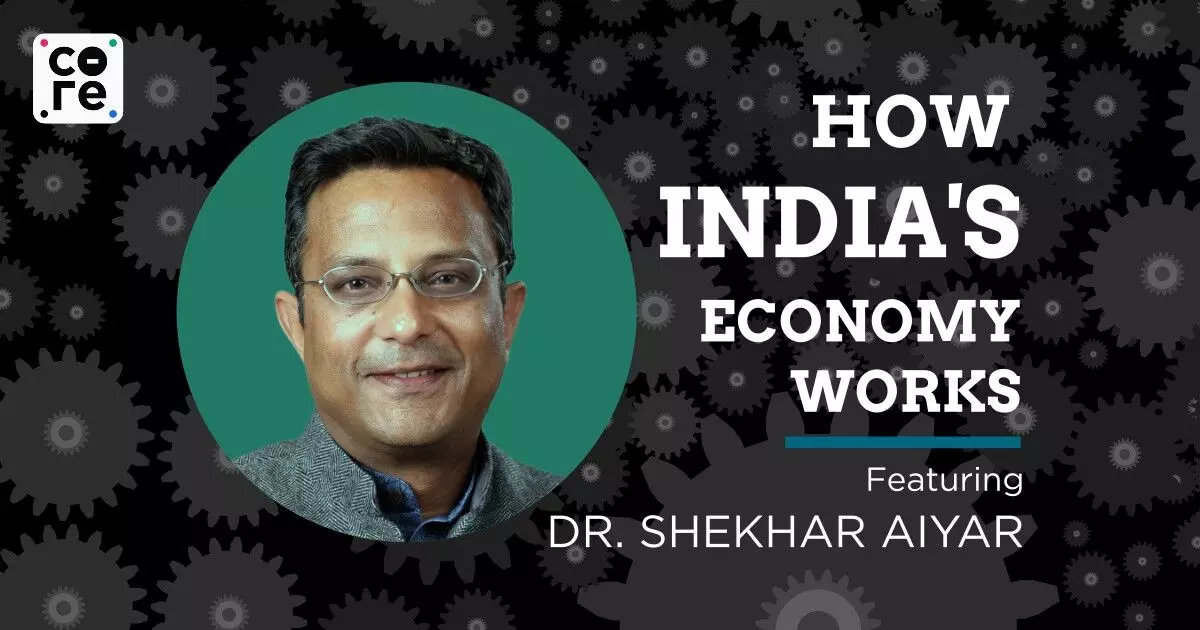
The Legal Setback to Trump's Tariffs is an Advantage for India. This Is How
- Podcasts
- Published on 4 March 2026 5:00 PM IST

Insights on the reshaping of India’s trade strategy
In this episode, journalist Puja Mehra speaks with economist Dr. Shekhar Aiyar about the recent US Supreme Court ruling that struck down the use of the International Emergency Economic Powers Act (IEEPA) as the legal basis for President Trump’s sweeping tariffs. As Washington recalibrates its trade strategy, Aiyar argues that the judgment is more than a legal setback — it reshapes the balance of power in ongoing trade negotiations, including those with India.
They discuss what this means for the current 15% global tariff, the earlier 50% duties imposed on Indian imports, and whether companies can realistically expect refunds. The episode also examines how the timing of the ruling intersects with India–US trade deal negotiations, and why India’s bargaining position may have improved significantly.
They also talk about the broader geopolitical implications of the decision — from the use of tariffs as strategic leverage to the erosion of the World Trade Organization’s dispute settlement system. As global trade becomes more fragmented, Aiyar makes the case for diversification, institutional reform, and a more assertive Indian role in shaping the next phase of multilateral trade rules. Tune in for insights on the reshaping of India’s trade strategy.
NOTE: This transcript is done by a machine. Human eyes have gone through the script but there might still be errors in some of the text, so please refer to the audio in case you need to clarify any part. If you want to get in touch regarding any feedback, you can drop us a message on feedback@thecore.in.
—
TRANSCRIPT
Puja Mehra: Dr. Iyer, thank you so much for coming to the show.
Dr. Shekhar Aiyar: Very welcome Puja, thank you for having me.
Puja Mehra: Dr. Iyer, what is the Supreme Court in the US saying, what have they ruled and how does it affect the Trump tariffs?
Dr. Shekhar Aiyar: So let me start by saying that this is a very important policy for President Trump. Nothing has more defined his second term than the widespread and very aggressive application of tariffs in a way that is really unprecedented since the post-war genesis of the WTO. And they have been applied to friend and foe alike based on a bewildering array of justifications that change frequently.
They range from remedying bilateral trade deficits, the so-called reciprocal tariffs, to curbing engagement with hostile third countries, like the sanctions on purchases of Russian oil, to pursuing geopolitical ambitions as per the remarkable, if promptly retracted threat to levy punitive tariffs on the EU because Denmark refused to cede the territory of Greenland. Now the legal underpinning of most, but not all of these actions and ultimatums is the International Emergency Economic Powers Act, IEPA, a law from 1977 that no previous president has used in such a sweeping fashion. It is this legal underpinning which the Supreme Court struck down about 10 days ago.
It ruled by a 6-3 majority that Trump exceeded his presidential authority in wielding IEPA as a trade bludgeon. Now on the face of it, the court's decision is simply a very plain reading of the text of the law. The fact that it arrives as something of a political earthquake speaks volumes about the speed with which Congress has been surrendering its legislative authority to the executive and the extent to which a conservative court has been deferential to that expansion of presidential authority.
As the small businesses that brought the litigation point out, IEPA doesn't even mention the word tariffs, and the power to tax imports is constitutionally vested in Congress. Now the court's three liberal justices were always going to rule this way. The surprise, if it is a surprise, is that a trio of conservative judges, Barrett, Gorsuch and Roberts, have now agreed with this logic.
And the majority opinion in fact was penned by Chief Justice Roberts himself, and it categorically rejects the president's power to quote-unquote unilaterally impose unbounded tariffs and change them at will.
Puja Mehra: So where does this leave the tariffs on Indian exports? What becomes of them?
Dr. Shekhar Aiyar: So, you know, unfortunately, this is not the end of the story. There's a long way to go. And what the court has done is it struck down IEPA, but there are at least three other instruments to which the president can resort.
Let me describe them very briefly. The first is section 232 of the Trade Expansion Act, which can be used to levy tariffs on national security crowns, as was done previously for steel and automobiles. The second is section 301 of the same act, which was used by both the Trump and Biden administrations to levy product-specific tariffs on China.
And the third is section 122 of the Trade Act, which allows temporary tariffs to address balance of payments issues. The White House has already, by the way, announced a 15% global tariff under this particular provision. But the thing to note is that all these three instruments are less sweeping, more time-consuming, and involve multiple procedural steps.
So section 301 and section 232 require a first and investigative report by the United States Trade Representative and the Department of Commerce, respectively. And section 122 tariffs can only be imposed for a duration of 150 days unless they are further extended by Congress. And as we all know, President Trump has been very reluctant to go to Congress to authorise any kind of trade action.
Another thing to bear in mind is that Trump administration is already stretching thin the interpretation of these acts. So if steel and automobiles qualify as national security threats, it's actually quite hard to imagine any product that doesn't. All we can say with certainty is that further litigation will follow.
Puja Mehra: If I'm not wrong, companies like FedEx have gone to court seeking refund of these tariffs. Can Indian exporters expect any refunds of the tariffs that have already been charged to Indian exports?
Dr. Shekhar Aiyar: I wouldn't hold my breath on that. Although the court ruled that AIPA was not the correct instrument for the President to use, they very clearly did not rule on the refunds. They sent that question back to the lower courts.
So if it goes through the lower courts, the administration will undoubtedly appeal the decision. And it will very likely, in my view, come all the way back to the Supreme Court. But it'll take a lot of time and a lot of effort.
Besides which, I think the major part of the tariffs was not really paid by Indian exporters, but by American importers. Now, from an economics point of view, this distinction is somewhat nebulous. Because when the two sides are bargaining about the price at which the transaction takes place, the Indian exporters will take into account that the US importers now have to pay extra amounts of money.
But as a matter of law, the tariffs were paid by US companies. So it's mainly US companies which will go for refunds. I don't think it will really affect Indian exporters too much.
One of the interesting things to note in recent times is that a bunch of hedge funds have actually bought up the claims to these cases. So if and when the refunds come, it may be that a bunch of hedge funds are actually the ones who get this money. But they have had to buy these refunds at cents to the dollar.
So if there's an adverse ruling against them, then the hedge funds tend to lose a lot of money. Either way, it doesn't really affect Indian exporters so much. So I certainly wouldn't hold my breath about that.
Puja Mehra: The refunds part probably doesn't. But the status of the tariffs and also what happens to the status of the India-US trade deal negotiations were sort of drawing to a close. How does that get affected?
Dr. Shekhar Aiyar: Yeah, so you're absolutely right, Puja. This couldn't have happened at a trickier or a more opportune time as far as India is concerned. So a mere two weeks ago, the two sides released this joint statement outlining the framework of a bilateral trade deal.
And then last Monday, they were supposed to have started detailed negotiations on translating that framework into legislation. That meeting has been postponed indefinitely. We don't know when it will take place.
Everyone's taking a breather and seeing which way things go. Now, in terms of what was there in the framework agreement, or in fact, what was there before the framework agreement, was that there was a 50% tariff on Indian imports, which comprised two parts. So one part was a 25% punitive tariff arising from India's purchases of Russian oil and a 25% reciprocal tariff.
The removal of the former and the reduction of the latter to 18% were the major concessions that the US side made to India. But because both the punitive and the reciprocal tariffs were under IEPA, they both stand void. So the tariff reduction is no longer a concession on the US side, but simply a fait accompli.
Now, as a matter of fact, if you add the old MFN rates of 3% to 4% to the new global tariff of 15%, that puts us in the neighbourhood of 18%. But that's a mere coincidence. It's no longer a magnanimous concession on the part of the US trade negotiators.
Now, I suspect that the US team will argue with some justice that the Supreme Court decision is only a hiccup and that alternative tariff instruments can be found and deployed at will, and that therefore the detailed negotiations should simply continue as if nothing's happened. But as we discussed a bit earlier, this is not entirely the case. Although they probably can find some combination of tariff instruments to replicate what they wanted to do earlier, it will now be much more difficult to do so, much more time consuming.
And in particular, it can't be changed at the whim of the president. So once it's been done, it's much more difficult to simply change it. It doesn't have the kind of flexibility that President Trump was exercising under IEPA.
One other thing to remember is that the US will at this point be keen to prove that it can close trade deals despite the Supreme Court ruling. So to put it very simply, India's bargaining position has improved dramatically.
Puja Mehra: Can the US administration still threaten trade partners, not just India, but trade partners with 150%, 200% sort of high tariff rates? Or is that also not possible under these three alternatives that you've just described?
Dr. Shekhar Aiyar: I'm not aware that there are any legislative restrictions on the rate of tariffs that can be applied, if that's what you're asking. And I do know that some of the product-specific tariffs which were imposed on China, for example, are quite high. So it can go high, but it needs an investigation.
So the United States Trade Representative's office will need to conduct an investigation, which typically takes several months. There will have to be a technocratic justification for why this constitutes a national security threat or a balance of payments crisis or whatever it is. And then typically, there's a period for comments.
So people can comment on the investigation. And just generally, it takes a long time. And then once you've fixed it, you can't just arbitrarily shift it around.
So it is a lot more difficult for the US side.
Puja Mehra: So that means that the tariff rates are likely to remain around 15%, is what you're saying, in the interim, while the trade deal is negotiated?
Dr. Shekhar Aiyar: As of now, that is the case. And my view, that's only possible for 150 days, because Section 122, which is the provision under which Trump has done this, only is legally binding for 150 days. At the end of that period, if we haven't reached a detailed agreement, then presumably that goes to zero.
Puja Mehra: And for it to be renewed, you said the administration will have to go to Congress for approval.
Dr. Shekhar Aiyar: The administration will have to go to Congress. But look, Puja, it's a very murky area, right? And this president has proved that he's willing to kind of act outside the playbook.
So although I haven't talked to any trade experts about this possibility, I don't see why he shouldn't allow the 122 tariff. For example, let's say it expires on a Monday. I don't see any reason why on a Tuesday, he can't simply do it again.
And then claim that it's not an extension, it's an entirely new measure. So who knows if this is going to be endlessly litigated. And I have a feeling that the Supreme Court is only seeing the beginning of its very difficult task in making sense of all of this.
Puja Mehra: All of which, as you already said, makes India's bargaining position somewhat improved from what it was before the Supreme Court ruling came.
Dr. Shekhar Aiyar: Absolutely.
Puja Mehra: So in which case, what would your recommendation be to Indian negotiators? How do you see these negotiations now playing out?
Dr. Shekhar Aiyar: So look, our bargaining position has improved, as I said, but we should use this leverage carefully. I think there's very little to be gained from publicly baiting a mercurial president who is smarting from the biggest legal reversal of his second term. Instead, we should be judicious about what we're pushing for and we should do it quietly.
You know, we could ask for lower tariffs on lines that are important to us. Things like apparel, footwear, and pharmaceuticals spring to mind. We could also see greater market access in areas like services, which are actually growing much faster than trade in goods.
The joint statement says that the two countries will establish a quote-unquote clear pathway towards digital trade rules. We could seek to shorten the timetable for that clear pathway. More importantly, I think it's a matter of principle, which is that we should strive to ensure that the bilateral agreement does not curb engagement with third countries like Russia and China and tries to adhere instead to the multilateral spirit of the WTO.
So India finds itself almost accidentally in something of a sweet spot when it comes to trade suitors. To all those countries that were seeking a China plus one strategy, we must now add those countries which are seeking to diversify away from the U.S. You know, Mark Carney's middle powers, so to speak. Many countries would welcome the prospect of strengthening ties with a stable, democratic, vigorously growing economy that is not identified with a distinct geopolitical block like the or the China block.
So we're in the sweet spot. We should strive to keep our options open to trade with partners from across the geopolitical spectrum, because this will ultimately help to insulate us from shocks arising from any given part of the geopolitical spectrum. Finally, I think we should be very careful about trying to walk back some of the concessions that we've made, because some of the concessions we've made are unambiguously in our own benefit.
This includes rationalising our Byzantine system of import restrictions of import licences and opening up to international standards. These are things that are beneficial for us with or without a trade.
Puja Mehra: In fact, I think one way of interpreting the way India has responded to what has happened over the weekend, the strikes on Iran, which the Indian opposition has sort of not welcomed. They have wanted India to take a more stringent stand on it, but we have not probably might be linked to what you just said about not antagonising President Trump at this point. But the larger geopolitical implications of the Supreme Court, US Supreme Court ruling, how do you see those playing out?
Dr. Shekhar Aiyar: So look, I think we've already touched on this a little bit. If you look at the current turmoil in the global trading system, it has really crystallised for a lot of people who perhaps didn't see it before, the advantages of geopolitical diversification in trade. So if you study finance at a graduate level, the very first, the fundamental tenet of building a portfolio is that the assets in your portfolio should not be overly correlated with each other.
That's called financial diversification. And I think a very similar principle applies to trade in a geopolitically turbulent world. So we should strive to kind of diversify our ideological links and be a good partner with everybody.
That's what the fundamentals of diversification are. There are a trio of university professors at Georgetown University who've recently come up with an index of geopolitical distance between any two countries at any given point in time, based on voting patterns of the United Nations. Now, the interesting thing is that if you take those geopolitical distances, and let's say you take, you know, you sum up the trade-weighted geopolitical distance with every other country in the world and take the standard deviation of that, that provides a very useful metric for geopolitical diversification.
When you do that for India, you'll find that we are actually one of the most connected countries in the world. Now, we don't trade enough. That's a separate matter.
So we don't take advantage of the enviable spread of trade partners that we have, but we do have that enviable spread, and that is something worthwhile, something we should strive to keep alive. We should keep that space open. And that goes back to what I said about making sure that any deal that we sign does not restrict our action vis-a-vis third countries.
I think that's the main lesson to draw from everything that's going on.
Puja Mehra: And last question, there is a WTO ministerial coming up. What would you say should be done there, keeping in mind this legal setback to the Trump tariffs?
Dr. Shekhar Aiyar: So I think, again, at the WTO, you know, it certainly seems hard times right now, but the spirit of the WTO is something that is immensely beneficial to countries like India. I think that rules of the game, standard rules that apply to everybody and are decided on technocratic grounds rather than the economic power of a particular country, this is especially beneficial to the global south. So we should strive to return to something like a rules-based system.
To be specific, at the ministerial, I think we should try to fix the broken trade dispute function of the WTO. So they have something called an appellate body, which is what hears and decides trade disputes between member states. Starting in 2017, the U.S. began to block appointments to this high court, and by the end of 2019, the appellate body lacked a minimum quorum of three members, and today all seven seats on the appellate body lie empty. So the crown jewel of the WTO, its dispute resolution system, has lost much of its shine. What we should do is to join hands with the Europeans and other partners to come up with an alternative dispute resolution system. There's already an embryonic form of this called the MPIA, which we should seek to strengthen and formalise.
And more generally, India has, perhaps understandably given our colonial history, always been a bit of a backbencher when it comes to setting global trade rules. We've been like the sultry kid with the backbenches kind of heckling the teacher, rather than actually taking part in the discussion and setting the rules. I think our circumstances have now changed.
As I said, we are an incredibly important trade suitor for a lot of countries. We are the most vigorously growing large economy in the world. Where we lead, others will follow.
So I think we should now take a leadership role in creating the new multilateralism.
Puja Mehra: Right. Thank you. Thank you so much.
Dr. Shekhar Aiyar: Thank you so much, Puja. Great pleasure to talk to you, and thank you for having me on.


