



 Newsletter
 Search
India’s Exports Jumped 45% in October. Can the Boom Last?
- Podcasts
- Published on 19 Nov 2026 5:00 PM IST
Insights on India's export ambitions and the future of its free trade agreements
India's merchandise exports have recorded seven consecutive months of double-digit growth, with October exports rising 45%. New free trade agreements, improved market access, a weaker rupee and efforts by Indian exporters to diversify their markets have all contributed to this performance. But sustaining this growth will require more than signing trade agreements and reducing tariffs. India needs to address longstanding weaknesses in trade facilitation, regulatory cooperation, logistics and the implementation of its FTAs.
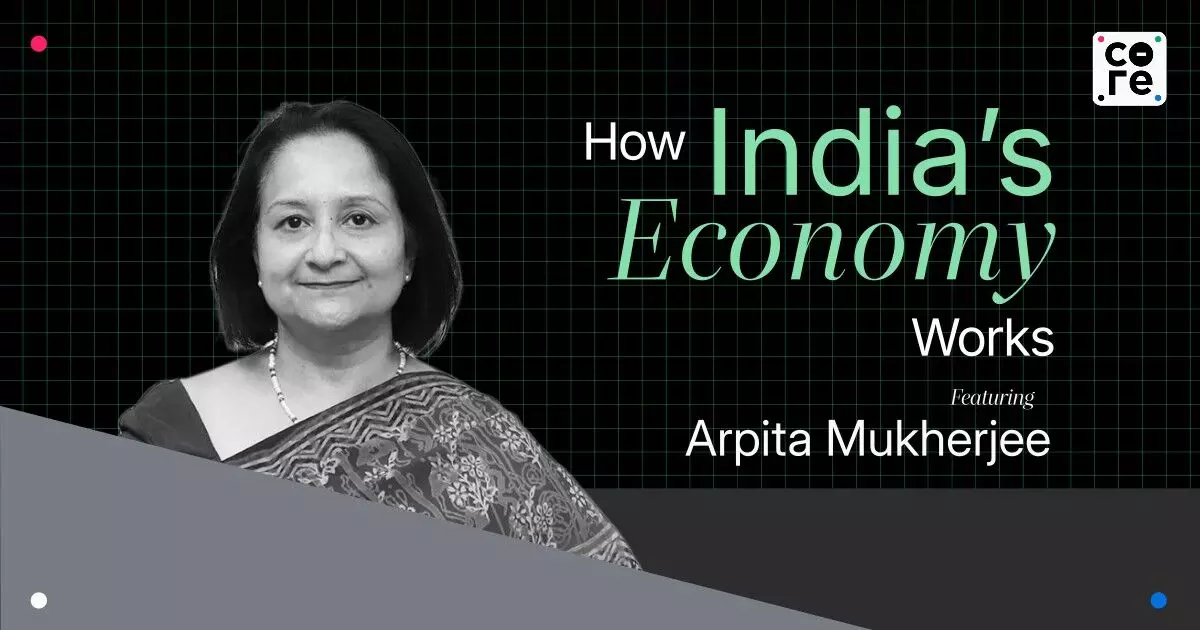
In this episode of How India’s Economy Works, host Puja Mehra speaks with Dr. Arpita Mukherjee, Professor at the Indian Council for Research on International Economic Relations (ICRIER), about India's changing trade strategy and the opportunities it needs to pursue. They discuss why India is yet to fully exploit its trade relationships with ASEAN, the reforms needed to make special economic zones more competitive, and why Indian industry must do more to identify and articulate the barriers preventing it from accessing international markets. They also examine the changing composition of imports, the importance of building resilient global supply chains, and how export-oriented manufacturing and rural product clusters could create jobs and livelihoods.
Tune in for insights on India's export ambitions, the future of its free trade agreements, the reforms needed to strengthen its position in global supply chains, and the opportunities to create jobs through international trade.
—
TRANSCRIPT
NOTE: This transcript is done by a machine. Human eyes have gone through the script but there might still be errors in some of the text, so please refer to the audio in case you need to clarify any part. If you want to get in touch regarding any feedback, you can drop us a message on feedback@thecore.in.
Puja Mehra: Dr. Arpita Mukherjee, thank you so much for coming to the show. I'm so glad to have you.
Dr. Arpita Mukherjee: Thank you, Puja, for having me.
Puja Mehra: I want to talk to you today about the exports performance that we've seen for the month of October, but also this is the seventh consecutive month of double-digit growth. In October, of course, merchandise exports grew by 45%. To begin with, let me ask you, what is driving this acceleration?
Is it a broad-based improvement across products and markets, or are these just a few blockbuster categories lifting overall performance?
Dr. Arpita Mukherjee: See, Puja, we are measuring the performance from April to October against last year's April to October. Now, last year, you may remember, the world was in a turmoil with the Trump tariffs, which kept on rising in August. So, last year was definitely not a good year for our exporters.
And this year is definitely a better year because this year, we don't have those tariff announcements coming in. We have a very positive announcement in the FTAs. Some of these FTAs are being implemented, and we are getting the zero-duty benefits.
So, we are getting our competitive edge back vis-a-vis our competitors in markets like the UK. So, there are many reasons which is helping us to actually improve the exports this year compared to last year. Having said that, if you look at the data for the last year also, October, November, because it is a season for Christmas, Christmas, festive season arrives in the Western world.
Therefore, your consignment generally shows even with the 50% announcement last year, you will see a hike in exports. The purchase season for that year in the Western world is between November till March. They have all their festivities during that season.
So, that's a very high boom season. So, that is how you have to look at both of this.
Puja Mehra: We are beginning to see the dividends basically of the new free trade agreements. Also, there is a seasonality to this rise. We see it every year.
Last year may have been an odd year because of the Trump tariffs. But this year, we saw some hold-ups and delays due to the blockage of the Strait of Hormuz. So, I want to ask if the impact of that has been outweighed by some of the other positive things like the signing of the FTAs.
And does the rupees depreciation also play a role here in making Indian exports competitive?
Dr. Arpita Mukherjee: See, the rupee depreciation helps. But also, I think the FTAs did help because you are getting price competition in many products like textile and apparel. You are getting zero for zero.
So, in gems and jewellery, these are the product categories where your imports have also become cheaper because UAE, you are giving it. So, somewhere there was a tax on our import also, which is we are importing, processing, exporting. So, all of that, if you look at these FTAs like with Afta, with UAE, you will see that the supply chain for some of these product categories, which are seeing a rise like gems and jewellery, is that we are able to go for almost a zero duty supply chain, right?
We are also not imposing duty. So, yes, the FTAs have helped. Rupee depreciation actually helps export, it reduces import, it helps services export.
So, there is many things that happens with the rupee depreciation, which is in services is a major export growth in this particular case. I would say the rupee depreciation benefit is more for the services, less for the goods. However, the points that you have mentioned that, you know, Hormuz is increasing the logistic cost, but government is now making logistics much more simpler also.
You know, India is trying to improve the logistics, resolve some of its logistic problem, like we have allowed inventory-based e-commerce export. Okay. So, this is good because if you do not have that many volume, you can just fly it out.
Now, the Hormuz problem has made it very competitive to fly things out often. Probably, if we reduce our ATF, our exports will be more competitive today. So, I would rather say like, let us focus on ATF now, and let us look at if we can reduce ATF, so that, you know, we can make this export very, very competitive, and we operate across all challenges, because your over-dependence on C is going to be a little dicey.
You should be able to use every channels to export. Now, coming to the Hormuz problem. Hormuz, actually, while there was issues, they did not really impact India.
India geo-strategically handled it very well. That is where I think we did the job well, in terms of we were not stopped. Cost increased, but we were not stopped.
Time increased. Everybody accounted for the time and cost. Everybody shared the time and cost, but the good part is that we also diversified our export market.
We really put in an effort to diversify, and Puja, here, I would also say that the companies have really worked hard. They reduced their dependence on US or one or two markets, and when they diversified, exports started increasing.
Puja Mehra: So, ma'am, you are saying that the government and its policymakers turned what were challenges into opportunities, and our exporters took advantage of that.
Dr. Arpita Mukherjee: Yes, they took advantage of that, and they themselves did a lot when things are not there. I give you an example. European Union has been announced.
Now, it is debated in the EU Parliament, so that FTA has not been signed, totally completed. It can be opened up also, and next year it will be implemented. But look at our export growth to the EU.
The exporters are trying to grab, understand, move forward, all the publicities of the government efforts to train people on FTAs, all of that together is creating a boom situation.
Puja Mehra: That's very positive. Let's move to the discussion on imports. The import bill has also risen sharply, and I read reports that say the increase is attributable to higher global energy prices and also seasonal gold demand.
But is that just the complete story, or when we look beyond oil and gold, are we also seeing a rise in investment or perhaps even consumption-led imports?
Dr. Arpita Mukherjee: See, the biggest problem is that we are importing different types of things. Let me go to the different types of things that we are importing. One is that, yes, our energy fertiliser, every import is very, very high, and that is going to see a pinch in the budget.
And that's why you may have seen, even the Prime Minister told us to reduce all this fertiliser and chemical fertiliser and all of that. So, there is a panic. Even with the gold, there is a panic, right?
Because we hold a lot of gold, that's why there was an announcement not to buy gold and stuff like that and hold it. Now you come to import is also increasing of many electronics. We are setting up data centres and all the electronic equipment.
So, we are also exporting, but we are exporting say mobile phone, but we are also bringing in hardware for our own domestic use. And that is where we are not manufacturing everything, like we don't manufacture so many laptops and stuff like that, which we need if your sectors have to grow. Now, I don't think those imports are bad.
As an economist, I would suggest that if I am doing something where I need to set up things for my upgrading. So, if I'm doing chip manufacturing, if I'm doing data centre, if I'm doing GCCs, I will need certain type of imports and those imports, I call them good imports. Where I am very worried is that still, you know, our fossil fuel dependency is very high and our cost of renewable is very high.
So, therefore, although we are very well placed to move to renewables, our cost is high. Therefore, if you look at pan India, that movement is pretty slow. And as a large country with increasing demand for transportation, car, et cetera, and the linkages, the transportation links are slow.
If you look at metro development in India, it is much slower than the need. Like if you go to Chennai, look at OMR, 10 years they are developing it, four, five years. No, you have to do it very fast, time bound, because it's not like people are using transport out of choice.
People are using transport out of necessity. Our domestic energy consumption has to be very targeted, project driven and needs to be reduced.
Puja Mehra: And our public transport policy alongside a renewable energy policy framework will probably help reduce the oil deficit and the dependency on imported oil. But the other point you made is very important. What you're suggesting is that India's data centre boom is contributing to an increase in electronic imports, particularly components and computer hardware.
And this is a phase. Subsequently, these very investments are likely to generate additional services exports. Therefore, going forward, the FTAs will see perhaps a further increase in merchandise exports.
We should expect over the years, good growth in services exports as well.
Dr. Arpita Mukherjee: Yeah, I mean, actually, it's not an automatically going to the services export. I may add my little bit that, you know, services sector of India is very IT dependent. And IT export, we call it services export.
OK, IT is only one component. What we need to do is that we need to find out why are we not able to export other services. If you ask me, my logic will be we still get a lot more export revenue out of the health care patients which we should be getting.
OK, we spend so much money on traditional health care. So much money we have. I mean, we don't get that kind of effect, that kind of an export.
The products are not being exported. Visas are not taken. Services is very low.
That is because the industry is not pushing in the right direction. And I always say there are a lot of things that the government is doing, commerce ministry is doing, prime minister is doing, but the industry is not asking for what it needs. Industry has not been very straightforward.
They have to come out and ask that, you know, I need this in this market. And that is how the I'm talking about the USTR report, right? American companies and the European Union trade barrier report, their companies come out and say that, you know, I need this and that material gets done.
So therefore, the companies in India so far just came back and say, I need my sector to be protected. You know, they have to now in an FTA phase, they have to come back and say, I need this to be opened up. I need that barrier to be removed.
And once they start doing this, export is, you know, Indians are very hard working and they are very good interpreters. So I don't think export is a problem.
Puja Mehra: I'm reminded of a few examples. For instance, Visa and MasterShare went to USTR and complained saying India does not offer a level playing field. Harley Davidson did the same for motorcycles.
You're saying that Indian companies are not, especially in the traditional medicine sector, that is Ayurveda, yoga, etc. They're not saying what they would need for them to have a level playing field. In fact, there isn't a question of level playing field.
There's a question of making inroads into newer market.
Dr. Arpita Mukherjee: No, no, they are not doing it in many areas. They are the ones like, for example, India has signed FTAs where we are talking about movement of traditional doctors, Ayurveda, nurses, etc. We do not have a caregiver guideline in India.
How are we going to do mutual recognition agreement? Now, this is something the government does not do. Commerce Ministry cannot do.
Line Ministry will not move forward until the industry comes together to ask for it. Of course, industry also thinks that if you do a lot of marketing, if you say we are doing great job, that helps. But in a modern world where everything is going very high technology, you look at a dress design, it is talking about AI and everything.
You talk about technology, you talk about standards, you talk about moving forward. The industry needs technology standards. Industry has to come together to tell the government that I need to have something like UAE is doing digital product passport.
And the Korean industries have come together to say, look, I need something, a government run system like that, which talks to the European Union system. And then, I am uploading in my government websites and kind of a stack and they approve. So, it is an intergovernmental talking systems.
And I need that. I need this system to be operational now. Now, I want all systems to be paperless, cross border.
Now, industry has to ask for it. In India, industry doesn't move to that extent. Industry are doing things, but they don't move to that extent to tell the government, look, there are international systems, other countries, like China is doing that.
China is doing a DPI system. What I'm trying to say is that, how do I improve my DPI to make it cross border is something which is a Chinese industry ask. I have seen it is a Korean industry ask.
I am seeing in case of India, I'm seeing that industry comes and says, OK, I am doing this, you are doing that. So, it is all very fragmented. It is not an intergovernmental ask to reduce the cost drastically of cross border trade.
Because cross border trade cost is actually depending upon customs, agreeing on customs, right? Regulating agencies agreed. So, these people have to now come into the common platform.
Puja Mehra: Could it be, ma'am, specifically in the case of traditional medicine that because the industry is not as organised as some of the other industries?
Dr. Arpita Mukherjee: No, no, no, it is not like that. It is basically because the industry lacks a vision document and a study to move forward. As of now, they are being promoted more by publicity and they have seen a very good result of a publicity.
So, people did not know about India and yoga. They knew about India and yoga through the yoga day, etc. So, but however, if I have to be treated medically, there is two things.
One is I can do an Ayurveda massage. OK, I don't need anything around that. But if I have to be treated, I have to get the product approved by FDA and all the UK and all of that.
That is the part which is missing. The service sector is not interested in that part. The product sector is interested.
The service sector is thinking that if I get a patient, I'll treat the patient here and I will make some money because foreign patient makes higher money. However, the patient will not come because they cannot do their post-operative care process. OK, this is the problem.
And here I would rather say it is also inter-country problem because when you go to push a product which is approved in many countries, for example, Ayurveda product is approved in India, Nepal, Sri Lanka, we should go together to push the UK rather than each of us going on our own. So that or else we spend so much money like China spends on pushing Chinese medicine, which is difficult for us. So my logic will be let's go together for something that we are together.
Like, you know, if you go together, it is very easy to get approved.
Puja Mehra: So we are doing well, but there is potential to do so much better if all of these things that you're suggesting get done. I also want to ask you about the India-ASEAN summit for which PM Modi is in Manila. It might be a useful occasion to ask whether India is making sufficient use of its geographical proximity to this very dynamic trading region to expand its exports.
Trade with ASEAN is substantial already and both India and ASEAN are now reviewing their trade and goods agreement. What do you think would it take to make this relationship an even stronger driver of Indian exports?
Dr. Arpita Mukherjee: See, India's relationship with ASEAN is both geostrategic, economics. We'll have to look at investment flows and Singapore is one of the largest investors. So we have the trade agreements.
They are pretty outdated. They need to be updated. No doubt about that.
Our trade agreement with ASEAN is much weaker, lower in terms of rules of origin, in terms of other activities than RCEP, which actually collates all the rules of origin, giving Chinese product an advantage. And China's individual trade agreements with ASEAN, each of those agreements are much better than any of our agreements. So no doubt we need to look at it.
We also need to look at ASEAN from the point of view of our changing manufacturing pattern. India is trying to move into high technology manufacturing, advanced manufacturing, clean technology manufacturing. We have not looked at collaborating with ASEAN in that manner.
For example, I am actually doing one study on whether we at all think about cross-border trade and investment on the healthcare product segment. And these are real gaps in our connectivity in ASEAN in particular and the APEC to be more wider. Now, the point is that we have a lot of discussions.
We have a lot of targets. We also know what needs to be done. You know, two days ago, RIS released a very thick report with all the things that need to be done.
Where we really fail is to actually monitor what we see in various summits. We monitor the target, we monitor the implementation, we monitor the issues. We call all issues non-tariff barriers.
They are not so. All issues are not non-tariff barriers. There is immense cooperation possibilities.
Like in some cases, we would like to, you know, like ASEAN countries to take UPL. However, maybe we will first have to do a custom cooperation agreement so that, you know, trade in India rupee to happen, that first customs have to agree. So, sometimes we need to put in place who has to come first and then who has to be the next person in the line.
So, those are the things we need to think through. We put everything in the agenda for the discussion. We need to prioritise, let's say, top 10 and move towards those top 10 agendas for collaboration and cooperation.
Our internal study shows that we have a lot of synergies with ASEAN and ASEAN needs to be looked into from that angle of building trust and partnership. We also compete with them, right. We compete with Vietnam significantly in any other markets and so does with many other ASEAN countries.
So, where can we build synergies, where can we build collaborations, where regulatory cooperation, what can be on harmonisation of standards, all of that needs to be thought through. And I think our potential in ASEAN is very huge and we are not using it.
Puja Mehra: So, if I understand you correctly, what you're saying is that we need to think at two levels, one at the strategic level and the other at the very day-to-day policy making and implementation level which reflects the decisions that have been taken at the top regarding not just the ASEAN trade agreements but also all of the other FTAs that you've described.
Dr. Arpita Mukherjee: One thing I am realising more in the context of our FTAs is that FTA signing is not a problem, tariff reduction is also not a problem. All the other chapters are not happening. For example, if you look at India, all our FTAs, only one mutual recognition agreement has been signed with Singapore in nursing.
Now, how many nurses are you going to export to Singapore? We have to understand that after signing an FTA, we need to sit on both sides. I'm not blaming India alone for that.
On both sides, we need to sit and first find out whether there is an agency on the other side or not. And that's how my Ayurveda came into the picture because I found in most countries, there is no agency to evaluate the qualifications. First of all, that is the problem.
So, if I have mobility, I need an agency on the other side, I need to put in place certain harmonisation. ASEAN in this case is a model. And why I'm bringing ASEAN is that ASEAN has put in a lot of effort to harmonise the processes and standards in their ASEAN.
And that is something that we need to really focus on how we leverage that and kind of seal that in our trade agreement.
Puja Mehra: Ma'am, what you said is so significant. Economist after economist comes on my show and they say that India is protectionist. India does not like to reduce tariffs, especially the change in approach around 2017 or so.
And economists say that we and we've also seen that we've for many years not been able to close FTAs. It's only recently that we are beginning to close FTA negotiations and sign agreements. What has changed or what is it that you're seeing that other economists are not seeing?
Dr. Arpita Mukherjee: See, everybody is seeing it today. Probably what we haven't, we used to use customs for three reasons as a source of earning revenue. So as a source of protecting the domestic industry and also learning from some other countries like who had protected the industry and the industry grew.
But unlike those countries, what we have done is we have protected the industry. The industry did grow in some cases like automobile, but once your industry is mature, you need to build up very mature supply chains, which we miss. Some of the domestic reform that helps countries to grow in India is a bit of a limbo.
I would say the SEZ policy. There are two areas which India really need to focus on now to drive on its export growth. One is the SEZ policy.
SEZs actually have been the driver of growth globally. With the WTO not doing anything much, we really need to have a very modern SEZ policy, which is not linked to import substitution or export growth, where incentive is linked to R&D, high technology, high growth, like the GCCs. And we bring in a very easy in-out model for less import duty and out because FTAs in which we are reducing the import duties.
So that is something if we can do and make our existing SEZs as competitive. If you give your SEZ the lowest FTA, believe me, everybody is going to come and manufacture in India. The other point where we really are not taking it very seriously is the investment agreements.
Of course, there is need to customise them in our favour, but with the UK, with the EU, with any other countries, we have not really cracked that. If we are able to crack that in December, like we are talking about with Oman, with other countries, if we are able to crack a few investment agreements by December, I think then bigger long-term investors who are investing in infrastructure and have long gestation period, they are likely to come.
Puja Mehra: Ma'am, what do you think is needed? Greater ideological clarity, administrative capacity or bandwidth or industrial ambition for what you're saying to happen?
Dr. Arpita Mukherjee: I think we have the ambition. At the top level, there is ambition. So therefore, I am going to give ambition the lowest ranking.
I think where we lack is inter-institutional collaborative platforms, regular monitoring, certain things which enables the benefit of the FTA to move forward. For example, trade facilitation, I would call digital trade facilitation and custom reforms, the next generation one. And sometimes, looking at examples of what other countries are doing.
So, India may be doing a lot of good things and I think we are doing a lot of good things, but is this enough? Because if I am progressing and implementing something, the other countries may be moving much faster than I am. So therefore, sometimes cross-country comparative lookout for what they are doing probably to harmonise the standards, improve the processes, regulate us to talk to each other is a good example for us to look.
We have our systems in place. And just to give you an example, when we came out with this online payment system, UPI, everything, onboarding, they were all different institutions, right? Overnight, they onboarded into our system.
Why can't we do that for export and import of, say, agri-product? Let's do a pilot on that. Why are we taking so long to integrate, you know, the SEZ IT software with the express IT software, with the ice gate software?
So, we have three parallel railway lines for exports and imports. Why do we need that? We need one line where the IT can separate out the products, right, through the channels.
So, those are very minor things. Indian companies are doing that everywhere. And we can definitely do it in our country.
You are saying we need an Indian trade stack, like we have the India stack. Think about the Bharatnet portal and everything. We need about, that is a mandatory requirement.
You may have heard Honourable Finance Minister talking about CII's integration in two years. She has given the go-ahead. The go-ahead is there.
Now, the process has to move fast on a time-bound manner. Every month there should be a review to see what has happened. We have a lovely National Trade Facilitation Action Plan.
It talks about a lot of surveys and reviews. We have only done one survey, which is team-based surveys, and people come and say what they have done. But there is no monitoring.
There has to be third-party monitoring to see. What I'm trying to say is that when monitoring and other things are done, things move very, very fast, because then they are questionable. Like how Delhi Metro Rail was made.
If we can make that for our cross-border trade, that would be lovely.
Puja Mehra: We've seen improvements. I don't know if our listeners would know, but now many mandatory clearances such as environment and protection, etc. are just given in a paperless way based on trust, given some disclosures are made by the importer But I want to go back and ask you once again, has the ideological question been settled that exports are good?
Because for a long time, we were once again hearing things that the Indian domestic market is so large, we don't need exports, and the focus therefore was only on high-end exports, high-tech exports, because we had a trade deficit in that segment, just like for gold, etc. So, that was all addressed keeping in mind the external account. But has, by and large, the ideological battle been settled in favour of exports now?
Dr. Arpita Mukherjee: Puja, the world that we are living in talks about one thing, be it US, be it EU's Accelerator Act, be it India, you name a country, they talk about one thing, make at home. Now, the export is bad, import is good, they are all subset of make at home. So, the point is make at home, secure your supply chain, have full control over critical mineral is the world that we are living in today with geopolitical tensions.
So, the theory today has not changed that export is good, import is bad or whatever. That theoretical framework has shifted to make at home. So, the theoretical framework today that everybody aims at, and logically I as an economist would like to also aim at, is how do we make India a bigger player in the global supply chain which is resilient, and how do I secure myself against all the geostrategic tensions which are unpredictable.
I did not predict Hormuz, and no, Oman did not predict that being a mediator it will be bombed. So, we discuss a lot with various trade partners and when I mention this thing that I want to protect myself, we had a good laugh with the delegates from Oman because they never thought that the Middle East is never going to be the Middle East like it used to be. So, you have to be resilient, you have to quickly change and export and imports are babies of this change.
I will call you to the broader changes that we wanted to, with the COVID, we decided and much earlier we decided we have to make more in India, that has been the focus. Why we have not reached that should now be the focus.
Puja Mehra: Anything ma'am that you want to say that strikes you the most as surprising or unexpected in the October trade data which tells us about the direction and quality of India's external trade which I may have missed out in this conversation?
Dr. Arpita Mukherjee: No, I don't think so. I immediately told you the first point. October always, if you look at last year's media also, you will find that October always shows a spike, September-October because you are delivering to the orders that were placed around August.
So, therefore, October is a good thing, it is good to be continuous, it is nice to see a boo. We are a bit worried, see everybody is a bit worried about some of the core markets. EU is not doing well in terms of its GDP growth.
US has, despite all its policies, have not seen a big growth. So, therefore, there is a bit of a tension relief also with the new US political developments. So, there are certain tension reliefs also that many drastic and sporadic things may not happen.
The world now needs a bit of predictability and growth enablers. Now, I'm talking about every market, even for the European Union market that I work very closely with, companies are tired with the European Union coming every day with their new directives and regulations. So, therefore, they are constantly trying to meet the requirement and that is increasing their cost and whereas the market is slowing down.
We also have our own set of problems. We have our problems of a huge population and a big unemployment as technology develops, modernisation happens, advanced manufacturing happens, you are not going to create mass scale employment for unskilled and low-skilled jobs. So, jobs is going to be a major issue.
So, there are many destabilising factors. I don't think import is ranked anywhere near the top 10 among the things that the government needs to worry about. Government is very worried about the budget deficits because of the fertiliser and other energy.
So, these are major budget deficit items and next generation, things will be more into investment, into green grids, green technology, reducing your day-to-day expenses of imports.
Puja Mehra: So, you are saying that we have to be strategic about our imports because they will help us build our economy over coming years. When I say build economy, what I mean is that create jobs, create export capacity, grow the GDP.
Dr. Arpita Mukherjee: Yes, and some of the items that the government has already identified a lot of items. Now, I'll just give you a last example. See, we have a lot of potential in our villages.
We can do a lot of creative exports from our villages. Now, the product has to be customised and a village, you know, handicraft person doesn't know. How do you consolidate those products?
How do you customise those products? How do you standardise those products? Market by market studies have to be done and that is not being done.
How do you enhance livelihoods of rural people? You know, these will automatically lead to export. Now, if you just tell people that you manufacture agarbatti for export, they cannot manufacture agarbatti that meets export requirement.
If you go to Vietnam, Vietnam doesn't manufacture agarbatti everywhere. They have put in clusters. They put in cluster-based development programmes and that is something India needs to really look at developing say cluster here for certain products and that is the cluster that gets certified.
So, you easily move that product out of that cluster into an international market and that those are the kind of things we need to really think through. We have identified the products but we haven't thought about where these clusters can be located. Amongst say 20 clusters producing coffee, can I identify three or you know tea like that and then you have to upgrade those clusters.
One good example is that of Tiruppur. They are doing a lot of work in Tiruppur in textile. Maybe we have to do product product clusters mapping and upgradation but if we just do one district or one product district as export hub, that's very very broad.
You know, that's very very broad and then you need to bring in the investment, you bring in the development, you have to monitor the growth. They require a really close eyes monitoring and hand-holding.
Puja Mehra: That's something for policymakers to think about how to not only grow exports further but also ensure that that will create jobs including in rural India at the village level. Thank you so much for this conversation, Dr. Arpita Mukherjee.
Dr. Arpita Mukherjee: Thank you very much.


