



 Newsletter
 Search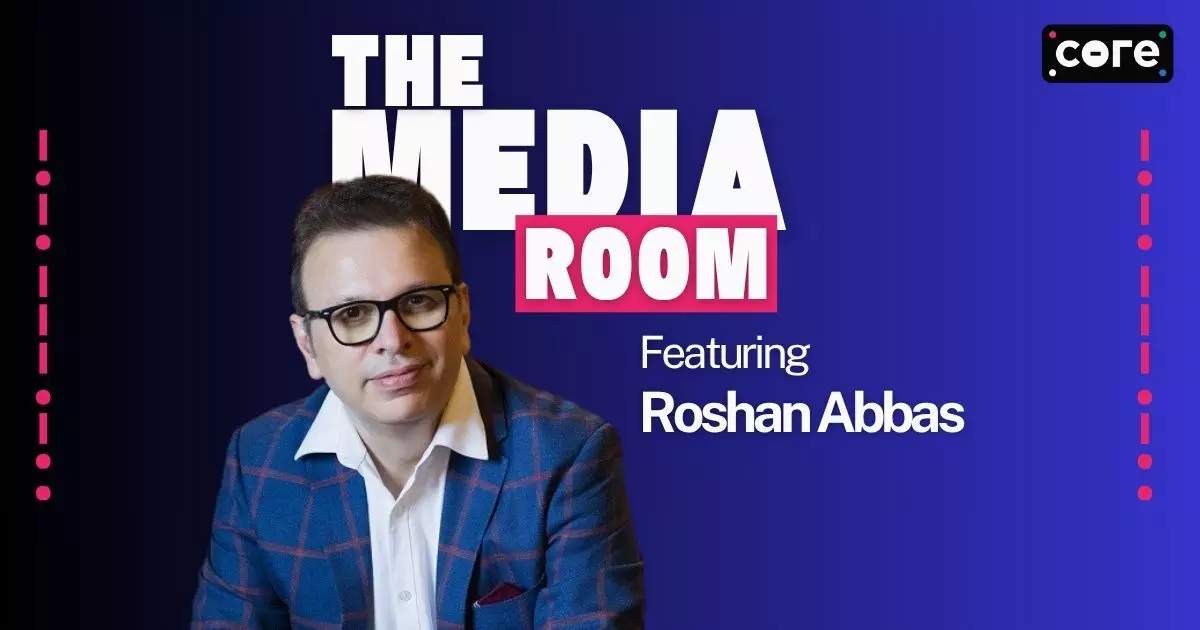
Roshan Abbas On Live Events, AI And The Creator Economy
- Podcasts
- Published on 17 Jun 2026 5:00 PM IST

From Indradhanush to AI, Roshan Abbas reflects on creativity across generations
Roshan Abbas on live events, AI and the creator economy is a sharp conversation on how India’s media business, entertainment industry and creative economy are changing as artificial intelligence, digital creators and live experiences reshape what audiences value.
In this episode of The Media Room by The Core, Vanita Kohli-Khandekar speaks with Roshan Abbas about India’s live events industry, the future of AI in media, and the changing creator economy. From radio and theatre to television, events, films, digital platforms and Commune, Roshan reflects on a career built around storytelling, audience connection and creative entrepreneurship.
The conversation explores why live events in India are growing again, why collective experiences still matter, and why creators must balance short form content, long form storytelling and audience trust. Roshan also speaks about AI generated content, artificial intelligence in the creative industry, digital creators, influencer marketing, content curation, creator burnout and the ethical questions around using AI as a creative tool.
He also shares lessons from investing in creative startups, building networks, spotting opportunities in media and entertainment, and why the future may belong not just to creators, but to curators with taste, judgement and human insight.
For professionals interested in business, media, marketing, consulting, technology, entertainment and India’s creative economy, this is a conversation about why creativity still needs people, why live experiences are becoming more precious, and why human intelligence may matter even more in the age of AI.
Subscribe to The Core for sharp conversations on business, media, economy, technology and culture.
#RoshanAbbas #CreatorEconomy #ArtificialIntelligence #LiveEvents #MediaBusiness #TheMediaRoom #TheCore
NOTE: This transcript is done by a machine. Human eyes have gone through the script but there might still be errors in some of the text, so please refer to the audio in case you need to clarify any part. If you want to get in touch regarding any feedback, you can drop us a message on feedback@thecore.in.
—
TRANSCRIPT
Vanita Kohli-Khandekar: Hello and welcome to The Media Room. Our guest today is one of my favourite people in the business. Roshan Abbas has been around for, I do not know, longer than I have been around and he has been part of the creative ecosystem as a writer, as a creator, as a radio jockey, as a filmmaker and a whole lot of other things.
His interests and knowledge, he calls himself a creative entrepreneur, but really his interests and knowledge make him one of the best minds to dig in when it comes to discuss or when it comes to talking about the creative economy and creation itself in this particular age. More on this with Roshan Abbas. Hello and welcome to the media room, Roshan.
Lovely to have you here with us. I think I have never had you on my podcast before. No, no, not at all.
We have not spoken on camera, we have spoken off the camera for print before.
Roshan Abbas: We have had lunch, we have had conversation, lovely lunch.
Vanita Kohli-Khandekar: Lovely lunch, okay. It was a five-hour lunch, I remember that. But Roshan, first, you are doing Indra Dhanush, a solo show and it is doing very well.
Please tell me a little more about it. I have not seen it yet, but do tell me about Indra Dhanush first.
Roshan Abbas: So, you know, Vanita, I think in some form it is a culmination of a lot of things that I have done. My career in the media started with radio. I did theatre before that, but theatre to radio, radio to television, television to events, events to film, film to digital, digital to commune.
So, that has been the entire journey. Because I am friends with a lot of people who now do solos, whether it is, you know, a Nayab or a Zakir or any of these people, I spent a lot of time around them. And when I see these people, I would often go and see their shows and watch them to see how these people just use a mic and a stage and whatever are their words.
So, I was like, you know, being from theatre, I believe that a certain amount of stagecraft, you know, could really add a value. So, I would occasionally say, what do you guys do with the lights? Why don't you do this with this and whatever?
And many of them would turn and say, sir, that is your department, our department is different. So, I think last year in December is when we started talking about saying, so I am often called to speak and I do some motivational things, I do storytelling. So, my manager in Amol, who had worked with me earlier at Commune, he was like, let's do something new.
So, he says, why don't you do a show about storytelling? So, it started from there. But when I started compiling the stories, I was like, hey, listen, this has really got a three-act structure.
It's got a great narrative arc. And I haven't done theatre since I did Monsoon Wedding in 22 with Meera Jain, the musical. And I'd done Aladdin before that.
And I was like, yeah, I really feel the need to go back to stage.
Vanita Kohli-Khandekar: You did Babasaheb Ambedkar's also something.
Roshan Abbas: Which I was the creator, producer of. I was involved with the writing and everything else or whatever. But again, like, see, every time, and my friends all know that when I'm inside a theatre, I am most alive as a performer, as a creator, and actually also sort of keeps my, just keeps my creative juices going.
So, just the thought of doing it was exciting. Then when I compiled it, I realised that life itself has so many chapters. So, I said, you know what I'm going to do?
I'm going to do Lucknow to Radio. For two reasons. One is that a small town story is such a great story to tell.
The second is radio is something which to anybody over 40 is a part of their life. To anyone under 30, it's like, what is this? Because they really haven't heard it.
So, the challenge is A, to make it relevant to the people who are under 30. So, I crack all kinds of funny jokes in between about radio. And on the other side, with people who are over 40, the minute they walk in, I know they are my audience.
Like, they hear the first song I play in the pre-function area. I play All India Radio jingle. I mean, I can see, I just see the smiles.
And you know, in a world which is so, you know, this entire thing of being so brittle, so fragile, so volatile, nostalgia is what everyone is going back to. So, as a business person, my mind was, let's do something on nostalgia. As a creative person, I said, this is my life story.
So, that's how I started. And then, you know, it developed into, oh, we'll do a 60-minute. Then I said, yaar, 90 minutes se kam nahi ho raha hai.
And now, I do a solo without an interval for sometimes even one hour, 40 minutes. And I just go. But I manage to.
And it's great fun. It's great fun because I bring everything I've learnt. I mimic.
I act. I sing. I do my radio bits.
I do my storytelling. And it's just, it's like doing a solo memory broadcast, as I call it.
Vanita Kohli-Khandekar: But you know, you mentioned Zakir and Zakir's work. I always think he'll run out of material because usne abhi bachpan se, gyaarvi tak, phir radio, phir kaam tak, kar diya. Ab aage kya cover karega?
Roshan Abbas: Hum logon ne mazaak pe ek baar yeh baat karegi. Toh kehta hai, kehta hai, abhi bhai bache hain. Parivaar bache hain.
Shahayat ab tak koi joke abhi, there'll be a partner also. So, we also have a good running joke on this thing, Zakir. Do-do saal ho gaya.
Do saal, do saal, do saal, do saal.
Vanita Kohli-Khandekar: Where's the material now?
Roshan Abbas: Abhi tabhi 6 saal ke liye aur hai. So, I'm like, yeah.
Vanita Kohli-Khandekar: No, but in many ways, I think this is a culmination of so much of what you've done from, you've written a book also. I know that you did a, you do all those workshops you do for corporates. So, culmination of all that.
Isme se agar mein bolun ki Indra Dhanush karte bak, what are the 2-3 big things which sort of, you had your Aha moment, your Eureka moment or something?
Roshan Abbas: I think the first thing was that a very dear friend of mine, Viraaf Patel, who's helping me with the writing. So, Viraaf actually after watching the first show, came to me very sweetly and mere 2 naam hain. I'm called Abba, because Abba.
So, S-R-K, Abba. Sabka Abba, Jagat Abba. Doosra, my other moniker is Jhaapana.
Jhaapana kahe ra, Jhaapana ko apne Navratan collect karne. So, I love talent, I love creative people and I actually spend so many days with people like that. So, Viraaf is one of those really lovely people and he's such a good writer.
So, he came up to the first show and said, Jhaapana, kuch jagon pe na aapka charm show ko carry karta tha. I said, you mean? He says ki no, I think there are more things that can land.
And you know, he actually started sitting with me and investigating and said, why did you want to leave Lucknow? Why did you want to get on radio? What was it?
And you know, at one point, we finally, you know, it suddenly strikes you saying, mere ghar ke bahar ek telephone pole pe, there were all these wires. And I said, you know, Viraaf mein amesha wo dekh ke kehata tha, that yeh isme sabke taar hai, lekin kisi ko pata nahi kaunsa taar kiska hai.
Vanita Kohli-Khandekar: Correct.
Roshan Abbas: And I think somewhere, the fear of dying with anonymity was something, I suddenly realised that when I was four years old, I got on stage and I always joke say, I got on stage when I was four, never got off. But I think a lot of it had to do with the fact of saying that I've seen my parents, they meant so much to so many people because they were teachers. But I, the minute I was on stage, I said, this is my space.
So I think a being able to discover what your real want is, your want is to perform, your want is to be on stage. So I think that is a big realisation for me, because at various points in time, it is like, is my want to tell a better story is my want to fulfil people's creative careers, my want to build commune as a platform. All of these things used to come.
But I think one big realisation for me was this, that this is where I my own need comes from. And I think any creator's need maybe comes from. The second two, three things, I think one was the fact of saying that how contemporising things, there's a line I use, by the way, that's why I know I start by saying, Lucknow, 70s mein, toh mai kehta hu, woh era jab petrol nabhe paise ka tha.
Right? And the audience, right?
Vanita Kohli-Khandekar: Bread do rupay ki thi, mujhe yaad hai.
Roshan Abbas: Cheeke, ab mai jab yeh line bolta hu, nabhe paise ka tha, uske baad by chance on the first show, it said, now trump that. People just went nuts, because he suddenly have contemporised the 70s with the Trump reference. And it became so like, I have to pause because people really just keep laughing.
Or, or if I talk about, you know, mummy put something on the gas, and then I say, woh zaman mein gas thi. Right? Now, I'm just passing a little comment on what's happening socially around you.
But the joy of being able to contemporise your narrative as a creator was something that I learnt. I mean, because when I see stand-up comedians, etc, I was like, why are they so relevant? How do they, it's not just their POV, it's how their POV relates to their audience that I found so unique.
Vanita Kohli-Khandekar: And they straddle across audiences. That, that is the thing.
Roshan Abbas:
And that, I mean, you know, two in one. Ab mai two in one ki jab baat karta hu, toh mai, you know, like, ab aapko ke liye mile liye two in one kya hai? Radio with a tape recorder.
30s se kam ke logon ko pata hi nahi tha. So, one girl asked me, saying, Sir, what's a two in one? I'm like, oh my God.
So, now I turn and say, two in one, aapko relationship status nahi. Then they go, haa, young kids, because, you know, they understand relationship status. Then I explain to them, saying, you know, it's when Spotify meets YouTube on the same thing, then they get it.
Toh aise samjhana padta hai.
Vanita Kohli-Khandekar: I don't think Spotify and YouTube will appreciate that.
Roshan Abbas: Will appreciate being together, but well, well, well, marriage is made in heaven.
Vanita Kohli-Khandekar: But you told me, I remember, over that long lunch once, and I remember that line that I can dissect a frog as well as the other guy, but nobody claps for that, correct? And I remember Naseer-ud-Din Shah in some interview said that the day I got on stage, I had the sense of, mere apne hone ka ahsaas hua mujhe.
Roshan Abbas: Bilkul, bilkul, bilkul.
Vanita Kohli-Khandekar:
And I think that is what any creator…
Roshan Abbas: Aur yehi hai, dekhe Indra Dhanush ka reference jab isme aata hai, the whole point is, I said, when you stand under the lights for the first time, maybe they scare you, but if you half close your eyes, your eyes become prisms and you actually see all the colours. And I used that metaphor, right? And the metaphor is, my father also used to show us in Indra Dhanush whenever it used to be in the sky.
And what is the relevance of the colours of life? What is the relevance of colour? And colour as creativity, colour as all the influences you have in a creator's life is what I really wanted to do.
And somewhere I believe that, you know, again there's a big thing which I say which says that jab kisi ki roshni na, kisi ki baarish se hoke jaati hai, tabhi toh Indra Dhanush banta hai na.
Vanita Kohli-Khandekar: Bilkul, bilkul.
Roshan Abbas: Toh mere liye bahut badi baat hai. So it's also kind of a philosophy of life saying, the good and the bad will happen, it'll come along. And stage for me really is the first time when I actually felt, oh my God, this light is emanating inside me, I'm feeling so wonderful.
I in fact told, that line is more like now with papa, I say that, you know, operation theatre se zyada theatre pasand hai. Right?
Vanita Kohli-Khandekar: So that has got modified.
Roshan Abbas: Haan, thoda sa modified ho gaya, because stage hai.
Vanita Kohli-Khandekar: But, you know, aap keh rahi hai, it's talking about the culmination of everything. But and I think I've asked you this question and you answered it beautifully last time, I want to see if your answer is different. What is Roshan Abbas about?
Because, because wo list itni labbi ho gayi hai jo aap karte hain. So you know, radio jockey, ab toh khe radio jockey wala nahi, you know, you're a corporate trainer, motivational speaker, writer, you directed a film, you've been a show actor, anchor on several successful TV shows. I mean, I'm reading out your CV here, but my point is, who is Roshan Abbas?
What if I was to say, what is your big talent? What would it be?
Roshan Abbas: I connect with people. Dekhi mujhe pata hai ke logon se connect karna, zindagi ka sabse bada skill hai. Logon ko unki jagah dena, giving people that opportunity is one thing.
The second is, I'm a person who's always looking for a bigger stage to say the things that I feel are relevant, right? Radio, theatre speaks to an auditorium, radio speaks to a city, television speaks to a country, a film speaks to the world. So I've always wanted to say these things and communicate them to a larger audience.
I also do realise that maybe if I was to divide life into phases, the first half of your life more often than not is about you taking all the fluid intelligence that you pick up along the way and utilise it, right? Kuch seekha, usko yahaan use kiya, kuch seekha yahaan use kiya. That I think was my personal era.
I think post-40, I definitely started wanting to be a bridge of possibilities for others. I really believe that connecting people to possibilities is a very large part of what I do. But that is still me being the platform, me being the possibility, I mean like commune for me as I always say is a place where people gather.
But deep inside toh aap creator hai na, toh aapko wo canvas, wo stage aap dhoonte rehte hai. I don't know whether I said what I said earlier.
Vanita Kohli-Khandekar: No, you said, I'll come back to that, you'd said I'm the Bheeshm Pitamah of the business. You'd said that because you're like a sutradhar, but you're also, you know, you're this platform thing, you've also invested in people whose ideas you liked as a personal or as part of a consortium. You want to talk a bit about that?
I mean, what are some of those things that you and what are the interesting ones?
Roshan Abbas: So see what happened was that in, where I sold Encompass, a middle class person when they suddenly come into lots of money, really don't know what to do with it. And I mean, and I remember WPP had done a workshop which I'd gone to for South Korea, to South Korea. And there this guy said that, you know, when you get suddenly get money, you are struck by affluenza.
Right? And it's such a true thing. Because suddenly acquisition becomes your thing.
Gadi, ghar, bungalow hai sab. Mujhe inn sab cheezon se koi farak nahi padta, genuinely. But acquiring people, woh mein kehta na, jaha panna ke, woh jo Navratra.
Ab woh Navratra kaha se mene? So the minute I actually, the minute I got the little leeway of having that, the first thing I did was, I always wanted to make a film. I'd written a play.
I did that. Two and a half years, learnt lots, figured I want to do this, but maybe later. So I said, okay, let's put a pause on this.
But I found Varun and Rohit who were running Glitch. It was a small garage operation where two people who were as big mavericks as I was in 97 when I set up Encompass, were doing something. They needed a little injection of capital.
They needed a little bit of business advice. And they also needed somebody who would be a mentor, guide to say, this is the road ahead. Now, you can either come in and say, you know, I'll tell you what to do.
Or you can say, I'll tell you what the options are, you decide what to do. I always choose the latter. I'm happy to be your navigator.
I don't want to be your pilot. Right? So taking that role, I invested in Glitch.
Glitch did really, really well. It was sold in 2018 to WPP again. 2015, Rohit came to me and said, hey, influencer marketing is going to be big.
I said, what is this? We were one of the first influencer marketing companies, Chatterbox, which I invested in again. And Chatterbox then grew.
We sold it in 2021. And currently, we're just finishing our earn out there. So that is something which we did at the same time.
After that, Rajesh Soni, who was my old radio friend, Reliance, if you remember, he was with earlier. He had set up a small fund called GSF. GSF continues to invest.
And in the first 10 years of GSF, from 2012 to 2022, I was an instrumental part of just being around with him, learning a lot, because I love to learn. And very often, you know, when you invest small checks, you're just buying a seat at the table.
Vanita Kohli-Khandekar: Correct.
Roshan Abbas: You just want to learn more. So I invested in a whole bunch of things. Today, I'm an investor in Praan, which is Angad Daryani, which I think is an absolutely fantastic company, doing work in the environment tech space.
E-Key is Agritech as a company. There are a bunch of media investments that I did early, which still remain. Many of them now, the games of the couple of gaming companies, which unfortunately, after this whole thing that happened with Vann, there's been a lot of lot of churn that two, three new age media ventures, you know, so Mugafi was one company that I put in a little bit of money in.
Katha was another company I put in some money in. I just put in a check in Thumpin, which is a new ticketing platform. So currently, it's a bunch of people who are in India.
They've all worked in various places like, you know, they've been early, I guess, at Insider, other places as well. And they're all coming together. But I think it's a very interesting bunch of people.
All will be revealed very, very soon.
Vanita Kohli-Khandekar: I'm very interested because I really think another ticketing platform is long overdue in this market.
Roshan Abbas: So needed. And, you know, so and I also often find a pain point and I say, if I can't address it, who is? And if they are, can I be a part of it in some form?
So I mean, like Tarsem, who runs TM Ventures, sold it to Universal, now is doing all about music or whatever. Now, these are my friends. And when we sit together, our discussions are, he knows the music industry, I have a view on medium or often the not of the creator economy.
And we'll sit and say, what can we do? So, you know, money is not a big deal. What can we do?
What is the opportunity? What is the canvas? It's more about that, which is what I really enjoy.
Vanita Kohli-Khandekar: No, but money is a byproduct of that.
Roshan Abbas: Hundred and one percent. Hundred and one percent.
Vanita Kohli-Khandekar: I mean, I could argue you have the Midas touch, but you just have a nose for the, you just enjoy the.
Roshan Abbas: Yeah. And, you know, and, you know, I remember after we had that last conversation, I said the Bheeshan Pitamah line. Later, I told a friend of mine, he says, Bheeshan Pitamah, because I also wanted to say that I've taken a bunch of the arrows as well, right?
But he said, he said, he says, But honestly, I didn't, like right now I can tell you infrastructure in events is a deeply needed in point.
Vanita Kohli-Khandekar: I mean, it's been needed for like 20 years now.
Roshan Abbas: Right. We have become an arena economy in three years. We, America took 50 years to become an arena economy.
You slowly started from basketball stadiums, went to bigger stadiums, went to the big football stadiums. Every venue became multi-purpose. Now, why can't you build venues?
So therefore, a place for public-private partnerships. If anybody was doing that, which district has done? District has bought Terraform in Bangalore.
So, you know, you can't just, you have to keep your eye about what's happening, see what's going on and understand those need gaps.
Vanita Kohli-Khandekar: Is there an investment that has gone into trying to do public-private for physical infrastructure?
Roshan Abbas: So, Terraform is a place which I think district has invested in. I think district is investing in at least three, four other venues. I do know that BMS signed a MOU, right?
Vanita Kohli-Khandekar: No, no, you, you.
Roshan Abbas: Personally, see, it's too big a sum of money. It really requires, it requires builders, it requires tech companies and it requires promoters. That is the ideal mix.
Vanita Kohli-Khandekar: In fact, yesterday I was speaking to Ajay Bijli for something and he was talking about, I've been asking him for years, you know, when are you going to do local? So, they are rolling out in July with PVR smart. But he says there'll be asset light, you know, we have an index of variables which we look at and but there will be 30 to 35 percent lower on everything from capex to working capital to ticket and FMP.
Roshan Abbas: Correct.
Vanita Kohli-Khandekar: But you need somebody to think through that.
Roshan Abbas: Absolutely, there was somebody had come. In fact, I remember just pre-pandemic, somebody here was trying to do inflatable cinemas, right? Because in the West, it did happen.
Really? So, when they came, I only turned to him and said, see, here… I said, see, in Hindustan, inflatable, be a little careful.
I've seen a lot of events where someone punctured it. I was watching it. You know, that happens a lot.
I was like, be careful about it. But there are tonnes of possibilities.
Vanita Kohli-Khandekar: But you know, when you… it's funny because you wear a creator's and writer's hat and you also wear the investor's hat. Does it give you some special insight across, if I was to ask you?
And who dominates? Which part of you dominates? I am thinking the creator dominates, but I'm just asking which part.
So, two, special insights and who dominates?
Roshan Abbas: So, essentially, the creator is the gateway drug. Anybody… you have to get my creator interest, right?
It's not… it can't be you'll put in X, you'll make Y. If I don't know anything about your business, why?
I'm not interested. I get so many of these calls, which are like, you know, this is happening in Dairy. I don't have an area of interest.
I understand media. I understand education a little bit. Agri-tech and environment-tech are areas of deep interest because I believe India needs them.
So, my interest there is more India-centric. So, these are the areas I look at. So, when somebody comes to me, I'm, again, as I said, my first thing is, is the idea exciting?
The second thing is, is the person exciting? You know, in most investments, what people will not tell you is that when the investment goes down, will you be that person's 3 a.m. call as an investor? Now, most people are like, I just put in a check.
No, you have a responsibility beyond just the check. So, I always look for that. Most of my investors have become friends over a period.
As in, people I invest in become friends. I can pick up the phone on them and ask them for something. They can ask me for something.
It could be as vague as, you know, where do I get a suit made? It's all right. Right?
Or, I'm coming to this conference. Who should I meet? Yes, that's also important.
Yes, I need investment. That's also important. So, whatever I can help with is an important thing.
Over a period of time, you know, Vanita, what happens is, you end up creating a network. Right? I mean, if you see more points, then your view becomes more HD.
Vanita Kohli-Khandekar: Correct.
Roshan Abbas: Right? There's a way to connect the pixels.
Vanita Kohli-Khandekar: You zoom out a lot.
Roshan Abbas: And this is what Amit Verma, a dear friend, always says. And he says, Roshan, you know, over a period of time, he says, you know, the richness of the connections you have made actually then decides or whatever. The investment bit, trust me, most of my creative friends who try and become investors fail because when we try to put on a purely commercial hat, there are 100 people who are going to run circles around us with one clause in something.
I've seen two, three investments where I just didn't read the contract properly. And I'm like, oh, I didn't read this. But that's not the way I am.
I'm too trusting a person. I creatively invest trust. So, let's just follow that hypothesis always.
So, creative first.
Vanita Kohli-Khandekar: The creative first.
Roshan Abbas: Absolutely.
Vanita Kohli-Khandekar: And big insight? When you straddle, you know, across these things, is there something big which, like I said, Indira Dhanushmay, but in your life, if I was to...
Roshan Abbas: I think really my big insights are your network is your networth. I have always invested in people and I always say that I'm so rich because of the network I have. My children sometimes say, who do you not know?
It's because I've kept up those relationships. Number one. So, keep up those relationships.
You know, don't... I believe that there's a point in time when you are going to be the person jumping on the trampoline. And then there's a time when you've got to hold and stretch the trampoline for other people.
Remember when the role is switched. When somebody is so used to being in front, they love being in front. I don't.
I decide what's... So, this problem that people have that I am Sir Oracle and let no dog bark while I open my lips. Right?
I mean, Shakespeare from Big Beth, I remember.
Vanita Kohli-Khandekar: Like, you know, it's like, yaar, kyu?
Roshan Abbas: And sabse bada hunar, again, I'm sorry, I'm going back to lines from Indra Darshan. I'm like, oh my God, this is a line from the show only. But sabse bada hunar jo hai na, bolna nahi.
Vanita Kohli-Khandekar: Sunna hai. Main toh yehi bolte hoon, audience kaha bachche? Sab bol rahe hain.
Everybody is talking.
Roshan Abbas: Prasoon said so beautifully, he said, Roshan, yeh jo record button hai na, iske bagal mein pause button hi ho beche.
Vanita Kohli-Khandekar: In fact, I asked Prasoon and it's a question I'm going to ask you because we're talking about this later in my questions. You know, we are in an era where, it's something, it's a question Vishnu must have heard like a thousand times, me asking people because I asked Nikhil Advani, I asked somebody else also recently. We're in the age where we have the most amount of stuff to consume.
Aapke aur mere pachpan mein utna nahi tha. Milkul nahi tha. You know, toh woh ek Chitrahaar ke liye ya ek Marathi movie ke liye bhi hum wait karte the.
Value kitti. Uski ek qadrati hai and we discuss it the next day. Aap from 10 seconds to 10 hours to movie and in between, and I'm talking video consumption, forget books and everything else.
Amount of content, the spectrum on which and the quality on which it is aware. So, both deluge, overconsumption, deluge and gluttony. I think we are caught between this aur ek, merko, I don't know if you agree and I think there's a lot of research happening.
There's a neurological rewiring happening. Aap kuch bhi kar lo. Hamara, I don't know if you find it, sometimes I find when I'm watching streaming shows, suddenly I go and play a word on Scrabble.
Why am I doing this? I'm enjoying this show, but it's happening to us. How do you become a creator?
Because I think everybody wants to become a creator. Nobody wants to listen, but everybody also wants to consume like, you know, at breakneck speed. I'm sorry, it's a very long break.
Roshan Abbas: I get exactly what you're saying.
Vanita Kohli-Khandekar: What I'm trying to ask is, how the hell do you operate as a creator in a market like this? And Indira Dhanush, therefore, is bang in the middle. You're serving this audience.
Roshan Abbas: I'll break this up into three parts. First is, there is the paradox of plenty.
Vanita Kohli-Khandekar: Correct, correct.
Roshan Abbas: When you have the paradox of plenty, you have bubblegum and biryani both available. Both are available, you eat one in two seconds, you eat one in half an hour, you enjoy both. Why?
So, therefore, number one, when people say, there is no place for short form, there is no place for long form, we have also made short form and long form in the world.
Vanita Kohli-Khandekar: Correct.
Roshan Abbas: Long form articles, we don't read long articles on Sunday, we read short news in the magazine. So, only the medium keeps changing. In consumption, people have got the space to consume everything.
Number one. So, when you have the paradox of plenty, what you need is curation. Curation is going to be the skill that people need to acquire.
People will trust curators, not creators. Because what will happen is, there will be 100 comedians. Now, which comedian to listen to?
Why is humans of Bollywood, right? Or humans of cinema, sorry, right? I follow that handle.
I follow a bunch of film handles because I love watching content. But I want to take some people's opinion on what content to watch. I will then go to Letterboxd and see some reviews.
But I like, I'm not going to just, you know, just doom scroll and say, whatever comes. Right? This morning, I discovered, I came across a reel, Anne Patchett has just won the Pen Award because she's an author.
After seeing that two-minute reel, because I liked her so much, I went and heard a podcast of hers for 30 minutes.
Vanita Kohli-Khandekar: Correct.
Roshan Abbas: After which, I heard a one-hour interview. After which, just before you came, I was listening still because I found her to be so refreshingly wonderful. A person who uses a flip phone, doesn't even know her own number.
Right? Because... Chris Nolan, he uses a flip phone.
Right? So many people do that at one level. The other thing is, so in the paradox of plenty, if you only consume, when will you create?
Therefore, the pause button on everything shows that good things come from boredom. Your brain, why do we sleep? We sleep because everything that happened in the day goes and slots itself into various parts of your brain and says, oh, this is a memory that I want to hold on to.
This is a transient memory. This is something that is coming and going. How you place it in that jigsaw is so critical.
So I keep telling people, first consume. But before creating, pause and go for a walk. Do something that is not, don't have this pressure of I have to create immediately.
The thing that is burning out young creators so much is the fact that number one, oh my God, if I don't create today, I'll be irrelevant. No, relevance is not decided by what you're doing. If you did one thing beautiful, you wrote one to kill a mockingbird.
You didn't write a second book?
Vanita Kohli-Khandekar: She didn't.
Roshan Abbas: Right? She's sorry, right? Now that one book is what you remember her for.
So similarly, if there is something which is created, which is gorgeous and wonderful, and you have just one off, it's great. It'll be a masterpiece, handcrafted. Or you could, as I said, do the bubblegum piece, which is keep doing stuff over and over.
So number one, find good curators to follow. Number two, please get bored. And number three, very important, find a set of people who you trust, who can review what you do.
The biggest problem is you put stuff out and people don't like it. You're like, oh my God, nobody liked it. Or if they hate it, oh my God, they hated it.
Why do you not have a review process? I have done, I'm on my 37th draft of Indra Dhanush. It is still developing.
Every time I finish a show, I record it because I've learned this from comedians. Comedians go, when a comedian goes on stage, see what they do. They place their phone on the chair next to it and they press play, record.
What are they doing? They want to see on which joke, what was the laugh? I have a graph I can show you of my show, which says, this line gets a one, this gets a five, this gets a 10.
You have to keep 10, you can bring 5 together, you have to drop 1. I've learned this from them. But if I say, no, I've been creating for 30 years, I know everything.
No, you don't. There should be a capability to learn, to listen. I've reviewed so many times.
Some people are coming to watch the show tomorrow because they've seen the first show. I said, come to see how much it's changed.
Vanita Kohli-Khandekar: Really?
Roshan Abbas: 40% over the last 8 shows because you realise. So comedians will go and do 5 minutes, 5 minutes, 5 minutes, 5 minutes in various places, take the best material, then coalesce it, then go and do it as a single show. Then that's what the whole cycle is.
So don't be scared of understanding all these three. Find the curation, find the time to collate it, be bored, put it together, find a bunch of people you trust who can be honest to viewers. That's the good creative process.
Vanita Kohli-Khandekar: You mentioned curation and creation. And this is something I remember last year, at some point I spoke to this guy who heads music for YouTube globally, Lior Cohen, I don't know if you've met him. And I was talking about the pressures on young people.
And he said, but musicians should only focus on making the music there. But discoverability is also one thing, right? Of course.
Whether you're on YouTube, whether you're in the theatre, and you're saying that if you're with the right curator, the right curator finds you. Is that solvable?
Roshan Abbas: 100, it absolutely is. Today, if you look at how First Wave is treating music, right, there are multiple music labels. First Wave is promoting a bunch of independent people.
But if you look at the way they do it, they put out a list of best indie songs every week. Now, that has become one of the top three playlists on Spotify. Now, if you get an artist listed there, the value of that artist is so much more because X number of people trust that playlist.
Similar. So, this is really, we are entering the era of curation. You know, the more you move up the ladder, I've seen now people do bespoke holiday creation.
Vanita Kohli-Khandekar: Yeah.
Roshan Abbas: Because I don't want to go to see Fujiyama. I want to go to Samurai Swords. I've had a craze since childhood.
Vanita Kohli-Khandekar: Correct.
Roshan Abbas: Right? Also, I mean, something beautiful I came across and, you know, I said, when initially, we are all Swiss knives. We do everything.
Over a period of time, we become Samurai Swords. We become great at one thing. Find the masters of one thing and become their disciple.
Mr. Javed writes, right? What else is he doing? He writes, always writes.
You sit once, learn 10 things and go.
Vanita Kohli-Khandekar: Oh, he speaks for five minutes. How much?
Roshan Abbas:
I did Boman's first draft event. I was just hosting. I learnt more.
Boman was so lovely because he messaged me later saying, I said, you don't need to thank me. I was there. I'm an attendee of your class.
I'm as much a student of yours as I am a host. And today, you've put on my hosting hat for you. But I learnt so much from the conversation you had with Mr. Javed. I want to talk to the 10 people who want to see what their screenplays were. Life gives you an access pass to so many things. We sometimes just don't turn up on time.
It's very important. Keep showing up. Show up.
I keep telling people, show up.
Vanita Kohli-Khandekar: They say, luck is your experience. Opportunity meets hard work. And if you don't do it, just keep at it.
Roshan Abbas: Absolutely. Keep going relentlessly.
Vanita Kohli-Khandekar: I agree. You spoke about the metaverse the last time we met. And you said, we could do a concert with Nusrat and Rahat.
Nusrat is no more. I'm a big fan of Nusrat's compositions also, by the way. But now when we see AI and the sort of exponential acceleration that it has given to, quote unquote, creation, how do you view it?
And I know you're the sort of person who wants to say opportunity. But I think there's an ethical debate there, which as a creator, I'm asking you about.
Roshan Abbas: I completely agree with you. I've had huge fights. And currently, I'm engaged in a huge fight with a bunch of people in our industry because they represent both real talent as well as they're running AI companies.
And I'm like, this is wrong. You cannot have real talent representation because what you're learning from there, you're using here by creating digital creators. And I was told, but that's where the world is moving.
The world can move to consuming, you know, snake oil tomorrow. Is that what you want to do? You must decide what you're...
There are times when you need to take a stand. I think the problem with our industry is nobody takes a stand, right? And which is why we get, you know, everyone shovels our shit and we keep taking it as much of it as comes our way.
I try my level best to maintain a stand. On AI, my stand is very simple. If it works as an assistant to you, that's fine.
Use it for research. Use it to, you know, copy proof your stuff or whatever. Do whatever.
If it is doing the creation entirely, then number one, don't claim it to be your work.
Vanita Kohli-Khandekar: Correct.
Roshan Abbas: First thing. Jo koi garta nahi hai, humaaye toh aise bhi nahi hai. AI generation right now is actually reaching a stage where Higgs Field released a 90-minute movie at Cannes, right?
You see the movie, it's okay. It's better than some of the drivel we've put up in the name of AI on various channels. Because just by saying humne pehle kara, pehle kara aur achche kara mein bahut farah hota hai.
Vanita Kohli-Khandekar: Correct.
Roshan Abbas:
First thing. So your first draft is not your final draft. First, understand that.
Secondly, you know, chance pe dance na, abhi 100 crore aur aa jayenge. Because I'm doing AI. Every pitch deck I get today says AI.
Vanita Kohli-Khandekar: The minute I hear it. It's a valuation driver.
Roshan Abbas: Trust me, after a while, it won't be. Because it takes very little time for something to become lowest common denominator. You know, so this friend of mine, Salim, actually.
He turned and said that, you know, in the world of artificial intelligence, it's time for art intelligence. Art intelligence is the same thing. Aapka curation, aapki knowledge, aapki ye understanding ki human experience kya hona chahiye.
See, I can generate a beautiful looking person. The person is only real when they have a flaw. See, when the skin is too touched up in a Photoshop, what do we say?
Kitna touch up kar diya. Because there's a place where flaws make you real. Which is why when we have this whole world of authenticity, vulnerability.
Why is it so important today? If today, I'll tell you, trust me, if you put a, if you get an email written by AI, and if you should put a spelling mistake in it.
Vanita Kohli-Khandekar: You know, I have a friend who started doing Janine. I write for her. She started putting this email has not been generated.
It has been generated by a human for you.
Roshan Abbas: Correct, right.
Vanita Kohli-Khandekar: So she started.
Roshan Abbas: Many people. I mean, it's being passed at Cannes right now. It's been done at the Academy Awards.
People are going to gatekeep and say, you can't come in here. That's fine. Miyazaki has existed doing hand drawn cartoons in the world of Marvel.
Vanita Kohli-Khandekar: Correct.
Roshan Abbas: Right. There's space for both. I do believe there'll be space for both.
But this still requires a lot of work. And you know, you know what's great? When YouTube came, what happened?
Suddenly your mobile became the device from which you could broadcast, create, edit, shoot, do everything. And even monetise.
Vanita Kohli-Khandekar: Right.
Roshan Abbas: You broke down the hegemony of a broadcast channel. Right. Oh my God, the gatekeeping of an editor, so and so.
All of that disappeared. Today, so many journalists have moved to Substack. I'm making millions.
Right. Not everyone, a bunch. Similarly, with AI today, what's the good thing about it?
You can prompt. Rather, I don't know what angle Adobe concept thing. Now you can wipe code as they said.
Right. Now, why coding in terms of just typing? You type a good prompt, but writing a good prompt is the art.
Humanities is the art. Trust me, in the world of, you know, this is the time when fuzzy logic wins. This is the time when humanities wins.
This is the time when Anthropic is hiring more people with a philosophy degree than with an engineering degree. Because the ultimate questions are going to become a lot deeper. They will be philosophic questions.
There will be questions. Why do you watch a movie and stick with it saying, I have seen Odysseus's story a hundred times. Why am I waiting for Christopher Nolan's version?
Because it is his version.
Vanita Kohli-Khandekar: Right.
Roshan Abbas: Your article at the end. Why do I look forward to it? It's your version.
When you're speaking to, I heard, by the way, the podcast, right? I mean, in terms of everything. So whether you're, when you're talking to Nasreen Muni Kabir, right?
You gave her the space. Look at her knowledge. Right.
When you are talking to a Tushar, you're asking about the creator economy, because you know. So, which is why I keep saying that in this era, people who will have their art intelligence, which is your own intelligence, your own specialism of that degree is what who's going to ultimately win.
Vanita Kohli-Khandekar: Interesting. But I also worry about AI being trained using existing sources. And I think that's where a lot of writers.
That's a, that's a different.
Roshan Abbas: But, but you see in Europe, they have settled the case by paying some 1.5 billion or whatever it was. But our problem is, who takes the stand?
Vanita Kohli-Khandekar: No one.
Roshan Abbas: No one?
Vanita Kohli-Khandekar: And in the US, two cases have been decided in favour of big tech. So I think it's an ongoing thing. It will happen.
Last question. I'm sorry. That was not the last question.
Which of the things that you do bring greatest joy? And actually feed and fuel you further in life?
Roshan Abbas: You know, trust me. Places where I am a student and not a teacher excite me the most. I'll give you an example.
Vanita Kohli-Khandekar: Are you being humble?
Roshan Abbas: No, no, no, no, no, no. I try to go to two places every year. I go to Fringe because it's a Disneyland of creativity.
Vanita Kohli-Khandekar: Yeah, I've heard about Fringe.
Roshan Abbas: I have been there thanks to Veer Das. I mean, he took me there the first time. Papa CJ was telling me about it for years.
But you know, again, this set of friends, who just keep goading you to go and do it. You know, I'm going again in August. The joy of seeing performance happening in a car, in an operation theatre, on a tree, in a bar.
There is no restriction. There is nothing which holds you back. So creatively for me, that is like really going to Disneyland and saying, Oh my God, my mind has opened.
South by Southwest, I try to go once every three years or two years. It's expensive. But the reason is because that's the business of creativity.
In my mind, there is a space for the business of creativity. There is a space for just pure creativity. And I like to fuel both.
So what really gives me maximum pleasure is that, a big joy today is that my kids are both versions of me. My son is a musician, an actor, a writer, a director. I call him our house's little Farhan Akhtar.
Who does everything. Now, when he comes to me and says, Abba, will you help me with lyrics? For a 24 year old boy to be asking a 55 year old man that help me with lyrics, just gives me a, it's a strange joy.
Very different that I am still relevant to even him. My daughter's 18. She's sitting and she's figuring out saying, I'm doing this course but I don't know what I'm going to do later.
Should I get into community management? Should I get into theatre? The fact that I can have those conversations and not just with them, all their friends.
I am a friend to that entire generation of creators. I think creators are most scared of becoming irrelevant. Right?
Yeah. I get very scared. See, I remember this because we talked about Guru Dutt in your podcast.
Vanita Kohli-Khandekar: Oh, yes.
Roshan Abbas: When Guru Dutt...
Vanita Kohli-Khandekar: He was alive. Guru Dutt didn't value him at that time.
Roshan Abbas: A lot of people don't value at that time. You take away the audience of the creator, the creator will die. Right?
We keep seeking new audiences. Trust me right now with Indu Dhanush, I performed about 800-900 people over these last eight shows, nine shows. The joy of playing that larger place, the joy of seeing the white of people's eyes, the joy of getting that applause at the end.
You know, the artist lives only on applause.
Vanita Kohli-Khandekar: Absolutely.
Roshan Abbas: If you keep getting that, you get a lot of joy. Anything you do, I don't care. You need criticism too.
But without feedback, a person... You need that loop.
Vanita Kohli-Khandekar: With that.
Roshan Abbas: When that entire loop is complete for an artist, you feel so completed. I feel that in my journey, I have been creator, curator, advisor, mentor, all of these roles.
Vanita Kohli-Khandekar: What is the next role after Indu Dhanush?
Roshan Abbas: I will make a film again. Really? What are you making?
Vanita Kohli-Khandekar: Which one?
Roshan Abbas: We are making our first show right now for Prime.
Vanita Kohli-Khandekar: Oh!
Roshan Abbas: First show, yeah.
Vanita Kohli-Khandekar: You are doing it?
Roshan Abbas: Yeah, we are making a show.
Vanita Kohli-Khandekar: You are writing, directing?
Roshan Abbas: I created it, co-created with Ranjeet Raina. Mahesh Mathai is directing it.
Vanita Kohli-Khandekar: Oh!
Roshan Abbas: It's...
Vanita Kohli-Khandekar: What is it about? Any details?
Roshan Abbas: So, it's a procedural thriller.
Vanita Kohli-Khandekar: Oh!
Roshan Abbas: That's what it is.
Vanita Kohli-Khandekar: Amazon?
Roshan Abbas: Amazon.
Vanita Kohli-Khandekar: Okay.
Roshan Abbas: So, that's...
Vanita Kohli-Khandekar: And film?
Roshan Abbas: So, I've written because of Indu Dhanush. For the last one year, I've also been writing about the golden era of radio. And again, I think nostalgia is working.
But at the same time, I think this world needs more love stories. If a one Saiyara can work, then I think there are many more Saiyaras to be made. And I have a lovely love story which juxtaposes love today with love then.
And I think it's a bit of a personal comment as well because that's how I like to talk about relationships.
Vanita Kohli-Khandekar: Love Aaj Kal?
Roshan Abbas: No, it's not Love Aaj Kal.
Vanita Kohli-Khandekar: Love Aaj Kal 3?
Roshan Abbas: Yeah, yeah. Actually, I'll call Imtiaz. Where is he?
Correct?
Vanita Kohli-Khandekar: It's Love Aaj Kal 3.
Roshan Abbas: But yeah, because I really think that those two eras... And all of us, after a point in life, you know, Mr. Dilip's line was, I think it was in Shakti, that goals change after half-time.
Vanita Kohli-Khandekar: Yes. No, it was in Shakti.
Roshan Abbas: Was it in Shakti?
Vanita Kohli-Khandekar: In Mashal. It was in Mashal. In Mashal.
Roshan Abbas: Because she's a journalist.
Vanita Kohli-Khandekar: Many become whatever, right? Yeah, yeah, becomes a mafia guy.
Roshan Abbas: It's like a football match. Goals change after half-time. When you sit and look at things from the other side of the fence, when you're not playing offence but looking at the other end, I think that's the true joy of being...
So, I think sometimes many of us as creators want to take you back to worlds that we knew or worlds that we felt you'd be more comfortable in. Like, through Dhanush, I show people Lucknow and I show them Delhi and I show them radio. I think through the film, I want to show them simpler times, better times.
Vanita Kohli-Khandekar: You know, but this thing of collective consumption and collective thing is over now. And that's what... That's why I find that that one Sayyara or that one Dhurinder or whatever it is that work, Ek kahi collective saal mein ek baar hota hai.
India ki baat even globally.
Roshan Abbas: Collective se bata hai, you mean consumption as in something that works?
Vanita Kohli-Khandekar: Something that works across and then you discuss it. Jab Kal Ho Na Chali Thi or Kuch Kuch Hota Hai or whatever, whatever movies I grew up seeing, we all talked about it. But now, I don't find all of us are...
I may be watching Devil Wears Prada 2 and somebody else is watching something else. You know, when people were watching Dhurinder, I was watching Ikkis. So, everybody is on different platforms.
Roshan Abbas: Global phenomenas are far, few and far between and they need to be spectacles for them to be recognised immediately if you're doing it at that level. And I don't agree entirely. One part is...
Dekhi aap toh... Dekhi circus mein aadmi tabh aata hai jab spectacle mein bada-bada haathi aata hai. Toh aapko bada haathi chahiye.
Lekin ek screen of intimacy bhi ban gayi hai. Toh jo cheezein aapke saath residual rehti hain, they may not have immediate impact. They will have impact...
You know, I'm quoting from your podcast because Nikhil said, that it's not about Friday, Saturday, Sunday. That's marketing. It is Monday that tells you.
There are things that stay in collective consciousness. If you ask the young Maitri who's sitting over this me, she will tell you the things that stay with her. Many of them will be things that have longevity as well.
Vanita Kohli-Khandekar: And then they become part of their collective culture.
Roshan Abbas: And they become part of their collective culture.
Vanita Kohli-Khandekar: I always wonder about this collective memory.
Roshan Abbas: No, no, it absolutely does. And trust me, in the dystopic digital times we live in, collective experiences are going to be more needed.
Vanita Kohli-Khandekar: And they are more precious.
Roshan Abbas: There are 3x more people going to live events. There are 3x more people going to live theatre. There are 3x more people going to bookshops.
Our time is back. Just keep writing. I'll keep creating.
Vanita Kohli-Khandekar: No, no, I wrote about this one. I wrote about this in the context of events. It has to.
But you're absolutely right. Lovely, Roshan. Yeh adda hai.
Roshan Abbas: Hamaar toh chalta hai.
Vanita Kohli-Khandekar: Baat karte rahe sakte hain.
Roshan Abbas: Aap camera off karte deeji, hum log baat karte rahe.
Vanita Kohli-Khandekar: But isko phir abhi toh...
Roshan Abbas: Whenever you say.
Vanita Kohli-Khandekar: Thank you so much for your time. Yeah. Lovely talking to you again.
Roshan Abbas: Thank you.
Vanita Kohli-Khandekar: Thank you.


