



 Newsletter
 Search
India’s Microdrama Boom: 110 Million Viewers, But Who Pays?
- Podcasts
- Published on 21 Oct 2026 6:00 PM IST
Can microdramas become a sustainable entertainment business in India?
India’s microdrama market is growing rapidly, with millions of viewers watching short, mobile-first stories. But can the format turn its growing audience into a sustainable business?
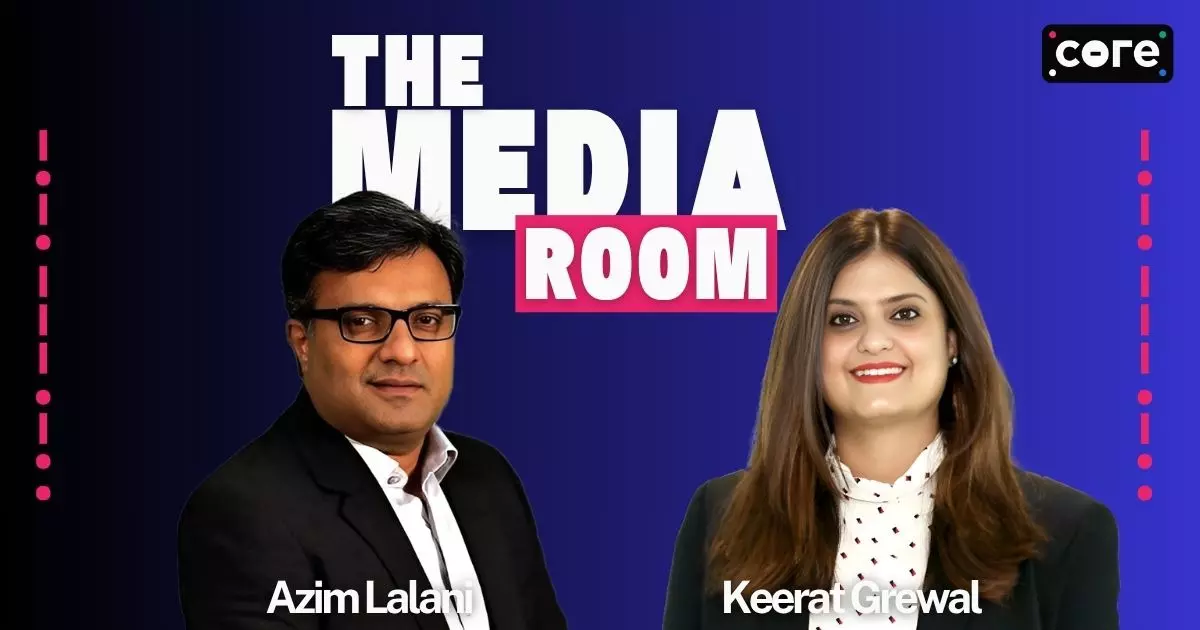
On this episode of The Media Room by Vanita Kohli-Khandekar speaks to Azim Lalani, Co-Founder and CBO of Bullet TV, and Keerat Grewal, Partner at Ormax Media Pvt. Ltd, about the rise of microdramas in India, changing viewing habits, AI-generated content and the challenge of monetisation.
India’s microdrama audience reportedly grew from 70 million in 2025 to 110 million in 2026. Yet, according to the Ormax data discussed in this episode, 72% of surveyed viewers had never paid for microdrama content.
The conversation explores:
• What is driving the growth of microdramas in India?
• Who is watching them, and how are platforms reaching new audiences?
• Can AI bring down production costs and transform storytelling?
• How do microdrama platforms make money through subscriptions, coins and advertising?
• Can Indian mythology, superheroes and regional stories find new audiences through AI?
• Will the market consolidate, and what does the future hold for microdramas?
As platforms experiment with new business models and AI-generated stories, the big question remains: Can microdramas become a sustainable entertainment business in India?
Watch the full conversation on The Media Room.
—
TRANSCRIPT
NOTE: This transcript is done by a machine. Human eyes have gone through the script but there might still be errors in some of the text, so please refer to the audio in case you need to clarify any part. If you want to get in touch regarding any feedback, you can drop us a message on feedback@thecore.in.
Vanita Kohli-Khandekar: Hello and welcome to The Media Room. Today I'm going to discuss something which all of us talk about a lot, but we really have no sense of what this whole thing is all about. Microdramas.
We did something with Vivek Kuttu on the Asia-Pac market for microdramas. But this time I've got two people who are going to discuss it from a completely Indian perspective. We have Azim Lalani, who's the co-founder of Bullet TV.
He set it up along with his co-founder Saurabh. And last year they had a strategic tie-up with Zee TV, which Azim will tell you more about. And I have Keerat Grewal, who's a partner with ORMAX and who has just worked in-depth on the ORMAX meta report on microdramas.
And by the way, she's a big consumer of microdramas herself, which was for me a God-given because I don't consume microdramas. So first of all, Azim, welcome to the show, both of you. Give me a sense of the shape of the market, Keerat, because you've just done this report.
What does the microdrama market in India look like from an overall perspective?
Keerat Grewal: Yes. So, you know, we've been sizing India's OTT audience since 2021. It's been six years.
And in 2024, everyone was noticing the rise of microdramas. So in 2025, when we did this report, we do a survey every year between June and July. And then the report typically comes out every September.
We introduced microdrama as a content format that we wanted to measure how many million people in India are watching microdramas, along with other formats such as anime and K-dramas that were coming up. So in 2025, when we first measured, we were around 70 million people in India. So India's OTT population, you know, this year is around 665 million.
Last year, 70 million of them are microdrama consumers. This year, that number has jumped by 50 percent. We're around 110 million people in India who are watching microdrama content.
Yes. And interestingly, the composition of this audience base is unlike the composition of the OTT audience base. So the OTT audience base in India is male skewed.
Yes, it is slightly more beyond that. 57 percent male audience, 33 percent female. So there is a slight male skew.
It was more skewed about maybe two years back. But when we're talking about microdramas, it's in fact the reverse. So we've got around 55 percent female audiences for microdramas, 45 percent male.
But it's not surprising. So when we see the data for China and when we see the data for U.S., almost 50 percent of China's microdrama audience are women, age group of 50 plus years. And 65 percent of this audience, in fact, in China comes from tier three and rural areas.
And when we look at the India numbers also, the India numbers are also reflecting the same. We are female skewed. You know, we are skewed towards less than 10 lakh urban and rural markets.
And I think that's where, in a way, the big challenge also comes, because while we've got viewership, the only thing similar for microdramas to the OTT audience in India is 72 percent of these 65 million are a-word audiences. They don't pay at all. And when we done, you know, we launched a report with Metta earlier this year to understand and profile the microdrama audiences, I think that's a big challenge that we found, that almost 72 percent of them have never paid for a microdrama.
So a lot of consumption was happening on social media.
Vanita Kohli-Khandekar: Picking up a couple of things here, and I want Azim to come in at the appropriate point. You're saying women, women skew in China, in India. Why is it?
I mean, I'm just curious what drives the female skew here and what drives the inner India skew here? I mean, is it the snackability? Is it low bandwidth?
Or is it the sense that this will be free? Because I'm just curious what drives that.
Keerat Grewal: I see a lot of the, so if you see content consumption for microdrama content, it's not a pull, you know, strategy. It's more, in a way, a push strategy. If you see, when we try to understand why did they sample it in the first place, more than 60 percent of the people are watching because the algorithm pushes it to them.
So because I'm already on Reels, I'm already on YouTube Shorts, and I'm already on Facebook, and I get to see the microdrama strategy of, you know, exposing or getting sampling is very different from OTT or theatrical, where they'll show you a teaser and a trailer, and then you need to come to an app or to a theatre to watch the film or the series, right? Here, you're watching a lot of it already free on social media. So they're showing you a good chunk.
In fact, I have personally seen ads, you know, ranging from more than 15 minutes, 15 to 20 minutes, not just a four or five minute ad. And it leaves you at a point where you are compelled to, in a way, just go, you know, see further, download the app, and then want to watch the entire story, which, of course, there is paid. Because they'll give you some parts free, but then they'll make you pay.
And I'm sure Azim, you know, can talk more about this. But it is not being seen as an alternative to OTT content. So it's not being seen as an alternative to a series or long format.
It is being seen as a fiction, story-like format of reels. So that's where the big difference is. When you're talking of it being female-screen, you're also seeing, you know, platforms such as Instagram, which do have a strong female composition, right?
So you've got an audience already sitting there. But interestingly, you're seeing an older audience coming in for this, when we try to understand what genres work for them the best. They're very GC-like genres.
So the top most-liked genres are romance, family drama, and comedy. You know, and that's why you're seeing that pull happening. Because in a way, I think China started the model, and you see a lot of their content is, How is it around romance?
Well, they give you a variety in terms of genres. You know, they'll give you fantasy, they'll give you historical, mythological. But romance is at the core of it.
And that's what's pulling in the female audiences.
Vanita Kohli-Khandekar: Azim, where is Bullet right now? You started it on your own and then tied up with Zee. So just give us a sense of where Bullet is, what it is doing, and then we'll get into more.
Azim Lalani: Yeah, hi, hi, thank you. So it's Bullet Microdrama App, to be clear about what's the name of the platform. If you go on Google or iOS, you will find it as Bullet Microdrama App.
The entire idea last year, like, you know, it started, the whole microdrama race started from 2024 November, when the first platform in India launched. And this has been going on in China, as you know, since the last five, six years. And, you know, the inflexion point, I think, is that in 2024 May, in US, there was suddenly a hockey stick jump in the kind of viewership and monetization models.
And the entire world took notice. And then most of the microdramas launched after that. And India was always brewing about this idea of, you know, when do we start, who will start first types.
So we launched, actually, we launched the beta version in, you know, December 2024 only. We were strapped at the start and then, you know, around April, May, we closed the entire partnership with Zee. The entire idea of partnership with Zee was that, of course, you know, we are more like our experience was more catering to technology and business side.
And we wanted a strong partnership on the content side and the kind of expertise and the legacy Zee has in India. I don't think that anybody can beat that. And second core point was that, you know, we always envisage this as a AI tech content company and not only a microdrama company.
So Bullet is not a microdrama company. It's an AI tech company. And we have a product called Trinetra AI, which is basically the universe of the entire, you know, game.
And Bullet microdrama app being one of the distribution platforms of this whole universe. And if you want the universe of, you know, of content, of intelligence, of what works, what not, of, you know, cultural nuances of India and all, you need huge data to train your models into, right? So even if you use a base model, which is, you know, available out there for your AI training, you need huge amount of data to see to it that if you are launching something in India from an AI content lens, then it has to catch the regional nuances of India, right?
So the idea of Zee partnership was that, who better than them who have 300,000 lakh hours, like 3 lakh hours of content, you know, in the last 33, 35 years. And we get access to that by default because of this partnership. And we have trained our models on that, right?
So that was the entire arrangement. And it's been one year. We started with live action, of course.
We tested all models, whether it's T-Word, A-Word, F-Word. We launched in seven languages. We were the first one to launch in seven languages because of, again, Zee's legacy.
And we launched our platform, AI platform, a couple of months back in beta. And now we are full-fledged also creating content on AI, right? So that's where we are right now after a year, I would say.
Vanita Kohli-Khandekar: Fabulous. This is very good stuff. I'm going to come back to you.
Azim, what's the experience been with Bullet? I know that you see yourself as more than a microdrama company. I understand that.
But within the microdrama space, what has your experience been on what people are consuming and how fast is growth happening? And how much – sorry, I'm asking multiple questions – but how much does being part of Zee help? Because you're on a bigger platform.
You're within Zee5. Does that give you an edge over standalone apps which try to – so three more questions there.
Azim Lalani: First of all, I'll answer your last question because Zee's help is from the understanding of content nuances in the tier-two, tier-three of India, like Keerat mentioned. This trend has picked up from tier-two, tier-three in India because also it's catch-up kind of content, which he also mentioned. And it's for people who have 20, 25, 30 minutes spare time where they were watching reels.
Here, the best part about microdrama and why people get hooked onto it is that they're not paying for the content completely. Of course, they like the content. They're paying for the content.
But what I mean to say is that they're paying for that emotional payoff which they get or the high they get on that cliffhanger where they leave maybe on the social media and come to the platform. And that's why they are compelled to pay because it's also of the fear of missing out of what happens next kind of a thing. And that's how the grammar is built of microdrama.
And that's how the kind of growth we are seeing is because of that because reels are very random. They are not connected to each other. And you don't remember reels.
Like if I ask you that 10 minutes back before this interview if you were watching some reel, you won't remember unless it was very informative and took what you were wanting to search for and it comes up on your stream. But unlike that, microdramas are made and the grammar is made in such a way that you have that emotional payoff when you are watching that content and when you are getting hooked onto it. So it's not made for just entertainment.
The entire grammar is made for where to leave, where to pay, where to add the paywall, where to bring the ad in. All that is very scientific. And people think that creating a one-hour microdrama is so easy.
But it's the hardest content format to crack because of the low attention span which we've been talking about. People don't have low attention span. The bar has gone up.
You are so over-served, audience. There's so much of content you're seeing. The bar of the user, what he wants to view has gone up and you have to raise your bar in content creation to get that attention and then maybe hook them in the first round of say 8-10-15-30 seconds.
And then maybe after 5 minutes you ask them to pay when they are completely hooked onto your content. So it's a very different cycle and it's a difficult format to crack. And I think in our case, because we have 7 languages, it makes us more different because we've been able to go to those pockets where the competition started with primarily Hindi and the Hindi heart.
We went deeper into Telugu, Tamil, Malayalam, Kannada, Bengali. So we were early to realise that what works in what market. And while the tropes are the same, like she mentioned, it's romance, it's hidden identity, it's rags to riches, it's all of that.
But the cultural nuance of every region is different. So if something works in Maharashtra, if I just dub it in Bengali, it doesn't work. If I want the same story there which we have done, we have to remake it in such a way that it captures the cultural fittingness of that particular content in that particular region.
So India, unlike China, is again very different. China, one language, one nation. India is changing every few kilometres.
So to crack India as a whole, even for OTT space, has been so difficult. So here it's difficult. For us, we've reached close to 7 million monthly active users in one year.
And we see a varied audience coming in from tier 2, tier 3. Surprisingly for us, it's more male heavy because maybe the kind of content we are making and the kind of content which is performing. While I agree that globally it's more female skewed, for us also there's a huge amount of female watching.
But the urge to watch, sorry, the urge to watch in females is higher and the urge to pay is lower. So still it's more males who are paying. And that's why the content which you see, while we've tried all kind of content, female POVs get good viewership in the initial episode.
But male POV content get good conversion on subscription. So it's still that in India, the wallet lies with the male. And maybe females are using maybe Gpay or Paytm of their husbands or their better halves maybe.
Because that's how we see that it's more male who are paying for the content. And of the total audience which he mentioned of say close to 120-150 million, there's only 10-15% of audience which are actually paying. So there's huge consumption happening.
But the paying propensity is still is very low of 10-15%. And that's the biggest problem even globally. If you see latest reports which have come in, platforms like Reelshots and all, their viewership is growing 100%-150% plus month on month or quarter on quarter.
But the paying propensity is just gone up by 10-15%-20% even globally. So they are also wondering how to crack this. And that's why this whole rage of AI content has come in.
Because it's very cheap to create, very easy to experiment into various genres like she mentioned fantasy, dragon stories and supernatural stories and period dramas and all. And it's also the churn is higher. So they are able to see which all tropes are working, the newer tropes.
And it's very low investment. Like one microdrama in AI, it takes maybe 5-7 lakh rupees in India to create versus 15-20 lakhs for a live action. And then you can expand your imagination because once you build with AI, you can do anything.
You can create such beautiful visuals. So I think 95% of content which is being made in China right now is completely AI. In fact, the top player like RealShot, which is globally number 2 in the world, 90% of their last month's content creation was completely on AI.
Vanita Kohli-Khandekar: You know, I want to bring the AI thing. But you mentioned say 7 lakh whole microdrama and 10-15 lakh. When you say whole microdrama, how many episodes?
Is it 1 or 2 minute episodes?
Azim Lalani: You can say 1 hour to 1.5 hours. So every episode is 1.5 to 2 minutes. And every microdrama is say approximately 75 minutes.
It can range between 60 to 90 minutes.
Vanita Kohli-Khandekar: Okay. And is there a particular scale at which it starts making sense? And Keerat, I want you to jump in here because I think the monetization question and which is why AI also comes in the monetization question is one which boggles the mind.
I mean, last I looked at NPA figures, they said it's a 10-12 billion dollar market and the bulk of it is China. Maybe a billion odd dollars is US. Some of it is scattered across Far East Asian countries.
So I don't know what India, there was one number I got which is India is about 650 crore. I don't know how correct that number is, frankly. This is a completely unvetted number.
At what scale does it start making sense? And because we are talking about a payout over what, 5 years, 7 years? People have raised all sorts of money, anywhere from 50 to 150, 200 crore from microdrama companies.
So at what scale does it start making sense, start making money? A. B.
Is it important? And Keerat, I really want you to also, because Azim has already answered this question in part. He's part of Zee.
How important is it to be part of a larger? So in China, many of the successes are part of larger social media companies. Most of them, I think.
In India, you have the MX Fatafat or a Taraka from Geostar. Bullet, like he mentioned, it's more like a content thing. But nevertheless, you have the backing of a large media company there.
How important is that for that payout to happen faster? Do you see in your usage, that the usage of apps from larger firms is better because they have the scale to push this through? So there are two questions.
One about scale. Azim, I wanted what scale at what size does one start seeing some joy in terms of profits or profitability? Or is it too early to discuss it?
Azim Lalani: No, it's too early. I agree. See, right now, whatever numbers you see, while, by the way, 650 crores is a lesser number, I would say collectively last year, the industry of the numbers, which I have again unvetted, but I know the competition, what they make and all of that.
Last year itself, we made close to two and a half thousand crores of revenue. Microramas. 100%.
You have players like, the top five players are making 95% of that money. And this year, if all goes well, it will touch 800 million to 1 billion also. So it will go to 1000 crores.
Vanita Kohli-Khandekar: I'll interrupt here, Azim. We're talking about advertising revenue or largely advertising?
Azim Lalani: No, this is completely subscription. India is completely different. I'll tell you why also.
And I'll tell you what is happening in the market for you to get that sense. I won't quote any names, but right now, it's all of them are funded companies, right? From VCs and from.
So it's like a burn game, which is going on to have the pole position. Like you see, you mentioned about 100-200 crores. You know, the top players have been funded off lately by 750 to 500 crores also, right?
So they have huge monies. Everybody is playing the ROAS game. It's return of, you know, ad spend.
And it's right now a marketing game, which is going on completely to acquire users and making sense only through a marketing to marketing kind of a piece. So every 100 rupees spent, people are trying that. Do I get 100 rupee back?
So what happens is that if your bottom line is the same, I'll explain you technically, if the bottom line remains the same, that if you're producing, say 50 micro dramas every month, or say 100 micro dramas every month, your tech spend is same, your everything remains the same. That means your cost bottom line remains stagnant, right?
Vanita Kohli-Khandekar: You're breaking even. You're breaking even on cash flow, basically. No, you're not breaking even.
Azim Lalani: On running cash flow, you're breaking even. Is that what you're telling me? On marketing, say, suppose I set the model where every 100 rupees spent, if I'm getting back 100 rupees, right?
Then I can push the pedal to any amount till the time it's making sense and it's not losing money on the contribution margin, which is the marketing money. So if I'm spending 1000 crores and if I'm making 1000 crores and my bottom line remains the same, it's just a top line game, correct? That's what is happening right now, that people are spending money on marketing and showing top line and making valuation sense and then acquiring kind of funding.
But right now, nobody has proved the model in India. Let's be very clear. Not even globally.
So everybody is bleeding, right? Nobody has understood that sweet spot. Everybody is in that trial and error phase.
We don't know whether this AI rage is also going to work, right? It's again in the trial phase where, you know, players, the top players have announced their IPO. So they are doing it for, you know, showing that kind of tech advantage and the kind of, you know, sense which they have to make.
So everybody is making money also because they've been able to crack the model on the marketing front. And not that they are profitable or they are making monies and all. So it's a very experimental stage right now.
It's still at the stage where everybody is experimenting and trying various models. And India, by and large, is a subscription market right now for microdrama, which is very unlike any other platforms, which are more monetised. Autopay, you know, it's how you get money from the users, right?
Vanita Kohli-Khandekar: Correct.
Azim Lalani: You can't judge right now. You know, even if I say we'll reach a 1 billion market, you know, is the retention happening after month 3? Because all of them are working on a 3-monthly subscription.
So what is their M4 number is a big question mark, right? And everybody is trying for that retention and watch time gain. For us, Northstar was always watch time.
We don't see that, okay, how many subscriptions and how many users and what kind of revenue we're getting. We are working on is my content, which I'm creating, is my technology, is my, you know, technology. So we have an intelligence layer on the Renetra, which tells us which content to green light also on the historical data.
By that, we have seen that how can we improve our hit ratio? So if 100 titles are hit, approximately 10 are hit, like it's a 10% hit ratio right now because there's so much of content being made. We are saying that, can I achieve that 10 hit ratio by making only 40 instead of 100 so that my hit ratio is 25% and not 10% and I'm making less, but I'm making the same amount of money, which maybe others are making.
So point number one is on whether whatever you green light is working or not. Are you understanding what is required by the market and what kind of content is required and what are the trends? Thirdly, are you being able to make in quality and through AI and through various means to bring down the cost and improve the hit ratio so that you have a sense of path to profitability?
So we are in that game. We are not in the game of burning money and getting top line because we are funded by a legacy player. We are not here in valuation game.
So that's the difference. Keerat, sorry I took too much time.
Vanita Kohli-Khandekar: No, no problem. Keerat, what are you seeing when you size this market? You've looked at what people are...
What are you seeing? What are the brands which are working? What are the shows which work?
You mentioned the genres which work but is there some patterns that are emerging here and especially bigger player versus standalone apps? Again, any patterns that you see?
Keerat Grewal: Yeah, I think I'll just break it down into the apps and the content. So I'll just touch upon the content part first. So like Azim said, they are creating a lot of content and when you have content coming out in bulk from an audience perspective, there is no recall.
So when you ask them to recall shows, it's a market which is flooded with so much content. They are not able to recall titles because it's not like you have some tentpole OTT web series which will come, which will get marketed for a period of three to four weeks. Then there'll be sustenance marketing.
It's very... It's like... It's the Zara model, right?
It's a fast fashion model. It'll come, it'll post something else. It'll come, it'll go, it'll come, it'll go.
It's meant to... And Azim, in fact, very, very correctly said it's very scientific. So micro-dramas are actually created to work on your biology.
They are created to... You know, your mind to get into a dopamine loop. So it's every drama, every episode is a loop in itself.
So it keeps you hooked and you can't get out. And once you've, you know, you've got that gratification of seeing... You know exactly how the story is going to pan out.
So it's not that you don't know, right? Which was also the GC model but of course, they would stretch it. But when you would ask audiences, they would know, now she will lose her eyesight.
Then she'll have a baby. Then she'll get married again. You know, all that stuff.
But you want to watch it because your mind wants that closure. Micro-dramas have condensed that into two two-minute episodes. So there's no recall of content.
I think the big challenge in India and I'm, in a way, also expanding on what, you know, Azim's been very rightly saying is because a lot of consumption is happening on social media. You know, when we did that report in, you know, early this year, when we asked them to name micro-drama platforms, almost 50% of recall was coming for Instagram, Facebook and YouTube. There was very low recall for the micro-drama apps.
And the other part is, you know, which is what we realise that brand building is of course a concern. And since then, of course, we've seen a lot of communication come from multiple platforms. They are trying to, you know, build their brands.
But like Azim said that, you know, for the audiences in India, India's as it is, like I said, we are a 72% A-word market. So even in India, the, you know, pure S-word is now going to be a thing of past. I think there's practically just for one platform left, which is an only S-word platform, which will also sooner than later become an, you know, ad-supported S-word platform, right?
We don't have that concept. We will have to get into ad revenues because we are a bulk market. So we are a market of volumes.
So, you know, this is where ad revenue will have to become a source of, you know, revenue stream. From an audience perspective, we saw around, like I said, 72% had never paid, but of the remaining 28%, 11% had paid and then gone off. So at any given point, so, you know, the retention, it's not just the acquisition is a problem.
Retention is also a problem. And there are two reasons for this. One is, of course, you know, the cost of it.
So, you know, one is wondering, why do I need to keep paying for it? And the second part is there is a lack of comfort in terms of credibility. Like he said, you know, it works in auto renewals.
Now, I may not want to watch that app. I get scared that they're going to keep deducting money because, and they don't make it easy to get rid of your auto renewal, right? So, like I'm struggling and that's one of the reasons why I stopped paying for microdrama apps.
The reason is you just don't know where the payment went from. Did it go from my GPay? Did it go from Apple?
You know, where do I find it? Because I can't see who I've paid. You know, I can just see that there's a payout that was done.
Vanita Kohli-Khandekar: Quick, quick interruption here, Keerat. Quick interruption. How expensive are microdrama subscriptions in India?
Keerat Grewal: In India, they're the cheapest. In India, they're the cheapest. So, I mean, you know, I know Zeeam's platform is available, I think for around 399 a quarter if I'm not mistaken.
Their annual plans for around, so around anywhere from 400 a quarter to around, you know, 700 a year. It depends on the app. So, it comes to roughly around 100, 120 rupees a month.
When you look international, international microdrama is available for 2,000 rupees a week. So, that's the difference that you're seeing. So, they're very premium, but of course, most of the platforms work on a gamified model also.
So, you watch some ads, you get some coins, you know, or you just buy some coins for about 50 rupees, 100 rupees, 150 rupees. You just get to see an episode or two. So, it does become a more expensive proposition to the audience, but they get fooled into thinking that maybe I'll buy 100 rupees worth coins, but then you realise you could just about see half of the remaining microdrama.
So, you end up paying more, then you end up paying more till you're wise enough to realise that, oh my God, I just wasted money. But that's where there is a lack of credibility and of course, India being a market which wouldn't want to pay. So, I think these, you know, acquisition and retention are concerns and definitely from a brand perspective, building brands is something there is no brand known to audiences right now.
It's primarily social media.
Vanita Kohli-Khandekar: You know, this thing about AI and scale and it just raises two questions in my mind. One is, of course, we know that China, like Azim said, and I've also read about this, that it's largely AI-led. But AI is, at some point, is going to create slop unless you can direct the AI to do good stuff.
And B, I think, whether it is from a one-minute episode to a three-hour film, the deluge of content that we had in the world today, and it's a question I ask everybody I interview, there is a deluge. It is leading to a neurological rewiring of sorts, I think, for all of us because all of us consume it. This is, you know, you're talking about creating content which gives me a dopamine hit every one and a half, two minutes.
And fine, games work on that same principle. But how long can you continue to scale on a model which is built on that? You know, it's just, maybe I'm being very naive here, but I just want to understand, A, what role do you see AI playing, especially in the Indian context?
Because if you're saying already there's a deluge of content, you're saying you'll create an exponential level of deluge. What happens to the business, therefore? Because then you have a business of slop and it's slop selling slop, basically.
And B, what does it mean for consumer brains also? And therefore, what do you create? Because you are ultimately catering to an audience.
And if your audience is continuously eating slosh, then will you be creating slosh throughout? Just, you know, curious about these two things. And I want both of you to react to that.
Keerat Grewal: Okay. So, you know, Vanita, okay, I think this is where watching the content helps, right? So I'll give you a sense of, and, you know, I'll request Azim to give the Indian perspective.
I'll give you a bit of an international perspective. Vanita, there are two parts to it. One is the, you know, the quality of the content.
And one is, you know, how much can you watch, right? Till around February this year, a lot of content that would come as AI generated, you could make out as AI generated, you would just skip it. It was a bit, you know, like awkward and, you know, you wouldn't really want to watch it.
I kid you not, but in the last about two to three months, practically everything that's coming from the international, you know, platforms, like Azim mentioned, and now I understand when he said 90%, everything, whether I'm watching Chinese, Korean, US, European, fantasy, mythology, vampire, Dracula, werewolf, everything is AI generated and you cannot make out that it's AI. In fact, the kind of production values and skills that you see is what you would see in movies like Avengers, even better, you know, what you would see in Harry Potter, you know, the kind of costs that you would have to incur over there. This is what you're getting to see at the micro drama level.
You're getting to see, you know, animation content, like the kind of, you know, detailing that you've seen animation is what you're seeing now in quote unquote live action, but, you know, AI content. You don't see that it's high quality in terms of visual grandeur and the stories are endless. So when I'm watching micro drama content, it's actually an alternative to reels.
It's not an alternative to long form, immersive, high quality content. It's just a storytelling version of reels. Like Azim mentioned, you scroll through reels, you're not able to play back.
What did I see? Because you just saw tonnes of them. The mind, in fact, when we see what is the main reasons for something, like I told you, algorithm push was number one.
Number two was time pass and boredom. And, you know, I come from like, you know, I come from a small town in India, but when I would go back there, like my parents were based in Mohali for some time. And when I'd go back there, Indians have a lot of time on hand.
I think we look at India from the lens of, you know, metros and mini metros, but that's not the rest of India. There's a lot of time. My Mali would come and then he would spend like two hours sitting under the tree outside somebody's house and he's sitting on his phone.
He's a 70-year-old man, but he's busy on his phone. You know, the cook in the house is just sitting there in the afternoon. She has nothing to do.
She's just scrolling, scrolling on the phone because Wi-Fi is there in the house or the data plans are so cheap. There's just a lot of time and I just want an alternative to reels content, right? So it's, I watch one and a half hours, spend one and a half hours, good time spent and I'm off.
So there's, it is, you can, of course, you know, one can talk about what is doing to your brains, but it's just the kind of content that I'm watching on Reels any which way. So it's nothing different.
Azim Lalani: Yeah, I would argue that the kind of quality of content we've been watching on, you know, premium OTT platforms, the tier two, tier three audience or the audience, which Keerat was also talking about, has never seen that, right? For them, it's an experience. For them, it's a mind-blowing thing, right?
They get, so you're talking about tier two, tier three, people in tier one, you will find a lot of, if you, I don't know whether you travel by rickshaw, but if you sit in rickshaw, you'll see, you know, these days rickshaws have that on the handle, a stand for, you know, uber ola kind of.
Keerat Grewal: They have a earphone attached to, you know, they put their phones on the stand in the front here.
Azim Lalani: In the front, and they keep watching micro dramas because it's easier to consume. It's private. It's intimate.
It's, you know, even if you are looking on the road and listening to it, you can, you know, understand. Your house helps while washing the vessels. She'll have the phone on the, you know, on the platform and her phone is going on.
Now for them, they had only YouTube access because that was free and they were watching things. But on YouTube, again, discovery is difficult. What do they want to watch is difficult.
Here they have something which they can watch. Here they have something which is specifically in AI. I am talking about which they have never seen an experience like, you know, what Keerat mentioned on most of the Indian platforms.
You see those mythos stories and those nagin kind of stories being made on AI. And they are, they are done so beautifully that even if you would have seen nagin on TV, this is way beyond what it was then when it used to come on TV. So their experience of watching content and the kind of content they are watching is to a next level now even in India because in India also the platforms which, you know, which are creating AI content are the same which are, you know, the same models which you used to create in US and China and the same, you know, tools.
So the, that's what I said, the bar of content creation has gone up. Maybe the stories are the same but the experience is different. It's cheaper.
The Wi-Fi is cheaper. Data is cheaper as, you know, Keerat mentioned and I think that brings in, that's why I'm, you know, agreeing to you that there'll be a lot of slop but good content creation is here to stay and this industry will consolidate over a period of time in the next two to three years where you will see a lot of platforms who are creating slop might vanish, right? They will have to, if they have to stay in the game, they'll have to, you know, raise their bar in terms of content creation.
It's not about the money they spend on the creation. It's about what kind of stories India likes and if they're able to capture that through AI, AI is now giving you what you couldn't bring to, you know, live on live action, right? Today, if I have to show a five-star hotel in live action at that budget, it's very difficult.
Today, I want to show a multi-billionaire, you know, getting down of a swanky car in real to rent that car is so difficult that I can't afford and people don't relate to it. Saying that is showing that he's a thousand crore man, but he's getting down of a old, you know, car, right? But in AI, I can do all of that.
I can bring the bling. I can bring the grandeur. I can show period drama so beautifully and we as a nation have so much content, which we were not able to expose in that kind of, you know, experience and now with AI, we can do that, right?
Our mythos stories are huge. Our superhero stories are untold, right? And all this Pandora box now opens and everybody is trying everything from Mahabharata's one particular plot, they're creating beautiful stories, which we didn't know of, right?
So I think it opens the whole Pandora's box at very minimal cost like animation you spoke about creation of animation on AI is the same. It's so cheap that you get world-class output in minimalist cost, right? And that is possible and I think that's why I'm saying that it's the industry will consolidate.
There will be maybe only 10 players remaining in three years time and they will be the ones who will give good quality content and tier one will also come to party, right? Now tier one has not come to the party. They're still watching international platforms.
Like Keerat mentioned they have that kind of pockets to pay 2000 rupees a week or 10,000 rupees a month. So they're still watching international because they feel that Indian content on micro dramas is still at not that scale but it will come and once they come, once it comes people will start watching. It will consolidate it.
Vanita Kohli-Khandekar: And if I look at a pyramid, I always say that the growth is at the middle and the bottom. There is the growth of premium but it's always you know the DD Friedrich market, the YouTube market. That's where a lot of the volume growth is.
And I think micro dramas for now is that's where a bulk of the growth it looks like middle and bottom of the pyramid kind of growth for now.
Keerat Grewal: And it was a real ship but not I think the real challenge like I think you mentioned is monetization because that's the model that needs to be cracked because it is very unlikely that you're going to get.
Azim Lalani: Everybody's trying new—everybody's trying something new. I'll tell you: there are players, even us with our, you know, some of the experimentation right now, a lot of micro-drama platforms is giving money to viewers to watch their content. Will you believe it?
Like what they do is they want—ask you to create a streak of, say, 30 days and say, "If you come every day and watch my content for 15 minutes a day, and you create a streak of 30 days, I'll give you 100 rupees in your wallet." And in that—and you collect coins every day and you can use them for watching content. It's the AVOD model style, the gamification styles which she was mentioning, wherein AVOD comes into play.
So there are a lot of platforms which are trying this because, "I will give you money to watch content." And all these people who are in Tier 2, Tier 3, they get very excited that, okay, it's not about 100 rupees; it's about that gamification that, "Okay, today I have to watch 15 minutes of content." And then they are forced to... it may be incentivising users to watch content, but that's how they are consuming ads. That's how the monetization model works. So there are so many models, interesting models, which are in works right now, and it will pan out slowly. It will evolve, and of course it will be a bigger AVOD market, I feel.
Vanita Kohli-Khandekar: You look at Spotify—music streaming is a great example. I just did some work around that. OTT—we can see the first slivers of profit coming in for many of them, many, many of them. So I suppose it's the same sort of evolution which... and in media, I found it's typically five to seven years. You compare DTH, cable, micro-drama, streaming, and globally that seems to be the five to eight—it's not three to five years, which it is for most industries. So I don't know if Azim would probably have more sense of figures in the—on the P&L, etc. But...
Azim Lalani: Yeah, I think—I think it will take another three to five years for this to pan out in terms of who will remain in the game and what will work, and will AI take over? Will it be a hybrid?
Like, I met a lot of, for my research, I met a lot of these Bollywood production houses and Bollywood directors and all to take their view on AI. And some of them are completely writing it off, who are very creative guys, but some of them are saying that, you know, it will be the—it will start with the hybrid wave first and then go on completely AI in the—in the big space. Because we also have a platform, so I was asking that: "What do you think of AI becoming a platform which will also, you know, be released in big screen?", which is going to happen. Like, we are going to see AI releases on big screen.
And they are more about: it will go hybrid way first, where universe is created through AI and the actors are real—something like that, like it used to happen in VFX and still happening. So I think that this is very interesting, you know, inflection points.
And I feel that people who embrace technology, science, you know, for which what greenlighting, you know, projects, figuring out what will work, what will not—a lot of work is happening on AI for even prototyping. That if you are going to release a movie and if you have a script in hand, you first create it in AI, test it out, dipstick, make changes, because it's very easy. Like, there are sweatshops in, you know, Kerala who are creating prototypes of movies and scripts at 10 lakh rupees for two hours, and producers are first viewing it, see—making changes, and then going on floor with their, you know, production.
These kind of prototyping, POC, promo creations, testing the market—all this is happening. So I think it will—it will, as I said, it will raise the bar of content creation in what is coming out, and you will see much, much better content stories coming out because now the—the creators are not just taking a call on gut. They are taking a call on gut plus intelligence plus creativity plus dipstick, everything all together, and then maybe taking a call whether they want to go out and create a content piece. So it will create that kind of, you know, better stories, I think.
Vanita Kohli-Khandekar: Okay, last word, Keerat: where do you see this market, say, two years, three years from now? And from your perspective, that is consumption, whether it's genres, what changes do you see, given that you've seen the evolution of streaming and all the other genres, all the other formats?
Keerat Grewal: Yeah, no, I do agree with you that maybe it's—it's not a three to five year, you know, period in which you're going to see growth. It could be a five to eight year period; I do agree with that.
Micro-dramas are still here to stay. If you see the volume and content that's coming in India and internationally, it's not going anywhere. Yeah, I think, you know, there's a bit of, you know, a red herring with the, you know, trying to find—follow the China model, because what's happened there is the laws are very strict, so they've been able to crack down on piracy very strongly. And which is why they've been able to, you know, have one of the most profitable, you know, micro-drama industries in the world today. Unlike India, where practically every micro-drama is available on Telegram or Dailymotion—people watch it there, they openly say it.
But what I am seeing is that there is going to be an understanding maybe in the next, you know, one to two years of what's the kind of monetization model that is going to work for micro-dramas. It's—it's—it's sitting in between OTT and AVOD, right? So it's sitting in between Reels and OTT, and that's—God knows what that between is, because this—you can't lean on either side. So I think a lot of experimentation is going to happen.
It's interesting to listen to Azim that, you know, what he said is happening right now. But like you also said, we're going to see a consolidation—a number of players. But micro-drama is likely to become a category which is going to be content created on AI primarily, because the quality and scale that you get—it's not going to be live action, it's not going to be, you know, based on actual actors. It is going to give you visual scale on, you know, on your 16-by-9 screen, but it is going to be more completely AI, and we'll have to see how it gets monetised.
Vanita Kohli-Khandekar: Super. Any prognosis from you, Azim, before we wrap up?
Azim Lalani: I agree to her. I'll just add few points: that the brand-integrated micro-dramas which we are doing now are also becoming... because the good part about micro-dramas is that the turnaround time at which it's made, AI can be conceptualised and made in a cycle of 21 days—like two to three weeks. And that—that allows you to capture a topical campaign, right?
Usually what happens in the big screen or OTT releases is that it takes you to create and release at least six to nine months of time minimum, right? So you can't catch the topical campaigns which brands want you to catch, right? Here, if there is a topical campaign which is a seasonal campaign of, say, Diwali, and if I close it now with the agency or with the brand, now I can release it before Diwali and catch that period and quickly, you know, make sense of it, because it's cheaper, it's integrated in a story, it's interactive, it's not on your face.
So we've been doing that and we're getting good response. And China has also shown that: that brand-integrated stories where there is subtle integration... and with AI, it's much, much more easier because the entire creative control is in your hand—how do you want to portray them, how show it on your face or subtly is all in your hand, and the changes which we make again and again are possible because it's in your hand and the creative control.
So I feel the brand solutions piece is going to become very big in the coming one or two years, you know. The piece is going to explode because there will be a lot of these, you know, brands who would want to be on micro-dramas because they are more interactive, intimate, you know, all of this. People are trying even m-commerce on, you know, micro-dramas globally. So that might come in to India also wherein, you know, it's integrated experience.
The coin model or the TVOD model, which globally is doing very well, will come to India, of course. And my prognosis is that in the next five years, micro-drama revenues will take over the OTT revenues for sure, because OTT revenues right now in India are not very—like if you see, your annual revenue of even the top platform is not that, you know, high. And it will be very easy for the kind of content, the volumes, the users, the intimacy of viewing—this will take over, you know, from the revenue point of view for sure, and of course viewers.
Vanita Kohli-Khandekar: What—OTT is what, 40, 45,000 crore right now? Streaming, if I include YouTube in it, and yeah, 40, 43,000 is what the last number I see. So that's a big one if you're saying that, you know... but what, just...
Azim Lalani: In the second year itself, it might touch eight to 10,000 crores, I'm saying.
Vanita Kohli-Khandekar: I just want someone to look at these numbers, because I don't know, uh, yeah, we don't have... Excuse me, I know Azim is... If you guys can get together and get an MPA or someone to size the market, that would be a wonderful service, I think, for people like me who analyse this.
Just quickly: do you see it remaining a mobile-only phenomena? Because if you're talking about eight, 10,000 crore or 40,000 crore, can it be that kind of numbers on a mobile-only, or do you see it moving to CTV or something else? So I'm not sure if only mobile format can generate that level of revenues.
Azim Lalani: It's vertical viewing for sure; it's mobile-only for sure. Yeah, Keerat, you have a point of view there?
Keerat Grewal: Yes, it is the format of, you know, 9-by-16—something you cannot watch on CTV, the viewing experience is not good. But we do know people who are actually shooting both vertical and horizontal—the same show, it's getting shot—because they're putting out that content then on FAST, you know, to have another monetization stream coming in. So once it's done the run on vertical, they'll put it out on horizontal.
Azim Lalani: We do that with few of our micro-dramas, and we do vertical, horizontal. The writing is also different while the trope is the same. So horizontal output might be a, you know, 2-hour output, and vertical output might be a 75-minutes output. So we do vertical, horizontal, and we're trying that, and some of them have already released on ZEE5 as a film.
Vanita Kohli-Khandekar: What a fabulous new world this has created, really. On that note, thank you so much, guys. I really enjoyed this discussion; I learned so much. Thank you, Keerat. Thank you, Azim. And hope to have you guys with me once more some—at some later time.
Azim Lalani: Yeah, definitely.


