



 Newsletter
 Search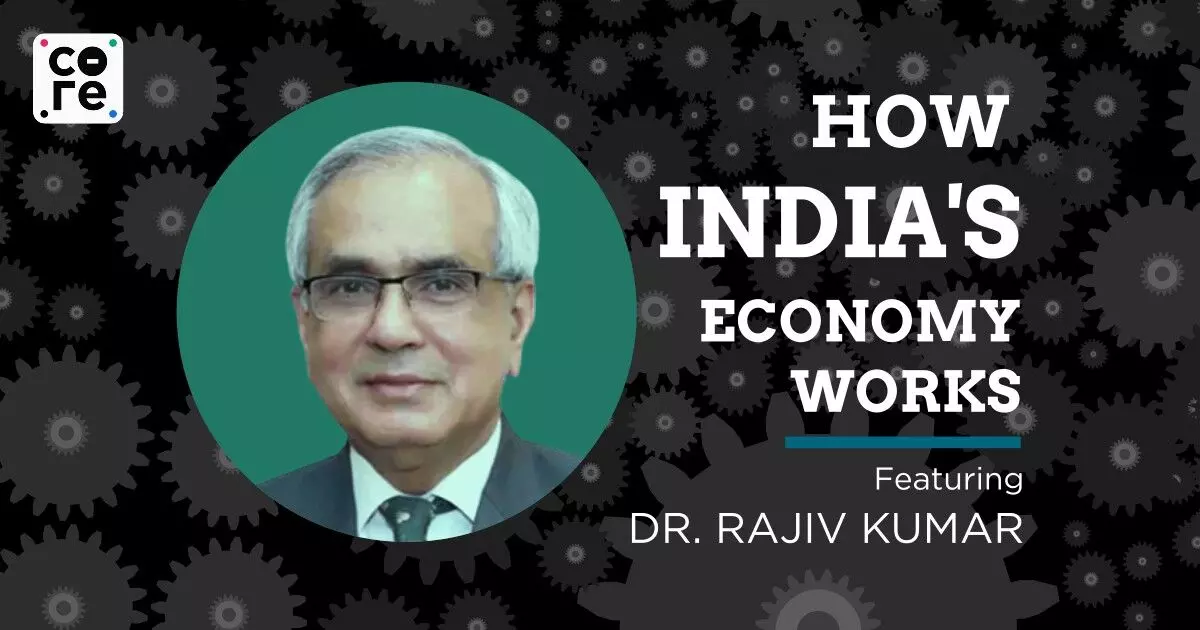
India's Manufacturing is Broken. There's Only One Way to Fix It, says Rajiv Kumar
- Podcasts
- Published on 27 May 2026 5:00 PM IST

Tune in for insights on why India’s manufacturing ambitions continue to fall short
In this episode of How India's Economy Works, journalist and author Puja Mehra speaks with economist and former NITI Aayog Vice Chairman Rajiv Kumar about why India’s manufacturing sector continues to underperform despite decades of policy attention and repeated attempts to boost industrial growth.
India has long aspired to become a global manufacturing hub, yet manufacturing’s share in GDP has stagnated and labour-intensive sectors such as apparel, leather and food processing have struggled to expand. Drawing on Dr. Kumar’s recent writing and policy experience, the conversation explores why India has failed to build an export-oriented manufacturing economy, why scale and competitiveness remain elusive, and whether the country has become too dependent on the idea of a large domestic market.
They discuss the limitations of production-linked incentives, the persistence of protectionist thinking, and why Indian industry has often preferred domestic shelter over global competition. The episode also examines the contrasting experiences of China, Bangladesh and Vietnam, the role of state governments in export promotion, the challenges facing SMEs, and why labour-intensive manufacturing remains crucial for absorbing surplus workers from agriculture.
The discussion raises larger questions about employment, industrial strategy and India’s long-term growth model. Can manufacturing still become a major engine of jobs and exports? What would it take for India to double its share in global trade? And are policymakers, industry and states aligned enough to make that happen?
Tune in for insights on why India’s manufacturing ambitions continue to fall short — and what it will take to build a more competitive, export-driven economy.
—
TRANSCRIPT
NOTE: This transcript is done by a machine. Human eyes have gone through the script but there might still be errors in some of the text, so please refer to the audio in case you need to clarify any part. If you want to get in touch regarding any feedback, you can drop us a message on feedback@thecore.in.
Puja Mehra: Dr. Kumar, thank you so much for coming again to the show.
Dr. Rajiv Kumar: Thank you. Thank you, Puja. Great to be here.
Puja Mehra: Dr. Kumar, I want to talk to you today about the manufacturing sector, which you've written about in great detail recently. For a long time now, not just the present government, but also the government before this, governments have tried very hard, successive governments have tried very hard to increase the share of manufacturing in the economy, to encourage the manufacturing sector. Make in India, in fact, has been talked about for many years now.
But as you've written, we're not seeing the kind of outcomes that we would have liked. And this is not for want of not trying. So I want you to help us understand a little what is going on in the manufacturing sector.
What do you see?
Dr. Rajiv Kumar: Puja, I think what's going on, I'm not sure. But I think what's happening is that we are not focussing sharply enough on the sector that we should be focussing on. And in my recent article published in the Economic Times, I made the point that we will have a rise in the share of manufacturing sector if we are able to tap into external demand, which is the global markets.
So we need to have a manufacturing sector, which is very sharply and very predominantly export orientated. But unless we do that, we will not be able to get the scale that we require. If we don't get the scale, we don't get the competitiveness, and therefore we don't get the growth that is required.
Now, in India for a very long time, for decades, we've been suffering with what I call export pessimism. And we started off with import substitution, etc. But we've never ever given export orientation the kind of push that it requires.
Now, even within the PLI, the Production Link Incentive Scheme, the idea at the beginning was that this will be an export orientated scheme. But lo and behold, it soon expanded into 14 sectors, and most of the sectors lost their export focus. And we have got only one sector there, which is the mobile phones, which has done whatever it has done.
And that's got the scale as we can. So the bottom line, the government and the industry have to come together on the agenda for expanding our exports and increasing the share of our exports in the world markets. If we do that, only and only then will the manufacturing sector share in the GDP rise.
Puja Mehra: So are you suggesting that this lack of focus is because of a lack of understanding of what is required? Because I discuss this topic with many economists, and I often come across three points. The first is slightly ideological sort of a point where national leaders, political leadership feels that the domestic market is so large that India does not need to focus on an export market, which is perhaps an overestimation of the size of the domestic market.
The second point I come across is that the Indian manufacturing sector does not have competitiveness, especially vis-a-vis China. And this is because of legacy issues. This is because of new upcoming issues.
And the third point that I come across is that there is a certain lack of ambition in the Indian corporate sector. It's not like their hands are tied behind their backs, but it's also because they just simply are quite content to cater to the domestic sector. And they ask for protection and they don't want to compete.
Dr. Rajiv Kumar: Taking them one by one, the first is that this is a myth that we suffer from, that India is a large economy. India is a large market. We are a large population, but not a large market.
For the $3,000 per capita, heavily skewed, and 65% of our people are still living below $3 a day. We are not a large market. We are a fairly small market.
And therefore, if we cater only to this market, which we tend to do, and which is the focus of all our action and policy response as well, then we will not get the scale that we require to be able to compete in the global market. And then we don't get the scale, therefore we don't get the competitiveness, and that's the end of it. So we have to shatter this myth that India is a large market.
That's the first thing. And also, this myth also carries over to the fact that, oh, because we are a large market, therefore all the foreign investors will come running to us in any case. And we can play coy with them and decide whom to get and whom not to get.
Complete zero. Total nonsense. And the boards of the big companies, India is just one market, and they take a decision on the basis of what is on offer from one country or the other.
So that's the first one. The second one is about competing with China. Yes, of course, it's very difficult now to compete with China.
But please also remember that our steel industry started much before China. In Asia, we were one of the first, if not the first to have started a steel industry, and we had the cheapest iron ore, and we had the cheapest coking coal right there, and also the cheapest labour. And yet what we have done ultimately is that we are still importing certain types of steel, while China has got 80 percent of the steel market in the world.
Why should that have been? That has been because the industry and the government both, for some reason, decided that the world is not their playground. It's just India that's the playground, and that is it.
And then the third one that you said, it is very true that our industry, unfortunately, has played the protectionist game to the hills rather than become export-orientated and go out and compete. And again, steel is a very good example. A lot of time with what is called the Steel Association of India is spent in getting the government to ban the export of iron ore, especially one with 65 percent ferrous content, etc., because that should be captive for us, and we should be producing this, etc., and so on. And then we went on to say that even the 45 percent content should be banned, while Anwar Hoda Committee, when he was a member of the Planning Commission some time ago, had said that India has more than 400 years worth of iron ore to play with. So there is no scarcity of iron, but we just wanted to compete. And then along with that is this ideological nonsense that we will not export or we will not compete in primary product, we will only compete in the finished product, the technologically superior product.
I call it the illusion of not exporting potato chips, but only semiconductor chips. At the end of the day, you do neither. That's what's happened.
So I think what we need to do is to really re-look and sit down with the industry. And this is where I think what we really need is a very candid conversation between the government and the industry, and also maybe the academia and their put together, to say that, look, our target is to increase our share in the world trade, in merchandise trade, from 2 percent to 4 percent in a given time period. Let's work together to figure out how we will do it.
So I think that conversation doesn't take place. And that is because I think each stakeholder works for its own objective rather than for the national objective of making India an export-orientated economy. So I think the bottom line, Puja, is that we don't encourage, we don't incentivise, we don't reward the exporters big enough for them to become role models for the rest of the industry.
And therefore, this domestic orientation and this closed economy stance continues forever and ever.
Puja Mehra: When you say we don't reward exporters, what would that be? Currently, exports of petroleum products are being taxed because there is a shortage. Is that a good policy?
Petroleum products are India's premium exports.
Dr. Rajiv Kumar: You know, I mean, exporting petroleum products is really a lose-lose situation. Because it's the most capital-intensive, least employment-generative exports possible. So therefore, you really don't want to export them because at the end of the day, you are importing the intermediates, you know, the sort of fuels.
And you're really just getting a refiner's margin to be able to export back the petroleum products. So that's not an industry to encourage. What you need to encourage are industries, you know, where employment intensity is much higher.
You know, and these are light manufacturing products. This could be leather products. This could be toys.
This could be light engineering products. This could be gems and jewellery. This could be garments.
It's such a misfortune that Bangladesh probably exports larger volumes of ready-made garments today than India. They started much, much later than us. So therefore, when I was in NITI Aayog, I tried to do this.
Couldn't succeed. Couldn't take it to the culmination of getting the ready-made garment industry people together with the textile ministry and the state government to say, what is it that is required to get the industry back up and start exporting? This brings me, Puja, to the point that I sort of wanted to mention, which is that I think one of the weaknesses for the exports is that we always want to have a pan-India export promotion policy.
Even the PLI is sort of, you know, framed in that direction. To that extent, mea culpa. What you need really is state-specific export promotion policy.
What is good for Punjab for exporting cannot be the same as being good for Tamil Nadu. You know, because they have very different histories. They have very different requirements.
They have very different resource endowments, skill endowments, etc. So what you need today, actually, urgently need, is for the central government, the Ministry of Commerce, to sit down with each state and work with it to create a state-specific export promotion policy, set up those targets, and work with the state governments to ensure that those industries which you agree on get the sort of, you know, help, you know, the double-engine or the triple-engine help that you want to give to get those exports going from that particular state. Because at the end of the day, the reward or the incentives or the ease of doing business for the exporters is also very much in the state realm, you know, because that's where it really, the rubber hits the road. So I think it's time, honestly time, even for setting up the Export Promotion Council of India, not the EPCR that we have, which doesn't work, but the one where the central government will sit with the state governments, and together they will determine as to what each state can do and determine targets and determine the incentive structures that are required to get the exports going.
And that will then take manufacturing to a different level altogether, in my view.
Puja Mehra: I think Tamil Nadu is a good example of how a state focused on exports, especially electronics exports, can solve some of these problems. But you were talking about textiles, the labour-intensive sector of garments, where Bangladesh has been doing well for a long time, much before the high US tariffs last year sort of spoiled the game a bit for Indian exporters. But Indian manufacturers have been setting up factories in Bangladesh.
So clearly they're facing some issues that we need to address. Why is it that we are not getting down to doing this?
Dr. Rajiv Kumar: A very close friend of mine has actually set up ready-made garment factories in six countries abroad. And has not expanded capacity in India. He's got some capacity, they do something.
And as you say, there are laws in them. The Bangladesh ready-made garment industry is actually run by Indian entrepreneurs and Indian professionals. So isn't it time for us to sit down with these people, call them over and say, what is it that you want from us?
And give them whatever they want without the bureaucracy coming along and imposing any number of licencing and compliance requirements on them and making life difficult and creating a runway where, you know, if you do A, the B follows and then the C follows. And everybody knows, you know, that this is the policy that you have. I think this is where we give lip service to exports and we give lip service to manufacturing.
But don't do pretty much anything to get the investors back into India and doing the sort of thing that we need to do. This is a big one that we need to do today. But if we don't, then the employment situation, you know, because our surplus labour and agriculture, which today has 43% of the workforce, etc., they will be absorbed only in the manufacturing sector. Yes, some of it will be absorbed in the services sector, but I don't agree with Raghuram Rajan's formula that all of them can be employed, absorbed in the services sector, and therefore the government should forget manufacturing because now essentially it's a defeatist argument saying that you can't do it, so therefore forget manufacturing and focus on services. Services require much higher skills and services, you know, I'm not sure whether you can rely on them to expand the share beyond now in the IT sector even because, you know, AI has made things completely different for the service sector. Yes, there is one sector where we should develop and the Prime Minister, the Honourable Prime Minister emphasised it often enough, and which is tourism.
But that again has to be state-specific. You can't do an all-India tourist promotion policy. It will have to be very different for each state.
What you need in Arunachal Pradesh, where the Pehle India Foundation has designed a sustainable tourism policy, will be very different from religious tourism that might encourage in UP or otherwise. So therefore, once again, we come back to the same situation. The centre and the states will have to work together very closely to figure out what's the best way to go forward in expanding our foreign exchange earnings, let's put it like that, whether it's through exports, manufacturing exports, or services, etc.
Puja Mehra: In fact, textiles is the second largest employer after agriculture, and we probably need to not only protect it in this time of competition, tariffs, etc., but also expand it a lot more, because it's the easiest for surface labour from agriculture to scale up into textiles.
Dr. Rajiv Kumar: Textiles, not fabric, but ready-made garments. Because where the technology is coming for fabric, it can be fully automated. Actually, I've seen, I've visited a factory in Turkey, where you can get cotton in one end and produce bed sheets for cell fridges at the other end.
There's hardly half a dozen people employed. So the looms are all automated. It is really the ready-made garments, because that still employs good amounts of labour and is the easiest to move workers from agriculture to that sector.
And it can be decentralised, it can be dispersed. So therefore, you can create jobs where people are. Now, here again, I think Jharkhand is a state which tried to put a textile zone near Rachi, if I'm not mistaken, and it didn't take off.
Again, that example should be studied very carefully to see what happened, because that was a good idea. Jharkhand is also a labour surplus state, which sends labour out, and therefore to create employment there is a very good idea. So I think that particular experiment deserves deep scrutiny to figure out what happened and then correct it and then put similar zones in all the other states if we can.
Puja Mehra: The piece that you've written in the Economic Times is in fact an eye-opener. It's a wake-up call. The data that you have there for how manufacturing is just stagnating and in some crucial sectors, in fact contracting, it's just sort of caught my attention.
Dr. Rajiv Kumar: The fundamental point, there were two points. One, that manufacturing has stagnated, and therefore the growth rate has been much lower than what we want, in fact much lower than the GDP growth rate. And two, that within manufacturing, it is more the capital-intensive, technology-intensive sectors which have grown much more rapidly than the employment-intensive and the labour-intensive sectors.
So therefore, your manufacturing policy needs a thorough review. And again, to repeat myself, this review would be far more useful if you did that in collaboration with the states, rather than just framing it, designing it in Bhartiya Ji Bhavan.
Puja Mehra: In fact, you've written Apparel has contracted 5.3%, leather 4.1%, food products grew but less than 1%. This is in the last financial year, but even over a period of the last 10 years, the average annual growth in IIP is just 3.5% on an average, and manufacturing is just 3.3% on an average. That's less than half of GDP growth.
Dr. Rajiv Kumar: That's right. How would you ever increase the share of manufacturing in the GDP with those kinds of growth rates? So I think, as you said, I hope it's taken as a wake-up call.
And then we should not give up on manufacturing. It's something that is beyond us any longer now because of China, and China is so far ahead. I think also for strategic reasons, there are some sectors in manufacturing that we just can't give up because that dependence will be critical.
But much more than that, my worry is about employment. And my worry is about generating employment where people are so that you don't also get these vast movements which showed up during the COVID days as to how people were moving back, etc. And that can be done through manufacturing.
The other point is that maybe what you need is a much better focus on the small and medium enterprises because, you know, after all, 80% of your workforce is employed there. How to help them become a part of the production network, regional production network? It's a very old saying, and I wish I didn't have to repeat it, is that, you know, Indian industries remain dwarfs, you know, and there's a missing middle.
We had very few examples of somebody starting small and then becoming big and increasing and becoming a global competitor. The youngsters who have gone into the startup business, etc., I think you will find at least the human material and ambition that you talked about there where they want to grow. I think in the entire SME sector, about 63 million units, I think just about 5,000 are ones, you know, which have a reasonable scale, you know, which you can focus on.
If I had the chance, I would actually get a database of all these 5,000 in extreme detail and work with the state governments to make sure these 5,000 get the kind of assistance and promotion and incentive that they require to grow, whether it is an access to credit or technology or markets. And these 5,000, what I would do is to try to tie them up with anchor investors from abroad, you know, because they would be ready for these joint ventures and, you know, seize that opportunity because these anchor investors, they have the, you know, they have the wherewithal. They have the technology.
They have the marketing, you know, knowledge. They have the size, the scale, and they're looking for partners, if the government can facilitate that because, you know, I think that will again become, that could become a pathway for expanding for manufacturing activity in the country.
Puja Mehra: It's very interesting you say this because I see in the discourse national champions being talked about. So the policy decision that seems to have been taken is to give a lot of support to national champions, not the medium-sized companies that manufacturing outfits that probably need the support. And to draw a parallel with China, China gives tremendous amount of support to companies when they're very small.
And then once they reach a certain size, they have to compete with each other. And in fact, the closure rate is very high. And that's how they become so competitive.
And that's how quality is improving.
Dr. Rajiv Kumar: Most people forget that the entire manufacturing scene in China started with what were called TVEs, town and village enterprises. And the county governments worked with them, gave them the land, took an equity partnership with them, got them to grow, got them to compete. There, by the way, again, that's the role in which this government has been doing much better than the past, which is the role of government procurement, which is that the government can give orders to these companies to get them to scale and give them preference, real preference, to other companies, and then they can grow.
And again, take the example of China. They did what I was suggesting, which is to bring the anchor investors, whether they're from Japan or the U.S. or Taiwan or South Korea. They brought them in, and they let them do what they could and collaborate with these guys.
One of the few conditions that they had is that they had to have a joint venture partner with the local that enabled the transfer of technology. That was necessary. And that's how the Chinese industry was built up.
So I think there's no harm learning from the Chinese, and therefore maybe we need far more, far deeper study into how the Chinese industrialised and expanded their manufacturing sector to see what can be applicable to us. And to that extent, we shouldn't be shy of that at all because the ultimate objective must be to ramp up our share in world trade, which has been stagnating at 2% or less for the last, I think, maybe five decades. I think it's in 1991 maybe onwards.
My submission really is to not give up on manufacturing because in the hope that we will now become a very high service-orientated economy, we are already a bit lopsided with 53% of our GDP, 55% be provided by services. But most services also, by the way, are not globally competitive. We will find that difficult as we go along with the impact of AI as you've seen layoffs, et cetera, even in the largest software company in India.
So I think it's time to really bring the focus back again on manufacturing, but do the thing that we need to do as I sort of said earlier.
Puja Mehra: So did you think that the PLI scheme was sort of conceptualised to do something like this? For instance, in mobile handsets now the domestic value addition is increasing. They're bringing more and more smaller companies into the value chain they're trying to build for mobile phones at least.
Do you think that is the way to do it? Is that what you're also suggesting and recommending?
Dr. Rajiv Kumar: Absolutely. And I think people who had criticised the entry of Apple saying that there is very little value added, domestic value added, et cetera, must now relook at what they had said because it's always the case that you start with the end output, which is the assembly, and then you backward integrate as you increase your scale and your competitiveness. And the same thing can happen with other industries too, and it's a pity that it isn't happening.
And therefore, what I would do now even, and maybe Neti Aayog with the new leadership can do, is to identify anchor investors in the other 13 sectors, one or two each, and then go out to them. And as we did with Apple, ask them the question as to what is it that they're required to come in and move in and provide those conditions. And those conditions would be provided in collaboration with the state governments because the central government can do only that much.
Maybe that's the very practical way forward because one of the sectors is, of course, textile and ready-made garments there also. But maybe what you need to do is to not look at all the 14 but focus far more sharply on a few because the governance capability, the capability to get things done is that much limited. Otherwise, you scatter yourself too thinly across the ground and you can make three or four more success stories than the rest might follow.
Puja Mehra: My last question, you did say that the bureaucracy tends to become a hurdle. I find a lot of economists say there is a deep state at work, the bureaucracy is coming in the way. But when I speak with bureaucrats, I find that they are very willing to do just about anything, at least in the central government, very willing to do just about anything it takes.
But they find corporate ambition lacking and they find political ambition lacking. And they also find, you know, they complain that economists often don't have workable solutions which take into account political realities. So how do you see this?
You know, where really is this falling in between these two worlds?
Dr. Rajiv Kumar: The onus is equally divided among all stakeholders. Let me put it like that. You can't put the onus on any one particular stakeholder as it were.
What I can say with a deal of confidence is that our governance is divided into impractical silos. And those silos need to be broken. That is the role that NITI Aayog was playing and can play much more effectively.
But not everything can be done with the prime minister's office and should not be done. It's too centralised. Those silos need to be broken, plus the silos between the central government and the state government.
I've taken it upon myself to get to the state governments, present ourselves as a partner to them and say what are the difficulties that they're facing vis-à-vis the central government or other things that we could get over. Now I think that is where maybe the nub is. That is where we see the bureaucracy in the central government.
It should go actually out of its way in a sense to work with the state governments to make things happen. This will be far more practical if we chose, let's say at best, six sectors and where you gave yourself the targets that you wanted to achieve. Then we have accountability.
That, by the way, is the key issue here. See there are none of the stakeholders that you talked about, whether it's the political leadership or the bureaucracy or the corporate world or the academia, they don't have an accountability to each other. So that accountability is required and that can happen if we create joint platforms for a select set of industries and decide that we will work together to achieve the targets that we set out to achieve.
A great example would be, let's say, the EVs, electric vehicles. We need that. So therefore set ourselves some ambitious targets, maybe 100% electric two-wheeler in the next three years.
Why not? It can be done. And see what it takes to get that done.
And similarly for other things. It's the working together of the principal stakeholders across silos and across levels of governments, which I think is required. And some mechanism should be found or should be created for that to happen.
The sooner the better.
Puja Mehra: Let's hope it'll get done sooner. Thank you so much.
Dr. Rajiv Kumar: Thank you, Puja. All the best.


