



 Newsletter
 Search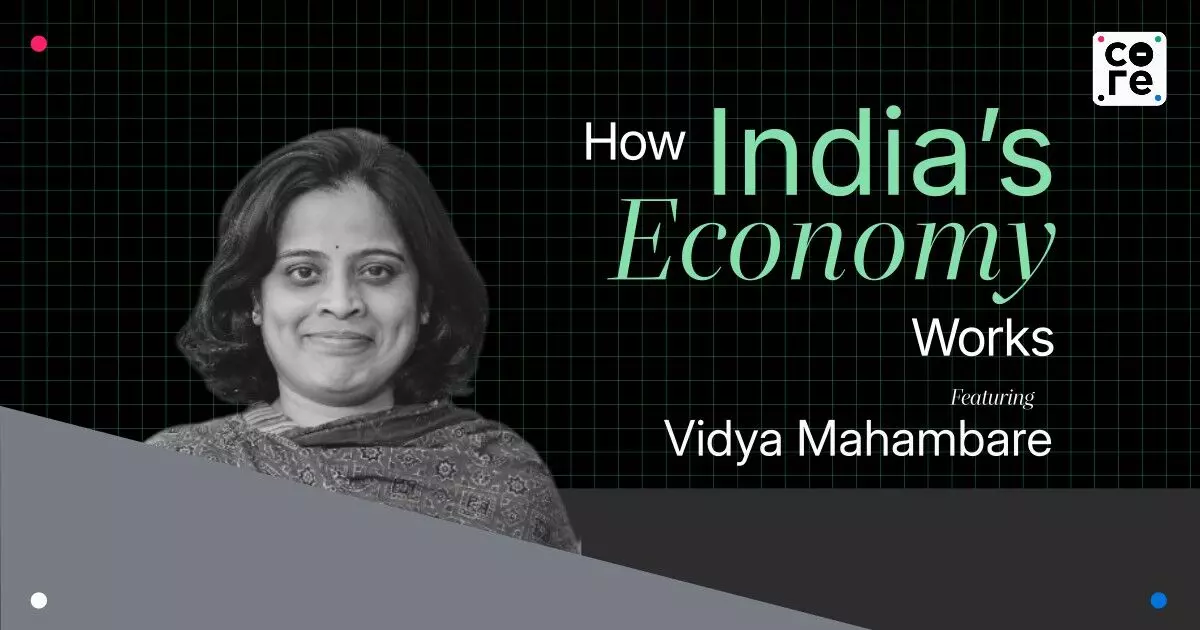
India Needs Cheaper Capital. Indian Households Could Hold the Key
- Podcasts
- Published on 30 Sept 2026 5:00 PM IST

Insights on India’s savings patterns, financial savings, household investment, borrowing costs and the policy changes that could reshape how Indians save
India’s households save a substantial share of their income, but much of that saving goes into physical assets such as gold and real estate rather than financial instruments. Why does this matter for the economy? And what does the composition of household savings have to do with investment, borrowing costs and economic growth?
In this episode of How India’s Economy Works, journalist and author Puja Mehra speaks with economist Vidya Mahambare, Union Bank Chair Professor of Economics and Director (Research and Fellow Programme In Management) at the Great Lakes Institute of Management in Chennai about India’s household savings and why financial savings are particularly important. They discuss why households save heavily in physical assets, the role of gold and housing, rising household financial liabilities, and why financial savings have increased but remain relatively small compared with physical savings.
They also examine whether tax policy creates different incentives for physical and financial savings, and discuss possible ways to encourage households to shift more of their savings into financial instruments without simply asking them to save more overall. Tune in for insights on India’s savings patterns, financial savings, household investment, borrowing costs and the policy changes that could reshape how Indians save.
CHAPTERS
(00:00) Introduction to Household Savings
(01:00) Domestic Savings and Investment Needs
(05:35) Financial Savings Lower Borrowing Costs
(07:16) Comparing Global Household Savings Rates
(09:35) Reasons for Physical Asset Dominance
(12:47) Rising Liabilities and Net Savings
(14:02) Distortions in Real Estate Taxation
(17:46) Ending Taxes on Financial Reshuffling
(21:44) Rebalancing Incentives Across Asset Classes
(24:20) Offsetting Fiscal Revenue via Agriculture
(27:12) Shifting Savings Composition Over Volume
—
TRANSCRIPT
NOTE: This transcript is done by a machine. Human eyes have gone through the script but there might still be errors in some of the text, so please refer to the audio in case you need to clarify any part. If you want to get in touch regarding any feedback, you can drop us a message on feedback@thecore.in.
Puja Mehra: Hi Vidya, thank you so much for coming to the show.
Vidya Mahambare: Thanks Puja for having me.
Puja Mehra: I want to talk to you today about savings in the economy and why it is important for an economy to pay attention to how much especially households save and especially their financial savings.
We know that economists complain that China saves too much and the general impression sometimes tends to be that Indians don't save as much. But economists often point out that Indian households do not have sufficient amount of financial savings and it's important that they should have financial savings from the macroeconomic point of view. So if you could help us understand why economists say this and what are India's household financial savings looking like?
Vidya Mahambare: So Puja, let's start with the end goal which is economic prosperity. National prosperity essentially depends on improving worker productivity or labour productivity. And in turn that depends in the sense how much a worker can produce in a given time, say an hour, depends on what is the technology they are working with, what are the skills they have, that is what helps them to improve.
And then if that happens then their wages go up and you know businesses do well and the economy does well. So that means we need to increase the investment and it's not only the quantity, quantity and the quality of investment. That investment can be in infrastructure, it can be quality education, it can be healthcare, so on and so forth.
So where does the money come then for this investment? So in any economy there are two broad sources. One is domestic savings and one what we call foreign savings.
So foreign savings will include say FDI, foreign direct investment. Now that's completely a different discussion. We know that for some time now India has not been doing well in terms of attracting foreign savings and there are several reasons to that.
When we come to domestic savings there are three main segments that they save in an economy. So there are households, corporate sector and the government. And within this household is the only sector who are net savers.
What do we mean by that? That is the corporates and the government requirement for investment is higher than what their saving is. So they still need to borrow from the financial markets to fund their overall investment.
So household is the only category which saves more than they invest. So in that sense household savings are very important for Indian economy at the macro level because households are essentially funding our investment. And you mentioned financial savings and that is because household savings have two components.
One is physical savings and one is financial savings. So when we say physical savings those are like real estate, gold, land, so on and so forth. Financial savings is when we invest in financial instruments.
So that can be bank FDs, those can be bonds, insurance, pension funds, direct stocks if we purchase or mutual fund investment. All these will be financial instruments. Now when we invest in physical savings and this composition, so households in fact save a lot.
You ask how much households save? Our overall domestic savings rate is about 35% of GDP. Within that around 21% of GDP is household savings.
So households are saving a lot. I know there is an argument that households in India should save even more. But if you convert that into as a percentage of their labour income, households are saving substantial amount.
In an economy where the aspirations are high and people still need to purchase durables, they need to purchase vehicles, so on and so forth, it is difficult to see how they can save more. But it is more of a problem, the composition of household savings. So whatever they are saving, two-third of those are essentially in physical form and only one-third is in the form of financial savings.
And why it matters for the economy is, you imagine you buy gold, right? So India hardly produces any gold. Most of it is import.
So that money essentially flows out. You buy a house which is suppose, you know, was constructed sometime back and you buy it now. Again, there is new asset that is created, right?
That doesn't add to anything in your GDP. That was an asset which was already existing. You just repurchase it from someone else.
So that way, money is getting locked into those assets. So at the individual level, you may feel that your wealth is increasing. But that money cannot be utilised, you know, by a country to fund a new investment.
This doesn't happen when you save in financial markets, right? When you save in the financial market as a household, then that money is utilised by the banks or equity markets to lend it to, you know, the corporates or to the government. So that's why the financial savings are very critical.
And financial savings though, they have risen somewhat. Net financial savings of households. Why I said net is because households save in the financial markets.
But as you know, they also borrow from the financial market, right? They borrow for housing, they borrow for personal loans, education loans. So net financial savings are only about 7% of GDP now.
Means they were as low as I think 5% a couple of years ago. But now they have risen to 7%. But still it is very low compared to the physical savings.
So I think that is the challenge for the economy or the policy makers. How do we increase the financial savings of the households rather than I feel, you know, trying to raise overall savings of the households.
Puja Mehra: So you're saying financial savings of households are a big source of capital, the raw capital with which investments take place in the economy, whether they are undertaken by government or by the private sector. Did I get you right?
Vidya Mahambare: Yeah. And if I may add, what happens is if there is more, you know, when I said when that money is available to lend to the private sector, corporate sector or the government, they can borrow because their funding requirement is high. There are more funds available in the market.
Your cost of borrowing declines, right? So right now what happens, we know, for example, whenever government, there is a huge requirement for the government borrowing, which will be the case is this year. Then the central bank comes to the aid.
And you know, central bank intervenes heavily in the market and ensures that the cost of borrowing for the government doesn't rise that much, right? But this is the intervention that the central bank has to do. But instead of that, if simply larger pool of, you know, resources are available in the financial market, it will not crowd out your private sector investment.
The cost of borrowing will not rise so much. So the quantity of money available as well as the cost of which. So we know, for example, I think if we see the government spending pattern, perhaps close to 40% of the government revenue goes simply in the interest payments, right?
The interest payment. And that is one of the highest, even among the emerging countries. So that much is already locked into paying your interest costs because you're, of course, your fiscal deficit also was higher, but the cost of borrowing also was higher.
Then you're very less leeway, you know, remaining to spend on other things that you really need to spend productive investment. So this will also help you bring down the cost of borrowing and lesser intervention will be required by the central bank, which is always, you know, better for any market functioning.
Puja Mehra: Right. And how does India's household financial savings as a percentage of GDP, how does that compare with some of the other economies? Are we considered low on the low end or do we compare well with other countries?
Vidya Mahambare: So it depends on what is, what do we take as comparison? For example, if you take some, you know, developed countries and if you take US. So in US as such itself, the financial saving, household savings are not high, right?
So because it is US economy is driven by, you know, consumerism, high domestic consumption. So US households must be saving only 3-4% of GDP at max. And at one point they were in negative, means, you know, a few years back when the financial crisis hit US.
But now they have rebuilt the balance sheet, but still it may be around 3-4%. I don't know the accurate number, but it will be only that. But within that, most of it is financial savings, right?
Now China, we know is maybe at other extreme, like they save a lot, right? So their financial savings as a percentage of this thing will be higher. But one thing is a comparison with other countries.
Second thing is simply what we need to do. Given that the foreign savings are not sufficiently available in India, we should have as much foreign savings as possible, because it's very minuscule amount of our investment is funded by foreign savings, right? Especially FDI.
But for whatever n number of reasons, we are not able to have that right now. So then at least whatever domestic savings are available, we have to utilise, you know, in a better fashion. So that's the current issue that we have.
Like, you know, so the question is why then physical savings are so high, I suppose.
Puja Mehra: Yeah, and also for perspective, I think just 3% of US GDP is a very large number.
Vidya Mahambare: Ah, yes, yes. In level terms, it will be absolute terms. It will be like, yeah, large amounts.
Puja Mehra: And US receives a lot of FDI.
Vidya Mahambare: So US receives a lot of FDI. US government deficit is also funded by other countries, right? Whatever we say about the US, it is still the country where people are happy to lend, right?
So the US government can fund its deficit by various ways. And it doesn't have to borrow from its own citizens necessarily to fund the deficit. Like even RBI would be holding US government securities.
You know, China holds US securities, so on and so forth. Compared to Europe, for example, European central banks, people still prefer holding, you know, Fed securities.
Puja Mehra: Although I think in lesser and lesser quantity. But let's come to the question of what you just said that, you know, what are the reasons for the low levels of financial savings in the Indian economy for households, especially when you said in some of the other more advanced countries, households tend to keep most of their savings in financial instruments and not in physical assets. So what's different about India?
Vidya Mahambare: So we can think of, you know, several reasons. So if we just start with, say, you know, culture matters everywhere. So for example, if you see something like gold, culturally it is considered an asset for a woman, right?
So you have traditionally the gold holdings. But also apart from that, gold also act as a collateral, right? So when you have large percentage of the workers who are in the informal sector and they cannot get, you know, loans that easy.
Now, personal loans and all have increased, I know from NBFCs and all. But in general, still the access to loans for the informal workers from the formal market is still less, right? So they are the ones who essentially find it easy to borrow, pledge gold and then borrow against that.
They can do it in the bank or they can do mostly in the informal through other channels. So that is one reason. So gold becomes, you know, one of the assets which they want to hold.
Second, if you see something like, you know, housing. Again, as an economist, whether housing is a, whether you stay in a rented house or you stay in an owned house, it should be equivalent, right? But psychologically, of course, for many people, an own house signals security and it signals status.
Again, a house can be purchased with borrowed money. You can take a loan to, of course, you need some down payment. But other than that, you can, you know, borrow to make house as an asset.
And plus, as we'll see, it is more tax efficient way than investing in some other financial assets. Okay, so we'll come to that why housing perhaps is more tax efficient away. Then if you come to, you know, financial sector, and if you think about like bank deposits or you think about any fixed income security, corporate bond or anything of that sort, think about the, you know, real return.
So real return is what is your nominal return minus the inflation. Or expected inflation. So that is really minuscule, like real return, right?
So if your FD earns like 6% and if your inflation is 6%, your real return is zero. And, you know, households, whatever, people are rational, you know, they understand this is what happens. So in the real terms, you're not making anything.
So it doesn't make sense to simply put money, you know, maybe you put like some precautionary savings into FDs, but you're not going to put like a lot of money, you know, park your money into FDs because real returns are almost nothing, you know. And after that, what we're saying about, you know, in the beginning when we said about the household savings and within the financial savings, there's a gross financial savings and net. So the gross financial savings are quite high, I think around 11-12% of GDP.
So that is what we save. So I start a SIP, I save. But I as a household, at the same time, have taken a loan and paying AMI or something.
So that is the financial liabilities of households from the financial sector. So one side, a household is saving, and one side now, previously, this percentage was much lesser. Household liabilities, financial liabilities, they're much lesser.
Increasingly, not only real estate liabilities against that, but also personal loan and so on, vehicle loans, that has been expanding quite fast. So that means only net is what we need to look at, net contribution, right? So that is another reason now the financial liabilities are increasing.
Of course, if they're increasing for the consumption purpose, that is not a good thing. Like if you're just going to spend that money, it's not useful. But I'm not sure all types of personal loans are necessarily in that category, though sometimes it's the whole category considered as for consumption.
But if you're buying for a durable, that is going to provide you a service over a period of time. So all those loans are not, how to say, rational or just for consumption. So that's going to happen.
So that is the household financial liabilities. So in net terms, because of that, the saving becomes lesser. And then finally, there is an issue of taxation between physical savings, especially real estate and the financial savings.
So for example, if you take anything like as simple as say like FD, when FD matures, now or any fixed income security now matures, after 2023, I don't exactly, around that time, since then we have this thing that whatever is the gain is returns on that is taxed at your slab rate. So if my slab rate is like 30%, it is taxed at 30% even if I'm going to renew the FD. So because it is a fixed maturity and when the maturity is over, that return automatically, it is getting taxed even if I'm not using for consumption.
But if you put in the real estate, it's very different what happens there. So similarly, now we know more and more. So people's savings into FD still dominate.
They have come down. They may be only now 35% of overall financial savings. They have come down, but nonetheless, they dominate.
Now more and more money is going into equity market because that is where people think they can make returns given that the fixed income doesn't give much real returns. But even if you now see the equity market, especially younger people, are investing a lot into mutual funds and into stocks and so on, right? Now, suppose on one particular scheme is not doing well in mutual fund.
So after one year, two year, I'm not saying they should buy and sell very quickly and do trading. Absolutely not like that. You park money, suppose like one year, two years, three years.
Suppose you want to do a switch, right? You don't want to sell. That is, I don't want to use money for consumption.
I just want to do a switch and I want to put into, say, another. Now, of course, there should be literacy around that and people should be able to evaluate properly. But after doing that also, the switch is also considered a sale every time.
So again, I'm paying the long-term capital gains of 12.5% on that. But whereas if you see a house or a flat, if you sell a flat, you can buy another flat within, I think, one or two years or you can build a new house within some three years and then the capital gains are not taxed at all. There will be a limit, but some 10 crores value of a house, something of that sort, like very large limit.
And I think once in a lifetime, you can do it for two houses as well, I think. If you don't want to do that also, then you can park some amount, like 50 lakhs or some amount in government bonds, again, for a particular number of years. But even then you can save tax.
So there are ways to save tax if you are into real estate, at least to some extent. Nothing like that exists in the financial market. So suppose you say that, you know, if I reinvest all that money within, I'm just thinking aloud, okay?
I'm not saying at all that I have solution or this may be necessarily the best solution. But something like, suppose, you know, if I reinvest immediately, you know, I just do a switch or FD, I reinvest immediately only, then, you know, we should think about really whether on reshuffling, whether I should be paying a tax, right? So that is one thing to consider because that clearly lowers the returns that I get, you know, in the financial markets, even when I'm not using that money for consumption.
And I remember like some years ago, Deepak Shenoy of Capital Mind, he had come up also with a idea called Mera accounts, that is like for the retirement savings at the individual level, empowered retirement savings account, which will be like a US40K account, okay? Or how we have in UK as well, that is you can put an amount into that, within that you can switch and shift whatever financial assets you want. It will be taxed only towards the end when you are withdrawing the money, till then you can grow your fund.
But that gives you then the flexibility, like within the financial instrument and you have incentive to grow that fund then, right? These are the things somewhere we have to look at if we want to tilt the incentives more towards the financial savings compared to physical savings.
Puja Mehra: Yeah, I think, I find it very strange that if a foreign investor is lending to government as we saw recently it was announced, then they are not taxed. When banks lend, why is that treated differently for tax purposes from us putting money in FDs because that is the money that banks use to lend. So these are anomalies and they lead to huge distortions in saving behaviour in the economy.
And as a result of which financial savings in the economy aren't as much as we need them to be. So you already said that what is the reason for these anomalies and distortions, but do you want to give specific recommendations for policy corrections to make sure that we can have more and more financial savings?
Vidya Mahambare: So somewhere we need to reduce incentives that are there for the real estate. So you have only physical savings and your financial savings, right? If we want people to move towards or we want to nudge them towards more financial savings, you have to reduce incentives for the real estate and you have to improve incentives for the financial savings.
So the number one thing can be, we should try and think about whether we can end the tax on reshuffling. As I said, if I just reshuffle within my financial savings, what is the logic that I should pay tax, right? Because I'm not taking that money out, I'm not using for consumption, then I should be able to defer my tax burden and you tax it the full gain at the end.
Whenever these are taken out fully, that time you tax. But in between, what is the reason that you tax is not clear? At least we should start having discussion, I feel, about how to end the tax on reshuffling within the financial instruments.
That is one. Second, retirement savings we have in the new tax code, other than NPS, we have no other reductions now. So then we should think about whether NPS will really build the pool of resources that people need.
That is not clear. So instead of that, why don't we hand it to the people only, like you be the best decision. It's not like you have to invest only in NPS or only via NPS.
You want to build a sufficient retirement pool. So there is a UK system also, I think, of the individual savings account for the retirement. So if I remember correctly, there are £20,000 sterlings that every year they can invest in that.
You can keep that in any form that you want. So you can put it in the fixed income securities, you can put into those stocks, you can put into FDs. Of course, they were having a problem that far too many people put money into simply cash or FDs and not into long-term investments.
So they're going to rejig that. I think they're going to put a cap on how much people can keep only in cash because then that doesn't serve the purpose because that doesn't grow your returns are very less. So they're going to tweak that.
But the idea is this, you have one account under which you can reshuffle in whichever way you essentially want. How it is different, I think, from that £40,000 and I'm not saying which will work better for India necessarily, but in £41,000, it is only at the time of the retirement that you can, the flexibility is not there. Only that time you can use that money.
Whereas here, you can take out money whenever you want. As long as it is within that, it is not taxed. It's not that you have to wait till the end, till retirement, as long as you're within reshuffling.
There are, I think in Sweden also, there is some other system. They do not essentially tax the capital gains, but they tax just some fixed amount, fixed percentage of your overall pool only every year. But in India, that will not go down well because that means even if there is a loss in a particular year, because the taxation is on the pool of money in that fund, you still get taxed.
Very less tax, but that we will not be okay with. I did not make any return on the why should I pay tax. But what I want to say is there are different models in different countries, which essentially we need to study and figure out what for the Indian culture and psyche will work better in terms of creating more incentive to more financial saving and reduce maybe the incentives for the real estate.
You have a 10 crore cap and once in a lifetime you can use that money to split into two homes. You can purchase up to two homes. Very few countries allow that.
Most of it is only your residential home is the home where there is a taxation benefit in most of the countries. So you have to reduce the incentives that side and improve the incentives on financial markets overall.
Puja Mehra: Yeah, I think part of the reason might be, I'm just speculating here, that political parties and politicians are so heavily dependent on real estate markets for their own campaign funding. We might be indulging in some wishful thinking here, but let's hope that good sense will prevail.
Vidya Mahambare: Yeah, so let's maybe leave like if that is the case, maybe we know the real estate maybe cannot be touched much, but at least you can improve incentives on financial market side. At least you think about how you create, so don't maybe reduce whatever is happening currently there in terms of taxation benefits, but at least relatively improve how is the taxation is currently happening in the financial market because most of the financial instruments, other than equity markets, real returns are really very, very less, right? And so more and more younger people put money into the equity markets and they will be now at a stage where they want to liquidate and put into something else, right?
They realise that now they are going to it with long-term capital gains tax. So that you many times realise only when it comes while paying the tax. When you're putting the money in, you don't think about that, right?
Then that question, same question arises. No, I just want to switch to another. So think about the regular funds and direct funds, right?
It is the same mutual fund scheme. For some reason, I had ended up putting into say the regular fund. Suppose the same scheme only, suppose now I want to move into a direct fund.
Even that time it is considered a sale. You see one identical scheme only I'm putting shifting from regular to direct. Of course, there is a, whoever you had invested through brokerage house or whatever.
So I'm not saying you invest through them and then immediately you are allowed to switch into direct fund. No, if you're taken their advice, of course they need to be paid via fees or whichever is this thing. But that doesn't mean year after year, year after year, I've got locked into regular funds, right?
For the same advice that was given, the commission or whatever is for years and years they are taking. Suppose I want to switch now, but then I'll end up the same scheme only. I want to switch.
Even then I have to end up paying the tax. So what is the logic is not really very clear there.
Puja Mehra: And for a finance minister who might bite the bullet on what you're saying and reduce the tax benefits right now that real estate enjoys. And at the same time brings the taxation of financial savings, especially on the debt side, more in line with the other instruments. There would be a gain because there is so much grey market and so much black money in the real estate market, even if it is less than what it was a few years ago.
But that is a net gain, I suppose, for any budget maker and for the economy. But also how will that compare with any revenue loss they might suffer because of the other side, the financial instruments, taxation of that that you're recommending.
Vidya Mahambare: So I think there are two parts there. One, if simply the financial savings increase, as we said, your cost of borrowing will come down in general in the economy. So that itself will lead to the reduction in your government expenditure and the requirement for borrowing.
So that is one part, right? And second, there will be revenue loss. I have no estimate of how much will be the revenue loss to the exchequer immediately.
But there are other parts of the economy which are not getting taxed at all. And again, it is going to be a political economic question. But just theoretically, if we think about it, there is no reason why the agriculture income should not be taxed because small farmers anyway will not pay tax because the income tax threshold only is now some 12 lakhs or whatever, right?
So whoever's income is lesser than that, anyway, they don't pay tax. So those farmers also will not pay tax. But there are smaller percentage of very high-earning farmers, right?
Now, ideally, they should be paying tax. There is no reason why that income should be tax-free at all. Of course, originally, there was an argument that it's difficult to calculate the net income from agriculture, farm income, and so on and so forth.
But sometime that has to be looked into, right? If we say that some half of the workers still are in agriculture, maybe I'm exaggerating, maybe half are not there now. But still, significant proportion of people are still working in agriculture.
And even if a small percentage of that are high-income earner farmers, they can still contribute a lot because anyway, they are enjoying all sorts of subsidies, correct? So giving subsidies, because subsidies are across the board in agriculture. It's not that we are giving subsidies only to poor farmers, right?
We are giving subsidies to all farmers only. So there might be fertiliser subsidy. And of course, that needs to be looked at.
Like another thing where the expenditure can be brought down is subsidies, including that fertiliser subsidy. So fertiliser subsidy, electricity subsidy, you know, what is happening to water, MSP. You know, all these things are across the board, all farmers only use, right?
Then the rich farmers are gaining twice. Not only they're using all the subsidies, plus they don't pay income tax. So that sometime, as a country, we have to look into that, you know, why that is not happening.
So one is that whichever part of the economy does not pay taxes, which they should be paying, and maybe politically it was difficult previously, or calculating income was previously difficult. But now we must look into that. So that will be one way of raising revenue.
Curtailing expenditure will be, you know, something like fertiliser subsidies. That's where like, for example, we can curtail expenditure. But at least if we begin to think around these issues, because raising financial, improving financial savings is going to be very critical if we want to have enough money for the domestic investments that we need to do.
And I believe, contrary maybe to many people, this what economists say, or many market commentators may believe, I'm not of the opinion that you can ask households to save way more than they are currently saving overall. Okay, because anyone saving, you know, 20% of their income, 25% of their income, if more than that they save, all of them save only, anyway, who's going to do consumption? Like, you know, you don't need investment and the corporate sector is not going to do investment if there is not enough consumption growth.
So we cannot say in the same, this thing that we want higher household consumption also, consumption growth also should be higher. And we want households to save more also. Both is, cannot work only, right?
So that is at the aggregate level, simply it cannot happen. Second, at the individual level also, when as the, I think evidence everywhere shows, as your income grows, your requirement for borrowing also increases only because you want to fund your, all these expenses, durable vehicles, you know, all those, these things, education. So your funding requirement for households also will go up.
So asking them to save more than now they're saving 20, 21% of GDP. More than that, I don't think really is viable rather than they have to focus on shifting the composition of savings only in favour of financial savings. And of course, improve the foreign savings overall for the funding requirement for investment, but that's altogether different topic why we are not getting sufficient foreign savings.
Puja Mehra: We'll discuss that another day when you come again to the show, but from what you're saying today, what I gather also is another point is that, you know, maybe doing piecemeal policy corrections will not political economy wise be sufficient. You have to probably plan a whole set of policy corrections, addressing various things so that the end result is what you're recommending. Vidya, thank you so much for coming to this show.
Vidya Mahambare: Thank you, Puja. Thank you.


