



 Newsletter
 Search
Growth, Inflation, the Rupee: What Should the RBI Prioritise?
- Podcasts
- Published on 4 Nov 2026 5:00 PM IST

Insights on the RBI's policy choices, the rupee's persistent weakness, foreign capital flows and the trade-offs between inflation control and economic growth
The Reserve Bank of India faces an increasingly difficult monetary policy challenge. With inflation picking up, the rupee under persistent pressure and economic growth showing signs of recovery, the RBI must decide how to balance three competing priorities. But can it address all three without compromising one for the other? And should stabilising the rupee become a bigger consideration in its interest rate decisions?
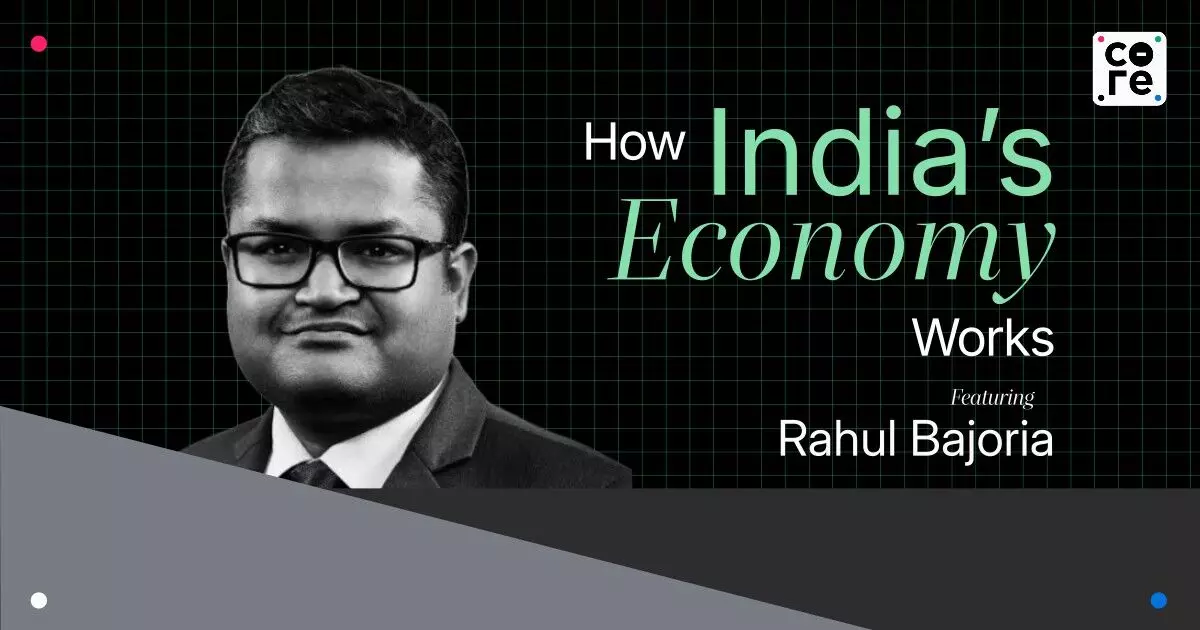
In this episode of How India's Economy Works, journalist and author Puja Mehra speaks with economist Rahul Bajoria, Head of India and ASEAN Economic Research at Bank of America about the RBI's monetary policy dilemma and the case for normalising interest rates without tightening too aggressively. They discuss why higher interest rates may not necessarily attract foreign capital, the limitations of using monetary policy to defend the rupee, and why India's ability to attract global investment depends more on its growth prospects than on offering higher yields. They also examine the risks of premature tightening, the possibility of inflation becoming more widespread, and the potential impact of higher borrowing costs on investment and the economic recovery.
Tune in for insights on the RBI's policy choices, the rupee's persistent weakness, foreign capital flows and the trade-offs between inflation control and economic growth.
CHAPTERS
(00:00) The Macroeconomic Policy Trilemma
(01:19) Conflicting Objectives Facing the Central Bank
(05:19) Gauging Financial and Exchange Stability
(10:12) Tenuous Link Between Rates and Inflows
(13:16) Balancing Inflation Normalisation and Growth
(15:29) Assessing Risks of Generalised Inflation
(16:58) The Case Against Aggressive Rate Tightening
(19:31) Growth Risks from High Borrowing Costs
—
TRANSCRIPT
NOTE: This transcript is done by a machine. Human eyes have gone through the script but there might still be errors in some of the text, so please refer to the audio in case you need to clarify any part. If you want to get in touch regarding any feedback, you can drop us a message on feedback@thecore.in.
Puja Mehra: Rahul Bajoria, thank you so much for coming on the show. Rahul, we have discussed on the show earlier that the RBI's monetary policy is confronted right now with the macro trilemma of growth inflation and exchange rate policy with other guests. And there is a debate out there right now going on about whether the RBI should be using its monetary policy tools for managing the exchange rate, which is a pressing policy objective for the RBI, especially given that the governor has in fact said that financial stability is also a policy objective for them.
But at the same time, we know that the inflation targeting framework lays down quite clearly that the policy objective for the RBI have to be inflation and growth. Now, what should get more importance amongst these three is something that is being debated. Before I ask you what your views on this is, I'd like you to help my listeners understand what this macro trilemma is.
Rahul Bajoria: See, in the last two years, right, ever since Governor Malhotra has taken over the RBI, the RBI has been grappling with, I would say, conflicting objectives to a certain extent. I mean, there's inflation, which was quite low in the early part of this term and then has subsequently normalised to a certain extent and now is sort of pinching higher as global commodity prices have moved up. There is growth, which was looking pretty weak, particularly on a high frequency indicators basis in the early part and then has subsequently improved and stabilised with a fair amount of heavy lifting being done by fiscal policy as well.
And then there's the exchange rate, which has been persistently weakening to a certain extent that there's been consistent underperformance, both in terms of where the macro cycle is, where the funding requirements are, and also where the global dynamics are, right, like the rupee has been a persistent underperformer, both against its own history and against other emerging market currencies. Now, within this entire framework, we have seen the central bank, to a large extent, focus on the growth primacy of its policy objectives. Sometime in the early part of this term, it was very clear that there was an emphasis on reviving growth and basically letting the exchange rate move on its own beat.
And so we saw, I would say, within the trilemma of managing between growth, inflation, and the exchange rate, the central bank basically saying that the growth is what is important and need to basically revive growth to a certain extent before we really try to focus on other areas. Now, in the last, I would say, 12 months or so, ever since the GST tax cuts were implemented, and there have been a series of other demand-side stimulus measures, the Indian economy has shown a fair amount of resiliency and rebound, both in terms of high frequency numbers and also, in particular, the monetary sector has seen a bit of an improvement. With this particular objective fulfilled, I think the RBI has correctly pivoted at the margin to thinking about a little bit more on the macro stability element.
And this is where I think the financial stability issue also comes in, is that with growth looking quite OK, the ability of the central bank to focus on inflation, which has moved up, but is moving up from fairly low levels over the last couple of years, and then the exchange rate, which has remained under persistent pressure, and there is a question mark over whether interest rate differentials can help in at least stabilising the exchange rate cycle.
It is what I think the trilemma is all about. Basically, the choice set between what sort of holds primacy in the policy objectives, and I think with growth being consistently above 7% and looks like we will have another quarter of 7% plus growth, this trilemma basically is this choice set between what sort of is the pecking order on which policy gets decided. And at this point in time, with growth looking quite OK, the choice set has become a little bit easier in the sense that the RBI can basically drive its policy with keeping inflation and keeping the exchange rate a little bit more in mind than what was the case a year ago, when it was a bit more conflicting between these three areas.
Puja Mehra: So, before I ask you for your view on what you think the RBI should be doing, let me ask you how you interpret what the RBI is seeing that it is trying to do. So, on the one hand, the Monetary Policy Committee has changed its stance to calibrated tightening. And also, in a recent interview, I think it was at the post-policy press conference, Governor Malhotra said that financial stability, too, he believes is a policy objective.
So, what do you think the RBI is trying to do in this trilemma, where there are three possible policy objectives of which they cannot simultaneously address all three?
Rahul Bajoria: Yeah. So, my sense of, you know, when I was reading the speech that he gave at Cortelia Economic Conflict in early October, my interpretation of financial stability was that it is linked, basically, to both the quantity of money, the price of money, and the external value of the money, right? Like, those are the three primary aspects on which one can gauge financial stability issues.
And at this point in time, if you look at the general dynamic around whether credit growth is a bit too high or a bit too low, I mean, we can have a debate about it. But I do not think there are essentially any imminent signposts of financial instability in India, right? We could think about whether there is a need to kind of recalibrate policy.
And that, I think, is where the signalling of the Monetary Policy Committee was in the October meeting that inflation is high enough for them to sort of think a little bit more about the balance between growth and inflation. But I do not get a sense that there is a feeling within the RBI or even within the markets that the RBI is meaningfully behind the I do not think that is the case at all. But there is a case to be made whether between having an objective around growth and inflation remaining at a particular acceptable level, a minimum amount of growth that we are able to achieve and a maximum amount of inflation we are willing to tolerate, where does the exchange rate sort of sit in?
And I would say to a large extent, the market has digested the comments around financial stability as an attribution to the RBI basically indicating that the willingness to sort of look at interest rate hikes, whether both in quantum and in terms of timing, to be calibrated around exchange rate management. Now, this is an interesting departure because, as Pooja, you know, and I know that since 2013, there has been this great delinking that has happened between monetary policy and exchange rate policy in India. So this particular attribution has been, I would say, at least to me personally, a bit of a surprise.
But at the end of the day, I do not necessarily think that there is an urgency to actually hike interest rates. And this is the point we have tried to make in some of the publications we have done recently, that interest rate differentials, in India's case, have not necessarily brought in a lot of inflows, right? Like if that is the end objective, it is actually growth.
And India being largely seen as an equity market, that growth revival is the, I would say, the necessary condition for capital flows to see a meaningful revival, whether it is in the secondary market through the equity channel or through the primary market through the FDI channel. And in that sense, I would say that interest rates have to be calibrated to manage inflation, no doubt about it. That is the first order priority.
But the second order priority is that we have never really been able to attract fixed income inflows through the channels offering a lot of yield, like that has never been the calling card of the general economic setup. And so I still believe that the RBI will effectively balance between growth and inflation. And the exchange rate is likely to be tackled mostly through regulatory channels, as we have seen with some of the measures that were rolled out in early October.
Most of them were basically designed to relieve the pressure of the market side of things rather than necessarily boosting inflows. And then obviously, the recent attribution by the Ministry of Finance of looking at taxation issues, looking at ease of doing business for foreign investors. I think those are the kind of measures I would look for as far as reviving confidence in the capital flow cycle is concerned.
But broadly speaking, I don't necessarily think that monetary policy will be actively used in order to bring about inflows. I think that's going to be a difficult proposition for a country which is very growth sensitive like India.
Puja Mehra: You're making three points. First, you're saying that the policy framework itself does not foresee the use of monetary policy tools for doing exchange rate policy. That's point number one.
Although during the Ukraine war, we did see use of interest rates into policy by the RBI to close the gap between the Indian interest rates and the Fed rate hike that had happened and immediately RBI pivoted. But that aside, so you're saying that the policy framework does not really have scope for this, number one, regardless of the exception. But two, you're saying that this time, even if such an exception was to be made all over again, it will not be effective in providing stability to the exchange rate.
And there you see the role for stabilising capital inflows lies more in the domain of government policy. And at best, what RBI can do is buy more time, manage supply and demand of dollars through its administrative measures, some of which many commentators have called quite heavy handed.
Rahul Bajoria: That's right. And I would say the proof of the pudding as far as the exchange rate and the interest rate linkage is tenuous at best, I would say, because for most of last year, India was actually running very, very high real yields, bond yields were, you know, kind of coming off and we still did not necessarily see a lot of inflows coming through on the fixed income side, right? Like, I do buy the argument that there is an interest rate differential issue between the rest of the world and India in the sense that it has compressed, but it has compressed for the right reasons that India's overall inflation management and particularly the supply side management has been quite, quite good.
And so the inflation decline and the fact that we are basically able to kind of run interest rates a little bit on the lower side is more a reflection of the gap between demand and supply side. And in previous instances, whether it was in 2022, which you mentioned, and, you know, even in 2013, when interest rates were increased, the current account deficit from a momentum standpoint was a lot higher than what India has historically been able to drop. Now, there is an argument to be made whether the 2% historical current account deficit that we see as being a sustainable level of financing, is that the right number at this point in time?
But to a large extent, I would say India does not have a current account deficit problem. We have not had one for a while, except for the last, I would say 2022 episode, India's current account deficits have been below 2% of GDP since 2013, right? So from a funding standpoint, the aggregate demand conditions in India are not high enough to basically signal that we need to destroy growth or we need to bring growth down quite aggressively in order to bring about stability of the exchange rate.
And even if we do that, the trade-off between looking at equity flows versus looking at fixed income flows, I think would be a little bit more difficult. Whether we can sort of attract fixed income flows by hiking interest rates aggressively, while then obviously having a knock-on effect on the growth side, which may have a negative impact on the equity flows, I think is the question to ask. I don't necessarily have an answer to this, but this is the trade-off that we are effectively thinking about.
And I'm not so sure whether this ends up as a zero-sum game or a positive-sum game or a negative-sum game in terms of where the capital flows end up, right? So this, I think, is the thought process we have and why we are not necessarily convinced that there is an argument to be made for hiking interest rates aggressively as a way to kind of defend the exchange rate. But if there is a case from an inflation standpoint and there's a case from a growth standpoint, for interest rates and the cost of money to basically be a bit higher, like we are calling for rate hikes, it's just that we don't necessarily think that the terminal rates in this particular cycle are going to be higher than what it was in the 2022 cycle, where it ended at 6.5%. But when the MPC says that the stances
Puja Mehra: calibrated tightening, can RBI prioritise growth at all?
Rahul Bajoria: It's not just about prioritising growth, but as I said, that we also have to be aware of the sacrifice ratios involved, right? That if there is no visible signs of overheating, and I'm conscious of the fact that inflation is going to be close to 6%, but a lot of it is coming from food inflation picking up after a fairly long period of low food inflation. So there is some normalisation in food prices coming through, but underlying core inflation while rising is still close to around 4%.
So you're not necessarily seeing runaway inflation. In fact, I would argue that's something that we were flagging a couple of years ago as a big issue, that the wage growth and the underlying inflation in the economy was just looking a bit too low. One of the reasons why India's growth looks to be a little bit more tepid is that our nominal growth has come off quite a bit relative to what we used to do in the previous years, while global nominal growth has picked up, particularly in the US.
And so to a certain extent, there has to be a balance, right? I'm not talking about letting the economy run hard, but we also should not be aggressively tightening at a time when our growth has just about started to revive. After a couple of years, we are seeing a little bit more momentum, particularly on the nominal side.
So we need to kind of let this run. And so there is a balance between managing growth and managing inflation. And inflation being largely a supply-side phenomenon at this point in time will take a while before global conditions improve, and that will help in managing inflation.
But there is a case to start normalising interest rates. I don't think there's a case to be made for aggressively tightening monetary conditions, because we have already had credit growth run in double digits for the last six, seven months, right? Like it's not been a very long period of credit creation that the economy hasn't seen.
Puja Mehra: In fact, I've had guests on the show over the past few months who have said that the economies had considerable slack. So that ties in with what you're saying about the economy not close to being overheated. Would you want to say something about whether or not how close we are to inflation getting generalised, and why you think that's not a reason for worry right now?
Rahul Bajoria: So I think the risks of generalisation and inflation will basically come from persistently high growth, which has not necessarily been the case in the last couple of years. I would say that two of the largest employers in the white-collar space, right, so both the financial sector and the IT sector, have generally not been hiring very aggressively. And while we are seeing the payrolls data that the RBI publishes normalised towards 12%, 13%, I think if that number was to start moving back towards 15%, 16% kind of a level which we were seeing back in 2022, I would start worrying about generalisation.
But at this point in time, I would not worry about generalisation because on a cumulative, like if you look at the CAGR of inflation in India over the last three years, it's actually been closer to around 4.5% rather than 6%. So some amount of inflation is also not bad. We need some inflation to basically have a degree of money illusion in the system where people feel that their earnings are going up and they want to spend.
In that sense, if nominal GDP growth is consistently around, say, 13%, 14% over a period of one to two years, I would worry a little bit more about generalisation of inflation. But at this point in time, that's not been the case for the last couple of years. So there's a case for policy normalisation.
I don't see a case for policy tightening in that particular context.
Puja Mehra: Right. But there are people who also say that one of the considerations is that real rates are nearing zero.
Rahul Bajoria: Yeah. And so real rates are definitely approaching zero. But we also had real rates being pretty elevated last year.
If you start thinking about an averages, have we seen necessarily a huge shift in the savings behaviour in the economy? Not necessarily. Deposit growth has been holding up reasonably OK.
I mean, some of it is FCNR money. But overall, I would say that we basically have to think about whether we are seeing a buildup of highly risky leverage in the system. And that's not been the case.
I mean, personal loans, etc., while they have gone up as an overall share in the last five years, at the margin, the growth rates are coming off. And a lot of it has to do with the regulatory environment and the tightening that we have seen around some of these loans. And so I wouldn't say any of these things are necessarily set in stone.
If there is a need, let's say in three to six months time, if there are signs of inflation generalising, you know, you're starting to see commentary of attrition rates going up. There is a case for policy tightening, and that can be done in a relatively short amount of time. It's much harder to revive an economy than it is to slow an economy down, as we have seen in the past cycles.
And so as long as there is a great amount of vigilance and there's a fair bit of awareness of data dependency, and that's, I think, what we were talking about back in June, you know, when the expectations of monetary policy tightening were not even there in the system. And we have had this call that RBI is going to start hiking interest rates. In this year itself, we were basically saying that, okay, growth is good, inflation is rising, you can start normalising policy.
But is there a need to then jump two steps ahead and say that we are going to start tightening policy aggressively because we don't want to create a problem a year down the line? I would say let the economy kind of play out. And if there is a problem, we can always tighten policy quite aggressively, very, very quickly.
It's quite easy to hike interest rates, but there's no need to jump to that. In that case, we are not in the camp of a 50 basis point hike. We are not seeing the telltale signs of overheating to a point where you need to aggressively tighten monetary conditions.
But there is a need to start normalising policy environment. There's no need to run the economy at 0% real rates. But I don't think we need to necessarily be at 2% as well.
That's how we are thinking about it.
Puja Mehra: Lastly, do you want to say what the downside might be if there are aggressive interest rate hikes, keeping inflation in mind or even the exchange rate considerations in mind? What kind of impact that could have on the revival and growth?
Rahul Bajoria: So basically, what we are looking at is an environment where if interest rates were to go up aggressively, we will see the nascent recovery and trade growth, I think, come under question. And, you know, you might see a period where investment demand, which is showing very nascent signs of revival right in the last few quarters, we have seen both from a credit perspective and from a channel checks perspective that the demand revival basically leading to some incremental capex growth that will start getting questioned at the margin, especially at a time when global interest rates are elevated as well, like the overall cost of capital will be high enough, perhaps for some of these investment projects to either be pushed back or, you know, to be shelved. And so we would worry about that aspect at the margin, whether it has any meaningful stabilisation effects on the rupee, I think has to be seen from the current account channel.
And I will say to a large extent, the widening in the current account deficit has been a reflection of higher energy prices and higher petrochemical and metal prices in the last 6 to 12 months. Whether that sees a pullback and whether that pullback is coming from the price side or whether it's coming back from the volume side, I would hope it's the price side. I don't think volume compression is a feasible strategy over a longer period of time.
Like India's core USP in terms of attracting capital globally has been the growth story. It's never been that fiscally we have done such a tremendous job over decades that we see a lot of fixed income flows. And so I go back to the basic idea that we get capital from outside because we grow fast and we should be aware of the fact that growth has to be at least a necessary condition in order to justify tightening of monetary conditions and you know whether we are being preemptive in the way monetary policy tackles inflation and exchange rate over a period of time.
Puja Mehra: Rahul Bajoria, thank you so much.


