



 Newsletter
 Search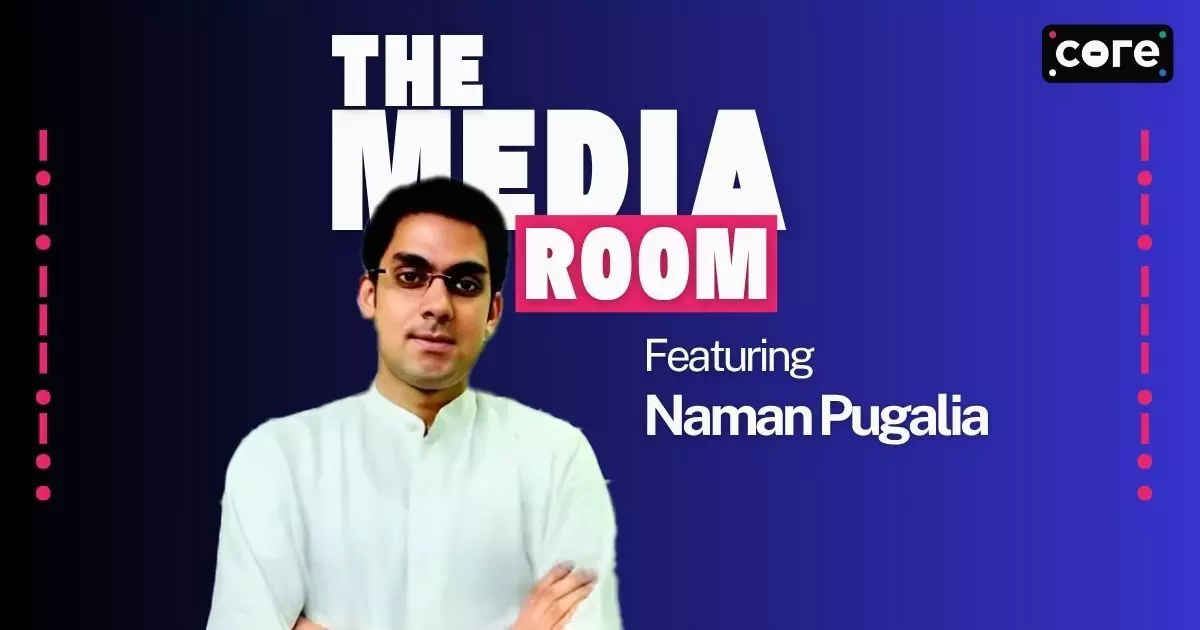
Coldplay to Lollapalooza Inside India’s Big Concert Bet
- Podcasts
- Published on 23 Sept 2026 6:30 PM IST

BookMyShow has sold close to 100 million tickets, while its live events business has grown exponentially in the last four years.
From Coldplay to Lollapalooza, can India’s concert boom become a lasting business? In this episode of The Media Room from The Core, Vanita Kohli-Khandekar speaks with Naman Pugalia, Chief Business Officer for Live Events at BookMyShow, about India’s concert economy, the growth of live entertainment and the investment needed to bring global artists to Indian audiences.
The conversation explores BookMyShow’s evolution from a ticketing platform into a concert promoter, spanning international tours, music festivals and stand-up comedy. Pugalia explains how digital payments, social media, music streaming and a growing willingness to pay for experiences are reshaping demand for live events in India.
What does it take to turn a cricket stadium into a concert venue? Can India build enough indoor arenas to host live entertainment throughout the year? And can ticket sales and brand sponsorships sustain the business beyond a handful of blockbuster shows?
Coldplay’s India concerts and Lollapalooza India offer a window into the economics behind the stage. Pugalia shares BookMyShow’s estimate that Coldplay’s two Ahmedabad shows generated ₹641 crore in economic impact. He explains how concerts and music festivals drive spending on hotels, airlines, restaurants, merchandise and local transport, creating opportunities beyond ticket revenue.
The discussion also covers concert infrastructure, crowd safety, international artists’ production requirements, Sunburn, the expansion of live music beyond major metros and the differences between cinema ticketing and live event economics. Pugalia examines the role of brand partnerships and why moving beyond expectations of free tickets matters for the industry’s growth.
For business leaders, investors, consultants, marketers, media professionals and anyone tracking India’s media and entertainment economy, this episode offers an inside look at the business behind the concert boom.
Watch the full conversation on The Media Room from The Core to understand India’s big concert bet and what BookMyShow’s experience with Coldplay, Lollapalooza and live entertainment reveals about its future.
NOTE: This transcript is done by a machine. Human eyes have gone through the script but there might still be errors in some of the text, so please refer to the audio in case you need to clarify any part. If you want to get in touch regarding any feedback, you can drop us a message on feedback@thecore.in.
—
TRANSCRIPT
Vanita Kohli-Khandekar: Hello and welcome to The Media Room. Today I have the man who runs the live events business for BookMyShow. Naman Puwalia is Chief Business Officer for live events at BookMyShow.
And we are going to be talking about not just Lollapalooza which is completing 5 years in India but also about why is it that live events seem to be having so much traction and what's happening around the concert economy. Hi and welcome Naman.
Naman Pugalia: Thank you so much Vanita ji.
Vanita Kohli-Khandekar: Naman, first of all, you know, events bring in about I think roughly half of BookMyShow's business top line if I'm not mistaken. And so, you know, the strategic fit is very clear. But you know, what is it within events?
What does it do to the whole business overall? And which are the big events? I know we are going to be talking about Lollapalooza but which are the other big events also?
Take us through a little bit of a roadmap of the events business at BookMyShow.
Naman Pugalia: So as you know Vanita ji and as your listeners and viewers may know in 1999, BigTree which is the parent company really began as a ticketing business. And for several years we cut our teeth in that business eventually becoming the largest ticketing platform not just in India but by volume today in the world. We do close to 100 million tickets on the platform.
Now a large part of these tickets outside of the cinema business obviously are for live events and you know and sports. But for live events we realised that we were anyway playing the role that a traditional promoter would. Right in the business which is advancing guarantees, ensuring that customer experience at some of the events that we were ticketing for.
Top-notch so on and so forth. Because you know in this business what happens is there isn't room for a lot of nuance. If a consumer is buying the ticket on my show for all practical purposes for them it's a BookMyShow event.
They don't necessarily differentiate between the promoter and the ticketing platform. We started thinking about what this means for the brand and the business. Because when it's a hit show obviously people only remember the artist.
When it isn't they don't remember the place where they bought the ticket from which was BookMyShow. So somewhat reluctantly we got into the business as a promoter. And you know the first big concert that we did while we had done other kinds of experiences including Disney's Aladdin and Cirque du Soleil and an exhibition game.
Our first big music outing really was with U2 when they decided to close the Joshua Tree tour in India back in 2019. That caused the COVID pause and subsequently we've doubled down on this vertical. You mentioned Lollapalooza in your opening remarks which is entering its fifth year in January 2027.
We do other tours and IPs and obviously the touring business has been spectacular. We're across EDM, pop, rock, so on and so forth. We've had opportunity to bring in a variety of artists.
Stand-up comedy has been another space which has been growing rapidly in the country. And again there we play the role of promoters as well as being the ticketing platform. So strategically speaking, given that Indians are increasing, seeking live experiences is an important vertical for the company and naturally ends up powering our ticketing platform as well.
So that's how we kind of got into this and this is where we are.
Vanita Kohli-Khandekar: But you do other events too. I mean you would do ticketing for other events also. It's not as if OML or as a business, Book My Show only does ticketing.
So there are a lot of other events but you're right, audiences tend to think. But it's funny, they don't tend to think that for films. That if, I don't know, which is that Project Hail Mary or Odyssey.
They know it's a Christopher Nolan film. They do not blame Book My Show. But for live events you think that they tend to conflict.
With the events company, with the ticketing company. Is that correct?
Naman Pugalia: You're absolutely right. I think there are a variety of reasons. Primal Fancy, it seems to me that the movie outing is somewhat predictable and controlled.
You're purchasing the ticket and you're going into a theatre that you've probably been to. It's a neighbourhood up close to your workplace. You know exactly what to expect from the seat.
You know exactly what you're having in terms of food and beverage. And it's a permanent build. So washroom facilities etc.
tend to be very well maintained. And then you can come back home. Whereas when you go for a live experience, you may be going to the venue for the first time.
Who knows what the traffic conditions on the day are going to be. The entry exit, every promoter has a different way of managing that. Food concessions, beverage concessions, merchandise.
Artist on the day could be in great form or she could not be at her topmost level of performance. So there are just too many variables as far as live entertainment is concerned. Which is why it ends up being a more convoluted picture.
Vanita Kohli-Khandekar: There are too many variables at play for an event. And there aren't enough venues, there isn't enough infrastructure in India. I mean this is something I've been hearing for 25 years now.
There are no venues, there are no venues, there are no venues. Given all that, what explains the last 4-5 years I've seen, I mean post COVID I would say, I've seen an absolute sort of boom in the business. What to your mind are the factors which are driving this boom?
And how permanent do you think it is given that the challenges still exist? That we do not have venues.
Naman Pugalia: First one, which is what in my opinion has led to this moment. This is a confluence of several forces coming together. The first one and arguably the most important one, is the kind of economic empowerment we've seen in the last few years.
And this economic empowerment has had downstream consequences as well. For example, the advent of Aadhaar and UPI making transactions, particularly digital transactions, more seamless than they used to be. For our industry, which is that India now has the highest number of English speaking people of anywhere in the world.
Which makes it a very natural target market for artists that do their music in English. Concomitantly, the electronic segment in India has grown because it was the earliest to enter the country. And the reason for that was that that doesn't require the kind of venues and infrastructure that a band does.
It travels light, it almost operates like a pop-up. So you could do an ADM show without needing a lot of paraphernalia that you need for live shows or music festivals. Obviously, because of the volume that I spoke about and the favourable economics, there's been growing interest in the market.
So that's been the second factor. The third one really is the advent of various forms of social media, particularly Instagram and YouTube, Spotify, all of the other streaming platforms that we have. This has exposed young Indians to a variety of genres, a variety of experiences, optically speaking, which they now crave.
It's not like entertainment hasn't existed in India. Obviously, a large number of Indians desire the same kind of experiences, which is why the moment was ripe for this kind of unlocking to happen. So these are some of the factors that I would point to as I think about what has gotten us to this place.
What Bookmai Show as a company has done is read the deals, invested in a significant amount of old infrastructure, worked on creating venues that can accommodate all of our infrastructure and all the other facilities required to do these shows seamlessly, and worked on getting the topmost talent in the world to Indian shores. So that's really what you've seen, all of these efforts coming to fruition in the last few years. The second part of your question, which is, you know, on the paucity of venues and infrastructure, it continues to be, like you said, a conversation that we've had for at least two and a half decades now, but things have improved dramatically.
Again, I'll point to a few reasons why this has happened. Number one, some of the artists that have come to India over the last four years in particular, would not have come if we didn't provide the gear that is essential to support their touring riders. For example, Colby, or Ed Kiran, or Travis Scott, or Festival Lollapalooza, you know, which we alluded to earlier.
All of them are extremely particular about travelling with a global specification. There isn't an India discount that they give you on that spec if they are to visit your market. So we've made all of these investments necessary to support these touring specifications, or what we call riders, in our parlance.
As a consequence of that, obviously, the market opens up for other artists and acts who want a similar level of info.
Vanita Kohli-Khandekar: No, so for example, what would Coldplay need, which you are able to ensure that it is there and therefore they can come to India to play?
Naman Pugalia: A variety of technical and non-technical gear. I'll start with the non-technical gear first. As you know, when Coldplay came to India, it was the first band of that kind of scale to have done cricket stadiums.
You know, historically in India, we've treated sports facilities as those meant for sports only. It's been almost too sacrosanct for its own good. Because when you build infra for single purposes, often maintenance.
Now, if you think about how many cricket matches happen at the stadium across the country. Of course, IPL is when they get a lot of tendency. But outside of IPL, they probably host a handful of international or domestic games throughout the year.
So there's no way to maintain these facilities unless you have a constant flow. The world over, most stadiums now are multi-purpose facilities. The United States, for example, didn't have to build a single new stadium for the football world cup.
Because they repurposed the NFL stadiums. They repurposed facilities, which didn't sometimes support soccer or football, but were built to host sports and entertainment. So, you know, if you look at what's happening in England, a lot of IPL clubs are now converting their facilities from soccer only to ones that support soccer or football, NFL, which is American football, and concerts.
And this is happening across Europe, North and South America. In India, that was the first time when two stadiums, Diwai Patil Stadium in Navi Mumbai and the Narendra Modi Stadium in Ahmedabad decided to let a promoter use that facility as a venue for a concert. The first thing, as you would imagine, that would be required to pull something off in a cricket stadium is protection of the turf and the pitch.
So that requires floor covering. This is material, which is made of a composite plastic slash fibre, which maintains the sanctity of the ground. And of course, it's technically quite sophisticated because it lets the right amount of sunlight and water in for the grass to not get damaged and parts that do invariably get damaged.
Some parts have to be replaced so that you need to build a nursery within the facility of the stadium to be able to replant the grass that you end up inadvertently killing. And you need staging, right? So all of these shows happen on stages which need to be able to carry a certain amount of load.
Then you need trussing that can handle the lights and speakers, etc. that go up. Scaffolding, so on and so forth.
So all of this stuff is inventory that Prakmashu invested in to pull off the core of that attitude and stature. Whether it's sound, lights, so on and so forth, right? A variety of gear that's required to pull off shows of this sort.
Mojo barricading, right? So for crowd control, safety and security, you need mojo barricading of a certain specification which didn't exist in India. He'll be invested in this stuff and got it manufactured here for EU specifications.
Then you need decks, right? So a lot of the VIPs and VIP seating is done on decking, right? So he invested in that decking, bought it and now use it for all our shows at these venues that we build.
I could go on and on about this gear.
Vanita Kohli-Khandekar: No, no, I got the point. But my point is this. You have found ways around the infrastructure issue and you have found ways to ensure that the foreign artists come in.
The ones who could get in the big crowds, correct? Is that correct? But the fundamental problem hasn't been solved.
We do not have the kind of venues, whether it's indoors or outdoors, to do music concerts, to do, I mean, a Madison Square Garden or a Sydney Opera Centre. I'm using very, because here in Pune, if I want to watch a decent stand-up comedy show, many of the venues are in shambles. They host some of the best talent there is, but they're in shambles.
And some of the good venues are privately owned venues. Of course, there's NMACC now in Bombay, which is world-class.
Naman Pugalia: India had venues for what it needed at that point in time. All the auditoriums, etc. in Delhi or where all of your classical shows take place in Pune.
Similarly, in Mumbai, there's Shannu Khananda, eventually NCPA, now NMACC. There have been these auditoriums which have existed for classical music plays, so on and so forth. You are absolutely right that even today, India has a scarcity of venues.
Having said that, I do want to acknowledge some progress that we've made. When I say we, I mean the entire ecosystem, which includes the government, it includes private entities, it includes promoters. What has happened is that there is a lot of renovation that has taken place at existing venues to support newer formats.
Some of the venues that only supported classical music in the past, today support theatricals or stand-up. And certain formats with shows. For example, Shannu Khananda, we do a lot of shows where historically, it was only classical music.
Today, it does stand-up, it does lots of western genres, which have an audience that fits there. Or for that matter, NSCI Dome. Built with indoor sports in mind, but repurposed gradually to hold shows.
Again, like you said correctly, it isn't comparable to the size of arenas that exist the world over. But it's still something that didn't exist, you know. I agree.
I mentioned at least two cricket stadiums and there are many others that are going to join these two cricket stadiums to allow for different formats to kind of happen in their vicinity. I mean, for example, Jawaharlal Nehru Stadium, we've done a few shows there now over the last few years. Or for that matter, Indira Gandhi Stadium, Indore Stadium.
I think we've made some progress on repurposing existing venues. Coming to what we really need to do as a nation, and again, multiple stakeholders required to get this right, is build new venues which from the get-go are multipurpose and are not multipurpose as an afterthought. There, Book My Show has recently begun working on a plan where across a few key cities, we'll invest in two kinds of venues.
One, semi-permanent. I'll give you an example of this, Jio Gardens in Mumbai. Today, at least Mumbai has a venue which is plug-and-play, where in a matter of hours, we can put up just the technical inventory that's required for a show because they already have turnstiles at entrances, they already have washrooms, they already have concession stalls.
All you need to do is put up the technical spec that you need for a particular show and get a concert going. We even have parking, right? So, that was built with this kind of a use case in mind.
This is in BKC, as you may be aware, right? So, we are investing in these kind of semi-permanent venues as far as outdoor shows are concerned. The biggest problem today for India as far as volume is concerned is that we're not a year-round market, right?
So, because we have largely outdoor venues only, we've been doing shows largely between November and May, right? So, summer and monsoon, we've not been operating. To overcome that, we are looking at indoor venues, arenas of the sort you've seen the world over, which again will be built with multiple use cases in mind, conventions and weddings and exhibitions and stand-up and sports and music.
This is extremely important in India because unlike the West, you don't have anchor tenancy from a sports team, right? So, the reason a lot of this infra exists in the West is because whether it's ice hockey or football or NFL or NBA, you know, they really built it with these use cases in mind. All of the modern facilities, of course, have been built with various other facets.
Absolutely. So, you know, there have been reasons why the West has obviously been faster in getting to world-class infrastructure for entertainment purposes. But I think it's not going to take us another two and a half decades to have venues which are truly world-class to support the growing entertainment economy.
Finally, is the momentum here to stay. Till a few years ago, Vanita ji, this business which you mentioned at the outset now almost compares in its scale to our cinema ticketing business didn't even exist, right? So, it's only in the last few years that we started from nothing and got to this scale.
We've barely scratched the surface. If you think about the new frontiers that we are opening up geographically, whether it was Post Malone in Guwahati or Guns N' Roses that will play there in November, Ed Sheeran in Shillong, Def Leppard in Shillong, Ed, in fact, went to markets like Chennai and Hyderabad and Pune, you know, in addition to all of the big markets. We are seeing tremendous interest and appetite on music all over.
When we started Lodhapalooza five years ago, you know, for our first festival, we have had around 30,000 people, right? We're more than two times that now. And it will continue to grow.
Vanita Kohli-Khandekar: But if I was to compare on a one-to-one basis the movie ticketing business and the events ticketing business, where are we? One is to three, three is to one, I have no clue what the ratios would be. I know overall how many movie tickets we sell in India.
But if I looked at book my show, you don't have to give me specific numbers. I understand that might be a problem. But, you know, just in a ratio kind of thing.
And how fast is one growing versus the other?
Naman Pugalia: A large part of our volume is still movie tickets, but that's obviously at a low price. Low value, absolutely. This is diametrically opposite, right?
Low volume today, but significantly higher value. Having said that, the pace of growth is vastly different. Cinema for us continues to grow, but at a predictable rate.
I don't think we expect that business to give us exponential numbers going forward. But we remain bullish because India still loves its movies. There are parts of this country, entire regions, where there are still new screens opening, so on and so forth.
On the live entertainment side, the growth has been exponential. Like I mentioned earlier, this was at near zero for us till a few years ago. And I'm talking about this as a promoter, obviously not as a ticketing platform.
We've always had revenue coming from live as a ticketing platform. And as a promoter, we've made our mark really only in the last four years or so. And this will continue to grow at extremely strong rates going forward.
Vanita Kohli-Khandekar: Lovely. Now, slightly more specific, last couple of questions probably. Which are your five largest properties and how are they different?
Or is there a basic format which is similar for each one of them? And then within each, so for a Lollapalooza, it's for a sunburn. Is there a template that you can apply?
Because you mentioned, we talked about variables at the beginning of our conversation. So five biggest properties and where do they stand in terms of popularity, tickets sold and templatization?
Naman Pugalia: On templates, yes, of course there are templates for our industry. I think when we think about events, whether these are for 200 people in a room or 100,000 at a festival, we obviously have lots of checklists that we follow, as you'd expect. But the complexity of every event, the nature of every event, the kind of decision matrices involved are vastly different.
So we set out to build a Lollapalooza. And I think this is an aspect of our work that frankly is under-discussed and under-appreciated in terms of just the amount of science that goes into making some of these decisions. So Lollapalooza, for example, which is one of our biggest ITs, you'll need four years now with the fifth one coming up, is the only Lollapalooza in the world, which is Lollapalooza India.
Every other Lollapalooza is a city-level festival. We always set out to cater to the whole nation. So when YOLA happens every January on a weekend in Mumbai, it completely transforms the economic fortunes of the city.
Because you have people from all over coming in. In what it does, hotels, restaurants and bars, retail, fashion, obviously surface transport, airlines, so on and so forth, is humongous. In fact, we've been trying to study this for a few years now and hope to have something to share with you in the near future.
What Coldplay, for example, did to End The Bar, we measured this. So we know that with two days of work there, we created 641 crores of economic impact. What Post Malone did to Guwahati in one night, 40 crores of economic impact.
Of course, this is a mix of GST collections and indirect, which are all the factors that I mentioned to you. Every single one of these outings has a very different flavour to it. So when you think about a festival, you have to remember that it's really a cultural crucible that you're creating.
Whether it's the food and beverage, the march, other experiences, they have to be thought of in a very different way. Because at a festival, the consumer really controls the pace of their experience and the nature of their experience, which is very different from a headline show or a tour that we do. Because that's compressed in a shorter period of time and there the experience is almost dictated.
There is an opening act or sometimes multiple opening acts and then there's the main show. Everything about that experience is largely defined. We don't expect it to be a wonder out there for a festival.
Even the kind of festival, what we do at Sunburn, for example, which is an EDM circle running for several years now. In fact, Sunburn is one of the largest EDM properties of anywhere in the world. It's very different from what we do at a Lodhapur Utsav.
So in terms of our book, the kind of experiences we build, so on and so forth, it's different. Because again, at Sunburn, we are catering to a more finite demographic, whereas Utsav is a catch-all for us.
Vanita Kohli-Khandekar: Last question, and this is something I think you as somebody who runs events for a large company always face. What is a larger proportion of your top line? Is it people paying for stuff or is it advertising?
And how bad is the whole free ticket phenomena now? Is it under control? Because India has this bad reputation of people expecting to be given free tickets.
But on a more serious note, pay versus advertising, has that picture changed for the live events business?
Naman Pugalia: It's not an exact split, but what I will say is that ticketing revenue is growing in a manner that it will really be our mainstay, which is exactly what we want as a business.
Vanita Kohli-Khandekar: So advertising is the mainstay?
Naman Pugalia: Not necessarily. It really depends on the format as well. For example, a festival exists for experiences.
A lot of these experiences can often be brand-led. So we have multiple brands coming in and supporting our festivals because what's also happening, Manitoji, is that brands are realising that the kind of attention, activation, trials, etc. they can get going in the live entertainment economy are unparalleled because what's the state of mind when someone's coming to our shows?
They are coming at their best. They've kind of put their worries behind them. They're coming to you on an extremely attentive day.
So it's really where you must meet them in order to make a case for your brand. Having said that, Indians are also getting used to paying strong values for tickets. We are so glad and so thankful that you call these free tickets and not passes because in that minor difference is a story which has hurt this industry for the longest time.
Longest time, yeah. Absolutely. We've not looked at these aspects but we are now beginning to and that's happening in a fairly secular manner which means across different groups, across geographies, so on and so forth.
So yeah, in both cases, I think in terms of our revenue from brand partners as well as our ticketing heading northwards and a split, like I said, depending on the context that's healthy for the business.
Vanita Kohli-Khandekar: Okay, three years from now, where is the live events business for Bookmyshow?
Naman Pugalia: It's going to be day zero for us. For a very long time. And I think it's because this market is pregnant with so much potential for this industry.
If you think about the volume of tickets that we do for live today, it's just begun. So as people get used to the idea of going out for multiple reasons, they get used to the idea of paying for tickets and they get used to the idea of experimenting with genres and formats that they never thought they would actually be interested in. We're going to see explosive growth for this space over the next few decades.
So three years, I'm going to be at the same place really thinking about how to build the cathedral that we hope to.
Vanita Kohli-Khandekar: But you know, just again, and I know I keep saying last question, but which is out of all the stuff in the last four, five years when we've seen growth, which has been the property with the highest number of ticket sales?
Naman Pugalia: Well, by volume thus far, it would really be the Coldplay tour, if you look at, you know, just one tour, right? Because they sold a large number of tickets and they did five stadiums, including two of the largest stadium shows of anywhere in the world. So that naturally gives it a lift.
But those were extraordinary shows because they had an aural and optical quality which doesn't exist in every show. So by volume, that would be one of our largest outings that we've done thus far.
Vanita Kohli-Khandekar: Number you can share?
Naman Pugalia: Well, you know, yeah, since a lot of this is public anyway, we would have done close to half a million tickets for the five shows.
Vanita Kohli-Khandekar: Any comparisons with other media properties which you can draw? Is it possible or it's not a correct thing to do? I don't know whether it could be an IPL, a movie, you know, what could it be?
Any mass media, because you're talking mass media properties here.
Naman Pugalia: I think it's a complex problem to solve simply because there is no precedent here. How do you compare this only in terms of number of tickets, which is a narrow view. Do you compare it with tickets and impressions?
Do you compare it with, you know, tickets, impressions, you know, and a variety of other purchases that happen alongside thrown into it. So I think, you know, it's a complicated question, one that I'd love to solve for. So we'll spend more time.
But at the moment, I think it's fairly incomparable because like I said, very few other media formats that meet our consumers in the form and fashion that we do.
Vanita Kohli-Khandekar: It doesn't have to be comparable, but I hear you that it's tough to make those comparisons at this stage. But on that note, here's hoping that it's many, many more million tickets to be sold. And you do manage to sell them.
Thank you so much for talking to me, Naman.
Naman Pugalia:
Thank you so much, Vanita ji. An absolute pleasure chatting with you.


