



 Newsletter
 Search
What Marco Rubio Was Really Doing In Jamnagar
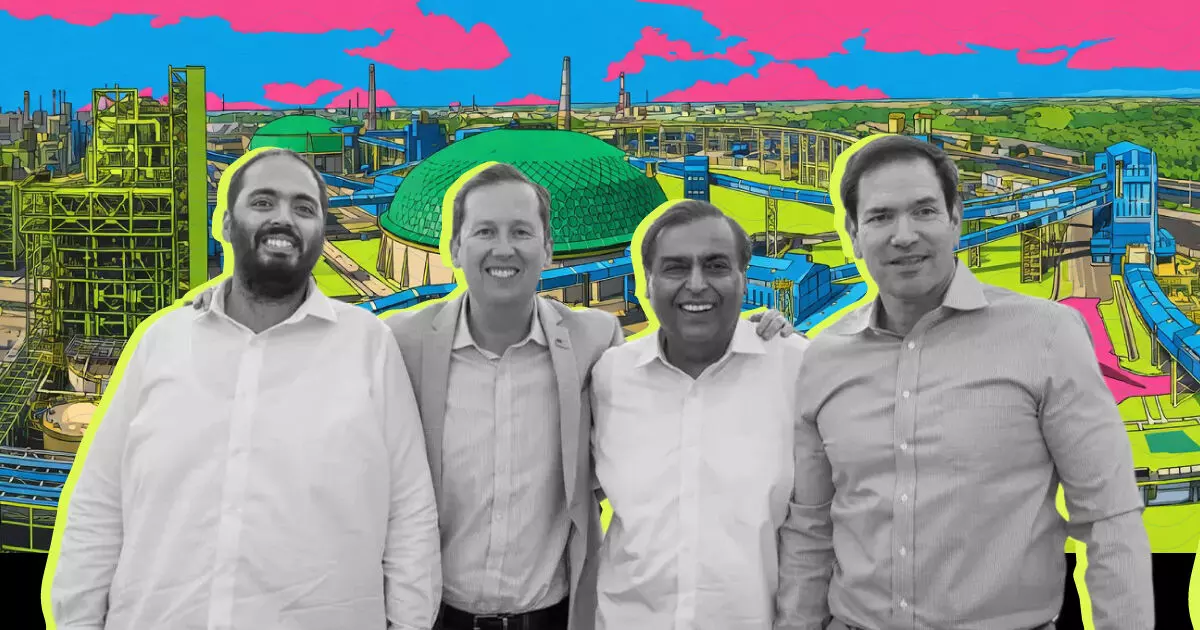
Marco Rubio’s visit to Jamnagar underscores how energy needs, India’s refining capacity and China’s import restrictions are reshaping diplomacy from political capitals to factory floors and refineries.
The Gist
- With diesel prices exceeding $6.5 a gallon, Secretary of State Marco Rubio prioritized supply chains over traditional diplomatic protocols.
- India's heavy reliance on China for pharmaceuticals and rare earths poses significant risks amid rising tensions.
- Rubio's visit underscores the need for pragmatic diplomatic approaches to address energy shortages and refine supply chains.
America desperately needs diesel.
With pump prices sitting at record highs of over $6.5 a gallon in most places and midterm elections just days away, Washington is operating on political calculus.
So, I wasn't entirely surprised last week when Secretary of State Marco Rubio touched down not in New Delhi, but in Mumbai and Jamnagar.
The diplomatic chattering classes immediately began their hand-wringing over the optics of an American statesman skipping the Indian capital.
They shouldn't have.
There is ample precedent for this sort of protocol-busting — recall when then-UK Prime Minister Tony Blair visited the Infosys campus in Bangalore back when the India back-office story was first wowing the world.
But there was only one motive for Rubio’s visit: supply chains.
It is one that Indian diplomats must rapidly learn to emulate.
The pandemic gave us our first bitter taste of supply-chain vulnerability, waking India up to its massive reliance on China.
Yet, despite years of trying, we still rely on China for some 70% of our active pharmaceutical ingredients (APIs).
If Beijing ever decided to throttle those exports, India’s booming pharmaceutical industry would practically shut down overnight.
Fresh tensions are now flaring on our shared border.
While China hasn't cut off anything, it is already quietly squeezing us elsewhere.
China’s Silent Embargo
Beijing has made it exceedingly difficult for India to import rare earths and, crucially, tunnel boring machines (TBMs).
This silent embargo has severely delayed a slew of critical infrastructure projects across India, including right here in Mumbai, where I live.
A lesser-reported fact is that Indian businessmen who travel to China to source materials are routinely being denied visas.
One executive, who imports high-value construction equipment, recently told me his visa application had been rejected seven times already and he is applying again.
The global energy shortage bringing Rubio to our shores is the product of similar geopolitical fracturing.
Donald Trump’s tariffs, initiated in April of last year, were a broadside against global production networks.
But all bets truly came off the table following the war that America and Israel launched against Iran.
We are now dealing with two overlapping conflicts that have crippled the supply of crude oil and refined products like diesel and jet fuel.
In West Asia, Kuwait, the United Arab Emirates, and Iraq have cut back diesel exports, while Houthi escalations have severely limited Saudi Arabia’s exports from its Red Sea refineries, choking off Riyadh’s main route to bypass the Strait of Hormuz.
Meanwhile, the Russia-Ukraine war, which seemed to meander for years, shifted dramatically earlier this year when Ukraine began striking Russian refineries and oil installations with deadly precision.
The world was suddenly plunged into a refined-products deficit.
This crisis exposed a glaring structural shift: the West has systematically starved its own refining capacity.
Asia Does The Refining
The current Trump administration may be gung-ho on domestic refineries, even encouraging Reliance Industries to invest in one, but broadly speaking, the Western hemisphere has been quite happy to let the Eastern hemisphere do the heavy refining and manage the attendant pollution.
The numbers tell the story.
A recent Bloomberg analysis noted that Africa and the Asia-Pacific will account for roughly 95% of global net refining capacity growth through 2030.
China and India alone account for 71% of total additions in 2026 and 2027. Conversely, markets like Europe and the US are bracing for further closures.
Global crude output, combined with gas-based fuels, sits at roughly 100 million barrels a day, matched by about 100 million barrels a day of refining capacity.
The US and China are the titans, each with about 18 million barrels a day of capacity. Russia sits at 6 million, and India at 5 million.
We may be far behind the top two, but in this specific geopolitical moment, India possesses what Manas Majumdar of PwC described to me as the vital "swing capacity" for diesel.
Hence Rubio’s arrival.
A Template For Delhi
Diplomatic niceties aside, he came to fix a hole in America’s supply chain, one largely of the West's own making.
He arrived as a supply-chain expert looking to strike a deal with a country possessing the refining muscle to supply diesel and process Venezuelan crude, which the US currently controls.
Rubio’s pragmatic, deal-making approach is something New Delhi should study rather than frown upon.
Imagine India’s External Affairs Minister skipping Beijing and landing directly in Changsha at the headquarters of China Railway Construction Heavy Industry, the company that manufactures our much-needed TBMs.
Or imagine a targeted Indian diplomatic mission to the massive API factories in southern China. Admittedly, that would be a difficult maneuver to pull off, but the premise holds.
India’s biggest need is affordable energy. The prospect of crude arriving from the Americas, being refined here, and shipping back as diesel carries an enticing sense of industrial reverse-colonisation.
But we must be realistic: prohibitive transport costs will eventually close this arbitrage window once the current desperation, and the American elections, pass.
We must also ask ourselves whether building endless refineries to serve Western deficits truly aligns with our own green agenda.
Indian politicians regularly travel overseas seeking foreign investment.
But Rubio’s visit offers a more sophisticated template: an executive on the road with a specific mandate to fix a specific physical problem.
The statesman of the near future will need to put supply chains ahead of almost everything else.
Core.
Core.


