



 Newsletter
 Search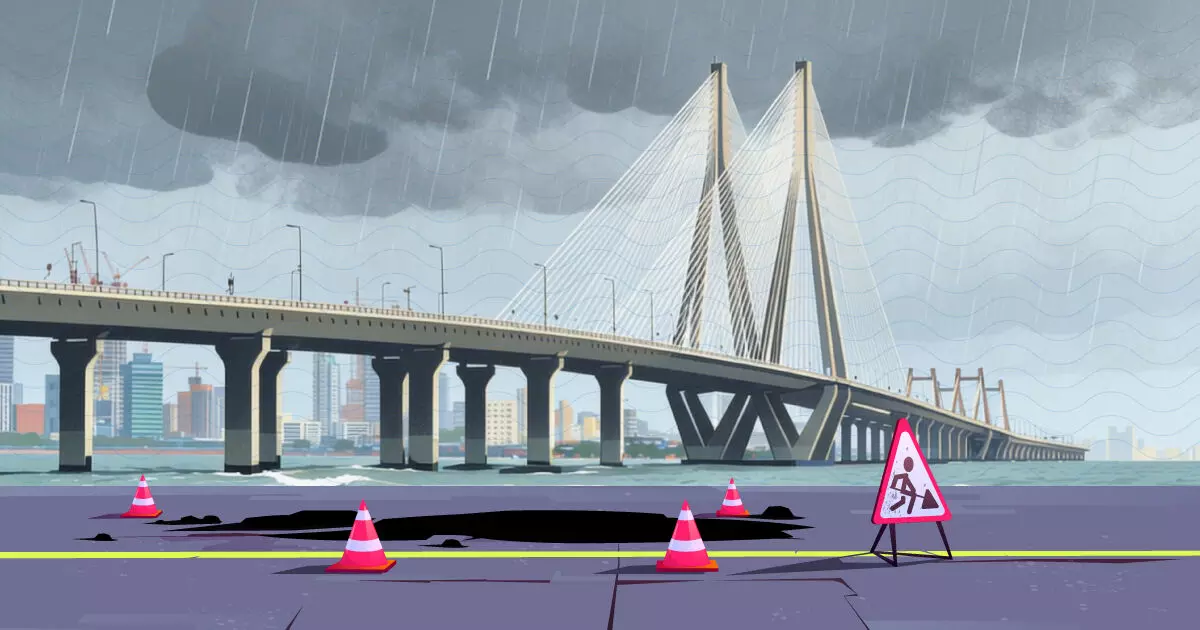
Mumbai Chases Vanity Projects While Basic Infrastructure Kills

As the monsoon season arrives, predictably intense, though somehow always treated as a surprise by city officials, Mumbai is once again buckling under the weight of misplaced priorities.
The Gist
- This conflict highlights a broader crisis in Mumbai, where civic neglect is evident.
- As the monsoon season arrives, infrastructure failures lead to tragic accidents, including fatalities from open manholes.
- The city's focus on flashy projects distracts from basic urban needs like safe pavements and functioning drainage systems.
Residents of Bandra, a bustling Mumbai suburb, are currently fighting a rear-guard action to save a local football ground from being paved over for a new convention centre.
The proposition defies economic logic: world-class convention facilities already exist a mere five kilometers away in the Bandra Kurla Complex (BKC).
Why civic authorities are so eager to pour more concrete over scarce urban open space is a mystery. Or given the track record of local governance, perhaps it isn’t.
This local skirmish over a patch of dirt is a microcosm of a much larger crisis in India’s financial capital.
Monsoon Exposes Civic Neglect
As the monsoon season arrives, predictably intense, though somehow always treated as a surprise by city officials, Mumbai is once again buckling under the weight of misplaced priorities.
The daily news reads like a grim ledger of civic failure.
Trees, their roots suffocated by improperly poured tar and concrete or left unpruned by municipal workers, are collapsing and killing pedestrians and some, like a student last week, inside a school van.
Even more perilous are the city's manholes. To manage excessive flooding, officials routinely leave sewer and storm-drain portals open
Last week, yet another citizen fell to his death in an unprotected manhole.
It is highly likely the victim was walking on the street because a safe, walkable pavement simply did not exist, a standard feature of Mumbai's inner-city layout.
This tragedy echoes the high-profile 2017 death of Dr Deepak Amrapurkar, a prominent gastroenterologist who slipped into a drain after abandoning his stranded car to walk home.
Following Dr Amrapurkar’s death, the Bombay High Court mandated protective grills over the city's vast network of drains.
Yet, the bureaucratic gears grind so slowly that the victim who perished last week died while this very installation drive was still sluggishly underway.
Thieves apparently love these cast-iron manhole covers.
That a city styling itself as a 21st-century economic hub cannot innovate a tamper-proof drain cover is a staggering indictment of its administrative capacity.
The absurdity of the situation was perfectly captured in a recent viral video: a municipal supervisor tumbled into an open drainage chamber while the city’s mayor was in the very same frame, ostensibly inspecting flood preparedness.
The Illusion of Progress
The contrast between the city's aspirations and its reality is jarring.
The same newspapers reporting these preventable infrastructural fatalities also carry splashy advertisements for new expressways across the country, which reliably develop potholes and cracks within months of their ribbon-cuttings.
Mumbai’s current showcase project is the Coastal Road on the city’s south-western rim and being extended northwards.
Soon to be adorned with corporate-sponsored parks, the operational part of the road is a grand, multi-billion-dollar engineering feat.
Yet, the Coastal Road cannot compensate for the decay within.
The deeper one travels into the city, the more the illusion gives way.
Visitors arriving at the airport expecting the gleaming promise of India’s economic engine are instead greeted by fluttering blue tarpaulins, perpetual construction debris, and deafening, gridlocked traffic.
The incessant honking alone is a recognised public health hazard, yet one entirely ignored by behavioural interventions in the city.
Rapid urbanisation strains any municipal government. It is entirely expected that civic authorities will struggle to keep pace with a booming population.
But in its haste to erect shiny new monuments to progress, like unnecessary Government-owned convention centres, Mumbai’s civic leadership appears to be struggling with its most basic duties.
Allowing rampant, unchecked construction when the existing grid is failing is not a sign of progress; it is a recipe for urban misery.
True progress is not defined by vanity projects. It is defined by clean streets, functioning drainage, and safe public spaces.
A simple, radical place for Mumbai’s leaders to start?
Build and maintain walkable pavements in the inner city.
That would signal a genuine commitment to public welfare and safety that no splashy coastal highway can ever match.
Core.
Core.


