



 Newsletter
 Search
Time Is Running Out For Tata Sons To Broker Peace
The Ambanis had Kokilaben to end their feud in time. Tata Sons now has mediators, but with 26 listed companies and chip bets at stake, they must move fast.
The Gist
The corporate strife at Tata Sons could have significant implications for India's market stability and its ambitious semiconductor initiatives.
- After unexpected reappointment, Tata Trusts contested the decision, causing operational paralysis.
- With government interests in semiconductor manufacturing at stake, the need for mediation is urgent to mitigate further instability in the Tata Group's strategic ventures.
When Dhirubhai Ambani, the founder of Reliance Industries, died in July 2002, he left behind a sprawling corporate empire and a ticking time bomb.
The simmering rivalry between his sons, Mukesh, the newly minted chairman, and Anil, the vice-chairman, detonated in public in November 2004.
Yet, by June 2005, the family had hammered out a settlement. The truce was largely brokered by their mother, Kokilaben, alongside veteran banker KV Kamath.
The corporate reputation bleeding was stopped, and the businesses moved on.
Today, India’s markets are watching another bruising and extended boardroom battle, this one at the apex of its most storied conglomerate.
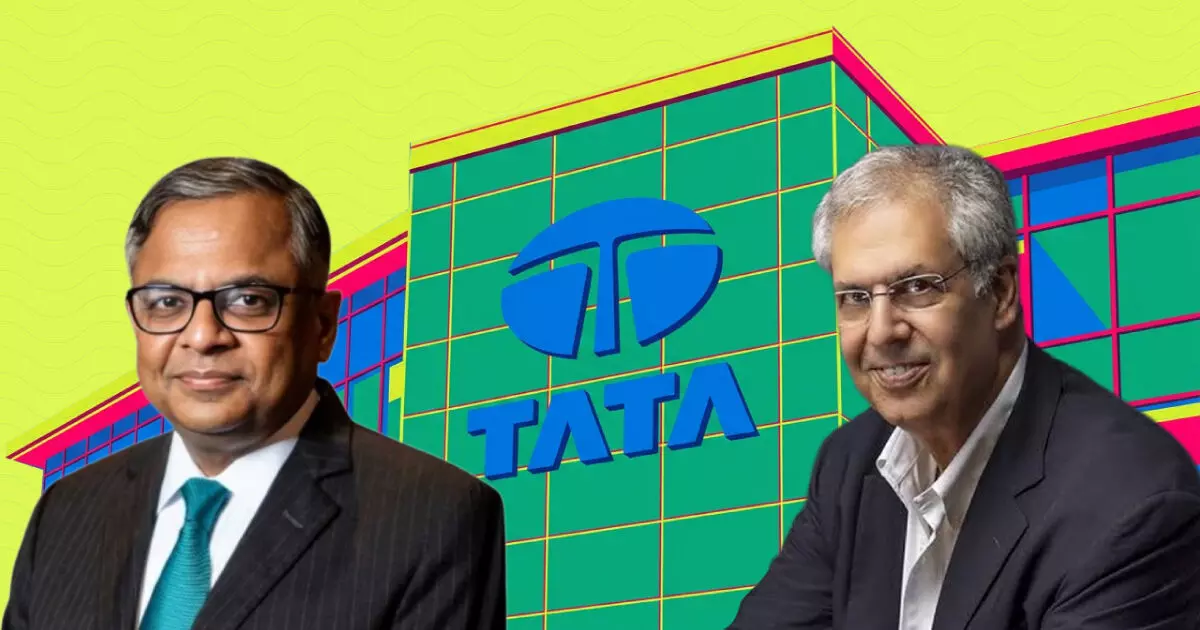
The feud between the principal shareholders of Tata Sons and its professional CEO, N Chandrasekaran, burst into the open on August 12.
Frustrated by a reappointment process that had been hanging fire since February, Chandrasekaran, referred by most as "Chandra" announced he would not seek another term.
Then came the twist.
On September 17, the Tata Sons board unexpectedly reappointed him to a term set to end in February 2027. The move was, and continues to be, fiercely contested by Tata Trusts, the philanthropic bodies that own 66% of Tata Sons and represented by Noel Tata.
A flurry of leaked missives and press maneuvering has followed.
While the headlines have quieted recently for reasons that will become evident in a moment, the structural paralysis remains.
The Cost Of Uncertainty
Technically, the largest shareholder holds the trump cards, though Maharashtra’s Charity Commissioner, who holds regulatory sway over the state's trusts including the Tata Trusts, has temporarily thrown a wrench into the proceedings.
Had this dispute been conclusively resolved in its first few weeks, the markets could have digested the outcome and moved on.
But a protracted boardroom war is inherently destructive, not just for Tata Sons, but for the 26 publicly listed companies under the Tata umbrella, a fact that all observers of this spectacle have repeated ad nausem.
In the early days of a corporate feud, the operational impact is usually limited.
We are well past that point.
The heads of Tata’s operating companies enjoy considerable autonomy, but they still rely on the Tata Sons CEO for strategic direction and green lights on major capital expenditures.
Today, those executives are left looking up at a paralysed holding company.
Even if advice is forthcoming, they would rightly wonder if the management team delivering it will even be there tomorrow. And the consequences if that were not the case.
Moreover, over time, executives down the chain are inevitably forced to take sides, which has further consequences and potential value destruction.
This friction is not merely about personalities; it is rooted in strategy.
The Stakes Run Higher
Much of the tension on the Tata Sons board stems precisely from the massive, capital-intensive bets the holding company is making in semiconductors, electronics, and digital businesses.
The good news is that mediation efforts have begun, involving both internal executives and external arbiters, a report in the Financial Express said two weeks ago and something this writer has also confirmed independently.
This is of course logical and to be expected though what will matter most is the identity of the personalities driving it and the pace at which they can move.
New Delhi is also nervously watching from the sidelines.
The government has leaned heavily on the Tata Group to spearhead India’s national ambitions in semiconductor manufacturing, a priority too critical to be derailed by an executive stalemate.
Even if a new group CEO were installed with the same technocratic competence as Chandrasekaran, the transition would trigger a period of instability.
Time is running out, and the mediators must therefore move aggressively.
Though whatever the compromise, it is likely Chandrasekaran will remain, perhaps his term will shift.
India’s corporate history is littered with bitter succession battles and boardroom civil wars, though not all have been in public domain.
While the ability to lean on family patriarchs and matriarchs to resolve disputes is a uniquely Indian or perhaps Asian corporate strength, professionalised conglomerates require the same decisive arbitration.
The Ambanis had a mother-figure who forced a timely solution to save an empire.
To protect its shareholders and its strategic bets, the Tata Group urgently needs to find one of its own.
Core.
Core.


