



 Newsletter
 Search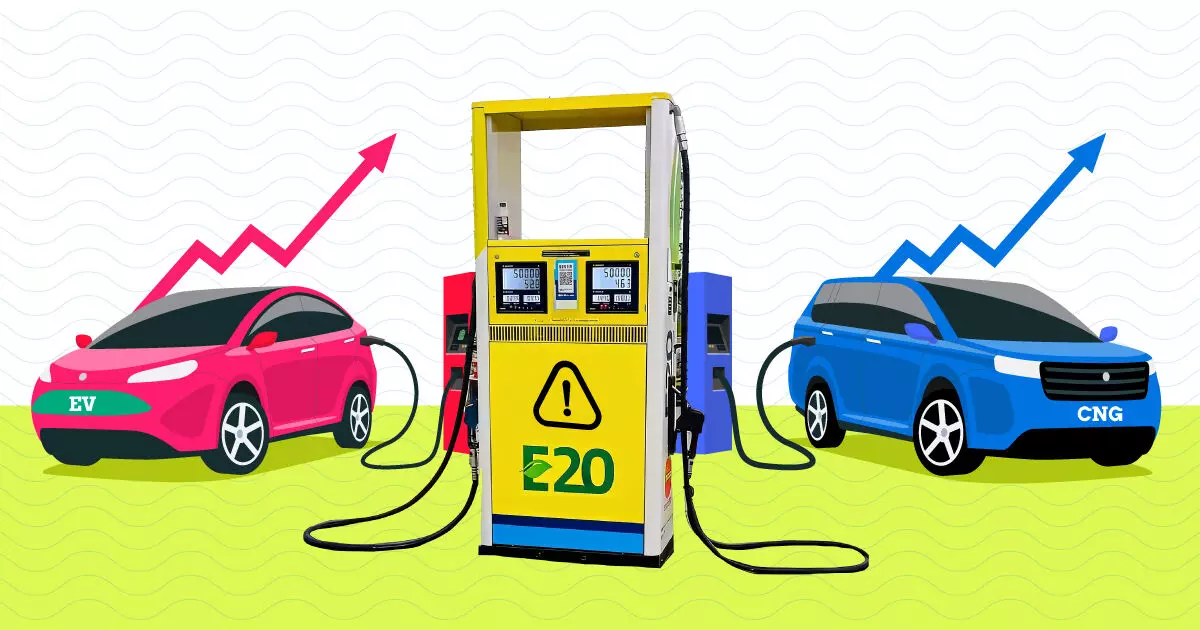
E20 Backfires: How India's Ethanol Fumble Accidentally Fueled the EV, CNG Boom
- The Take
- Published on 10 Aug 2026 1:00 PM IST

How a fuel policy meant to save foreign exchange ended up saving the EV and CNG market instead
The Gist
- The government's plan to reduce oil imports through E20 petrol has led to consumer distrust and a shift to alternative fuels.
- Social media reports of engine damage have heightened apprehension among drivers, despite official reassurances.
- As petrol vehicle sales plummet, CNG, hybrids, and electric vehicles are surging in popularity, indicating a significant market shift.
Thank you Mr Gadkari.
New Delhi’s botched rollout of ethanol-blended petrol is driving consumers to alternative fuels, achieving the right goal for the wrong reasons.
For many months, a dark cloud of consumer suspicion has hung over India’s vehicle owners.
The culprit is E20, petrol blended with 20% ethanol.
The government’s intentions, naturally, were noble. India imports roughly 90% of its crude oil, a massive economic vulnerability.
Blending petrol with domestically produced ethanol, distilled from crops like sugarcane, corn, and wheat, was billed as a silver bullet to slash the import bill and green the economy.
But drivers haven’t been buying the government's assurances.
Buyers Flee to Alternatives
A steady stream of social media reports including videos depicting damaged engine parts has documented a litany of glitches in cars and two-wheelers running on the E20 blend.
The panic has proven impervious to government counter-claims.
It has not helped that the auto industry itself has offered a masterclass in mixed messaging.
Most recently, for instance, the Society of Indian Automobile Manufacturers (SIAM) which represents major auto makers highlighted E20 problems in a report that made it to public domain, only to hastily backtrack.
Now, the numbers are in, and Indian consumers are doing what they do best when faced with a flawed government mandate. They are voting with their wallets.
While overall auto sales across categories logged another blowout month in July, petrol vehicle sales have hit a wall.
Over the past year, petrol cars’ share of the passenger vehicle market has plunged from roughly 48% to 42%.
Where are those buyers going? Well, to the alternatives.
The market share for compressed natural gas (CNG), hybrids, and electric vehicles has surged to 40.6%, barely a percentage point shy of petrol.
Meanwhile, the share of diesel vehicles has held steady at just under 18%, despite the government paring back diesel subsidies almost a decade ago.
Why?
Because diesel does not blend with ethanol.
For the anxious Indian motorist, diesel has become a "pure" safe haven of sorts though there is no substitute for heavy commercial vehicles which run only on diesel. (The Government is testing diesel blended with isobutanol, but that looming headache is a story for another day.)
Failure Fuels The Right Result
The panic at the dealership level is palpable.
Sai Giridhar, Vice President of the Federation of Automobile Dealers Association, representing over 15,000 dealerships and 30,000 outlets, told The Core Report that despite erecting posters and aggressively counseling buyers on the safety of E20, consumer apprehension is not going away.
Here is where the ironies of public policy compound.
India’s Government set out to reduce the nation’s dependence on fossil fuels by forcing drivers to adopt an ethanol blend.
By poorly managing the rollout and the public relations surrounding it, the government only succeeded in terrifying the motoring public.
But in doing so, it has accelerated a migration toward entirely different alternative fuels. At this pace, it is possible that CNG, hybrids, and EVs will overtake petrol outright in a matter of months.
The state achieved its objective, albeit in a somewhat backward fashion.
In a final stroke of political irony, the E20 fiasco has somehow been hung entirely around the neck of Nitin Gadkari, India’s roads minister, rather than the energy minister whose portfolio actually dictates fuel production and distribution.
Gadkari’s image has taken a beating in the court of public opinion.
But given that his ethanol crusade has inadvertently turbocharged the adoption of alternative vehicles, perhaps we do owe the minister a debt of gratitude.
Because in the often messy world of public policy, outcomes often matter more than the competence of the effort.
Core.
Core.


