



 Newsletter
 Search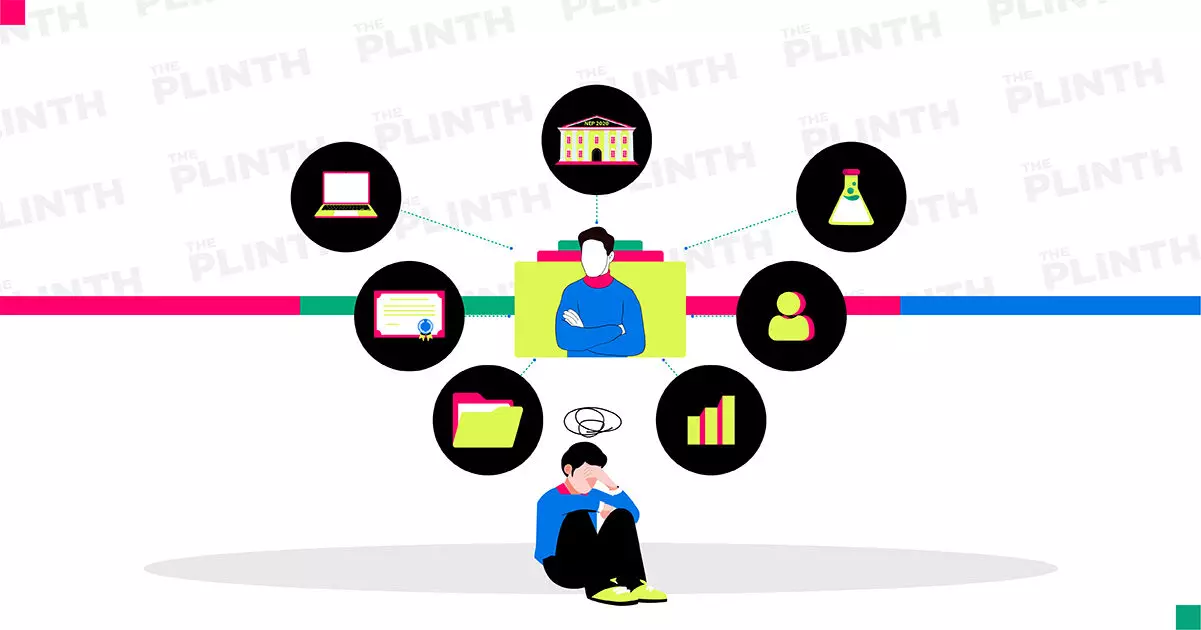
India’s Massive Higher Education Overhaul Faces A Major Software Crisis
- The Plinth
- Published on 30 April 2026 6:20 AM IST

The institutional learning platforms NEP 2020 is meant to run on were architected for a pre-NEP world, hosted abroad, and procured before the data-residency law existed.
The National Education Policy of 2020 is the most ambitious rewrite of Indian higher education in a generation. It promises multidisciplinary degrees with multiple entry and exit points, credit-linked entrepreneurship, vocational integration, and a National Credit Framework that puts a school certificate, a B Tech, a community college diploma, and an apprenticeship on the same numerical scale.
At its centre sits the Academic Bank of Credits. It’s a national depository, operated through DigiLocker, in which every credit a student earns at any registered academic institution is recorded against their academic ID and can be redeemed against a degree at any other.
The intent has been to dissolve the old silos of arts, science, commerce, engineering, vocation and replace them with a single mobile credit economy in which a student moves between institutions and disciplines, and from classroom to venture seamlessly and without losing previous learnings.
The policy architecture is mostly built. The Bank is live. The National Higher Education Qualifications Framework has been notified. The University Grants Commission has issued enabling regulations on multiple-entry-multiple-exit, dual degrees, transnational education and online learning.
The All India Council for Technical Education has rewritten its model curriculum. The Ministry of Education has launched DIKSHA for school content and SWAYAM for higher-education courses, both positioned in the policy text as national digital infrastructure.
Yet none of this works without the software that records, transmits and validates the credit. The learning management system is the layer where policy meets operation, and the layer at which the policy is silent. The Indian higher-education estate runs on platforms procured a decade ago, hosted abroad, and built for a course catalogue rather than a credit economy. This column argues that the LMS, long treated as an IT line item, has become the binding constraint on whether NEP 2020 actually runs.
A learning management system, in 2026, is not a content-delivery website. It is the operational substrate of a university. It holds the academic record, routes the credit, ties the student to the cohort, the cohort to the faculty, the faculty to the assessment and the assessment to the credential.
If a credit is to flow from a vocational module at one institution to a degree at another via the Bank, the learning management system (LMS) at both ends has to issue, log, transmit and accept it in a standards-compliant way. If entrepreneurship is to be credit-bearing across disciplines, the LMS has to recognise an incubation cohort, a venture-studio milestone, and an industry-issued micro-credential as academic activity rather than as extra-curricular noise.
A Pre-NEP Installed Base In A Post-NEP Regime
The Indian higher-education LMS estate today is dominated by a handful of foreign platforms installed between 2012 and 2019, before NEP was a draft. They were designed for a single-institution course catalogue, faculty-led delivery, multiple-choice assessment and the standard American or European semester. They were not designed for credit interoperability, stackable industry credentials, venture-studio workflows or the granular credit accounting the National Credit Framework now demands.
They were also not made for the Indian data-residency law. The Digital Personal Data Protection Act of 2023, with its restrictions on cross-border transfer of student and research data, has turned the deployment topology of every foreign-hosted LMS in an Indian university into a compliance question that no procurement officer wants on their desk.
The mismatch is peculiar. The policy is national, as are the compliance regime and the credit framework. Yet the software is hosted abroad and based on another country’s requirements.
Universities have responded the way they always respond to a software gap — by stitching together adjacencies. A typical entrepreneurship cell in 2026 runs coursework on one platform, mentor sessions on a second, document repository on a third, venture-studio tracking on a spreadsheet, certifications on a PDF generator, and outcomes reporting through a separate dashboard built by an outside agency. Each system is competent. None of them talks to the others.
The credit NEP wants to flow through the Bank ends up trapped in whichever silo recorded the activity, and the institution loses the ability to demonstrate to a regulator or a board of governors that the policy is operationally working.
Three Pressures, Disaggregated
Three structural pressures are pushing this gap toward resolution.
The first is the replacement cycle. Institutional software contracts in higher education run on five-to-seven-year cycles; the wave installed before NEP is now mechanically up for renewal. A procurement committee, advised by its chief information officer, is forced to ask whether five more years of the same architecture is defensible against the policy regime that has emerged in the meantime. The honest answer, in most cases, is that it is not.
The second is regulatory preference. NEP names indigenous digital platforms as part of the desired infrastructure. The DPDP Act, notified in 2023, is India's first horizontal data-protection statute, covering every entity that processes the personal data of an Indian resident and giving the government discretion over which countries the data may leave for. It adds a structural disadvantage for foreign-hosted SaaS, particularly in government-funded institutions and any university whose research portfolio touches sensitive data.
Procurement preference for Indian-built platforms in centrally and state-funded institutions is now an articulable rule; the AICTE and UGC have begun, in their accreditation conversations, to treat sovereign deployment as a question worth asking. None of this, though, is yet a hard mandate.
The third, and the most underweighted, is convergence. The policy now requires curriculum, virtual labs, certifications, mentorship, incubation and venture enablement to be treated as a single academic continuum rather than as separate departmental fiefdoms.
The software estate has not converged with it. No architectural reason exists for curriculum delivery, lab orchestration, industry-credential issuance and founder-cohort tracking to sit in five different vendor systems at five different points of integration with five different data-residency profiles. They sit there because they were procured separately, by different parts of the institution, before anyone wrote a policy that asked them to be the same thing.
What The Replacement Layer Would Have To Do
NEP 2020 asks for an institutional operating system. This has to be a single platform that holds the academic record under Indian residency, speaks the standard interoperability protocols, runs on whatever deployment topology the institution requires, and treats curriculum, certification, lab work and venture activity as varieties of the same credit-bearing object.
The standard that matters at the protocol layer is LTI — Learning Tools Interoperability — maintained by the international 1EdTech consortium. An LTI-compliant LMS can launch any compliant external tool inside its own interface, with single sign-on and grades flowing back automatically. Virtual labs from one vendor, certifications from another and venture-studio modules from a third plug into the same credit-bearing record without bespoke integration work.
Deployment flexibility imposes its own architectural requirement. The platform must be built as small containerised services that schedule, scale and self-heal software across clusters of machines. The open-source Kubernetes is popularly used for that. The same code base then deploys air-gapped inside a defence academy, on a state university’s sovereign cloud, or as multi-tenant SaaS for a small private college, without rewriting the application.
The technical specification is unglamorous. Standards work, deployment engineering, institutional sales discipline. Missing is not the technology but a domestic supplier base willing to commit to the long sales cycles, the bespoke integration work ,and the air-gapped deployments that Indian institutions actually buy.
That supplier base is now assembling. A handful of Indian companies — some from enterprise open-source backgrounds, edtech adjacencies, and system-integration work for government — are building NEP-native platforms designed around credit interoperability, sovereign data residency and the curriculum-to-venture continuum. But they will compete against incumbents who can cut price aggressively, build local hosting partnerships and lobby through the procurement chain. The policy tailwind helps but it does not deliver the market.
A modern stack also folds in an AI capability layer that no pre-NEP LMS can retrofit at the architectural level. These include adaptive learning paths, retrieval-augmented tutors grounded in the institution’s own curriculum, agentic evaluation that grades large cohorts against rubrics with human override. None of this is exotic in 2026. The novelty is in having it sit inside the same platform that holds the credit record, under Indian residency, governed by the institution.
What Could Still Go Wrong
Procurement cycles in Indian universities are slow, typically six to nine months for a serious deployment, longer in centrally-funded institutions. Foreign incumbents will defend their installed base with sharper pricing and Indian-region hosting. NEP’s preference for indigenous platforms is directional, not enforceable; a university that wants to renew the same platform for another five years can still do so.
The most honest difficulty is cultural. Many institutional CIOs grew up on foreign platforms and trust their support apparatus. They will need a tangible operational argument to switch.
NEP has, perhaps for the first time, made the LMS layer a strategic question rather than a procurement footnote. For most of the last decade, the choice of learning platform sat in the IT department’s annual budget line. It now sits at the intersection of credit policy, data-protection law, accreditation regime, and entrepreneurship mandate. The institutions that recognise this early will set the template that the rest of the system follows.
The policy has done its part. The institutional layer underneath is the next chapter, and it is the one that awaits a new notification.
Core.
Core.


