



 Newsletter
 Search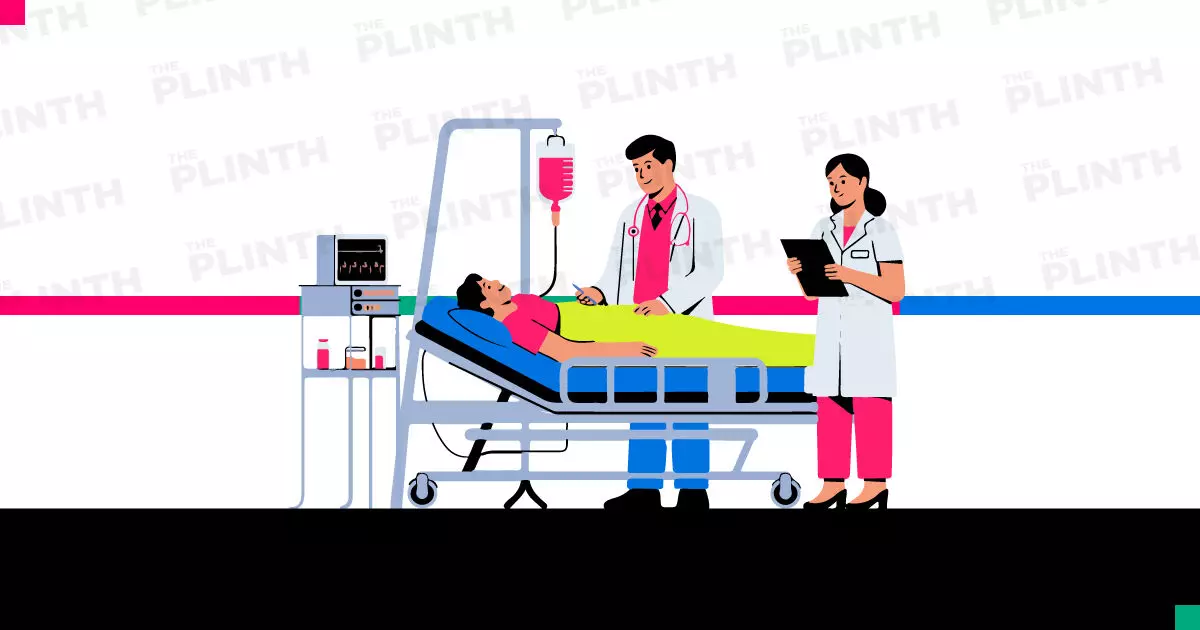
The Planned Hospital Bed That Has No Doctor
India counts the hospital beds it is short of. It seldom counts the doctors or nurses needed to run them.
The Gist
India's hospital sector is set for a historic expansion with plans to invest Rs 300 to 320 billion to add 14,500 beds over the next two years.
- Fourteen states are competing to attract this investment.
- The country currently has a significant shortage of doctors, which remains unaddressed at the policy level.
- Despite increased medical school seats, the pipeline for senior specialists remains long, complicating the hospital expansion efforts.
The money arrived well before the question did.
India’s listed hospital chains plan to spend Rs 300 to 320 billion adding 14,500 beds over the next two years, the biggest expansion the sector has ever announced. Fourteen states are competing to attract that money, the Union Budget has made it cheaper to raise, and rating agencies have turned positive on the sector.
In the last three months alone, as of 25 May 2026, the BSE Hospitals index rose over 4% while the BSE Sensex fell by over 1%.
The most discussed investment rationale has been the bed gap. India has 1.3 to 1.5 hospital beds per 1,000 people against a global median of 3, and closing that distance is national policy. It is tracked, published, and acted upon.
Yet, the shortage that has been biting harder and longer is not that of beds, but of doctors. That has so far no policy-level white paper, no target, and no ministry on the hook for fixing it.
A Bed Without A Doctor Is Mere Furniture
A hospital bed on its own is just furniture. What turns it into a working clinical unit is the doctor on the round, the resident covering the ward overnight, the nurse in surgery, and the ICU consultant managing the patient afterwards.
For the most complex cases, including premature babies, paediatric ICU patients, and cancer surgery, you need a senior specialist who has trained for years in that one area, and you cannot move a kidney specialist into the neonatal unit for the day.
Training one of these specialists takes time, in a fixed sequence: five and a half years for an MBBS, then three years for an MD or MS in a broad speciality, and another three for the super-speciality (the DM or MCh) needed for fields like neonatology and paediatric heart surgery. Eleven to twelve years from admission to a qualified senior specialist, with no faster route.
India has expanded medical schools sharply. There are now 1.37 lakh MBBS seats across 816 colleges, almost double a decade ago, and postgraduate seats have crossed 70,000, up roughly 127% since 2014.
But more seats today do not produce more senior specialists today. A student starting MBBS now will not be a senior specialist before 2036, which means the hospitals opening beds this year and next are not competing for that cohort at all.
They are competing for the much smaller pool that trained ten to fifteen years ago, when the medical education system was a fraction of its current size.
Empty Seats And A Shortage
The postgraduate exam data tells a strange story. After two rounds of NEET-PG 2025 counselling, more than 18,000 PG seats lay empty, forcing the cut-off mark to be lowered round after round. At the lowest point, a candidate with a negative score got an MD seat.
On the surface, this looks like too much training capacity. The deeper reading is the opposite.
The empty seats are mostly in less popular subjects, smaller cities, and poorly resourced colleges, while the shortage is concentrated in the very specialities the new hospitals need most. There are only about 2,300 super-speciality (DM) seats across the entire country. India has widened the bottom of the funnel without widening the top.
Service bonds add another twist. Several state governments require freshly qualified specialists to either serve a fixed number of years in government hospitals or pay a penalty that can run from Rs 30 to 50 lakh.
The intent is to keep doctors in the public system. The effect is to slow private hiring in exactly the districts that need doctors most, and to push the freshly qualified toward states with easier rules.
Bond terms vary widely from one state to the next. The Supreme Court flagged the inconsistency as far back as 2019, but no national rule has followed. The country’s scarcest specialists, who should be the most carefully placed, are instead being pulled in different directions by different state policies, with nothing tying them together.
The Nurses Are Leaving Too
The nursing shortage runs alongside this as a separate but reinforcing pressure. Annual nurse attrition across the major listed chains runs between 20% and 30%. Ashutosh Raghuvanshi, who runs Fortis Healthcare, has said he expects the strain to last another three or four years.
Some chains are doing better than others. Max Healthcare brought attrition down from about 30% to 28.7% in FY25, and Apollo Hospitals had its best year on retention, holding on to a thousand more nurses than before.
But these are improvements at the margin, and Jupiter Life Line’s management called nursing a “perennial problem” on the same call where it reported strong revenue growth.
Marriage and family relocation used to be the main reason nurses left. They still are, but they are now compounded by organised migration: to Riyadh, to Birmingham, to Toronto. The Gulf pays better, the UK offers a route to citizenship for the family, and the NHS provides a kind of long-term security that Indian private hospitals have not yet been able to match. A meaningful share of India’s trained nurses now work abroad.
What Gets Counted, What Doesn’t
This is where the asymmetry in the state’s posture becomes most visible. India measures the bed shortfall, publishes it, and runs incentives, financing schemes and inter-state competition around closing it. The supply of specialists is left to the exam system. But an exam system picks the best candidates from a given pool. It does not decide that the country needs, say, two hundred more neonatologists in eastern India by 2030. That is a planning question, not a selection question, and no institution is currently asked to answer it.
This shows up most painfully where the new beds are going. The expansion is pushing into Guwahati, Coimbatore, Warangal and Rajahmundry, smaller cities whose local training ecosystems have always struggled to retain specialists.
A new children’s hospital in one of those cities, which opened without enough experienced neonatologists and paediatric ICU consultants, does not just fill up slowly. It cannot safely take the cases that justify its existence: premature babies, complex heart conditions, and the difficult presentations that determine whether the place is a credible super-speciality hospital or just a well-equipped building.
That kind of credibility is built over years, by senior consultants who stay, train residents and become the doctor a district’s paediatricians know to call.
The sector’s investment narrative acknowledges all of this in passing, as a risk factor in annual reports and a management talking point about retention programmes. What it does not acknowledge is that this is not a problem the sector can solve from within itself.
Private capital can build the hospital, design the retention programme, and run the in-house nursing academy. It cannot shorten the twelve-year training pipeline, redirect super-speciality seats toward the regions where the new beds are going, or untangle the state bond rules. Those are policy levers, and right now they are pulling in the wrong direction.
The beds will get built. What India is not measuring, and not planning for, is the doctor on the other side of the bed: how many specialists are being trained, where they end up, and which rules they have to navigate to take a job.
Until that changes, the binding constraint on India’s hospital expansion story will not be land, or capital, or patient demand. It will be the doctor who was never trained for the bed that is waiting.
Core.
Core.


