



 Newsletter
 Search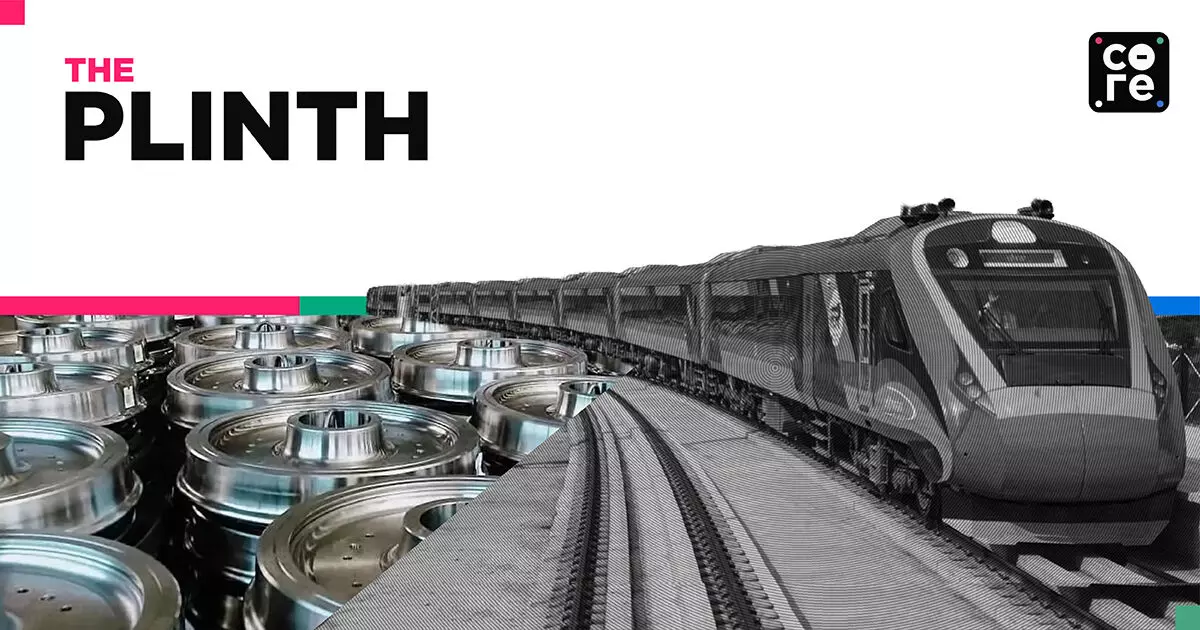
Wheelsets: The Risk That Could Derail India’s Rail Boom

India's Railway ambitions hinge on the wheelset, a small, unglamorous, but critically important component for railways.
India's railways are a happening sector. The Union Budget 2026-27 has sanctioned seven new high-speed rail corridors at an estimated cost of Rs 16 lakh crore to serve as "growth connectors”. About Rs 28,740 crore has been earmarked for ongoing metro rail and mass rapid transit systems nationwide for FY27, with long-term ambitions to scale to 50.
All these ambitions are hinged upon the wheelset, a small, unglamorous, but critically important component for railways. Two wheels press-fitted onto a single axle, the wheelset must bear dynamic loads, transmit braking forces, and resist fatigue cracking for hundreds of thousands of kilometres without failure. The engineering demands are severe. The safety margin is zero.
India, it turns out, can barely make one.
In Titagarh Rail Systems’ Q3 FY26 earnings call in February 2026, Umesh Chowdhary, its Vice Chairman and MD, was direct: “The company is not limited by capacity. We have proven ourselves to produce 1,000 wagons a month. The only constraining factor is the wheel set.”
The Geopolitical Anatomy of a Shortage
India’s wagon builders have a theoretical capacity of 60,000 units per year. They are producing 35,000–40,000. The constraint is not assembly capacity. The gap is not orders. It is wheels.
A distinction matters here. Indian freight wagons have historically used cast wheels — poured molten steel, economical but limited in performance. SAIL’s Durgapur Steel Plant has an annual capacity of roughly 40,000 cast wheels, but cast wheels address a different performance envelope from the forged product now in demand. SAIL cannot serve the segment that is growing fastest.
Vande Bharat trainsets, LHB coaches, metro cars, and European freight all require forged wheels: pressed and rolled under intense heat for superior fatigue resistance and higher axle-load tolerance. These are different products, of different metallurgy, moved by different supply chains.
The shortage has two further dimensions. First, an aggregate deficit of domestically manufactured forged wheels forces reliance on China and Eastern Europe. Second, a type-wise mismatch: 840mm diameter wheels suit older wagon designs; 1,000mm wheels are required for newer high-axle-load configurations. When Indian Railways (IR) shifts specifications on policy timelines that don’t align with supplier investment timelines, even available inventory can become useless.
The import valve is unreliable. Ukraine was a significant supplier until February 2022. The war ended that supply chain overnight. China filled the gap, but that too is a risk now. A Chinese export restriction on railway wheels, entirely plausible in any sustained trade or military confrontation, would be an operational crisis for a network that cannot run without them.
The strategic logic of domestic wheelset capacity is identical to that for semiconductors. Yet, perhaps because it generates fewer headlines, the Aatmanirbhar Bharat framework has been slow to notice the gap in its own backyard. The performance linked incentives scheme for speciality steel overlooked forged wheel manufacturing entirely.
What The Metro Boom Changes
The freight wagon shortage is the proximate crisis. The metro expansion is the structural one, building behind it.
Metro wheels are a distinct product: smaller diameter, higher precision, a different fatigue profile shaped by constant starts, stops, regenerative braking, and tight curves. They are currently sourced almost entirely from European suppliers such as Lucchini RS and Bonatrans
This has a persistent opportunity cost. State-owned heavy equipment manufacturer BEML alone carries a Rs 10,625 crore rail and metro order backlog. Titagarh is targeting 500 metro cars by FY30. Total metro wheelset demand across the national expansion programme could reach 50,000–80,000 units annually within five years.
It is a market that is not being serviced by any domestic player. Not even by those who might have benefited directly from manufacturing these wheelset inhouse. For example, BEML’s broader indigenisation drive has been articulated by Chairman and MD Shantanu Roy, covering metro care manufacturing, including an MoU with BEL, a state-owned electronics manufacturer, to develop an indigenous Train Control Management System. Wheelsets, conspicuously, are part of BEML’s plan.
The Race to Fill the Gap
The cost of inaction is already in the quarterly numbers. Titagarh’s freight revenue fell roughly 25% year-on-year in Q3 FY26 — not because orders dried up, but because production stalled.
Jupiter Wagons built 1,697 wagons that quarter, against 2,259 in the same period the previous year, a 25% decline driven by the same constraint. Management at Jupiter expects the disruption to persist for another two to three quarters, through late 2026 or early 2027, before private-sector capacity brings the market back into balance.
Two bets, totalling Rs 4,500 crore of committed capex, are the industry’s answer.
The Titagarh-Ramkrishna JV in Chennai, Ramkrishna Titagarh Rail Wheels Ltd, brings together Titagarh’s domain knowledge and captive freight demand with Ramkrishna Forgings’ heavy forging expertise. At 228,000 forged wheels per year, the Chennai facility will rank as Asia’s second-largest forged wheel plant. It has a contractual obligation to supply 40,000 wheels to IR in FY27, scaling to 100,000-plus in FY28 as it opens to export markets. As Naresh Jalan, Managing Director of Ramkrishna Forgings, noted in its Q3 FY26 earnings call in January 2026 that IR has “started showing a demand” worth Rs 2,000 crore, and that his company expected double-digit sales growth from the railway segment in the next two years.”
Jupiter Wagons, through Jupiter Tatravagonka Railwheel Factory at Khurdha, Odisha, targets 100,000 forged wheelsets by 2027. European partner Tatravagonka a.s. is committed to offtake 50,000 wheelsets per year, and Jupiter has earmarked half its total capacity for global markets, where pricing of Rs 2.5–3 lakh per forged wheelset is commercially viable. At full ramp, Jupiter projects Rs 3,000 crore in annual revenue from wheels alone. Its existing assembly operation is already scaling — 4,476 wheelsets produced in Q3 FY26, a 96% increase year-on-year. “Having navigated supply challenges in Q1 and July, wheelset deliveries are now back on track,” Vivek Lohia, Managing Director of Jupiter Wagons, said in the company’s Q2 FY26 results in November 2025, that once operational, the Odisha facility will produce 100,000 wheelsets annually by 2027 — a major step toward self-reliance.
For Titagarh, the revenue upside is transformative: Rs 40–45 lakh per wagon at 1,000 units per month implies Rs 4,800–5,400 crore in annualised freight revenue, against a figure currently held down by the wheelset constraint. For Ramkrishna Forgings, the Rs 13,000 crore JV order book hedges its automotive exposure. For Jupiter, the wheel business at full ramp would exceed the company’s total current revenues.
Yet the combined private-sector capacity of 328,000 wheelsets covers wagon demand only marginally; it leaves metro entirely unaddressed. A third entrant in forged wheels is needed.
Why Are Commitments So Few?
The economics have always been structurally hostile. Forged wheel manufacture requires Rs 1,000–2,000 crore of specialised capex in press-and-roll technology, quite distinct from conventional open-die or closed-die forging, with a product liability profile most boards avoid. For decades, IR defaulted to cast wheels for standard freight, keeping the forged wheel market small, import-dependent, and without the domestic volume needed to justify investment. Worse, IR historically refused to commit assured offtake to private manufacturers. Without that, any investment would have been speculative.
The RINL-owned Rae Bareli forged wheel plant made this concrete. Built at Rs 2,300 crore, with German equipment and 100,000-wheel annual capacity, it sat largely idle after commissioning disputes. Every boardroom in Indian steel and forging had that example in front of them.
When IR finally floated a competitive tender in 2023, only three bids arrived. Ramkrishna Forgings won at Rs 1.88 lakh per tonne. Bharat Forge — with world-class forging capability — quoted Rs 2.75 lakh, 46% higher. SAIL bid Rs 2.89 lakh. Neither could make the margins work. The conclusion was pointed: only a mid-tier forging specialist, without the overhead of a large integrated-steel operation, could price competitively at IR’s expectations.
The most conspicuous continuing absence is JSW Steel. JSW operates a rail mill in Piombino, Italy — currently 0.32 MTPA, expanding to 0.60 MTPA, backed by a €33 million Italian government grant and €359 million in long-term contracts with Rete Ferroviaria Italiana. Its management speaks of a “Value Added and Special Products” strategy for railways. But the focus is rails and structural components. Not wheelsets.
India’s largest private steel producer, JSW Steel, has the metallurgical capability and the balance sheet. It has, so far, chosen not to use them here.
Until that changes, the forged wheel segment — the one that matters for every high-value railway application India is scaling — will remain a two-player market.
The wheelset will not feature in a Budget speech. It will not attract a ribbon-cutting. But the distance between 228,000 wheels and 320,000 is the distance between India’s railway ambitions and its industrial capacity. Two private-sector bets, Rs 4,500 crore of committed capital, trial production beginning next month: the gap is finally being taken seriously. Whether that will be filled fast enough is the question that will define India’s coming railway decade.
Core.
Core.


