



 Newsletter
 Search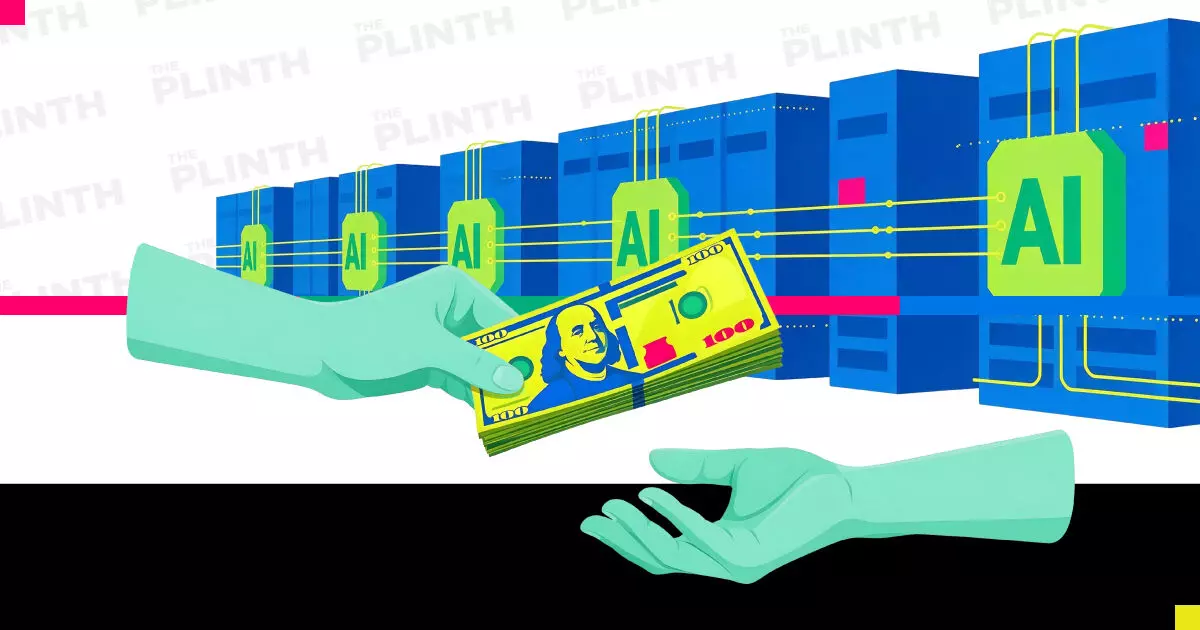
India's Startups And MSMEs Have No Use For The Data Centre Boom
- The Plinth
- Published on 7 Aug 2026 6:00 AM IST

The customers India's data centre boom is meant to mainly use American services, ultimately billed in dollars and indifferent to what gets built anywhere else.
The Gist
- Investments in data infrastructure are substantial, yet most Indian startups still utilize American tools and models.
- The lack of local alternatives hampers the development of a self-sufficient technology ecosystem.
- Policy efforts should prioritize creating indigenous platforms that can compete with global giants, ensuring economic value stays within India.
India's data infrastructure story, told in press releases, is a compelling one.
The Adani Group has committed $100 billion by 2035 to renewable-powered, AI-ready hyperscale data centres, which is expected to catalyse a further $150 billion across the wider ecosystem.
Microsoft has committed $17.5 billion over four years to cloud and AI infrastructure in India, its largest investment in Asia. Google has partnered with Adani Enterprises for a gigawatt-scale AI campus in Visakhapatnam, and AWS has committed $12.7 billion through 2030, $8.3 billion of it in Maharashtra.
Data centres now carry Infrastructure Status, unlocking cheaper long-tenor credit, and the India AI Mission has budgeted Rs 10,372 crore for shared AI compute accessible to Indian startups. The market is projected to roughly double to $22 billion by 2030.
On paper, the plumbing is being laid for India's AI decade.
But ask an India-based startup, the kind building AI-first SaaS products on large language models, a simple question: name one Indian technology, owned and located in India, used to build the product.
The typical answer would be “none”. For such startups, 90-95% of billings are in US dollars; the small remainder billed from India mostly covers basics such as local hosting, billing, and accounting tools.
That remainder is the operational residue of being physically located in India — a GST invoice.
The Stack They Actually Use
Walk the stack from the bottom up. Compute and storage sit on AWS, Google Cloud or Azure, all priced in dollars and provisioned through foreign entities. The AI models that increasingly power product features come through APIs (the metered connections through which one company's software uses another's) from OpenAI, Anthropic and Google, billed in dollars under American terms of service.
The backend and authentication layer for most modern startups is Supabase, a San Francisco-based platform built on PostgreSQL, billed in US dollars, with no Indian data residency by default.
Everything else a startup runs on, from GitHub for its code to Notion for its notes and Figma for its designs, plus the long tail of tools for deployment, monitoring and bug tracking, is American too. Dollars, again.
Supabase is worth pausing on because it illustrates how invisible the dependency is. It is not a hyperscaler and not a household name, but it has become the default backend scaffolding for a significant share of Indian startups. Their users log in through Supabase, their data is stored in Supabase, and their files are served through Supabase. An Indian equivalent does not exist.
This is not confined to startups.
Affle (India) has migrated its infrastructure to AWS Graviton chips. Happiest Minds is a consulting partner for both AWS and Microsoft. LTIMindtree holds strategic partnership agreements with AWS, Google and Microsoft simultaneously. HCLTech's AI Force platform is integrated with Azure OpenAI, Anthropic's Claude via Amazon Bedrock, and Google Gemini. The operational and AI stacks of India's most prominent technology companies are entirely American.
The dependence, in other words, runs across India’s technology industry. This piece anchors on startups and MSMEs because they are the customers in whose name the buildout is justified, and therefore the test of its promise.
The Indian MSME or startup building a product in 2026 is, in technological terms, a dollar-spending entity that happens to have its founders registered with the Registrar of Companies.
India has neither a foundation model nor hyperscale cloud with the service depth AWS has spent fifteen years building, nor an equivalent of Supabase, Stripe or Twilio.
The startup builds on what exists. What exists is American.
What The Boom Is Building, And Who Gets Paid
The billions being committed are, for the most part, not aimed at the Indian MSME or early-stage startup.
The construction narrative also underplays a deeper dollar leak: the operators themselves are dollar-exposed on both the capital and operating sides, and much of the revenue they generate flows straight back to the United States.
India does capture value from hosting: construction contracts, land, power sales and colocation rents, a market projected to roughly double to $22 billion by 2030. But these are real estate and utility revenues. The higher-margin layers above them, software, models and platform fees, are the ones that leave.
Start with the hardware. Every GPU powering an AI-ready rack in Navi Mumbai or Hyderabad is an NVIDIA chip acquired in dollars. Blackwell B200 chips list at $30,000-40,000 apiece, and India carries a 25-30% import duty premium over global prices; an 8-GPU H200 server costs roughly Rs 4-5 crore before infrastructure. NVIDIA's near-monopoly on AI accelerators, reinforced by CUDA lock-in, means the chip economics flow overwhelmingly to Santa Clara.
Then there is the software layer. Indian operators leasing capacity to hyperscalers are, in effect, real estate and power companies; the hyperscaler controls the software, the customer relationship, the service pricing and the brand.
When an Indian enterprise buys Azure from an Indian data centre, Microsoft's global US dollar pricing applies. Operators reselling through the cloud marketplace ecosystem pay revenue-share fees, typically 3% on SaaS listings at AWS and up to 20% on server-based offerings, with Microsoft and Google broadly similar.
Every inference call through OpenAI, Anthropic or Google's APIs is a dollar payment to an American company, whichever data centre it is routed through; their fee structures set in Redmond and Seattle.
One Partial Exception Worth Naming
The Delhi-based, NSE-listed E2E Networks runs what it describes as India's largest H200 cluster, 2,048 GPUs split between Delhi NCR and Chennai. Its pricing is rupee-denominated and MeitY-empanelled: an H100 costs Rs 249 an hour on demand, against international providers routing Indian traffic through Singapore or the US with 100-200ms of added latency.
For a startup training models 200 hours a month, the saving runs to Rs 20,000-30,000 a month on compute alone. It is a credible, sovereign, rupee-billed option for a specific workload.
But E2E is compute, not a platform. It does not replace Supabase, the model APIs, or the long tail of American services a live product leans on every day.
A startup that moves its training runs to E2E, a sensible and genuinely Indian choice, still wakes up the next morning running its application on AWS, its database on Supabase, and its AI features on Anthropic or OpenAI. The Indian-billed remainder does not move.
Why MSMEs Are Not the Target Customer
India has some 78 million MSMEs registered on the government's Udyam platforms, and the government's vision of AI-enabling this base (demand forecasting for a Surat textile cluster, quality inspection for an Ahmedabad pharmaceutical plant) is legitimate. It is also disconnected from how AI is actually deployed.
The startup building that tool for Surat calls an American model API, hosted on AWS or Azure, with its backend on Supabase, all billed in dollars. The boom changes where the servers are, but not who controls the software, model, and API layers on top.
The distinction matters for industrial policy. When the government counts AI adoption by Indian MSMEs, it is often counting usage of products that merely serve them. But the economic value of the underlying technology flows abroad. Data localisation under the DPDP Act pushes Indian user data through Indian data centres; it creates no incentive to build Indian alternatives to the services those data centres host.
A server in Chennai on American hyperscaler infrastructure, authenticating through Supabase and calling an American model API, is localised data in a narrow compliance sense. It is not meaningful technological sovereignty.
The Layer India Must Build
The construction boom will continue, the economics are sound enough, and state governments are competing aggressively for anchor investments.
What will not follow automatically is a shift in where Indian startups buy their services, which models they call, or which platforms they build on. That requires Indian alternatives competitive on capability, price, latency and ecosystem depth.
A foundation model trained in India; a cloud platform with the service depth of AWS; an Indian Supabase that a founder can spin up on a Saturday morning and scale from zero to a million users, all in rupees, all under Indian jurisdiction. E2E Networks is evidence that Indian infrastructure can compete on a focused workload. But one compute provider is not an ecosystem; the India AI Mission's compute initiative is a first step, not a platform.
The practical agenda follows from this.
First, extend the IndiaAI compute programme up the stack. The mission subsidises GPU hours; the gap is everything above them. Public money should fund rupee-priced managed services on empanelled Indian compute, databases, authentication and model APIs served from Indian infrastructure, rather than more concrete.
Second, use procurement to guarantee first demand. Government and PSU cloud spend, alongside DPDP-driven localisation, can anchor Indian providers’ order books the way NPCI’s rails anchored UPI before private volume arrived. A purchase preference at par pricing is cheaper than capex support, and it disciplines quality.
Third, back open source at the backend layer. Supabase is itself built on open-source PostgreSQL tooling; an Indian-hosted, Indian-governed equivalent is an engineering and funding problem, not a research one.
Some layers of the stack will remain global. Foundation-model capability may take years, and NVIDIA’s chips have no near-term substitute. But the platform layer, the part a founder touches on a Saturday morning, is buildable now. That is where policy should aim.
Until it does, the boom will remain a construction story, with much of its economics denominated in the currency of the country it is nominally designed to reduce dependence on. And India's most dynamic technology entrepreneurs will keep building the country's future on someone else's foundation.
Core.
Core.


