



 Newsletter
 Search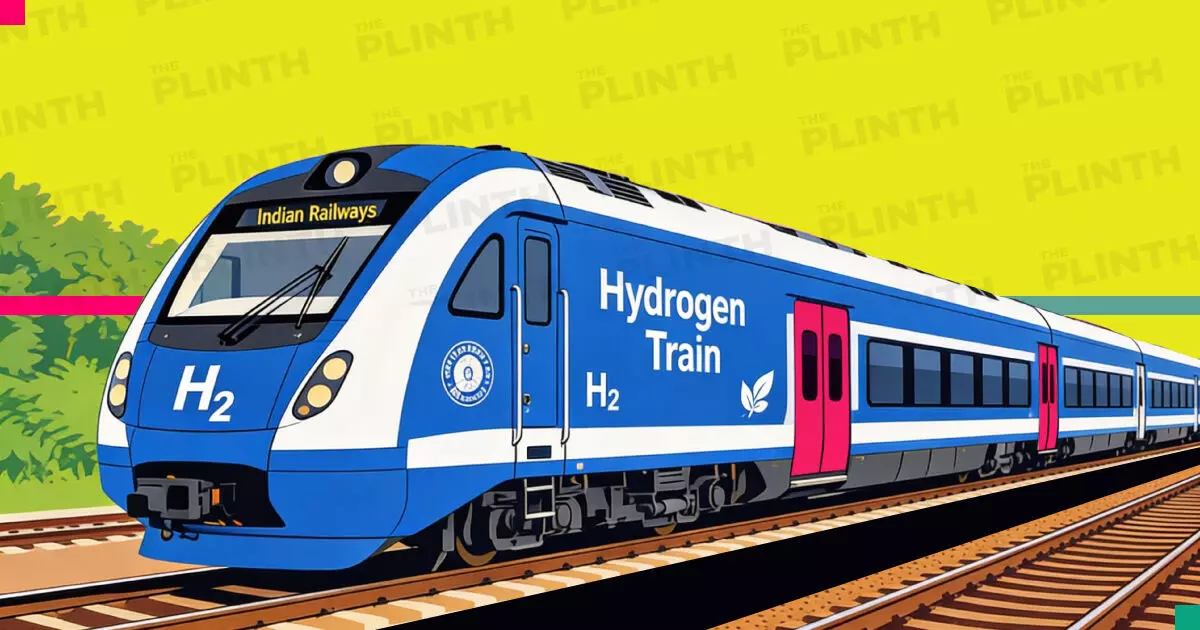
How Made-In-India Is India’s First Hydrogen Train, Really?

India designed, built and integrated the trainset. The fuel cell stacks at its heart and the materials inside them come from abroad.
The Gist
- The global hydrogen-rail supply chain is unstable, with past failures in Germany raising concerns about reliability.
- India's ambitious plans for hydrogen trains face economic and sustainability questions, particularly regarding the renewable energy source for hydrogen production.
On 22 May 2026, India announced an engineering milestone. The Railway Board cleared a 10-coach hydrogen fuel cell trainset for commercial service on the Jind-Sonipat section in Haryana.
Built at the Integral Coach Factory (ICF) in Chennai, it will draw its fuel from a green hydrogen plant rising at Jind.
The rake is designed for speeds of up to 150 km/h, though the pilot will run it at a deliberately conservative 75 km/h.
Railway Minister Ashwini Vaishnaw has been calling it the longest and most powerful hydrogen train on broad gauge.
The cost so far, across the trainset and its ground infrastructure, runs to roughly Rs 112 crore, with a wider plan to put 35 such trains into service for about Rs 2,800 crore. In this framing, India joins Germany, Japan, China and the United States in the hydrogen-rail club, and does it on its own hardware.
What the framing leaves out are the layers of this train that are Indian, and those that are not.
What’s Indian And What’s Not
The railcar and its coaches are built at ICF. The diesel-electric multiple-unit being retrofitted is Indian. System integration sits with Medha Servo Drives, a Hyderabad firm, working to specifications framed by the Research, Design and Standards Organisation.
The Jind plant, its electrolyser, the 3,000 kg of hydrogen storage, the 11 kV supply and the refuelling apparatus are all domestic builds. The engineering is meaningfully more than buying a finished Coradia iLint — world's first passenger train powered by a hydrogen fuel — off its French manufacturer Alstom and bolting it to a domestic timetable.
Germany simply bought complete Coradia iLint trains from Alstom and ran them; India designed, built, and integrated its own vehicle and fuelling system rather than importing a finished train off the shelf. That is a genuinely higher rung of capability.
But the heart of a hydrogen train is the fuel cell, the device that combines hydrogen with oxygen from the air to generate the electricity that drives the motors, with water vapour as the only exhaust.
It is the engine of the engine, and that is where the indigenous story thins out. The pilot retrofit programme Indian Railways awarded to Medha Servo Drives ran on modules from Canada's Ballard Power Systems, eight units of 100 kW apiece.
Ballard's technology is built on proton-exchange membrane stacks that India does not manufacture.
The latter ICF-built trainset has been reported to use fuel cell systems from Tata Advanced Systems, though that sourcing is not officially confirmed, and even Tata's fuel-cell activity has historically leaned on imported stacks rather than a stack designed and made in India from first principles.
The government has published no localisation breakdown.
The Materials Base Barely Exists
It is tempting to soften this as “indigenous except the stacks.” Run down the chain, and it imports almost the whole way.
The membrane, the thin polymer sheet at the centre of each cell that lets protons pass while keeping the hydrogen and oxygen apart, is perfluorosulfonic-acid film of the Nafion family, dominated by Chemours, Gore, and a few Japanese and Chinese suppliers.
The catalyst, the platinum-group metal (PGM) coating that drives the reaction at each electrode, sits on carbon; India neither mines PGMs at scale nor manufactures the catalyst-coated membranes and membrane electrode assemblies that form the genuine core of a hydrogen fuel stack.
The gas diffusion layers, the porous sheets that spread the gases evenly across the electrodes and carry water away, are carbon-fibre paper from a handful of foreign makers. Bipolar plates, the balance-of-plant, the traction-rated converters; the carbon-fibre-overwrapped hydrogen tanks are all imported or assembled from imported subcomponents.
What India can do today is the layer that does not turn on materials science: build the railcar, integrate the modules, wire the traction, design the controls, and stand up the plant. That is the systems-integration layer, not the technology layer.
The membrane electrode assembly, where the intellectual property, the cost, and the failure modes live, India does not yet make.
The Wobbly Supplier Base
This dependency would matter less if the global hydrogen-rail supply chain were healthy. It is not. In Germany, the country that effectively launched modern hydrogen rail, Alstom pulled most of its Coradia iLint fleet out of service in late 2024 for urgent rework. By August 2025, only four of the 14 units in Lower Saxony were still running, with diesel filling the gap. The state transport authority there has cancelled further hydrogen purchases and ordered 102 battery-electric trains instead.
The reasons are instructive. The trains did not fail because the railcar was bad. They failed on fuel cell degradation running ahead of the service interval, on hydrogen supply reliability, and on software. Those are the components India does not control.
Meanwhile, Cummins has sold its low-pressure fuel cell business, taking a charge of around $199 million, with the rail piece going to Alstom, citing lower hydrogen adoption expectations. The unit it offloaded is the same kind that made the stacks for the iLint.
So, in a programme branded for self-reliance, the single most sensitive input rests on the same supply chain that just failed elsewhere. The vehicle being Indian does not insulate it from the part of the chain that actually broke.
The pilot framing obscures the cost dimension. Imported stacks carry not just a purchase price but a service tail: replacement modules sourced from abroad, foreign exchange exposure on every overhaul, and lead times set by a supplier's order book rather than by Indian Railways.
On a heritage programme, the per-train capital was once pegged at around Rs 80 crore plus roughly Rs 70 crore of route infrastructure, before any of the recurring import bills are counted. A 35-train programme of around Rs 2,800 crore inherits that exposure, multiplied. Feeding a fleet would also demand far more electrolyser capacity and a steadier renewable supply, none of which has been costed in public.
MOUs Are Not Factories
The announcements expected to signal real capability are memoranda and research centres rather than operating plants. Adani has signed an MOU with Ballard to explore PEM manufacturing in India. Hyundai is building an HTWO research centre at IIT Madras focused on localisation of the hydrogen value chain. BHEL has a ten-year tie-up with Singapore's Horizon Fuel Cell Group to commercialise fuel cell locomotives. Every one of these is the posture of a buyer working toward a capability, not a producer that already has it.
You do not sign a decade-long licensing arrangement for technology you can already make competitively.
For What's It's Worth
None of this makes the Jind-Sonipat pilot pointless. On a non-electrified branch line, the alternative is not a clean electric train, but a diesel locomotive. Hydrogen has a real, if narrow, use case on routes where ridership does not justify full electrification, on hilly sections where overhead wires are awkward, and on heritage lines.
Vaishnaw has been careful to say that comparing the per-kilometre cost against existing traction would not be fair at the pilot stage, which is an honest admission that the economics are not there yet.
A further caveat is buried in the word “green.” The Jind electrolyser splits water using electricity, and the emissions case holds only if that electricity is itself renewable. The plant itself was reportedly set up with the Spanish firm Green H, another reminder of how much of the value chain sits abroad.
India has not published the energy mix powering it. If it draws from a grid that remains heavily coal-fired, the sustainability argument gets muddier, and the headline of a zero-emission train starts to depend on accounting choices made well upstream of the platform at Jind. That is a question that becomes more pressing, not less, as the programme scales.
But the real question is not whether the train runs. It is what India has bought: an Indian railcar and Indian infrastructure wrapped around an imported energy-conversion core, with no commercial-scale domestic capability in any of the critical fuel-cell materials.
That capability of turning the MOUs into actual membrane and MEA production lines is a multi-year, capital-heavy, materials-science bet India has yet to show it can win.
Until then, the most powerful hydrogen train on broad gauge will keep running on a stack that India imports. That is not a failure. It is just a far less flattering sentence than the one being announced.
Core.
Core.


