



 Newsletter
 Search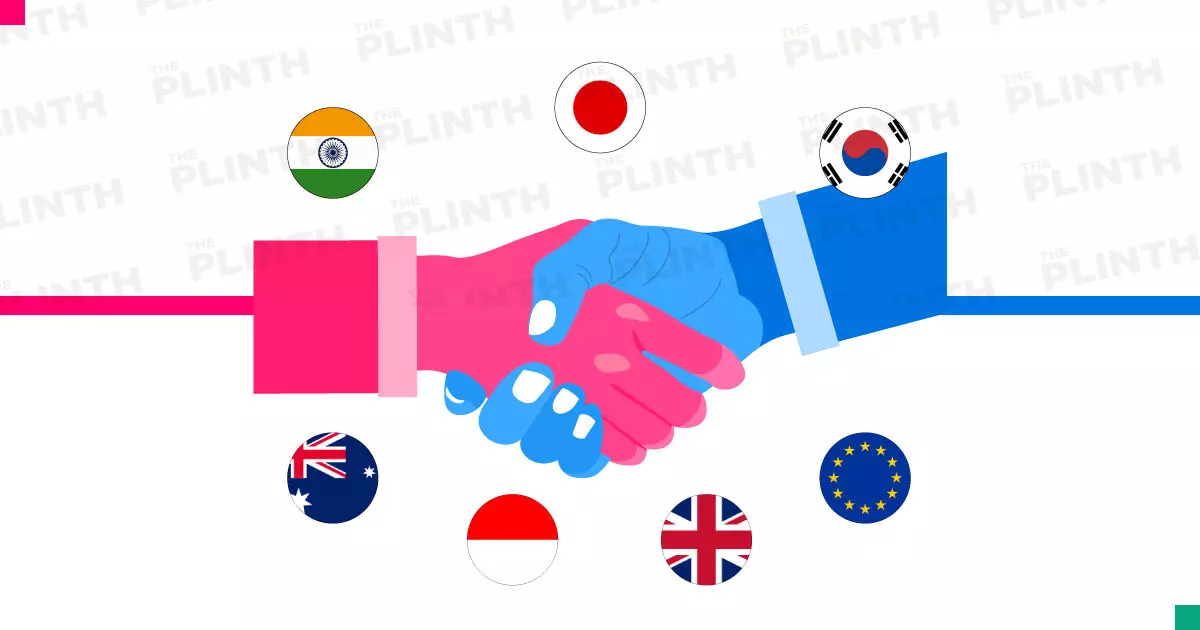
India's Early Trade Pacts Failed. The EU Deal Can't Afford To
- The Plinth
- Published on 24 July 2026 6:00 AM IST

India's Asian trade deals produced tripled deficits and endless repair talks. The UK and EU papers put at stake what the old ones never had: a surplus.
The Gist
The Indian government is reassessing its free trade agreement with Japan due to a significant trade deficit and stagnant exports.
- The deficit with Japan has nearly tripled over the past decade, prompting the review.
- Officials seek increased Japanese investment and improved export conditions for Indian agriculture and pharmaceuticals.
- India's overall trade agreements with G20 nations show a pattern of underperformance, raising concerns about the efficacy of these pacts.
The government is reviewing its free trade agreement with Japan, prompted by a deficit that has nearly tripled in a decade and exports that have barely moved.
The review is overdue and insufficient because it isn’t just the Japan pact that has failed.
What Delhi wants from it, officials indicate, is more Japanese investment through the pact and easier quarantine and testing rules for Indian farm and drug exports. The formal terms are not yet public.
India has free trade agreements in force with three G20 economies of South Korea, Japan and Australia, while a fourth G20 member, Indonesia, trades with India under the ASEAN goods pact of the same vintage.
A fifth, with the United Kingdom, was signed last July and awaits ratification. A sixth, with the European Union, is nearly done. That first batch has been through fifteen years of exams. The grades are due.
What Makes A Good Pact?
Export growth into the partner, the deficit trajectory, how much of the preferential access exporters actually use, and the state of the review each pact eventually required are fair measures to gauge whether a pact is successful or not.
The last measure is the most significant.
Trade pacts that deliver results do not typically require years of renegotiation.
India has, however, been reviewing its pact with South Korea since 2016, ASEAN since 2023 and Japan from this year. When every major agreement ends up being reworked, the issue may lie as much with the approach as with the partners.
One split worth keeping in view as the grades follow: the Japan and Korea gaps are overwhelmingly in goods, the very trade the pacts were meant to grow, while the Indonesia gap is mostly coal and palm oil that India would import regardless.
The Class Of 2010 And 2011
South Korea went first.
The Comprehensive Economic Partnership, CEPA in trade shorthand, is India’s label for pacts that cover goods, services and investment together.
The Korea CEPA, signed in January 2010, set the template for everything that followed. India's deficit with Korea has roughly tripled since, from about $5 billion before the pact to north of $14 billion, as Korean steel, electronics and auto components flowed in at discounted rates.
Indian exports grew off a small base and stayed small. The asks that mattered to Delhi — pharmaceutical approvals, services access, movement of professionals — produced chapters rather than shipments. The discounts were also claimed unevenly. Korean exporters used their tariff concessions into India at several times the rate Indian exporters managed in return.
Delhi asked for an upgrade in 2016, and a joint ministerial statement that June launched what both sides called 'upgradation' negotiations. Ten-plus rounds later, they remain unconcluded. Grade: D.
Japan's CEPA, in force since August 2011, is the subject of the review now under way. The numbers bear repeating only in outline: a deficit that nearly tripled inside a decade to $15.4 billion, exports that crept from $4.6 billion to $6 billion, a mango trade suspended on quarantine grounds, and officials now describing the agreement's purpose as attracting investment rather than selling goods.
"Every FTA has its own purpose. We want to leverage this agreement more to bring better investment into India, which will boost the economy," a government source familiar with the review reportedly said. Grade: D. Japanese investment earns the pact some credit, but the quote takes most of it back: when officials pitch a trade agreement as a way to attract capital, they are conceding it failed at trade.
Indonesia is the failure fewest people talk about.
India never signed a bilateral FTA with Jakarta, but the ASEAN goods agreement, in force since 2010, covers it. The trade deficit between India and ASEAN was $43.6 billion last year, with imports of palm oil and steam coal accounting for over $25 billion.
The review launched in 2023 promises, in the words of the ASEAN-India joint statements, to make the pact "more user-friendly, simple, and trade facilitative"; its 2025 deadline has slipped. Grade: fail. This is the pact Indian negotiators privately say they would most like to renegotiate from scratch.
The causes are common to the class, built in from the start. Each partner's tariffs were already low while India's were high, so India traded away its most valuable bargaining chip for discounts on walls made of standards, testing and certification rather than duties.
India signed anyway because the pacts were sold as strategic Look East commitments, with services access and investment inflows meant to make up for the tariff asymmetry. That compensation is the part that never arrived.
"Japan has strict SPS measures, and that is not specific to India. It applies to all countries," the government source said of the food-safety and quarantine rules Indian farm exporters run into.
True of every country, and that is the point: the agreements never touched them. The sectors that show it are the ones such rules bite hardest: in Japan, marine products and mangoes stopped at quarantine, rice and tea failing residue checks.
Paperwork was the second wall. To claim a tariff discount, an exporter must prove where the goods were made and show 35 per cent Indian value addition; only about a fourth of the discounts on offer get used, by most estimates. The services and mobility chapters that were supposed to be India's compensation stayed on paper.
The Transfer Student
Australia is too recent for a final grade, but the early marks look familiar. The ECTA, in force since December 2022, gave India preferences in a market whose average tariff was already about 2.5 per cent; most of that market was open before the agreement.
India in turn removed its duty on coal, Australia's largest export to this country, and began unwinding a 150 per cent wine tariff. Early export numbers were respectable, led by engineering goods and apparel, but the shape of trade has not moved: exports of roughly $8 billion face imports around twice that, dominated by coal and gold.
India's substantive asks, on services, professional mobility and recognition of qualifications, were deferred to the full CECA, which remains unconcluded more than three years on. Grade: incomplete, trending C, with the pattern of 2010 visible in the margins.
Two Exams Ahead
The United Kingdom and the European Union differ from the class of 2010 in one basic way: India runs surpluses with both. Exports to the UK are about $13 billion against imports of about $8.5 billion.
With the EU, India's largest goods trading partner, the surplus is roughly $15 billion on total goods trade in the region of $135 billion. The East Asian pacts risked, and delivered, a flood of imports into high-tariff India. Britain and Brussels present the opposite risk: rules that slowly eat into surpluses India already holds. The danger flips, from buying too much to being allowed to sell less.
The UK agreement, signed last July, would be the batch's best paper if ratified as negotiated. Tariff eliminations on textiles, apparel, leather and footwear give Indian goods a price advantage of 8 to 12 percentage points over Bangladesh and Vietnam.
The social-security convention sparing Indian professionals double contributions for three years is a real saving. India's concessions on whisky and automobiles are phased and capped by quota, which limits the damage.
The risks are just as plain. The UK's average tariff is under 4 per cent, so the margin India buys is thin. The instrument that will bind hardest on Indian metals and engineering exporters, the carbon border levy the UK plans from 2027, is entirely outside the text.
The mobility gains beyond the social-security convention are modest, a point London insisted on, and Delhi absorbed. Both governments advertise a doubling of bilateral trade to $120 billion by 2030; going by the record, treat such targets as advertising and read the annexes instead. Likely grade: B minus, if the carbon-border and product-approval homework is finished before ratification rather than promised after it.
The EU negotiation is the exam that matters most, because the surplus at stake is the largest and the regulatory wall is rising fastest.
The EU's carbon border tax, the CBAM, began charging in January, with roughly $8 billion of Indian exports in its scope. The charge will climb as the EU phases out the free credits its own factories currently enjoy.
A separate deforestation law has covered coffee, leather, rubber and wood since December. Pesticide-residue limits have already stopped rice, tea and chilli consignments at European ports.
Brussels, meanwhile, wants tariff cuts on cars, wine and spirits, movement on dairy that Delhi has so far refused, and sustainability chapters with review clauses of its own.
India's asks — easier movement for professionals, European acceptance of Indian testing and inspections, and recognition of India's data-protection rules — all fall on the side of the table where Europe concedes slowly.
One recent agreement shows what better drafting looks like. India's 2024 pact with the EFTA bloc of Switzerland, Norway, Iceland and Liechtenstein tied its tariff cuts to a $100 billion investment commitment from the other side, with the option to revisit those concessions if the money does not arrive.
It is the first Indian trade agreement to make a partner's promise enforceable rather than a hope. That clause belongs in the Brussels text too.
What a pass requires is the one thing the first batch never wrote down: putting the partner's regulations on the negotiating table, not just its tariffs.
Indian exporters should get credit against the EU's carbon tax for what they already pay under India's own carbon scheme, instead of paying twice for the same emissions. Testing done in Indian labs should count in Europe.
Both sides should commit to dates, product by product, for recognising each other's approvals, with a formal route to complain when an approval stalls.
Write these into the text and the surplus can be defended; the EU paper could earn the batch's first B. Settle instead for the vague cooperation language India accepted from Tokyo and Seoul, and the EU deal will repeat the Japan experience, with a carbon tax on top and far more trade at risk.
Two simple fixes would improve every grade at once; neither needs a partner's consent. Publish, every year and for every agreement, how much of the promised access exporters actually use, so that failure shows up early instead of a decade late. And give review clauses deadlines with real consequences, such as concessions that lapse when a review drags past its date, so that repair talks cannot run forever.
The exams of 2010 and 2011 cannot be retaken. The two that count, with London and Brussels, are still being written.
Core.
Core.


