



 Newsletter
 Search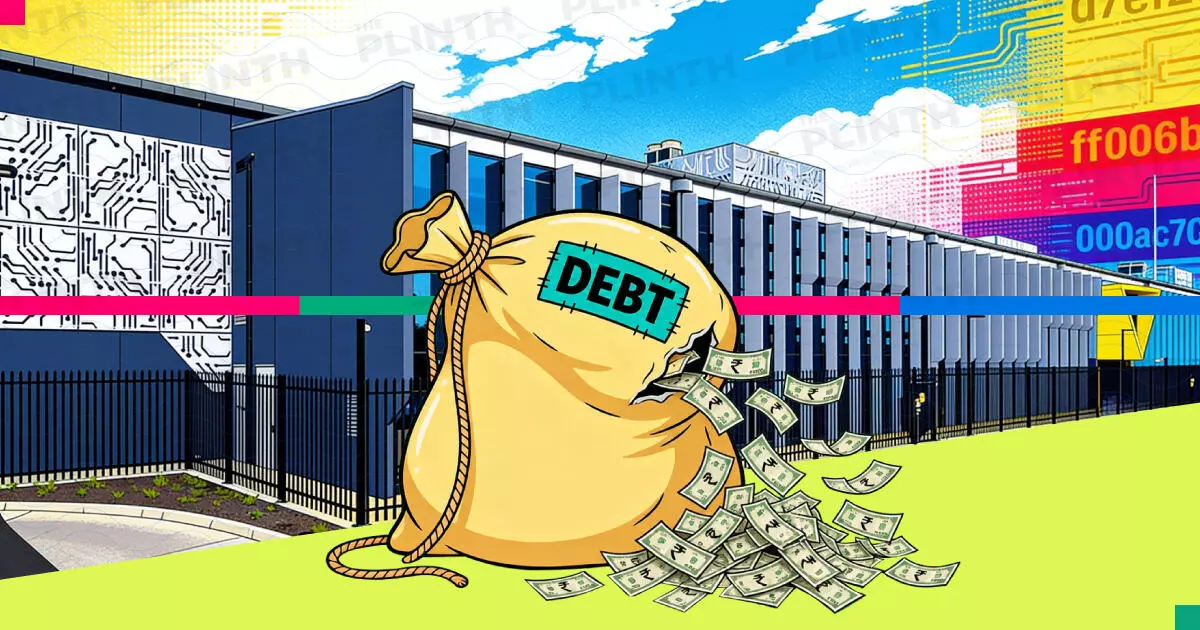
India’s Data Centre Demand Curve is in California. The Debt Lives Here.
India's speculative AI boom runs on local bank debt, wagering the system on unsigned California demand.
The Gist
- India's operational data center capacity is set to triple or quadruple by 2030, driven by AI demand.
- Developers rely on local debt financing, unlike American hyperscalers who utilize equity for AI buildouts.
- Potential oversupply and reliance on global demand assumptions could lead to financial strain on Indian banks and lenders.
Every few weeks now, another gigawatt is announced. An American cloud giant commits billions to an Indian region. A real estate developer discovers it was a digital infrastructure company all along. A state government signs a memorandum promising land, power and single-window clearances for an AI city.
The numbers have acquired the pleasant unreality of a boom.
India's operational data centre capacity, roughly 1.5 GW today, is supposed to triple or quadruple by 2030, with announced pipelines — Visakhapatnam, Jamnagar, Navi Mumbai, Hyderabad, Chennai — that comfortably exceed everything built in the previous two decades combined.
There is a genuine story underneath the froth.
Rules that keep Indian data on Indian soil, the payments system, streaming, companies moving to the cloud — these generate real, contracted, rupee-denominated demand, and the data centre landlords who grew on it have decent economics. But that is not the story being financed in 2026.
The step-change in the pipeline — the part that turns a Rs 200-billion industry into a Rs 2,000-billion one — is artificial intelligence capacity. GPU halls. Liquid-cooled, power-dense, built for AI training runs and usage that do not yet exist in India at any scale that would justify them.
Not all of the announced pipeline is this speculative AI capacity; a large share is conventional colocation with AI-capable halls built in, underwritten by contracted enterprise and cloud tenants. It is the incremental, purpose-built AI capacity, leased to no one yet, that carries the risk this column is about.
Two questions, then: whose demand assumption is this, and whose balance sheet carries it?
Two Buildouts, Two Capital Structures
Follow the money in the American AI buildout, and you find, mostly, the deepest corporate balance sheets in history.
Microsoft, Alphabet, Amazon and Meta — the hyperscalers — will together put something north of half a trillion dollars into land, buildings and chips in 2026 if their public forecasts hold, funded overwhelmingly by the cash their businesses throw off: $100 billion a year per company.
Where debt has crept in, it has crept in carefully quarantined, handed to investors who are paid to take it, in a market with brutal feedback loops. When a listed GPU-rental company's shares halve, that is the system working.
The Indian buildout runs on a different balance sheet entirely.
The developers are not hyperscalers. They are data centre landlords, conglomerate infrastructure arms, and — increasingly — real estate companies executing a pivot.
Their model is the model Indian infrastructure has always run: three or four rupees of borrowed money for every rupee of their own, lent by groups of banks against the project itself, refinanced with bonds once the facility is leased and earning.
SBI and the large private banks are lending; the country's largest bank has gone as far as building a dedicated project-finance unit for AI-era industries.
The state power-sector lenders — PFC and REC, their mandates freshly widened to lend beyond electricity — are sanctioning loans. Domestic private credit funds are taking the riskier middle layer, the slice that banks decline.
Listed developers are selling new shares on the strength of the story, and bondholders are buying bonds backed by facilities that are, in many cases, not yet leased.
Where global capital does arrive — Canada's CPP has committed a billion Canadian dollars to a CtrlS partnership — it arrives as equity. The debt is local. Which is another way of asking who bears the downside.
Foreign equity can be written to zero without a domestic casualty; local debt cannot. If the demand does not arrive, the loss surfaces first with the Indian banks, NBFCs and bondholders who funded the build, and then, through committed power, with the wider system.
This is the asymmetry buried in every glossy pipeline chart.
The American AI trade is an equity bet made by companies that can afford to be wrong. The Indian AI trade is a debt-heavy infrastructure bet — financed on Indian balance sheets, priced off demand assumptions minted in California.
The forecast Indian developers are underwriting is not their own. It is the hyperscalers’ global compute-demand curve, drawn in Redmond and Mountain View; the domestic lease that would validate it locally is, in most cases, still unsigned.
The Delaware Machine
What "carefully quarantined" means in practice is the heart of the contrast.
Consider the most instructive deal of the boom. Meta's Hyperion campus in Louisiana, a multi-gigawatt AI facility that Meta chose not to fund from its own operating cash.
Instead, in October 2025, the asset went into a joint venture — Blue Owl Capital's funds holding 80 per cent of the equity, Meta keeping 20 — and the venture borrowed $27 billion through Beignet Investor LLC, a Delaware entity created solely to issue the bonds, in the largest private bond sale on record.
PIMCO took the largest slice; Morgan Stanley arranged it; the bonds run to 2049 and pay interest of about six and a half per cent.
The engineering is in who carries what. The lenders have no claim on Meta itself, and the borrowing never appears on Meta's books. What supports the bonds is a lease where Meta rents the campus back from the venture, initially for about four years with extensions, and the rent pays the interest.
Blue Owl's investors take the equity risk knowingly, at private-credit returns, in funds built for the purpose.
The most speculative asset class of this cycle — a debt-financed, purpose-built AI campus — has been paid for with money that is contractually walled off, charged extra for the risk, and held by institutions whose job is to absorb losses.
The Hyperion deal is not evidence that the AI trade is safe. It is evidence that the people financing it in America do not think it is.
Now ask which Indian data centre loan comes with that kind of safety net, that kind of wall, or shareholders prepared to lose everything. The answer, so far as public disclosure shows, is none.
The Imported Assumption
What is the demand case for an unleased 100 MW AI-ready facility in Chennai or Noida?
One, global demand for AI computing power grows exponentially and indefinitely.
Two, hyperscalers and model labs will need to spread that computing around the world, and India, with its cheap power, cheap engineers, data rules, and geopolitical hedging, captures a share.
Three, domestic AI demand arrives later to backfill whatever the global tenants don't take.
Not one of these propositions is priced in Mumbai. The first is a bet on OpenAI's training plans and on how fast companies in the American Midwest adopt AI.
The second is a bet on budget meetings in Redmond and Mountain View — meetings that can, and periodically do, reprioritise regions with a single slide.
The third is the classic Indian infrastructure bet. Build it and the traffic will come. It’s the same wager that underwrote the ultra mega power plants of the 2000s and the BOT highways whose bids assumed traffic growth that never materialised.
The early price signals should worry the lenders more than they apparently do.
GPU rental prices have already been through one violent reset: an Nvidia H100 that rented for $8 an hour in 2023 could be had for under $2 by 2025, before the chip was three years old.
GPUs are written off over three to five years inside a building financed over twenty-five years. The revenue-generating asset dies four or five times over before the debt does.
The distinction that decides this is whether the operator merely leases the building, as a shell landlord whose tenant owns the GPUs and the obsolescence risk, or also owns and rents the GPUs as a compute provider carrying that three-to-five-year write-off directly.
The projects now stretching lender assumptions are the second kind, where the depreciating asset and the debt sit on the same balance sheet.
In India specifically, the government has become the price-setter of last resort. The nearly 40,000 GPUs the IndiaAI Mission offers at subsidised rates of Rs 65–100 per GPU-hour are at once the proof of domestic demand and the ceiling on its price.
The largest visible domestic AI tenant is a subsidy programme.
The capacity is not worthless; it is an option on a future that may not arrive. Indian project finance is not built to fund options; it is built for annuities, assets that pay a steady, predictable rent. A bank lending to a data centre at rates meant for a fully leased conventional facility, when what it is really funding is a wager on the global AI trade, is mispricing risk in a way that becomes visible only when the cycle turns.
The Transmission Mechanism
Suppose the AI trade does what every investment supercycle eventually does: a few years in which what is already built gets absorbed and put to work before new money follows: hyperscaler spending forecasts flatten for two years; model labs consolidate; and the cost of running AI models falls faster than usage grows, as it visibly has been doing.
In America, this is a shareholders' problem: valuations shrink, some credit funds book losses, Delaware investment vehicles get restructured by the lawyers who built them for this contingency. The system absorbs it, as it absorbed the fibre glut of 2001, and the overbuilt capacity resurfaces as cheap computing for the next generation of applications.
In India, the same correction transmits differently because this time the debt is not in a Delaware special purpose vehicle. It is with Indian banks, Indian non-bank lenders, and Indian bondholders.
The marginal tenant — the hyperscaler expansion that every leasing plan assumed — defers.
The GPU-rental operator, squeezed between falling rental rates and fixed loan repayments, defaults first. The developer who sold shares at a data centre valuation discovers he owns an industrial shed with very good power supply.
The lending banks learn that a data centre without a tenant is not infrastructure; it is real estate with unusually expensive air conditioning. PFC and REC, having stepped out of thermal power precisely to escape being stuck with plants nobody needs, find they have walked into a faster-wasting version of the same problem. And the states that committed dedicated power lines and guaranteed supply are left holding capacity contracted for demand that never showed up, a bill that ends up spread across every other electricity consumer.
The pattern is not new. India has a recurring habit of importing a global demand thesis at the top of the market and financing it with domestic borrowing: merchant power plants off Chinese-boom coal assumptions, telecom towers off per-user revenue projections, roads off traffic studies.
Each time, the global assumption corrected abroad and the loan losses landed at home, and each time the banking system spent half a decade metabolising it.
The Risk Register
The exposures will surface in a particular order.
Credit risk comes first, because loans priced as annuities are funding options, and the interest rate does not say so.
Refinancing risk follows: the construction loans made in 2024 and 2025 come up for renewal from 2028–29, against occupancy and leasing tests, and that is where a soft market becomes a hard conversation.
Beneath both runs pricing risk, since so long as the IndiaAI Mission's subsidised GPU rates set the ceiling, no private operator can cover what its money costs on domestic demand alone. And at the end of the chain sits power risk: the guaranteed supply and dedicated lines that states have committed become somebody's dead cost if the demand never arrives.
In India, that somebody is always, eventually, the state electricity distributor.
The buildout itself is not the mistake — India plausibly does need multiples of its current capacity, and being long compute in a compute-scarce world is a defensible national bet. The mistake is how it is funded: bets like this should be paid for with equity that can absorb a total loss, not loans that assume a steady rent.
So, watch the hyperscaler spending forecasts out of California — because that, not anything decided in Delhi or Mumbai, is the small print that governs this cycle.
A few second-order questions are worth keeping in view. India’s edge over Southeast Asia or the Gulf rests on more than data-localisation rules: it is the scale of domestic demand, engineering labour and localisation together, no one of them decisive alone.
Power is an advantage only on paper until grid reliability and evacuation catch up, which is why firm supply and dedicated corridors matter more than installed capacity. And the subsidised GPU rate is best read as early demand creation that doubles as a price ceiling, useful for adoption but awkward for any private operator trying to earn a market return above it.
The question under all of them is the one the banks should be asking: is this lending against a signed anchor tenant, or against the thesis? The plinth is being poured here. The architect lives eight thousand miles away, and he has not signed the lease.
Core.
Core.


