



 Newsletter
 Search
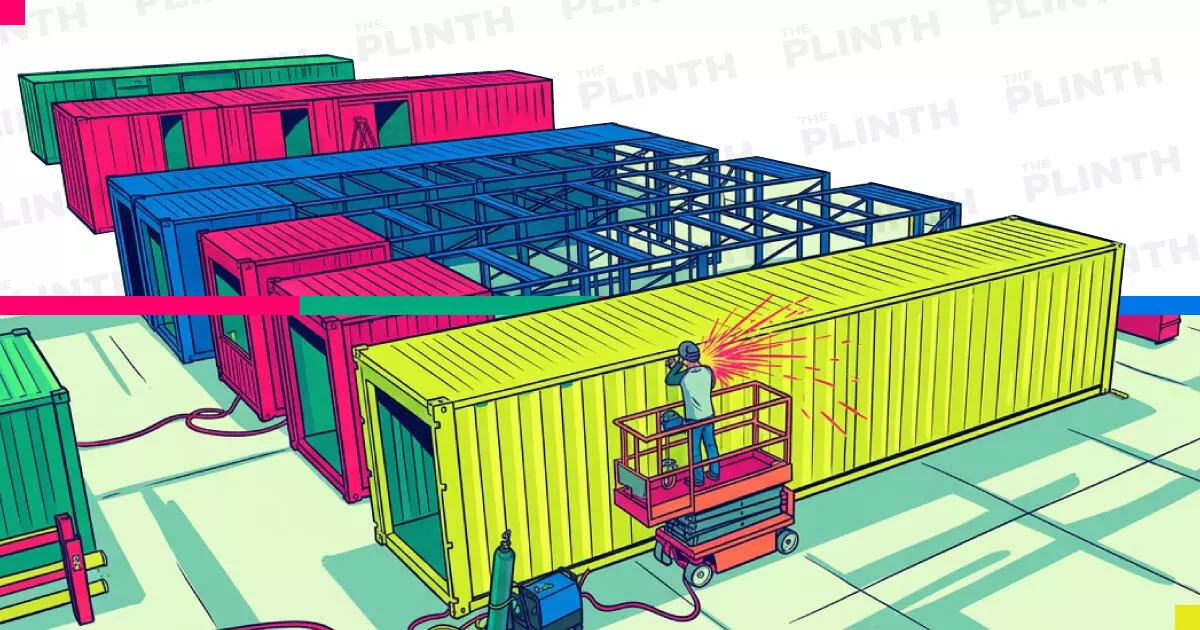
India’s Rs 10,000 Cr Container Scheme Doesn't Reduce China Dependence

The subsidy to make shipping containers pays for every box welded in India, without asking how much of it, from corner fittings to floorboards, will actually be made here.
The Gist
The Indian government has approved a Rs 10,000 crore Container Manufacturing Promotion Scheme to boost local container production.
- The scheme aims to reduce reliance on imported containers, primarily from China, and enhance domestic manufacturing.
- It includes financial incentives for factories, but concerns remain about sourcing essential components locally.
- Implementation will depend on guidelines regarding local content and payment structures to ensure sustainable growth in the industry.
On October 28, the Union Cabinet approved a Rs 10,000 crore Container Manufacturing Promotion Scheme to incentivise Indian factories to make the steel boxes that carry most of the country's trade.
The scheme was first announced in the February Budget. In August, the government said the money would be spent over five years. The Cabinet version spreads it to 2039-40, about 13 years.
That stretch turns a short sprint into a long, thin subsidy. It comes four months after DCM Containers, a Faridabad manufacturer, built India's first export-grade box for Maersk, the Danish shipping line.
What India has not yet shown is that it can make the parts that go into that container. The scheme, as published, does not ask it to.
A Box India Borrows From China
A shipping container is a standard steel crate, 20 or 40 feet long, built to international (ISO) rules so the same box fits any ship, train or truck. Capacity is counted in twenty-foot equivalent units (TEUs), the industry's standard measure, in which a 20-foot box counts as one TEU and a 40-foot box as two.
India imports nearly 2 million empty containers a year to carry its exports, according to the government. Almost all of them are made in China, which, by one industry estimate, builds 97% of the world's boxes.
That dependence costs most in a crisis.
In July, amid this year's West Asia disruption, a Coimbatore shipping agent described an exporter who booked a Kochi-to-Iraq shipment for $1,500 and ended up paying nearly $50,000 to secure an empty box.
A country that makes none of its own containers takes its place in someone else's queue.
The idea has taken nearly six years to reach the Cabinet.
In December 2020, with boxes scarce after the pandemic, state-owned BHEL and Braithwaite were lined up to make 1,000 containers each for Container Corporation of India (CONCOR), the government's rail freight arm.
In 2023, the shipping ministry weighed an Rs 11,000 crore production-linked incentive (PLI) for container makers. The Cabinet sent it back that September, citing a glut of containers and falling global exports.
A few months before that, in December 2022, Tata Steel, India's oldest private steelmaker, had received the first Bureau of Indian Standards (BIS) licence to make the weathering steel containers need.
Its Jamshedpur plant could now make container steel, but the factories to use it did not follow.
Indian makers could not match Chinese prices, and with the 2023 incentive shelved, nothing covered the difference. Without volume orders, no maker could build the scale, automation and casting supply that bring costs down.
India has made containers before. State-owned Balmer Lawrie ran a plant in Kochi for 22 years until it moved to shut it down in 2000, and other makers went out of business as China made boxes at about half the Indian cost.
What The Rs 10,000 Crore Buys
The scheme has three parts. The smallest, Rs 150 crore, pays for shared testing rigs. The second, Rs 859 crore, covers 3% a year of the interest on loans taken to build new plants or expand old ones.
The third, and by far the largest, is Rs 8,891 crore of operating support, paid in cash for every certified container sold at home or abroad. Reported rates are Rs 49,500 for a 20-foot box and Rs 86,625 for a 40-foot one.
On paper, this design has learned from the PLI, the government's main factory subsidy since 2020. Last month I wrote that PLI 1.0 had paid out less than a fifth of its Rs 1.97 lakh crore, much of it lost between a finished plant and enough sales to qualify.
The container scheme allows three years to build before payments start, and helps pay for the factory, both fixes that column argued for.
But nine-tenths of the money is still paid per box sold, the form of subsidy that, under the PLI, paid best for final assembly and worst for the earlier stages.
At Rs 49,500 a box, Rs 8,891 crore pays for about 18 lakh TEUs over ten production years, or about 1.8 lakh TEUs a year.
The government's target is a tenfold rise in annual capacity, to 7.5 lakh TEUs. At these rates, the subsidy can support about a quarter of that output. Either the payment per box shrinks as volumes grow, or most new capacity will one day have to sell without help. The guidelines will have to say which.
Even the full target would replace well under half of the empties India now imports a year.
An Indian-built container has cost about $1,000 more than a Chinese one, according to industry reports. Rs 49,500 closes a little over half that gap; the rest must come from scale or cheaper inputs. Inputs are where the scheme says least.
What Goes Into A Box
A standard container's walls and roof use Corten, a weathering steel that forms a protective rust skin instead of corroding through.
Cast-steel blocks at its eight corners, called corner castings, carry the weight of the boxes stacked above and lock them together. The floor is hardwood or bamboo plywood, and the box is finished in marine paint.
Kalyani Cast-Tech, a Haryana foundry turned container maker, told investors in 2024 that a TEU cost about Rs 2.66 lakh. The scheme's Rs 49,500 is therefore close to a fifth of the price of a 20-foot box.
India makes little of what goes into that box at container scale. The government's own notes list corner castings, Corten steel, wooden frames and paints as industries the scheme hopes to grow.
Steel is furthest along, thanks to that Tata Steel licence. Corner castings are next.
Foundries in Rajkot, Ahmedabad and Chennai can make them to the ISO standard, but not yet at the volumes a container plant needs.
That is the scheme's weakest joint. A payment per finished container rewards assembly, whatever the box is made of. If the castings, floors and paint keep arriving from Chinese suppliers, India will have moved the welding line but kept the dependence.
Two of my earlier columns show where that road leads.
The medical-device PLI pays to assemble scanners around imported X-ray tubes and detectors, and the import bill grew with the subsidised output. The rare earth magnet scheme will fund plants that run mostly on oxide refined in China.
The magnet tender at least requires winners to do the last three stages of production in India. The container scheme sets no such condition.
Who Is Making Them
DCM Containers, headed by Rudra Shriram, first made containers in a 1993 venture with Hyundai. It is not the listed DCM Shriram Ltd, which has denied holding the order.
Since the Budget, Maersk, MSC, CMA CGM, JSW Group and CONCOR have shown interest in building or buying Indian boxes.
Listed exposure is thin. Company filings compiled by Cofacto show Kalyani Cast-Tech is the only listed company already making export containers, about 6,000 TEUs in FY26, and is adding about 10,000 TEUs in Kutch, Gujarat. At about 48 times trailing earnings as of October 29, 2026, its price already assumes much of the scheme goes its way. Artson Engineering, a loss-making Tata Projects subsidiary, says in its FY26 annual report it is in talks to make pilot containers with Tata Steel Corten. It lost Rs 10.9 crore that year. The corner-casting and flooring makers the scheme most needs are not listed at all.
What Decides Whether It Works
Whether the scheme builds an industry or only plants depends on what the guidelines have yet to settle.
The first is local content. If the per-box payment rises with the share of Indian steel, castings and flooring, assemblers will pull suppliers into the country with them. If it does not, the cheapest route will be to import kits from China and weld them together in India.
The second is how the payment tapers. If companies know in advance when the payment will shrink, they know when they must survive without it.
A schedule works only if companies believe it. The PLI record gives them little reason to — schemes that struggled were mostly relaxed rather than closed. Textiles halved its minimum investment, IT hardware was rewritten with more than double the budget, and battery-cell winners were given until 2031. A container maker watching that history has every reason to wait for easier terms.
The next time freight markets seize up, a garment maker in Tiruppur or an engineering firm in Ludhiana will still need an empty box at the nearest depot. Indian plants can put one there only if the steel, the corners, and the floor of that box are made here too.
Core.
Core.


