



 Newsletter
 Search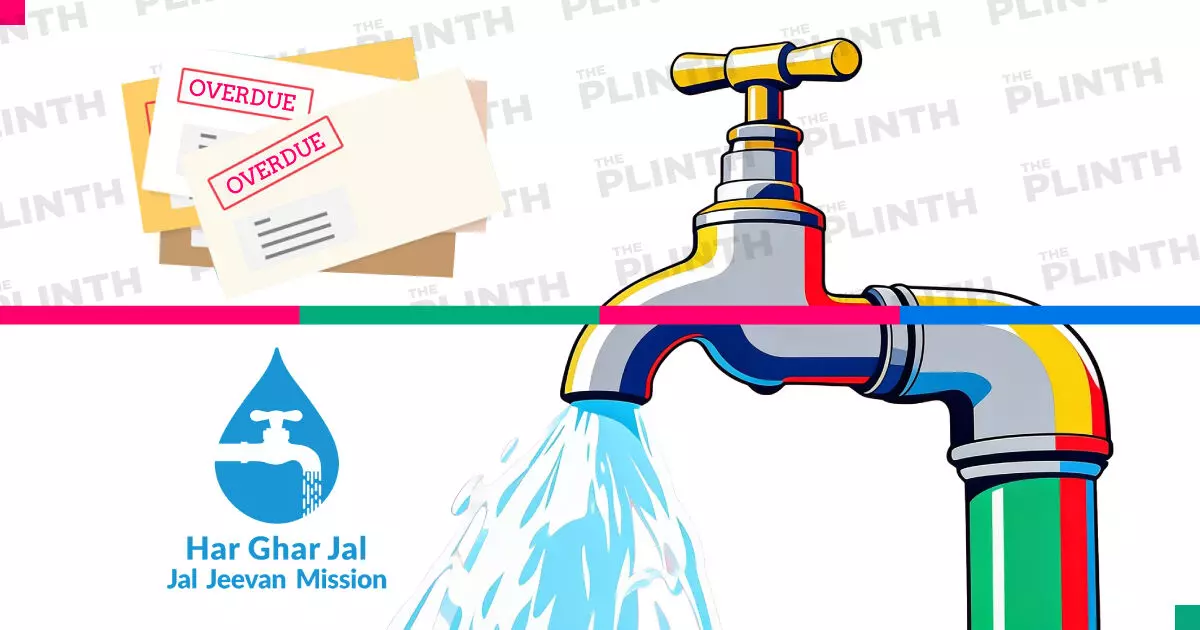
Jal Jeevan Mission Relaunched As 2.0, But Contractors Still Steering New Bids To Central Agencies
India relaunched Jal Jeevan Mission, its rural water scheme, with fresh funding — but contractors are steering new bids toward central agencies, not states. Some now refuse state risk entirely.
The Gist
Despite the ambitious goals of the Jal Jeevan Mission, the actual provision of reliable water connections in rural India remains far below expectations.
- Independent surveys indicate that only 30% of rural households have piped water as their main source, contrasting with official claims of over 60%.
- Contractors face financial strain due to unpaid bills, leading to a slowdown in infrastructure projects.
- The government’s recent budget allocation for JJM 2.0 aims to address these issues, but execution challenges remain a significant concern.
When Prime Minister Modi launched the Jal Jeevan Mission in August 2019, the promise was a working tap connection in every one of India’s 19.36 crore rural homes within five years.
By March 2026, the dashboard reported 15.80 crore households connected, around 81.6% of rural India. Still, Sunil Katial, who runs Electrosteel Castings, India's largest ductile-iron pipe maker and a top supplier to JJM's pipe-laying contractors, told analysts in February that water actually flows reliably from only about 50 to 55% of those taps.
An independent check points the same way: the National Sample Survey's 79th round found just 30% of rural households had piped water as their main source at home, against the more than 60% the mission's own administrative data claimed at the time.
Coverage thus has fallen well short of the claim, and the firms that closed even that smaller gap, by laying the pipes and building the schemes, have been saddled in turn with the cost of the failure, in the form of bills the government has not paid.
On 10 March, the Cabinet relaunched the scheme as JJM 2.0, with a longer deadline and a larger outlay. The contractors who built the first phase have not waited to find out if this time is different.
Consider what happened to the year just ended.
Budget 2025-26 had set aside Rs 67,000 crore. The Revised Estimate, presented in February, came in at Rs 17,000 crore: a cut of three-quarters, leaving roughly Rs 50,000 crore unspent. The new Budget restores the headline allocation to Rs 67,670 crore. The mission is funded again on paper.
The Receivables Pile
Many invoices submitted more than a year ago, signed off as work completed, are still waiting to be paid, most in Uttar Pradesh and Maharashtra. Industry body Assocham has written to the Jal Shakti ministry asking for a public payment dashboard and a mechanism to compensate firms for the wait.
Katial estimated that roughly Rs 30,000 to 35,000 crore is owed to contractors across the sector. He described demand for pipes, once half of Electrosteel’s domestic market, as having hit a “pause button”, with funding releases stalled and central audit teams investigating reports of “sham fulfilment” on the ground. — connections logged as complete in the mission's records that do not, in practice, deliver water.
Another leading infrastructure company, NCC Ltd, the most exposed listed contractor, sits on Rs 7,000 crore of unfinished JJM work, around a ninth of its order book.
Q4 FY26 results, reported May 15, showed receivables (trade and unbilled) falling to Rs 3,015 crore, down from Rs 3,700 crore in Q3, after the company collected Rs 1,000 crore during the quarter and a further Rs 450 crore in April; outstanding dues still stood near Rs 3,000 crore.
The UP order book alone remained at Rs 6,181 crore pending as of end-March, of which Rs 1,730 crore was executed through the year. CFO Sanjay Pusarla, on his fourth consecutive call answering the same question, declined to give FY27 guidance, citing payment cycles he still could not predict.
The February forecast — that management expects to recover everything outstanding by the end of 2026-27 — has not been repeated since; that outcome still depends on how quickly the Centre releases funds, states match those releases, and Lucknow and Mumbai clear the paperwork.
The geography is consistent. Uttar Pradesh is the worst offender by some distance: Part of the Shapoorji Palonji Group, Afcons Infrastructure's Q1 FY27 call, held 10 August, put a finer point on it: the company's total JJM order book is Rs 1,221 crore, split Rs 510 crore in UP, Rs 414 crore in Madhya Pradesh and Rs 297 crore in Rajasthan.
Payments are flowing in the latter two states; in UP, roughly Rs 400 crore sits in receivables and only a small fraction is being cleared even on completed last-mile work. Afcons' own Q1 FY27 profit fell to Rs 30 crore from Rs 137 crore a year earlier, a decline the management linked in part to the same stretched payment cycle.
Ion Exchange, a water and environment management company, described UP releases as “very subdued or very negligible”. Rajasthan is the second hotspot; VPRPL ended December owed Rs 3,355 crore on a consolidated basis.
Jindal Saw, global manufacturer and supplier of iron and steel pipe solutions, has not updated the picture since; the most recent public confirmation remains Jindal Saw’s 28 April call, more than five weeks after JJM 2.0 was approved: management said whatever water-pipe sales the company recorded were “predominantly backed by state-level funding rather than central Jal Jeevan Mission disbursements”.
The Cabinet decision had not yet shown up in the order book. Part of the reason payments lag is in the rules: the Centre releases its share only after a state has put up its matching half. For states whose finances are stretched, that requirement alone creates a bottleneck that does not exist in projects funded by the World Bank, the ADB, or directly by central agencies. Even after a state clears that hurdle, money can still stall a step later: the Comptroller and Auditor General's own audits of the mission list "pendency in payment to contractors" as a specific finding — funds released to a state treasury do not automatically reach the executing agency, such as Uttar Pradesh Jal Nigam, that actually owes the contractor.
Ion Exchange: A Formal Exit
Ion Exchange has detailed what the freeze is doing to its accounts. A stalled JJM is a stalled revenue line, not just a stalled pipe order. The Q4 FY26 numbers show it has not eased. Engineering operating profit fell nearly 28% year on year in Q3.
By Q4 FY26, reported in late May, the strain had moved from the top line to the bottom: consolidated revenue hit a record Rs 863 crore for the quarter, but operating profit excluding other income collapsed to Rs 19.87 crore, a margin of 2.3% against 10.3% a year earlier, and net profit fell 62% year on year to Rs 24 crore.
The company's position pre-dating JJM 2.0 has not changed: it does not intend to take on any more JJM contracts under the current rules. Ion Exchange is instead chasing semiconductor fabrication, solar, green hydrogen and data centres: customers who pay on time because a bank lender is watching, not because a state finance department gets around to it.
Where Is The Money Going?
Electrosteel Castings has told investors that as JJM “fizzles out”, irrigation and river-interlinking projects will replace it as the largest source of demand for ductile-iron pipes. NCC is pinning its hopes on Ken-Betwa, run directly by the Centre, to lift performance back to normal in 2026-27.
OM Infra is going after Rs 2,000 crore in the Eastern Rajasthan Canal Project; Dilip Buildcon was named lowest bidder on a Rs 702 crore Narmada embankment contract; PNC Infratech is chasing Rs 400 to 450 crore of irrigation orders. The common thread is the choice of customer: a central agency, a foreign development bank, or a sovereign-backed entity.
Anyone, in other words, except a state water department dependent on matching releases from Delhi. To answer that plainly: it stalls in two places, not one. The first is the Centre-state matching requirement described above. The second sits inside the state itself, after that hurdle is cleared — the CAG finding on payment pendency, detailed further up, is the second gap.
The Premium for Picking Your Customer
VA Tech Wabag, a water and wastewater treatment EPC contractor, has gone furthest in turning customer selection into formal company policy. Chairman Rajiv Mittal refuses to bid for any contract where the eventual paymaster is a state government in a JJM-style arrangement; Wabag will only take projects funded by the World Bank or ADB, with a sovereign guarantee, or run directly by central agencies. The numbers say this is not costly.
By the end of FY26 (year to March), Wabag had an order book of Rs 17,234 crore, up 26% year on year, split 62:38 between fresh EPC construction and the long-term operation-and-maintenance contracts that follow, with a net cash position of Rs 950 crore and no offsetting debt — its sixth consecutive year net cash positive. Full-year revenue was up 21% to Rs 3,944 crore, profit up 25% to Rs 371 crore, with roughly half the business now from outside India.
EPC giant Larsen & Toubro has put a concrete cost on the JJM problem. Chairman S. N. Subrahmanyan said earlier that excluding water projects, infrastructure revenue would have grown 8 to 9% in 2025-26 instead of the reported 5%. Q4 results, published on 5 May, showed what happens when execution is matched to customers who pay: an order book of Rs 7,40,327 crore, the highest in L&T's history at the time and up 28%, with overseas customers at 52%. Annual order inflow crossed Rs 4 lakh crore.
The Q1 FY27 results published on 28 July pushed the order book to a fresh record of Rs 7,79,954 crore, up 27% year on year — but for the first time, management flagged execution challenges specifically in the Water & Effluent Treatment business as a risk to watch, alongside margin pressure in Infrastructure & Utilities. The four-percentage-point drag from JJM-style state water work — on the Infrastructure segment's own revenue growth rate, not L&T's overall topline — remains the single most quantified cost of taking that risk in India today; the new figures show what the rest of the business looks like once that drag is set aside, even as the water business itself continues to lag.
What JJM 2.0 Fixes, and What It Leaves Alone
With JJM 2.0, the government has effectively conceded that the original 2024 deadline was missed, that the headline coverage figure was flattered by counting pipes that did not always carry water, and that delivering through state governments was always going to be vulnerable to local capacity and politics.
The new outlay is Rs 8.69 lakh crore through December 2028, with the Centre’s share rising by Rs 1.51 lakh crore to Rs 3.59 lakh crore, well short of the Rs 2.79 lakh crore the Jal Shakti ministry had requested. Sujalam Bharat, a national digital register, will track water from source to household tap; certification will require village panchayats to confirm that local maintenance is in place, not just that pipes have been laid.
None of which addresses the cash-flow problem.
The Rs 17,000 crore actually spent in the year just ended is a sunk number; the firms that built against the planned Rs 67,000 crore have been carrying the cost of the wait on their own balance sheets.
The Rs 67,670 crore newly allocated will be released against the same matching contributions from states that produced the underspend.
Five months into FY27, the Jal Shakti ministry's first disclosure of releases under JJM 2.0, published 6 August, bears this out: Rs 6,150 crore released to states so far, split between reimbursements and disbursements through the new SNA SPARSH platform, with Uttar Pradesh — the state owing contractors the most — receiving the single largest share, Rs 2,712 crore.
Against Katial's own February estimate for the sector, that is a start, not a resolution.
The mismatch between when work gets done and when a state actually clears the bill sits in the scheme's design, not in political will.
The companies that come out of this cycle in the strongest shape will not be those with the deepest JJM expertise; they will be those that worked out, in time, that in building infrastructure for the government, who you build for matters at least as much as what you build.
Core.
Core.


