



 Newsletter
 Search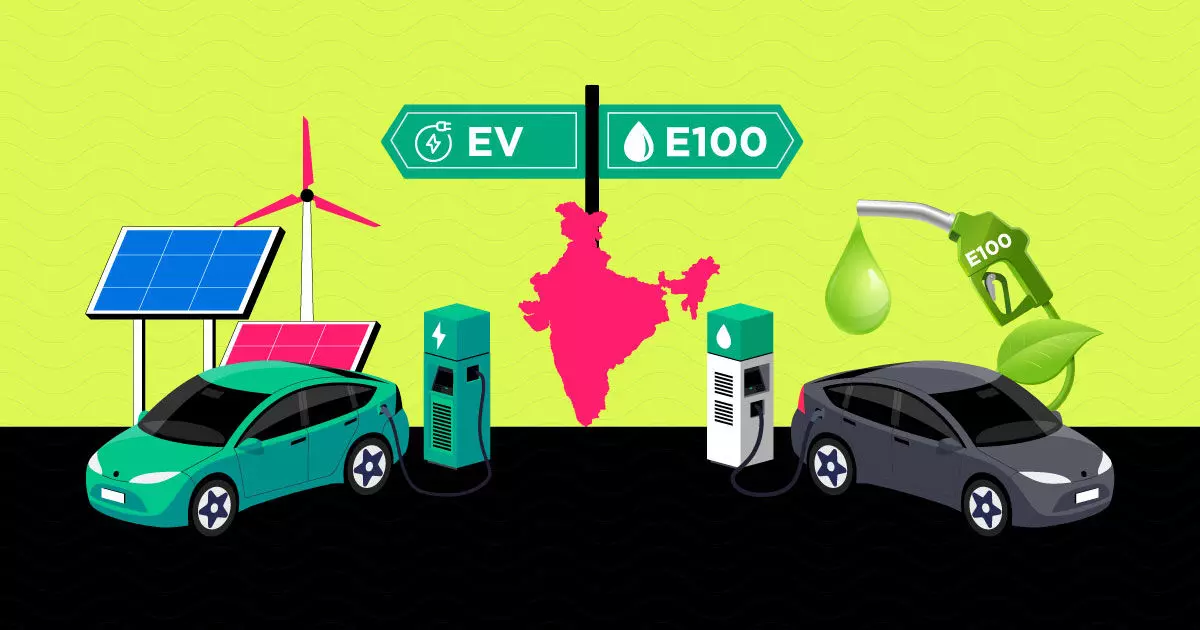
India's Push for E100 Risks Diluting EV Transition
 By Sanjay Dube
- Opinion
- Published on 21 Aug 2026 3:23 PM IST

India's parallel push for e-mobility and ethanol blending raises concerns over infrastructure, food security, and inconsistent policy direction.
The Gist
- The transport sector significantly contributes to petroleum consumption, necessitating alternative mobility solutions.
- Three main pathways include cleaner vehicle technologies, stricter fuel efficiency norms, and scrappage of old vehicles.
- However, fragmented policies may lead to regulatory uncertainty and inefficient investments without coordinated implementation.
Over the last decade, India has begun exploring multiple pathways to reduce crude oil dependency. The transport sector alone accounts for a significant share of India’s petroleum consumption, making it imperative for policymakers to pursue alternative mobility pathways.
However, parallel policies from electric mobility and ethanol blending to fuel efficiency standards risk creating fragmentation. Therefore, Ministries and departments entrusted with their implementation must be aligned in their vision and execution.
Without this, the market may face regulatory uncertainty, technology confusion, and inefficient investment allocation.
India’s Pathways Towards Reducing Oil Dependency
India is currently exploring three broad pathways to reduce crude oil dependency. The first focuses on cleaner vehicle technologies such as electric vehicles (EVs), strong hybrids, flex-fuel vehicles, and ethanol blends. The second pathway is tightening the Corporate Average Fuel Efficiency (CAFE) norms. The third pathway involves scrappage of old petrol and diesel vehicles significantly reducing fuel inefficiencies and improving air quality.
Beyond these, E100 is being proposed as a new mobility option.
The government’s objectives are clear: reduce crude oil imports, support domestic agriculture, create a market for surplus sugar production, and lower net carbon emissions. However, introducing E100 at scale may face distinct mechanical, practical, and economic challenges.
Will Dual Technology Pathways Benefit The Market?
Since 2015, India has shown a clear intent to transition to e-mobility via several policies and schemes. India’s combined public and private investments into the e-mobility ecosystem stand at about USD 26.6 billion. EV penetration has reached about 8.5% across segments and India aims to achieve 30% EV penetration across all vehicle segments by 2030.
India has also finalised its e-mobility R&D roadmap, prioritising the indigenous development of tropical EV batteries, power electronics, and charging hardware. India is also actively investing in alternative battery chemistries, domestic manufacturing capabilities, and supply chain diversification.
More recently, the Ministry of Petroleum and Natural Gas has been aggressively pursuing ethanol blending and plans to roll out about 5,000 E100 dispensing stations by late 2027. Therefore, India is advancing what can be described as a dual-path mobility transition.
On one side, national and state policies focus on large-scale electrification. On the other hand, they are working towards ethanol blending targets.
However, diluting the focus from an EV roadmap to E100 risks a paradoxical policy shift towards a completely different ICE ecosystem.
This sudden pivot raises concerns including vehicle compatibility, fuel efficiency reductions, infrastructure readiness, food v/s fuel dilemma, and regulatory contradictions.
What Will It Take To Introduce E100?
Ethanol has different chemical properties than petrol, including lower energy density and higher water absorption tendencies. Consequently, automakers would need to invest heavily in redesigning flex-fuel vehicle platforms for Indian climatic conditions, including specialised engine calibration, corrosion-resistant materials, modified fuel systems, and redesigned combustion management systems.
Scaling up E100 dispensing stations poses a key infrastructure challenge, as India lacks storage and fuel dispensing systems, safety and handling regulations (as of now, petroleum safety regulations are applicable with a few additions like anti-corrosive tank), fuel quality monitoring and requires dedicated logistics and transportation system to avoid disruptions.
Ethanol production economics also presents a challenge, remaining heavily linked to government incentives. Scaling E100 will require extensive fiscal support, stable procurement prices, and long-term purchase commitments to avoid market disruption.
A critical concern associated with large-scale E100 adoption is its impact on agriculture and water security.
India’s ethanol production is predominated by maize and sugarcane-based feedstocks. Expanding E100 targets could incentivise farmers to shift from food crops towards more profitable maize and sugarcane, leading to monocropping.
These crops also need high water and in higher proportions can deplete groundwater faster, creating agricultural water stress.
Therefore, without synchronised investments across fuel supply chains, vehicle manufacturing, consumer awareness, and the right policies and regulations, E100 adoption could have serious implications.
The E100 Strategy: Key Policy Questions
The E100 strategy raises several questions that require clarity from the government, including whether E100 is being positioned primarily as a renewable fuel for carbon reduction, what the long-term timelines for nationwide adoption would be, and how much budgetary allocation would be directed toward E100 infrastructure.
Equally important are what India’s sustainable ethanol production capacity actually is, and what safeguards exist for groundwater conservation and to mitigate food security risks.
The government’s stated aim is to reduce crude oil imports and emissions. While ethanol reduces carbon monoxide, non-methane hydrocarbons, and particulate soot emissions, it also introduces new concerns.
Technical evidence suggests ethanol combustion may increase Nitrogen oxide (NOx) (which are not captured under PUC currently), Acetaldehyde, and Carbonyl compounds 4, pollutants which are highly under-regulated in India.
Brazil, which has extensive ethanol usage, evolved sophisticated regulatory systems to monitor these emissions which India currently lacks.
Similarly, developed economies such as the United States and European Union typically restrict ethanol blending in fuels to around 15–20%, directing surplus toward industrial decarbonisation applications.
This raises a strategic question for India: Should ethanol primarily serve as a transitional transport fuel, or should it be prioritised as a decarbonisation resource while transport rapidly electrifies?
What's The Best Formula For Regulatory Alignment?
India’s pursuit of energy security places it at a critical juncture, triggering simultaneous investments in e-mobility, ethanol fuels, fuel efficiency standards, and connected transport systems. However, without clear medium- and long-term policy direction, the market faces uncertainty regarding which technologies will dominate.
E-mobility offers the clearest pathway for long-term crude oil independence. Scaling affordable BEVs across segments can deliver rapid oil displacement and should remain the central pillar of India’s transport decarbonisation strategy.
Ethanol may serve as a transitional solution where short-term BEV adoption is economically difficult. However, relying excessively on ethanol may delay India’s e-mobility transition and introduce food security, water stress, agricultural distortion, and emissions regulation challenges.
Ethanol should therefore be strategically deployed rather than universally promoted.
Lastly, CAFE norms must prioritise technologies and fuels that deliver the highest reduction in crude oil dependency. They can act as enabling frameworks only if supported by inter-ministerial coordination and long-term policy clarity.
India’s automobile transition must therefore move beyond fragmented technology promotion, towards a synchronised national mobility strategy balancing energy security, environmental sustainability, industrial competitiveness, and social resilience.
Core.
Core.


