



 Newsletter
 Search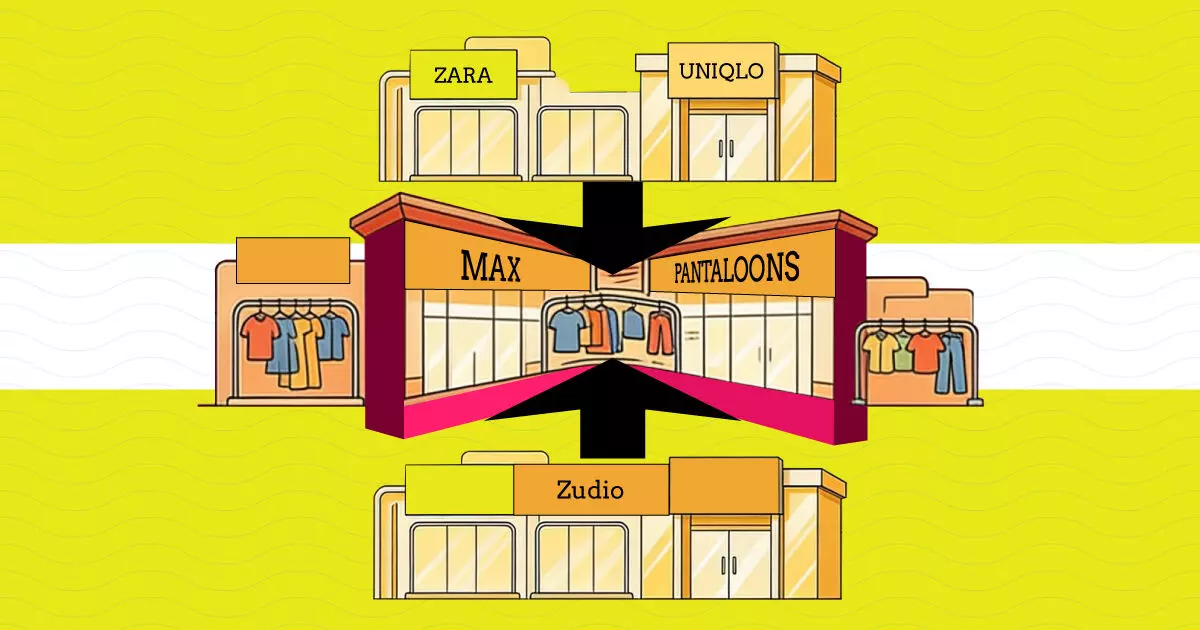
Stuck In The Middle: Fashion Brands Like Pantaloons And Max Are Facing An Identity Crisis
- Business
- Published on 9 Jun 2026 6:00 AM IST
As value retail charges ahead and aspirational brands pull consumers upward, retailers like Pantaloons and Max find themselves without a clear constituency.
The Gist
- Zudio's rapid expansion and appealing price points have disrupted the traditional customer flow from value to mid-market retailers.
- Retailers like Pantaloons report revenue growth but continue to face net losses, indicating deeper financial issues.
- Online platforms and D2C brands are increasingly catering to fashion-conscious consumers, leaving mid-segment retailers struggling to define their market positioning.
Walk into any Zudio showroom on a Saturday afternoon, and you will likely struggle to find a spot to stand. The racks are full, the queues at trial rooms are long, and the average bill is well under Rs 1,000.
Drive a few kilometres to the nearest Pantaloons or Max, and the mood is different, quieter floors, more space, and shelves that carry fashion that is not cheap, not premium, just somewhere in between. These are stores that earlier would have had the kind of crowd that is seen in Zudio now.
India's mid-segment fashion retail, the tier that includes Pantaloons, Max, Lifestyle, and their peers, has been caught in a squeeze for the better part of the last four to five years.
On one hand, value-fashion chains, led most aggressively by Zudio, have upgraded both their design language and store experience enough to draw away customers who once had no better option than the mid-market. On the other hand, international fast-fashion brands and a growing crop of direct-to-consumer labels have made it easier for aspirational shoppers to bypass the mid-segment altogether.
What remains is a shrinking centre and brands that have not yet figured out who, exactly, they are dressing.
The Numbers Tell Part of the Story
Aditya Birla Fashion and Retail Limited, which operates Pantaloons, reported FY26 consolidated revenue of Rs 8,177 crore, an 11% increase over the previous year. Pantaloons posted a 19% revenue jump in Q4 FY26, with 14% like-to-like growth, figures that, taken at face value, look healthy. These are ABFRL's consolidated figures spanning multiple businesses.
At the Pantaloons segment level specifically, the picture carries important nuance: Pantaloons generated full-year revenue of Rs 4,560 crore in FY26, and while its Q4 EBITDA margin of around 16% showed an improvement, the segment continued to post losses at the PAT level.
ABFRL's consolidated EBITDA for FY26 grew 28% to Rs 967 crore, a meaningful operational improvement, but the company's consolidated net loss for the full year widened to Rs 829.9 crore from Rs 455.8 crore in FY25, driven significantly by the cost of aggressive expansion and the scale-up of its OWND value-format. (FY25 figure is on a restated, comparable basis following the demerger of the Madura Fashion and Lifestyle business into Aditya Birla Lifestyle Brands Ltd.) Pantaloons ended FY26 with 399 stores, having opened four and closed eleven in the final quarter alone.
The picture looks broadly similar across the mid-segment peer group, suggesting this is a challenge for the entire segment rather than a Pantaloons-specific one.
Shoppers Stop reported FY26 consolidated gross revenue of Rs 6,057 crore, up 8% year-on-year yet the company posted a Q4 net loss of Rs 16 crore, against a profit of Rs 2 crore in the same quarter last year. Profitability remained elusive even as revenue grew. Max Fashion, part of the UAE-based Landmark Group, which operates over 535 stores across 200-plus Indian cities saw revenue climb, but the brand has been repositioning itself from "value" to "democratised fashion", an implicit acknowledgement that its existing positioning no longer fully resonates. Lifestyle International, also under Landmark Group, last publicly reported revenue of Rs 11,672 crore in FY23. Reliance Trends, part of Reliance Retail Ventures, sits inside a parent that crossed Rs 3.7 lakh crore in FY26 revenue, growth of 11.8%, but Reliance Retail does not break out Trends' standalone performance.
Across this cohort, profitability metrics are under pressure even where revenues are growing, a pattern consistent with a market that is competitive, margin-thin, and increasingly dependent on discounting to drive footfall.
The comparison with Trent is stark. Trent, which operates both Zudio and Westside, crossed Rs 20,074 crore in FY26 consolidated revenue, an 17% increase over the year before. Zudio ended the year with 963 stores across India and the UAE, adding 198 net stores during FY26. Westside, Trent's more mid-market format, which operates 300 stores, grew online revenue 25% in Q4 FY26 and was profitable, operating EBIT margin for Q4 FY26 was 11.5%, up from 9.7% a year earlier.
Unlike Pantaloons, Westside benefits from an almost entirely private-label model and a tighter, more curated merchandise mix that has given it cleaner positioning. Trent's consolidated Adjusted PAT for FY26 stood at Rs 1,741 crore, up 13% year-on-year, a profitable, expanding business at both ends of its format portfolio. That contrast with ABFRL's Rs 830 crore consolidated loss is sharp.
The value-fashion chain had already crossed $1 billion in annual revenues, and it is still expanding aggressively into new cities. The contrast between one format closing stores and another opening 109 (Zudio) in a single quarter tells much of the story.
Disruption From Below
To understand why mid-segment brands are under pressure, it helps to remember what India’s fashion market looked like a decade ago. At the lower end, you had large-format value retailers like Vishal Mega Mart and V2 Retail.
Their product was functional, the design language was basic, and their core customer was largely in the lower-middle class or from tier-2 and tier-3 cities. If you did not want to shop there, if you wanted something with a bit more design sensibility, Pantaloons or Max was where you went.
That trade-up path has been disrupted.
"What has happened is, the whole overall store ambience and visual merchandising at value retailers has significantly improved. The design element is also significantly better than what value retailers used to offer," said Rohit Bhatiani, an industry analyst who tracks the apparel sector. "And therefore, there is an appeal with younger consumers."
Zudio's rise is the clearest example of this. Unlike the older generation of value retailers, Zudio invested in store design, visual merchandising, and faster trend cycles.
Its sub-Rs 999 pricing and rapid merchandise turnover made it genuinely appealing to college-going shoppers who had previously reluctantly settled for whatever mid-market brands were offering. Bhatiani points out that much of Zudio's growth has been driven by people moving from unbranded to branded for the first time, customers who might otherwise have eventually graduated to a Pantaloons or a Max.
They didn't make that graduation. They stopped at Zudio.
"A lot of growth is driven by people who are moving from unbranded to branded. Potentially, players like Max or Pantaloons are caught somewhere in the middle. They're not exactly where Zudio is, and potentially they also don't have the aspirational value of what an H&M would have," Bhatiani says.
Hard evidence for this consumer migration is, admittedly, more anecdotal than empirical; no large-scale independent survey has yet directly and rigorously measured footfall transfers between mid-market and value formats. But the directional signals are consistent.
A Bain & Company report on how India shops online in 2025 identified Zudio specifically as one of the "trends-first" brands, alongside H&M and Zara, that have successfully offered a compelling proposition to Indian consumers, noting that online platforms like Flipkart Spoyl and Myntra Fwd are also actively competing for Gen Z fashion shoppers in the same space as mid-market incumbents.
When overall discretionary spending contracts, mid-market brands with less distinctive positioning tend to lose shoppers to both cheaper and more aspirational alternatives simultaneously.
The pattern is visible at the format level too: Pantaloons closed 11 stores in Q4 FY26 even as it opened four. Shoppers Stop's Q4 saw a Rs 16 crore loss despite its highest decade-level like-for-like growth. These are not brands in crisis, but they are brands whose store economics are under strain even in a period of revenue growth.
The Online Threat
A competitive force that gets less attention than Zudio in this narrative, but may be equally consequential, is the online fashion marketplace.
Myntra, Ajio, and Amazon Fashion together account for the bulk of India's approximately $60-billion e-retail GMV, with Myntra alone estimated to command over 50% of active online fashion shoppers.
These platforms have become powerful alternative shopping destinations for exactly the consumer that mid-market physical formats once owned: the aspirational, fashion-aware urban shopper who wants to spend Rs 800-2,000 on a piece of clothing and wants variety, convenience, and discounts. The compounding effect is significant in two ways.
First, Myntra and Ajio have built their own private labels, Myntra's Roadster and HRX, AJIO's Avaasa, that compete directly in the mid-market price band while benefiting from the platforms' marketing reach and pricing algorithms. Second, both platforms carry and actively promote the D2C brands that are eating into mid-market mindshare.
A young consumer shopping for occasion-wear need not walk into a Pantaloons today: Myntra or Ajio will show them Snitch, Rare Rabbit, or a dozen other brands at comparable or lower price points, delivered in 48 hours. India's online fashion penetration crossed 15% of total fashion retail sales by mid-2025, with Tier 2 and Tier 3 cities accounting for over 55% of new e-commerce fashion buyers, precisely the geography where mid-segment physical retail had hoped to find its next phase of growth.
The D2C Factor
Another category that is pulling away younger, brand-conscious shoppers who might have gone to mid-segment retailers for slightly more expensive occasions.
The D2C fashion boom has its roots in the pandemic. When physical retail shut down in 2020, a generation of young brands that had been slowly building social media followings and online-first supply chains found themselves with a sudden, massive addressable audience. Consumers who had never shopped for fashion online were forced onto apps.
New entrants who could operate without stores had a structural cost advantage. Investor attention followed: a report by PGA Labs and Knowledge Capital noted that $1.4 billion had flowed into Indian D2C companies between 2014 and 2020, with the pace of funding accelerating sharply through 2021 and 2022 as the pandemic validated the model.
Brands like Snitch, often described as one of India's fastest-scaling men's fast-fashion labels, built momentum through rapid weekly product drops, influencer marketing, and sharp social media presence.
They resonate with a Gen Z consumer in a way that Pantaloons, with its family-department-store legacy, struggles to replicate. Snitch can reportedly move a design from a social media trend to its warehouse in under 21 days. The broader D2C fashion space has drawn hundreds of crores in venture capital over the past three years, with Snitch alone closing a $40 million Series B in June 2025.
For a young consumer who wants to spend a little more than Zudio prices but is not ready for an H&M or Zara bill, the D2C market now offers dozens of options, each with its own aesthetic, community, and influencer ecosystem.
"If I look at a college-going kid, they are either looking at a fairly value option like Zudio, or there are a lot of D2C brands that are able to resonate much better with the younger audience if they want to spend more," Bhatiani said. "In between these cool-looking D2C brands and value-oriented formats, these mid-market formats are really stuck. Who do they really appeal to?"
How International Brands Became Mainstream
A third competitive layer, one that was easier to dismiss a decade ago, is the expanding footprint of international fast-fashion brands. Zara entered India in May 2010 through a joint venture with the Tata Group, opening its first store at Select City Walk mall in New Delhi, a flagship in a premium location accessible to a small, affluent urban elite. H&M followed in 2015, initially rolling out in metro markets and major malls. For much of the early 2010s, these brands were aspirational but effectively inaccessible to most mid-market shoppers: few stores, premium mall locations, and pricing that was noticeably higher than Pantaloons or Max. That has changed materially.
H&M now operates 70 stores across India, reaching cities like Jodhpur and Mohali that would have been unthinkable as targets a decade ago. It launched products on Myntra in 2019 and has been available online ever since. Zara operates around 22-23 stores across 12 cities, with an active online platform offering in-store pickup and two-hour delivery.
What was once a Delhi-Mumbai luxury has become, for a significant and growing segment of urban India, a broadly accessible choice. H&M India also now sells under Rs 1,000 for many items, overlapping directly with the pricing architecture of mid-market incumbents.
The Supply Side Is Feeling It Too
The squeeze has travelled back through the supply chain, too.
Rahul Mehta, Chief Mentor of the Clothing Manufacturers Association of India (CMAI), said orders from mid-segment retailers have been getting smaller, driven by subdued retail sales, the inability of brands to cope with longer credit periods, and margins that have thinned enough to make the business model less attractive for manufacturers. "Increasing competition resulting in lower margins makes it a not too attractive business model.”
Rising fabric and production costs have compounded the problem. Mehta says garment manufacturers are being hurt by the combination of higher input costs and slow retail movement, with long credit periods from retailers adding to the strain.
Smaller, more nimble regional brands are responding by focusing on faster design cycles and closer-to-season production, moving new collections from factory to store in 30 to 45 days. Larger mid-segment retailers, with their more rigid buying calendars, are less able to match that speed.
An Identity Problem
Shoppers are no longer relying on a single mid-market retailer for all their apparel needs. Vinit Bolinjkar, Head of Equity Research at Ventura Securities, said, "The traditional model of broad multi-brand department retailing supported by heavy discounting is steadily weakening as consumers increasingly prefer either strong value or differentiated fashion positioning.”
The consumer loyalty that brands like Pantaloons once relied on has, in his assessment, fragmented significantly. Spending has become category-specific and occasion-driven: basics go to Zudio, festive or office wear goes to a premium or niche label, and mid-segment brands are left with neither a clear stronghold nor a clear identity.
This is an identity problem as much as a competitive one. For decades, mid-segment brands served a clear, aspirational need for a customer who had graduated from pure-value retail and could not yet afford or access premium international brands.
That customer still exists, but the options available to them have multiplied.
What Would It Take to Turn Around?
ABFRL launched OWND, a Gen Z-focused value-fashion concept, in 2025 by converting its StyleUp network, with plans to scale aggressively. The format, which now has 79 stores, is a direct acknowledgement that the company needs a sharper answer to Zudio's appeal.
Pantaloons has also refreshed stores and strengthened its omnichannel presence, with e-commerce growing over 30% in FY26.
Bolinjkar said the most important strategic shift for mid-segment retailers is moving from broad-based merchandising toward targeted sub-segments, youth fashion, affordable occasion wear, or value-driven casualwear, with faster inventory cycles and tighter demand forecasting to reduce their dependence on discounting.
Private labels, he argued, remain the most viable long-term lever. Max has historically operated with an almost entirely in-house private-label model, giving it better margin control than brands dependent on third-party labels. Trent, too, has repeatedly cited private labels as a driver of both profitability and inventory efficiency. Westside's stable gross margin profile, even through aggressive expansion, reflects the benefit of this model: Trent's gross margins across Westside and Zudio held steady in FY26 even as the company added 272 net stores.
On the manufacturing side, Mehta said smaller brands are already demonstrating what is possible. "Smaller brands are far more nimble and able to respond much faster to consumer tastes. Many of these mid-level brands also have their own manufacturing units. As a result, their production planning works on a much shorter cycle — resulting in new designs hitting the market in 30 to 45 days."
The larger mid-segment retailers have not yet matched that speed, and in a market where Zudio is refreshing its merchandise rapidly and D2C brands are dropping new styles every week, that lag is costly.
India's fashion retail market, valued at $115.5 billion in 2025, is projected to reach $218.4 billion by 2032, growing at a CAGR of 9.6%. Within that, the premium and bridge-to-luxury segment is expected to grow at 12% to 15% annually, outpacing the mass market. The growth is real. The mid-segment simply is not where most of it is landing.
Digital discovery, Instagram, marketplaces, and influencer recommendations are increasingly shaping customer preference, and mid-segment brands have been slower to build that kind of cultural presence.
"The challenge is less about demand destruction and more about relevance," Bolinjkar said.
Bhatiani says, "From premium to the mass end, any brand will have to really think about what need and what consumer they are catering to. A lot of these brands need to think about what they stand for."
Core.
Core.


