



 Newsletter
 Search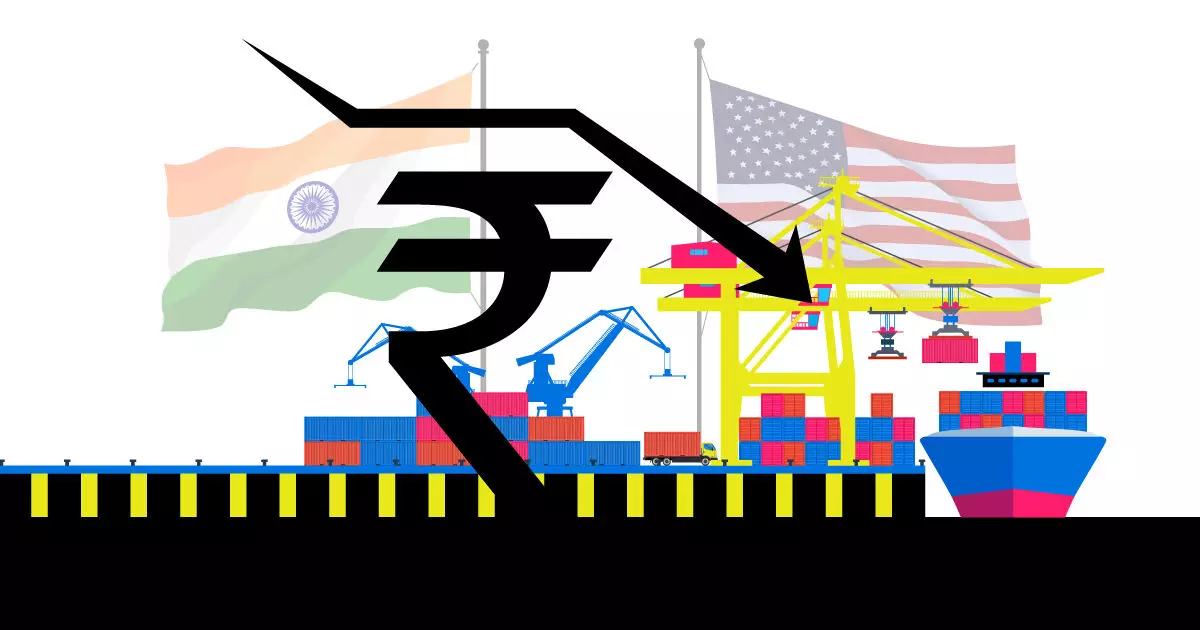
Why Is India Committing To Massive US Purchases For A Trade Deal That No Longer Exists?
- The Take
- Published on 25 May 2026 1:17 PM IST

Capital is fleeing India. The rupee is sinking. And New Delhi just promised Washington $500 billion it has no reason to spend.
The Gist
India's commitment to purchasing $500 billion in US goods during a time of declining foreign investment raises questions about its economic priorities.
- India's net FDI has dried up since 2024, highlighting a need for structural changes to attract capital.
- The economic rationale for the $500 billion deal collapsed after the US Supreme Court's tariff ruling.
- India must prioritise its own economic interests and focus on attracting foreign capital rather than acting as a major US customer.
It is fast resembling the theatre of the absurd.
As the Indian rupee scrambles to avoid hitting the century mark against the US dollar — a milestone that is excellent for a batsman at the crease but dismal for the optics of an emerging economy — New Delhi is sending baffling signals to global markets.
Over the last 18 months, foreign portfolio investors have pulled close to $50 billion out of Indian equities.
Net foreign direct investment (FDI) has slowed to a trickle. Yet, amid this capital drought, India has somehow committed to investing a staggering $500 billion into just one country: the United States.
At a moment when India should be aggressively signaling its desire to attract foreign capital, it is effectively declaring, via visiting US Secretary of State Marco Rubio this time, that it is here to dispense it.
The Capital Flight Reality
To understand the problem with this posture, look at India's balance sheet.
A collapse in FDI is at the heart of the country's capital flow story.
As economist Sajid Chinoy recently noted, net FDI, which historically averaged 1.5% of GDP, has completely dried up since 2024.
Between 2010 and 2025, India’s net FDI has been heavily correlated with US’ 10-Year Treasuries, acting as a proxy for global financial conditions.
When global yields are low, India receives a gush of capital; when yields harden, that capital vanishes.
In other words, India's FDI is currently governed by global "push" factors rather than domestic "pull" factors. The last time India generated its own pull was during the strong corporate capex cycle of 2005 to 2010.
Contrast this with Vietnam, which has consistently managed to attract FDI above 4% of its GDP, entirely agnostic of global financial weather.
India urgently needs to rebuild this kind of structural magnetism. Instead, it seems to be playing geopolitical philanthropist !
A Deal Devoid Of Logic
This brings us to Rubio’s visit and the heralded Indian commitment to purchase $500 billion worth of American energy, technology, and agricultural goods over the next five years.
The glaring problem?
The underlying economic logic for this spending spree has already collapsed.
A recent note from Ajay Srivastava at the Global Trade Research Institute (GTRI) details why this commitment may never, and should never, materialise.
The $500 billion purchase plan was originally baked into the February 6, 2026, India–US Joint Statement. It was part of a Bilateral Trade Agreement (BTA) framework in which Washington agreed to reduce reciprocal tariffs on Indian exports from 25% down to 18%.
But on February 20, the US Supreme Court struck down the legal basis for those reciprocal tariffs, effectively nullifying the economic rationale of the entire BTA.
Following the ruling, the Trump administration slapped a uniform 10% tariff on all countries under Section 122.
The math is now starkly simple: If India receives the exact same 10% tariff treatment regardless of whether it offers sweeping concessions on market access, digital trade, and agriculture, what exactly is it buying for $500 billion?
The commercial rationale is dead, yet New Delhi remains inexplicably silent.
India Must Put Itself First
Other nations have recognised the shifting reality and acted accordingly.
On March 15, Malaysia boldly walked away from its own trade agreement with the US after initially accepting a negotiated 19% tariff rate in exchange for market concessions.
Once the uniform 10% tariff was applied globally, Kuala Lumpur rightly declared its agreement "null and void."
India should take notes.
Sourcing $500 billion in American goods is not just a logistical nightmare but a strategic mis-step. We could, theoretically, buy fleets of Boeing aircraft, though it would be interesting to see how Airbus would compare (on price terms) following an impending free trade agreement with the European Union where the aircraft is made.
Outbound investment is a natural and desirable consequence of globalised business, and Indian corporations must inevitably expand overseas for market access and technological gains.
But sovereign signaling matters.
Right now, India needs capital to come in.
This isn't a quick fix to arrest the depreciation of the rupee, but a structural necessity. The country needs technology, capital, and world-class businesses to set up shop and grow domestically.
Secretary Rubio is welcome to visit, survey the market, and announce deals. But New Delhi must look out for its own economic interests.
And right now, those interests do not converge on acting as America's half-trillion-dollar customer.
Core.
Core.


