



 Newsletter
 Search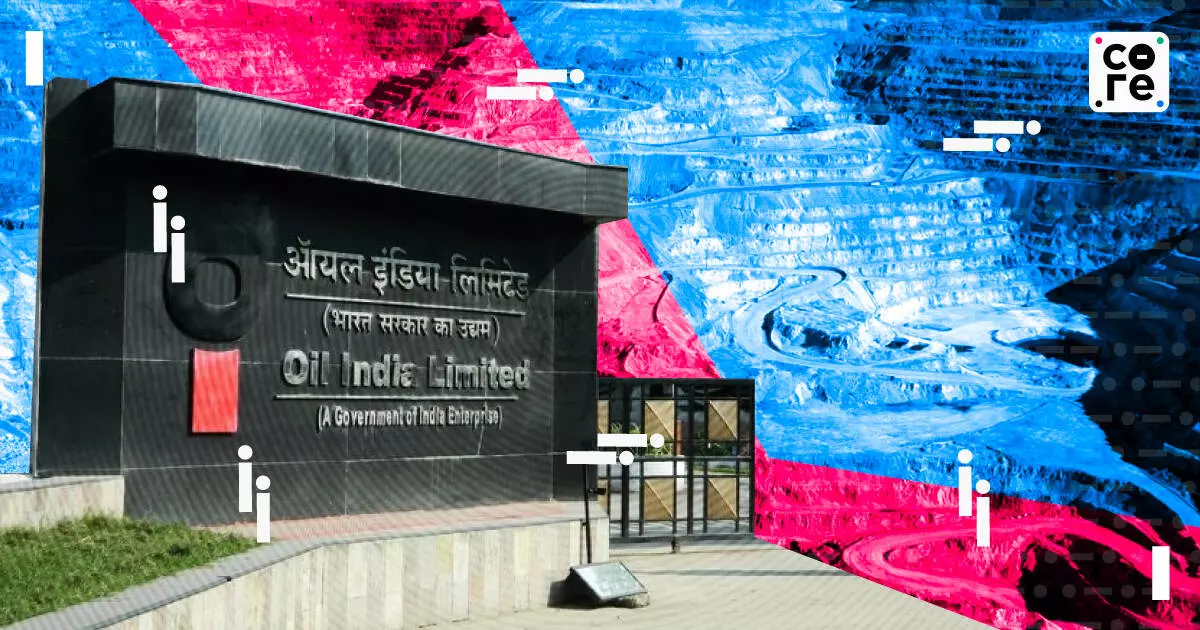
Rare Earths Become Oil India’s New Strategic Frontier As China Risk Grows
- Economy
- Published on 24 Jan 2026 6:00 AM IST

Under the National Critical Mineral Mission, the company is leveraging its existing subsurface expertise to secure resources vital for India’s defence, space, and green energy sectors.
The Gist
Oil India Ltd (OIL) is diversifying into critical minerals to reduce dependence on Chinese exports, aligning with India's National Critical Mineral Mission.
- OIL has shortlisted eight critical minerals for exploration, leveraging its subsurface expertise.
- Exploratory blocks include graphite and vanadium in Arunachal Pradesh, and potash in Rajasthan.
- The shift from bulk to rare earth minerals reflects a strategic government push for enhanced exploration and processing technology.
Critical minerals have that name because, well, they are critical to different sectors, be it health, mobility or communication. In the face of China blocking the export of these minerals, the government is looking to cut dependence.
Oil India Ltd (OIL) is aggressively diversifying its portfolio into critical minerals, marking a strategic shift for the state-run explorer as the Indian government seeks to insulate its supply chain from Chinese export restrictions.
Under the National Critical Mineral Mission, the company has shortlisted eight out of 24 identified critical minerals for exploration, leveraging its existing subsurface expertise to secure resources vital for India’s defence, space, and green energy sectors.
"As we do exploration for oil and gas, we saw that the same exists for critical minerals, a select few. So, out of the identified 24, we have shortlisted about eight. And basis, we also had another shortlisting parameter, we said wherever we have our area of operation. So, as we speak, we have got two exploratory blocks, it's in composite licence mode, unlike the oil and gas block," said Dr Ranjit Rath, chairman and managing director of Oil India told The Core as part of the Indian Energy Week.
One of the blocks of graphite and vanadium is located in Arunachal Pradesh, near Itanagar and holds about 5 million metric tonne of reserves of graphite and 5 million metric tons of vanadium.
Oil India is also exploring a potash block in Rajasthan that holds around 25 to 26 million metric tonnes of potash.
Strategy Shift
While India's focus was earlier on the exploration of bulk minerals, such as limestones, bauxites, iron ores and hydrothermal minerals like copper, lead, zinc and black, the focus has now shifted to rare earths.
"There is a concept called obvious geological potential areas with GSI (Geological Survey of India) maps. That mapping has already been done. There is a significant thrust from the government of India as a two-pronged strategy. One is enhanced exploration, per se," said Rath.
Oil India and other entities, such as the GSI and Coal India, are carrying out this exploration. The second is for processing these minerals.
"Significant thrust is underway to acquire processing technology and also to encourage both the private sector and the public sector and the research organisations," Rath said.
Global Ambitions And Hydrocarbon Resilience
Beyond domestic borders, OIL is scouting for lithium and other critical assets in Australia, Africa, and the "ABC" lithium brine region (Argentina, Bolivia, and Chile) through Kabil, a joint venture with the Ministry of Mines.
Despite the pivot to minerals, OIL is simultaneously scaling its hydrocarbon operations. The company reported its highest-ever production of 6.71 MMT of oil and gas equivalent in the 2024-25 fiscal year. It plans to drill 80 wells this year, increasing to 100 wells next year.
In partnership with Total Energies, OIL is pushing into deepwater frontiers. The company recently established the presence of a functional petroleum system in the Andaman Nicobar basin. Upcoming projects include a 6,000-meter target in the Kerala Konkan basin — potentially the deepest offshore well in the region — and a 6,500-meter well in Assam.
“One thing that we have established by virtue of this reported occurrence that petroleum system exists in Andaman Nicobar basin. And that's our achievement or an accomplishment,” Rath said.
Downstream and Renewable Integration
The company’s downstream arm, Numaligarh Refinery (NRL) in Assam is undergoing a capacity expansion from 3 MMT to 9 MMT, supported by a new 1,640-kilometre pipeline from Paradip.
Diversification efforts also include a world-first bamboo-based feedstock plant for 2G ethanol and a new 360 kTPA polypropylene unit, as the company seeks to enhance its petrochemical intensity index amid volatile global oil prices.
Core.
Core.


