



 Newsletter
 Search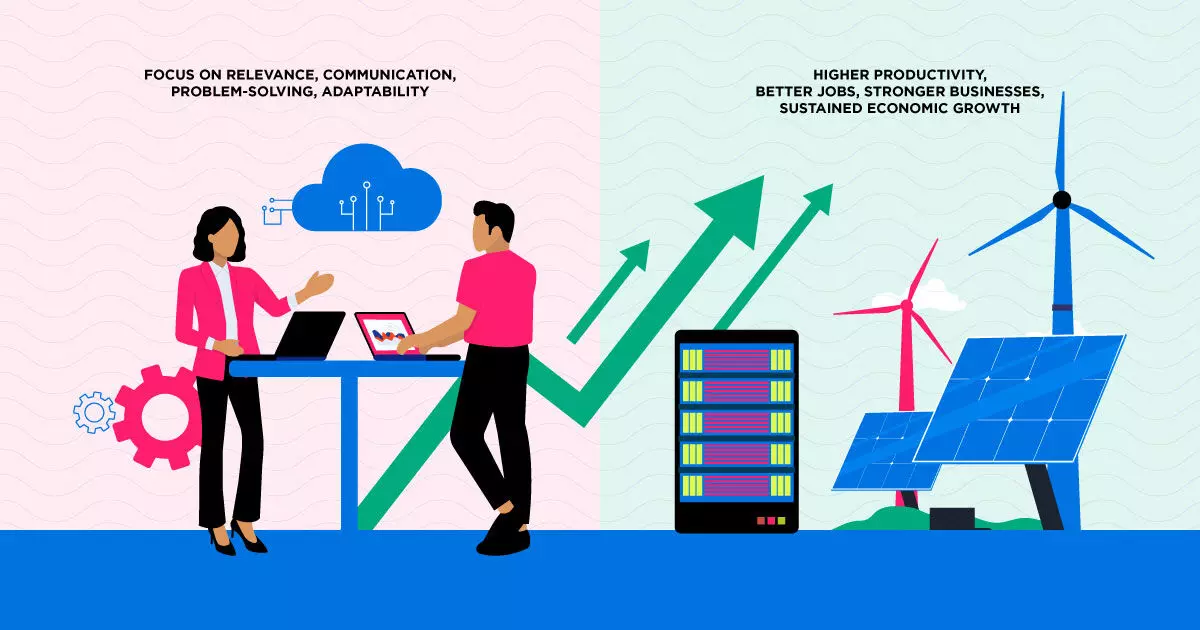
India's Skilling Story Needs A Productivity Chapter
 By Vikram Kumar
- Economy
- Published on 21 Aug 2026 11:00 AM IST

Millions have been trained. The next question is whether that training is actually making businesses and workers more productive
The Gist
- The focus has shifted from merely training individuals to ensuring skills translate into productivity and economic growth.
- Recent initiatives emphasize employment outcomes, industry participation, and quality certifications.
- Despite progress, a significant gap in workplace readiness remains, necessitating a stronger collaboration between industry and educational institutions.
India's workforce story has, for years, been rightly centred on one objective: equipping more people with skills. Through initiatives like Skill India, the country has expanded vocational training, strengthened industry partnerships, and created opportunities for millions of young people to improve their employability. This focus on scale was necessary and timely.
Today, India's aspirations have evolved. As the country pushes to become a global manufacturing hub, accelerate digital transformation, and lead the transition to a greener economy, the question is no longer just how many people have been trained. It is whether those skills are translating into higher productivity, better jobs, stronger businesses, and sustained economic growth.
Manufacturing grew 7.72% in the first quarter and 9.13% in the second quarter of FY 2025-26. Medium and high-technology industries now account for nearly half of the country's manufacturing value added. These sectors demand workers who can operate advanced machinery, adapt to new technologies, and contribute to continuous improvements on the shop floor. Success, therefore, cannot be measured by enrolments and certifications alone. It must be measured by the value people create once they enter the workforce.
Bridging The Gap Between Skills And Workplace Productivity
India has made real progress in strengthening its skilling ecosystem. Recent initiatives have placed greater emphasis on employment outcomes, apprenticeships, industry participation, and certification quality. Digital platforms are helping connect learners with employers while enabling better tracking of outcomes — a shift from measuring activity to measuring impact.
But one challenge persists.
The gap between education, training, and workplace readiness remains significant. The India Graduate Skills Index 2025 found that only 42.6% of graduates were considered employable in 2024, with employers continuing to report gaps in communication, critical thinking, creativity, and problem-solving.
A certificate may secure an interview. It does not guarantee workplace readiness. Many employers still invest considerable time helping new recruits adapt before they can contribute effectively. In an economy under constant pressure to improve quality, adopt new technologies, and stay globally competitive, that transition period directly affects productivity.
Experience across workforce development initiatives shows learners succeed not simply because they acquire technical skills, but because they develop workplace behaviours: communication, adaptability, digital confidence, problem-solving, and the ability to learn continuously. These capabilities let them contribute from day one, and increasingly determine productivity in modern workplaces.
The challenge, then, is no longer one of quantity. It is one of relevance. Training must be designed around the needs of industries, not simply around how many people can be enrolled.
Building A Workforce That Drives Competitiveness
The Union Budget 2026-27 reflects this shift in priorities. Alongside a higher allocation of nearly ₹9,886 crore for the Ministry of Skill Development and Entrepreneurship, the government has announced investments to modernise Industrial Training Institutes under PM-SETU, strengthen manufacturing across strategic sectors, and support small and medium enterprises. These measures recognise that building a globally competitive manufacturing base requires not just capital investment, but a workforce that can use new technologies efficiently and adapt to changing production systems.
Policy, however, can only create an enabling environment.
Industry must play a much larger role in shaping what is taught and how it is taught. Businesses are often the first to spot changing skill requirements — in automation, artificial intelligence, clean energy, or advanced manufacturing. Their participation in curriculum design, apprenticeships, and workplace-based learning is essential if training is to stay relevant.
Productivity also depends on more than technical expertise. As automation takes over routine tasks, employers increasingly value workers who can solve problems, communicate effectively, collaborate in teams, and adapt to changing roles. These are no longer complementary skills. They are now central to workplace performance.
India has already shown it can scale skill development. Under PMKVY 4.0 alone, more than 27 lakh candidates have been trained across 38 sectors and hundreds of districts. That is a strong foundation. The next challenge is ensuring these investments translate into measurable gains in productivity, innovation, and competitiveness — not just employment numbers.
As India moves closer to its vision of becoming a developed economy, the way it evaluates workforce development must evolve too. The number of people trained will always matter, but it cannot be the final measure of success. The real question is whether those skills let workers create greater value, businesses compete more effectively, and the economy grow stronger.
India has already proved it can build scale. The next frontier is building productivity. Only then will skill development fulfil its true purpose — not simply as a pathway to employment, but as a driver of innovation, competitiveness, and inclusive economic growth.
Core.
Core.


