



 Newsletter
 Search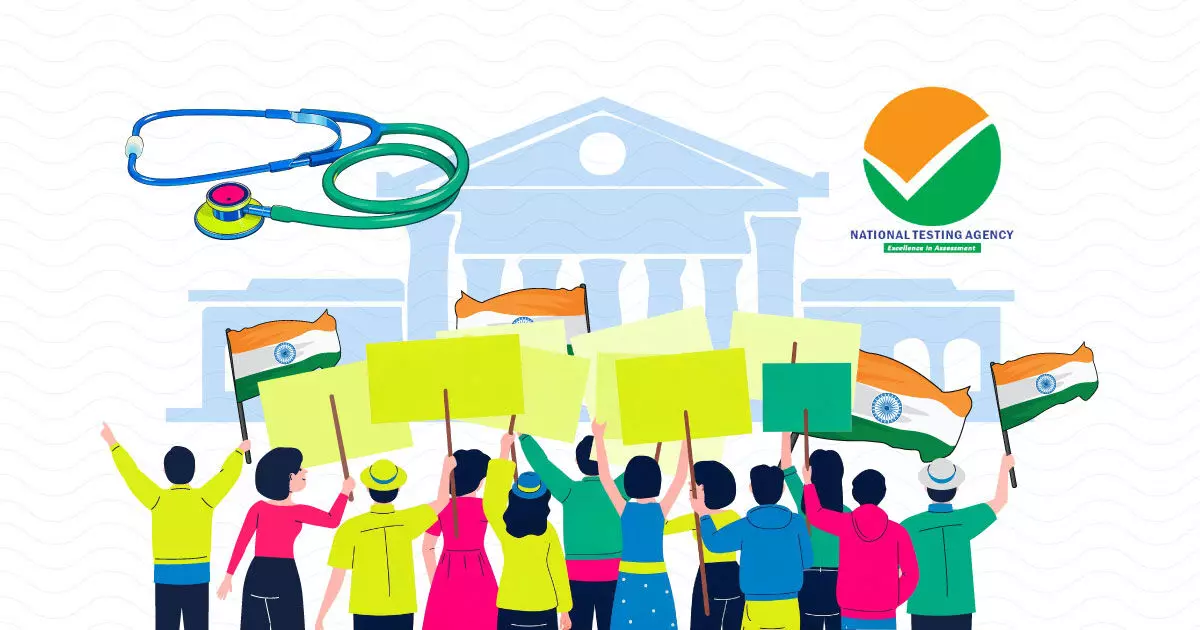
India’s Education Crisis Demands Imagination Beyond The Exam Factory
- The Take
- Published on 27 July 2026 12:04 PM IST
Beyond leaked papers and bureaucratic fixes, India's education crisis demands the kind of bold institutional imagination that Ukraine has shown even amid war.
The Gist
- Widespread leaks led to the postponement of a crucial medical entrance exam.
- Reports suggest 10 to 20 student suicides linked to the exam crisis.
- The government faces criticism for a flawed education system that places immense pressure on students.
India’s education minister has resigned, a key demand of student demonstrators across India who called for his head after widespread paper leaks forced the postponement of a key medical entrance exam and, far more tragically, drove many young applicants to suicide.
Unconfirmed reports put the death toll between 10 and 20.
But even if a single student has died by suicide in this context, it should make those directing education policy hang their heads in shame.
Because there is profound cruelty in a system where a teenager feels a lifetime of opportunity has been destroyed by missing or being unable to sit for one entrance exam.
The Scarcity Trap
The odds are never favourable.
Some 2.2 million students sat for the National Eligibility cum Entrance Test (NEET) for medical seats in May, only for the government to cancel the results after it transpired that the papers had leaked.
Students who endured the agonising preparation for the first exam were forced to pick up their textbooks again for a retake in June.
Of the 2 million who appeared, only about 5% were selected for 139,489 medical seats. Some 35,000 head overseas, mostly to former Soviet republics, the Philippines, or Bangladesh.
Even to return and work as doctors in India, they must clear the NEET cutoff, The Print Editor Shekhar Gupta pointed out in his National Interest column, underlining the severe supply-side problem.
Millions of others endure similar panics for engineering colleges and the Common University Entrance Test (CUET), a standardised exam designed to level the field across state and national school boards.
The question we must ask is: for what ?
Setting medicine aside, what does a student who beats the odds and hits the jackpot actually achieve compared to someone who misses out?
This is a perennial question, but it commands far greater weight in 2026, at a time when artificial intelligence is rewriting the rules of the job market.
The leaks and street protests of course reflect a much larger set of anxieties and disillusionment, including a total lack of visibility into future careers and proper jobs.
And a sense that the Government of the day was not being accountable on the failure of the system.
More Laws Are Barking Up The Wrong Tree
The solutions offered right now are predictably bureaucratic, including harsher punishments for test-leakers, new oversight committees, and more state nominees to run them.
The Government has also announced a new task force for exams headed by Infosys founder Nandan Nilekani.
Or go back to the old way, which is leave it to the states to run admissions, which had its own set of problems.
But creating new laws distracts from the central question and a clear definition of the problem.
If the state’s objective is to give young citizens a clear, tangible path to a bright future, rather than subject them to endless promises funnelled via social media, then these are clearly not the solutions.
I do not pretend to have all the answers.
But a recent, momentary encounter with Anna Novosad, Ukraine’s former Minister of Education and Science, highlighted what is possible when imagination is put to work.
Lessons In Institutional Imagination
Novosad, who spent two years in her role as Minister, returned to capital Kyiv from a fellowship overseas when Russia launched its full-scale invasion in February 2022.
Moved by the devastation of schools by bombing, which she noted the Russians target to inflict civilisational damage on her society, she co-founded a non profit called savEd.
Children in war-torn communities lose the shared spaces critical for in-person learning and human connection, so savEd started conducting engineering assessments and began rebuilding damaged schools.
More fascinatingly, it began renovating bomb shelters and basements into modern underground learning centers equipped with ventilation, heating, generators, and books.
With the look and colorful feel that a child’s classroom should have.
SavEd is also constructing modular classrooms inside clinics and cultural centers as a fast-response alternative. SavEd operates 160 such centers today.
An initiative like savEd stands out for its sheer imagination and clarity of purpose.
Which is to protect Ukraine’s children and preserve their learning journeys at a time of war and incessant shelling.
Are we clear about what or how we want to protect the future of our youth? Maybe, but more in a general sense it would appear.
India needs far greater imagination and clarity in approach when it comes to writing education policies for this era.
And for those who do not remember, over 18,000 Indian students were studying medicine in Ukraine when the invasion began in 2022 and were evacuated back home.
Many have returned since.
Core.
Core.


