



 Newsletter
 Search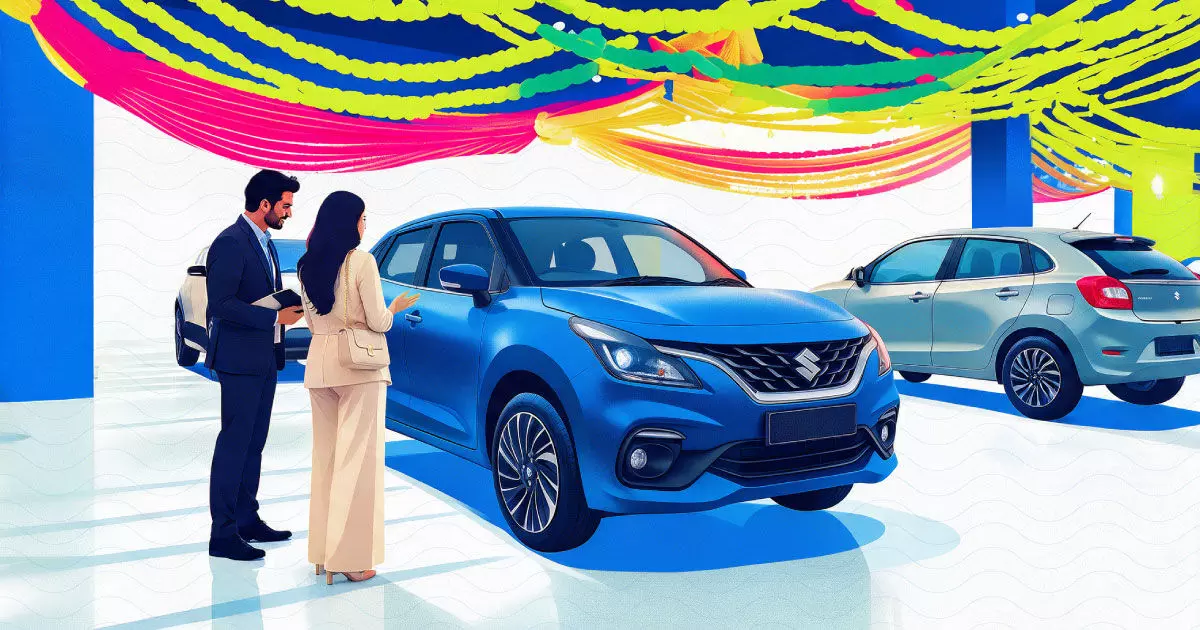
Festive Demand To Lift India’s Car Market, But Global Risks Linger
- Economy
- Published on 15 Sept 2026 6:00 AM IST

As passenger vehicle sales are set to cross 5 million units this year, crude-led inflation and input cost pressures call for a closer look.
India’s auto industry is gearing up for the festive season with optimism, as customers prepare to spend, dealers stock up, and manufacturers ramp up supplies in anticipation of strong demand.
Festivities are just around the corner, with Ganesh Chaturthi giving way to Navratri, Durga Puja and Dussehra in October, followed by Dhanteras and Diwali in November. The festive season typically accounts for 30% to 40% of annual passenger vehicle sales in India, making it a crucial period for this sector.
“This should be a bumper festive season,” Sai Giridhar, President of the Federation of Automobile Dealers Associations (FADA), told The Core. For him, the setup for this year's festive window looks favourable.
Aided by a steady repo rate following the successive cuts last year by India’s central bank, the Reserve Bank of India, interest rates are also stable on auto loans and EMIs.
According to a market research report from IMARC Group, India's car loan market grew from $41.51 billion in 2025 to $44.42 billion in 2026. Growth is being driven by rising vehicle ownership aspirations, expanding middle-class incomes, digital lending adoption, and increasingly competitive offerings from banks and NBFCs.
Yet, even as domestic demand remains promising on all measures, the industry is entering the season with certain factors that could dampen the sentiment. The ongoing West Asia crisis, input cost pressures, and volatile crude prices threaten to cloud the momentum ahead.
All Ingredients In Right Place
Last year on August 15, Prime Minister Narendra Modi announced that GST rates would be lowered by the festive season, in an effort to ease affordability pressures and boost demand.
As a result, many prospective vehicle buyers held off on purchases through August and into September, waiting for the reduced rates to be implemented before making their move. The cuts finally came on September 22, when Navratri had begun and Ganesh Chaturthi had passed.
The rate on small cars was reduced from 28% to a flat 18%, and the compensation cess was removed.
With the festive season starting much earlier in 2025 and the GST rate cuts coming only in September, the sales volume surge came only after the GST rate cuts were implemented. The industry also temporarily faced some logistical challenges.
Consumers increasingly began preferring vehicle delivery at specific festive occasions, and automakers struggled to meet delivery timelines. There were initial constraints on trailer availability, prompting automakers to work on improving dispatches to their dealer networks.
However, Giridhar pointed out that this year, OEMs are more prepared, with availability expected to be in place. Dealers’ stock holdings are at around 38-40 days.
"This time around, the OEMs are more prepared. The availability would be there," he said, adding that the passenger vehicle segment is on track to cross 5 million units this calendar year for the first time in Indian auto history. In 2025, the industry recorded 4.47 million units, marking a 10% year-on-year growth.
It is a milestone that he expects the industry to "hopefully" breach as double-digit, record-breaking growth continues.
Similarly, Puneet Gupta, Director at Mobility Global, expects the industry to have a “strong festive season.”
“India’s passenger vehicle market is on track to post around 14% growth in calendar year 2026,” he told The Core.
Notably, sales growth has averaged 20% year-on-year during the first seven months of 2026, following a subdued first half of 2025 that picked up only after the GST cuts were announced in September.
Industry expert Arun Malhotra called the auto sector the "star performer" on this front. Unlike FMCG, consumer goods, and other industries, auto has been among the biggest beneficiaries of the GST cuts, sustaining strong momentum in their wake.
A Pinch Of Salt
Experts caution that year-on-year comparisons for this year's festive season could be misleading.
Many customers deferred purchases last year until the GST cut kicked in, and the 2025 festive season itself was concentrated in September and October, without spilling into November, thereby skewing the base for comparison.
Giridhar added that a more meaningful indicator of demand would be the industry's ability to convert showroom enquiries into actual sales during the peak festive months. "The true test of the season lies in showroom conversion through September to November, not in year-on-year optics," he said.
Gupta said growth is likely to moderate in the coming months as the market begins to lap the strong base created last year following the GST rate cuts.
“Growth could slip into lower single digits over the next four months, even as volumes continue to rise,” he said.
For the full financial year ending March 2027, Maruti Suzuki is projecting around 10% growth for the Indian passenger vehicle industry.
Speaking at a media call recently, Partho Banerjee, Senior Executive Officer for Marketing & Sales at Maruti Suzuki, said the industry is currently averaging 4.5 lakh units a month and is on course to hit 5.3- 5.4 million units for the full financial year, up from roughly 4.8 million last year.
Maruti, which has one of the widest portfolios of small cars in the market, said it has seen strong demand for the segment, particularly since the GST cut. Banerjee expects this momentum to sustain through the festive season, and beyond.
Malhotra noted that this festive season, the domestic market has every positive factor working in its favour. The only real risk, if any, will come from external factors.
Nagging Geopolitical Issues
Looming over the optimism are the geopolitical risks to industry’s post-festive season growth. Benchmark Brent crude futures breached $100 a barrel last week for the first time since July 24, hitting a six-week high amid intensifying conflict in West Asia.
Should the government pass on rising fuel costs to consumers, experts warn, it could dampen sentiment sharply as inflation tends to push big-ticket vehicle purchases down the priority list behind basic needs.
The biggest risk to demand is a potential pass-through of higher fuel prices, according to Gupta. “Rising fuel costs could add to inflationary pressures, making consumers more cautious about big-ticket purchases and encouraging some buyers to trade down to more affordable vehicles.”
The cost pressures are also building on the supply side, and are becoming harder for the industry to absorb frequently.
The West Asia war, which began in late February and shows no signs of slowing down, has pushed up input costs across the supply chain, and manufacturers have so far only partially passed these on to buyers.
Every carmaker, including Maruti Suzuki, Hyundai, Tata Motors, Mahindra, and Kia, has announced multiple price hikes in the last few months. Most recently, Maruti has raised prices on select models by up to Rs 20,000 in September. And this is the company’s third hike since May, though unlike the previous two, this one will not be applied across the entire portfolio.
Fuel Choices Are Shifting Too
For the first time in India's history, alternative fuels, including CNG, hybrid and electric combined, have overtaken petrol in the passenger vehicle retail market, accounting for almost 42% of sales against petrol's 41%. Just over a year ago, petrol led this contest by nearly eleven percentage points, according to FADA.
Experts suggest that while petrol will continue to account for a significant share of the market, its dominance is likely to continue to weaken. From April 2027, the mandated Corporate Average Fuel Efficiency (CAFE-III) norms will come into force, pushing automakers towards cleaner technologies and further diversifying the industry’s fuel mix.
The shift is also being supported by a wider choice of alternative fuel models in the market. Automakers that previously did not have hybrid offerings are now introducing them ahead of the festive season. Kia has launched the Sorento Hybrid, while Renault is set to introduce a hybrid version of the Duster SUV around Diwali. JSW MG Motor, meanwhile, recently launched the Hector Tomahawk, which is the only plug-in hybrid electric vehicle (PHEV) available for the mass market currently.
The shift to alternatives also came alongside growing consumer concerns over petrol vehicles. The nationwide move towards higher ethanol blended petrol from April 2026 has raised concerns among some vehicle owners over lower mileage and the impact of E20 fuel on components in older vehicles that were not designed for higher ethanol concentrations.
Interestingly, Gupta pointed out that in an attempt to move away from E20, some consumers are shifting from petrol towards diesel in segments where it remains available. This is particularly among SUV buyers, as diesel’s superior mileage over E20 petrol continues to support its appeal.
Meanwhile, CNG wins on lower upfront cost and cheaper running expenses, while EVs win on energy and maintenance costs, particularly for owners who can charge at home. However, challenges of long queues at CNG stations and limited availability of EV charging points continue to hold back a portion of customers.
As long as the economics of a particular fuel type work in the favour of the consumers, they are surely spoilt for choice.
And the ingredients for a strong festive season, including better credit, more disposable income, healthier dealer stock and model availability, are largely in place. But with crude-driven inflation weighing on the larger macroeconomic perspective, and last year's high base flattering the year-on-year growth rates, the season's sales shall be best judged against that fuller picture, not the headline growth figures alone.
Core.
Core.


