



 Newsletter
 Search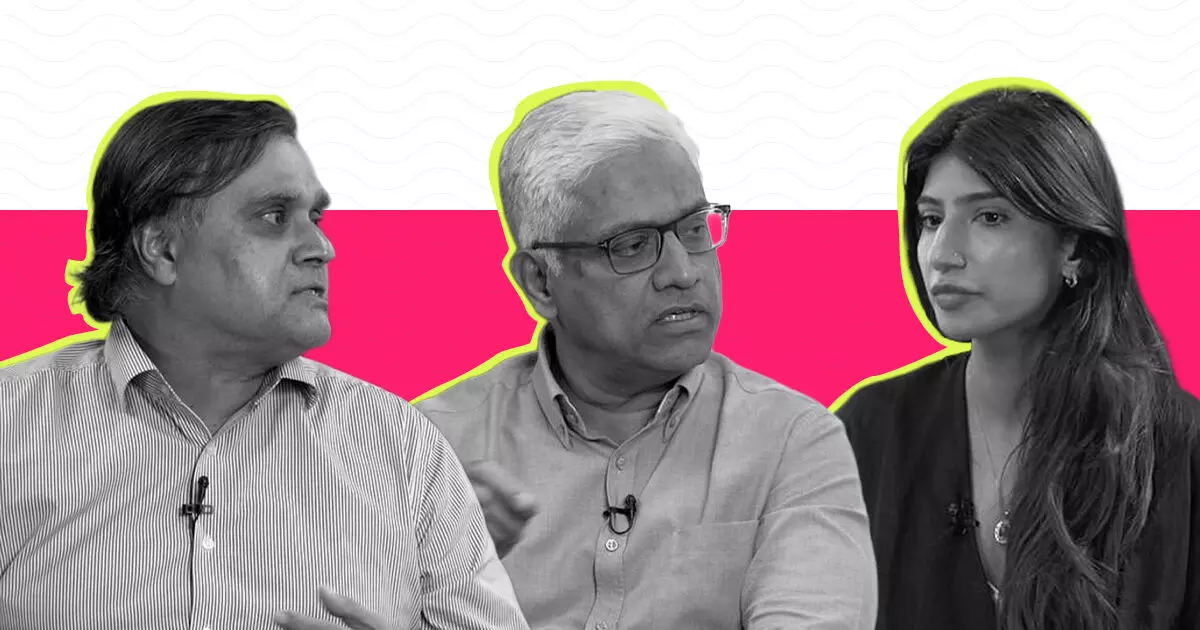
Can Private Wealth Save India's Water And Wilderness?
- Economy
- Published on 19 Sept 2026 6:00 AM IST

In this edition of The Core Report, Shloka Nath: Founder and CEO, Dorahi, Mobilising Philanthropic Capital for India’s Climate Transition, Harish Yarlagadda: AIP Founder; Founder & Chief Mentor, Malaxmi Group; and Co-Founder, Dharmavana Nature Ark (DNA), Ravi Mariwala, Founder & Chairman Smaart Wateron why biodiversity, water reform and "unlock" capital, not more schemes, will decide India's climate future.
The Gist
- Shloka Nath emphasizes the interconnectedness of climate and development agendas.
- Harish Yarlagadda highlights the importance of biodiversity and moral responsibility in addressing ecological challenges.
- Dr. Ravi Mariwala focuses on water management and the need for effective sewage treatment to ensure public health and environmental sustainability.
NOTE: This transcript contains the host's monologue and includes interview transcripts by a machine. Human eyes have gone through the script but there might still be errors in some of the text, so please refer to the audio in case you need to clarify any part. If you want to get in touch regarding any feedback, you can drop us a message on feedback@thecore.in.
Hi, and welcome to this Core Reports special edition. We are talking today about how climate can be addressed through wealth, or more specifically, how Indian philanthropy can address one of the most defining and fundamental challenges we face: climate change. We will approach this in two or three different ways, but we are going to explore it through the eyes of people who have done work on the ground, through their experiences of how they have tried to address a particular problem and then scaled up. We will also try to understand where they want to take this world, and how they envision a world that is, let's say, a better place to live in.
To do all of that, I am joined by three guests: Shloka Nath, who has been mobilising a lot of philanthropic capital and previously served as CEO of the India Climate Collaborative; to my right, Harish Yarlagadda, founder and chief mentor of the Malakshmi Group and co-founder of the Dharmavana Nature Arc (DNA); and finally, Dr. Ravi Mariwala, founder and CEO of Smart Water, who is also a promoter at Marico Limited. Thank you all for joining me.
Let me start with you, Shloka, and get a broad sense of things. There is capital today, there is wealth in this country — we all understand that we want to do something about climate, and many indeed are doing something about it. So how would you define the scope of what we want to do, in the context of how we are thinking about it?
Shloka Nath, Founder and CEO, Dorahi, Mobilising Philanthropic Capital for India’s Climate Transition
That's a big question, but let me try to frame it with this one thought: there is no real division between a development agenda and a climate agenda, and I fear that is unfortunately where we are in terms of our mindset when we think about climate change. The development agenda *is* the climate agenda. Climate is the biggest force multiplier when it comes to our existing development constraints.
It is not a new problem that has suddenly been thrust upon us, and yet, in philanthropy, when we talk about capital, we talk about climate as something that arrived recently. In reality, it is entering through every single existing problem we already have. So how we choose to address that, we have to be very aware that today there is no critical pathway to sustainable development that is untouched by climate anymore. It doesn't exist.
So the first thing we have to do in philanthropy — and more broadly, when we think about the transition of India's economy — is accept that climate change *is* the development agenda. It underpins it, and we need to think more in terms of how we actually risk-proof that development agenda, and ensure that growth is not sacrificed because of this threat multiplier that is exacerbating our existing issues.
This has obviously been a live issue for a few years, and you have been at, perhaps, the epicentre of it, particularly from a philanthropy point of view. What would you say has been achieved in the last few years?
Shloka Nath
That's really interesting. When we first set up the ICC, we would go door to door and ask, "Do you know what climate change is?" I think the challenge today isn't that funders, bureaucrats, or implementers don't understand what climate change is.
We have a distinct problem compared to the Global North, where there is still a lot of climate denialism. Here, I think we're steeped in acceptance of the problem — the real challenge is that we don't seem to be able to create a whole that's greater than the sum of its parts.
We face coordination challenges and ecosystem challenges. For instance, most funders still want to "build the bridge," if I can use that analogy, but who is going to fund the engineers, the maps, the standards — everything it takes to ensure we don't end up with 20 bridges going to 20 different places? We have to be able to fund things in totality.
For example, say you want to fund a solar company. That means you also have to look at how women will be represented in the jobs that are created, how we think about regulation, and how we think about the standards for the technology involved. No one is funding those wider ecosystem pieces. So the challenge isn't really about whether we understand what climate is and whether we should address it — the challenge is whether we can build an entirely holistic approach to solving this problem, and ensure that the system has the agency to coordinate around it. I'm happy to talk more about this in detail, but that's what sits with me today.
Got it. Harish, you've been a power entrepreneur, working in the energy space more broadly, and then you transitioned — or additionally transitioned — into this work. Tell us about it.
Harish Yarlagadda, AIP Founder; Founder & Chief Mentor, Malaxmi Group; and Co-Founder, Dharmavana Nature Ark (DNA)
Fully transitioned, actually. So, building on what Shloka said — we really don't understand climate. I made money; I was a polluter, burning a lot of fossil fuel to make that money. At some point in life, you realise that what you're doing isn't the right thing to do.
Whenever we talk about climate, whenever we talk about the planet, we really only talk about ourselves. We don't talk about the other billion living organisms on this planet. We divide ourselves into countries and languages, not realising that we all descend, mitochondrially, from the same lineage. Human beings are very confused, and the cultures and religions we grew up with developed, in part, through falsehoods. The day we invented language, the first thing that came out was lies, and through those lies we became who we are today. We are heavily influenced by the things around us.
When that realisation hit me, I understood that I needed to widen my circle of moral concern. Today, my circle of moral concern extends to myself, my family, my region, my friends, my country at most, to human beings but not beyond that. That is where it really struck me, and I decided the first place to focus was biodiversity, because it isn't only about protecting species that share this planet with us in a symbiotic relationship, it's also about carbon capture, usage, and storage (CCUS). That's why, as a first step, I exited most of my power plants it took some time and now I concentrate mainly on biodiversity as a non-profit, alongside a few sustainability-focused companies working on water management, compressed biogas (CBG), and climate resilience.
And biodiversity specifically — did some other thought process lead you there? You seem to be among the few, if not the only person, I've encountered who has focused on biodiversity as a specific challenge.
Harish Yarlagadda
Yes. Before this interview, I was chatting with my fellow panellists about this. Biodiversity is genuinely difficult work. I could plant a Miyawaki forest, but that isn't biodiversity. Many people mistake "greening", say, greening Haridwar or greening the planet — for biodiversity. It isn't. What lives in the rhizosphere, where plant roots grow, accounts for 25% of living organisms. That's what we have to protect; everything else follows automatically. That's where most of the real action is happening.
Think of the movie *Avatar* — the way life on that planet connects through mycelium and mycorrhizal fungi. That's the kind of connection we need to build here. That's why I chose biodiversity as my first step.
And by definition, biodiversity is about scale, we'll spend some time on that later. Ravi, where did Smart Water begin, and what was the inspiration?
Ravi Mariwala: Founder & Chairman Smaart Water
The inspiration was very simple. I was building a house about 15 kilometres outside Mumbai, as the crow flies, and found there was no piped water. Even in places like Panvel or Khopoli, the same problem exists, and it's fairly uniform across the country: urban and peri-urban areas lack water, and in rural areas, people often have to fetch fresh water themselves.
I was staying at a friend's house, trying to finish construction, and he said, "Ravi, this is a problem out here." I said no, it's not, he had a great water system, except he had to press a button to switch on the generator that drove it. I asked why that was necessary, and realised there was nothing technologically new about his setup, so I decided to build my own.
Being a young engineer with a bit of hubris, tempered somewhat now, after seeing what's really happening in the water sector — I calculated that I would need exactly 481 watts to run a system for a five-bedroom house. I like numbers. So I went to the market, bought pumps, the most inefficient ones available, with an efficiency of just 27% (which, as it turns out, has much larger implications for the country) and it took me five and a half months to build the system.
Why so long? Because I needed a plumber, a mason, and an electrician together at the same time, and the odds of getting all three in one place were less than 1%. It took five and a half months, with many modifications, because the engineering wasn't perfect at first. I also learned that peri-urban areas lack trained plumbers and electricians; masons have practical experience but not formal training; and the materials commonly used aren't the right ones. Eventually it worked, and it still works today — the only thing I keep replacing is capacitors, because power quality in those areas remains poor.
A friend then asked, "You built this for yourself — why not build one for me?" Then another friend asked. I realised we were, in effect, in business the entrepreneurial instinct kicked in. I built six systems with my own hands (I enjoy building things myself) and sold them within three weeks.
At the time, I was running a lab that analysed water and food, and the data started "speaking" to me — I could look at water test results and conceptualise treatment systems almost intuitively. My engineering background helped a great deal with that analytical work. That's how it started, and I took it one piece at a time. Today, we provide the "last-mile" solution for gated communities and individual homes — just a month ago, we added a kitchen filtration product, something I had resisted for a while, and now we offer a complete, full-stack water solution.
This includes things I actively promote, like rainwater harvesting and groundwater recharge — I think that's essential, because without it you're effectively cutting off your own future supply. I also discourage people from maintaining large lawns, which consume a lot of water; I prefer endemic trees instead. At my own house, we've measured a temperature difference of almost four degrees compared with homes that have large lawns. There's a lot of complex science behind this, and what I enjoy most is understanding these complex systems and communicating them simply to a wider audience.
I also taught a subject called Chemical Plant Utilities at the Institute of Chemical Technology, covering things like how to generate steam and manage power and water. I loved it, and working with students taught me a great deal about the problems we need to solve. Looking back, if I had to start over, I'd want to begin as a teenager.
Let me ask a step-back question: what are the biggest water-related problems India should be addressing right now?
Ravi Mariwala
The biggest problem, without question, is sewage treatment and the reuse of water for non-potable purposes. Treating sewage is extremely important because untreated sewage contaminates our good water sources, and that's fundamentally a public health issue.
Let me give you a couple of examples. Looking at rural sewage treatment systems, they are contaminating wells and tube wells, which is causing serious public health problems. In 2023, I was in the Himalayas near Uttarkashi, where the women I met were well-educated — many with degrees, including in Sanskrit — but they told me they were having stomach problems. It became clear that sewage water was mixing with their drinking water, and that was causing gastrointestinal issues.
Second, in urban areas, societies with more than 100,000 square feet are legally required to treat and reuse their sewage. That itself creates a healthcare problem, because while they use the treated water for flushing, it doesn't remain stable — it has a shelf life of less than four hours. This is what I'd call the "low-hanging fruit": be truthful, and be rigorous, about water quality, and I think that alone would solve a significant part of the problem. Today, we treat only about 20–25% of the total sewage generated in the country.
Harish Yarlagadda
What about industrial discharge?
Ravi Mariwala
Industries are somewhat better off, since zero-liquid-discharge regulations have come into effect, but many are still looking for workarounds. I think the regulation has been implemented a bit too harshly, it needs to be phased in gradually, and we need to be more creative about the energy dimension. We've studied this extensively: the expectation that industries will evaporate and reuse all their water is a very expensive proposition, especially for an energy-starved country like ours. So people adapt and, as the saying goes, the solution to pollution often becomes dilution.
So sewage is the biggest issue. What would be next, in terms of water?
Ravi Mariwala
We have seasonal rainfall, so storage capacity and groundwater recharge are among the most important things we can do. For years, our policy was essentially "drill baby drill", borewell after borewell, much like the oil industry's old adage, and we've depleted groundwater dramatically as a result. It's actually quite easy to recharge the ground and treat it as a kind of savings account, building capacity for the future.
If you look at Amit Chandra's work, for instance, what he has championed, building a strong financial model for desilting water bodies, is a very achievable, low-hanging fruit, and it has produced excellent results. Securing our water future is critical, and it doesn't require high technology; we simply need to return to older practices. Water management in this country was once very good, people understood it, but today we've lost respect for that knowledge and haven't adapted it to changing times.
As Shloka said earlier, we need to look at climate change, water conservation, and water security together, but water *resilience* also needs to be built in. We have to apply systems thinking to understand how everything is interconnected. For example, industries need to change their processes, can they reduce water use? Textiles, for instance, consume enormous amounts of water in certain processing stages. How can we address that? Those are some of the challenges we need to tackle.
Shloka Nath
And Ravi, to your point, water underpins the entire food system, and yet we talk about nutrition separately from water; we talk about everything in complete silos, when water is really at the heart of it all.
Ravi Mariwala
Absolutely. Take the issue of ethanol, for example, essentially, we've been blending water with petrol, because ethanol is generated from sugar, sugar prices are rising, and rice cultivation while making our "granary" look productive is effectively exporting water. Water touches everything, and the real challenge has been how we price it. Today, water is priced far too cheaply, much like virgin plastic being cheaper than recycled plastic, that's exactly why adoption of better practices remains poor.
Water in Mumbai, for instance, is priced at Rs 6.23 per 1,000 litres, which is minuscule. And who benefits from that mispricing? Bottled water companies, they claim everything else, including municipal water, is bad. It isn't. Municipal water in Mumbai is actually excellent, and in some parts, based on tests I've seen, it's even good enough to export. The real, well-documented problem lies with housing societies that fail to maintain their infrastructure and follow the guidelines given to them.
Shloka, we've discussed two illustrations in some depth. Looking around at the people you talk to, how do you see these kinds of solutions stacking up? Are there other examples you can share, in the context of climate interventions by businesses?
Shloka Nath
What's interesting is that one piece of advice we often give the people we work with is that a climate solution doesn't have to be a "climate solution" per se, and you don't have to be a dedicated climate funder. You have to think about the development dividends that every rupee you invest can produce, regardless of the sector. For instance, why do cold storage facilities make sense as a climate solution? Because they help increase farmer incomes, improve food and nutrition outcomes, and also reduce emissions. Until we start evaluating solutions through that lens, the multiple dividends they can produce from a development perspective, I don't think we're going to solve the problem.
The key thing about philanthropy, and why I think it's so powerful, is this: I'm tired of the conversation where people say, "Yes, but philanthropy isn't enough it's such a small pool of capital." Sure, but I don't think the amount is what really matters; it's the catalytic impact of that capital and what it can do. What can philanthropic capital achieve that no other type of capital can? Ultimately, it's the capital that can be used to risk-proof initiatives; it's patient capital — the kind you use to build demonstrable pilots that government can scale, to generate data and evidence that markets can act on, to aggregate small organisations into a real pipeline, and to ensure institutions engage before a crisis hits, not after.
So, to me, the exciting part of "climate solutions" isn't really about specific projects or thematic programmes, though I have enormous admiration for the pioneering work my fellow panellists are doing, and I hope more people follow similar paths. What we tell people is to think about the "unlock." Think about it from a systems perspective: where can your capital go furthest? How can it be leveraged to unlock further pools of capital, whether private or public? That's the real power of philanthropy.
I feel that in India we still think too small, and too transactionally, about philanthropic capital and that's a generalisation that excludes the two gentlemen beside me and many others we've met, but as a whole, we still treat it as charity. In reality, philanthropic capital is nation-building it's what we used after independence to build this country. To me, climate change is the next nation-building agenda. Call it climate, call it *Viksit Bharat*, call it whatever you like — we have to think about the future we are building with every rupee we invest. Climate simply underpins that.
Harish Yarlagadda
Two things stood out to me from what you said, philanthropy, and macro-level national thinking. First, I think the word "philanthropy" itself is somewhat misleading, it literally means "love for human beings." To truly widen our circle of moral concern, we need to move beyond that framing. The bigger problem is that, of the roughly ₹30,000 crore mandated under CSR, only about 6–7% goes toward environment and climate. We need to raise that to 40–45%, and help people understand that serving human beings should start with serving nature. For example, if bees disappear from this planet, we would all be dead within ten years — I know that sounds extreme, but it's the practical reality. Our crops would fail, our biodiversity would collapse, everything would fail. That's one aspect — at the individual, human level, our thinking has to change.
Shloka Nath
Can I add to that before your second point? I want to say you're completely right and while I don't claim to represent the entire climate community, I think the biggest disservice we've done is take a purely human-centric approach to solving climate change. In the Global North, it's even worse, because the approach is not even people-centric, it's industry-centric.
Harish Yarlagadda
My second point is this: the biggest problem I see is that governments aren't thinking correctly at the macro level. Before signing the Paris Agreement, before committing to the SDGs, before pledging carbon neutrality by 2070, India should have established a "Ministry of Climate Resilience" that isn't folded into the Ministry of Forests, Environment and Climate Change, as if climate change only concerns forests. It touches agriculture, women's empowerment, healthcare, infrastructure, ports, everything. If sea levels rise, ports stop functioning, economies stall, and we'll see climate refugees flooding into the Northeast from Bangladesh, since it sits on a delta and would be submerged. All river deltas will be affected; ports in Mumbai, Vizag, Kolkata, and Chennai will all be at risk. We need to understand this and, at long last, establish a genuine Ministry of Climate Resilience. Some island nations are already thinking this way, because they face submersion once warming reaches two degrees.
There is, in fact, a Coalition for Disaster Resilient Infrastructure — co-founded by the Government of India and inaugurated by Prime Minister Modi alongside the French President at the time. It now includes more than 55 countries, including island states that are perhaps thinking about these problems most actively.
Harish Yarlagadda
The Maldives is probably one of the most engaged, the Maldives and some Caribbean nations too.
Singapore is building its western sea wall; several Pacific island nations are engaged as well. But interestingly, India is actually leading or trying to lead this conversation, including around funding for disaster resilience: for instance, how airports can become more resilient to disasters. A couple of years ago, Dubai's airport shut down due to unprecedented rainfall. So how do airports, power plants, or telecom networks stay resilient when exposed to extreme weather?
Shloka Nath
That's a valuable effort, and it's the kind of leadership we want to see from India, we want civil society to move in this direction too. The issue is that we're treating the symptom, not the cause: there's very little investment in *preventing* disasters in the first place. From a philanthropic or business perspective, when a disaster strikes, people rush in with immediate relief, but we should also talk about what happens three months later, or longer.
Studies show that the resulting loss of household income can persist for up to 19 years per disaster — many households simply never fully recover from these shocks. So how do we build genuine resilience, pre-disaster? How do we build early-warning systems before extreme heat harms informal workers, before forest fires spread, before water crises hit? I think we're still living in a world that denies this reality, and philanthropic institutions and capital are still playing catch-up.
Harish Yarlagadda
There's actually a hypothesis for that, it's called the "rivet-popping hypothesis."
Shloka Nath
Please tell me about it.
Harish Yarlagadda
Imagine we're flying in a plane, Earth, in this analogy, moving through space. One rivet pops; nothing happens. A second pops; still nothing. A third pops; still nothing. But at some point, the eleventh rivet, or the twelfth, or the fifteenth, or the twentieth, we don't know exactly which the whole structure fails, and there's no way to recover from it.
Shloka Nath
I'm going to use that.
Harish Yarlagadda
That's essentially how the human mind works. To be fair, India is doing a great job, we have about 32 policies in place already: solar schemes, the PM-KUSUM scheme, and others that are actually being implemented. But the biggest thing we have to recognise as a country is this: even as a $4-trillion economy, compared to Japan's $5-trillion economy — Japan accounts for only about 2% of global pollution, while we account for around 7%. When you point this out to politicians, they'll say our per-capita emissions are low because of our population but pollution isn't driven by population; it's driven by GDP. We need to understand this.
There are many books that address this, Shloka referenced some earlier; we've identified 15–20 books on "degrowth" for our DNA project. Kate Raworth's *Doughnut Economics*, for one, talks about SDGs as a "wedding cake." The way SDGs are normally displayed — in seminars and presentations, is actually the wrong framing. They should be shown as a wedding cake, where the base layer is the biosphere, above that the social structure, and above that the economy. But industries tend to focus only on the tip of that cake.
Let's move to some practical questions, since you were talking about the "unlock", how people can actually get started, even if they have the capital and the intent. Harish, tell us: once you conceptualised your project, you said you decided to focus on biodiversity because that was where the real problem, and solution, lay. What was your next step? Was it simply a matter of buying 400 acres and beginning? I imagine you ran into some hurdles.
Harish Yarlagadda
To do biodiversity work in a real sense, you need at least 250 acres especially in a region like the Deccan Plateau, which is dry, arid, and characterised by woody scrubland. I searched for suitable land for nearly two years without success, until a friend of mine, a scientist at CCMB named Karthik, suggested I meet an American gentleman, Fred, who was also looking for a partner.
I met him, he had already acquired 400 acres and was working to restore biodiversity across the Deccan and Eastern Ghats, regions that have never really received the attention given to the Western Ghats, the Himalayas, or the Nilgiris. I liked what he was doing, and I found we thought alike, so alike, in fact, that we share the same birthday, and we both practise pantheism, the belief that nature is God. So we agreed to become partners.
It's structured as a non-profit. We built a 7.2-kilometre compound wall around the property, since it's close to an urban area — a 10.5-foot granite wall topped with two rows of barbed wire, plus a 16-foot buffer corridor with another cement-slab wall. We deliberately keep this buffer free of vegetation to prevent forest fires, since we're surrounded by that particular species: *Homo sapiens*.
Having built the wall and fenced the land, what was your next step?
Harish Yarlagadda
Inside, we go around collecting seeds from various forests, primarily across the Deccan and the Eastern Ghats. We select mother plants and record their exact location, the longitude and latitude, then grow the seeds in our nursery without pampering them; no manure or fertiliser is used, so only the fittest survive. If we start with, say, 100 seeds, 50 might germinate, and only 20 of those might survive. We also collect soil from around the mother plant, since the microbial life in that soil is essential for the seedling's survival.
Those 20 surviving plants go into what we call the "Arc." As they grow, a few will ultimately thrive, and since we know exactly where each mother plant originated, we can track and monitor them closely, they become the mother plants of the future. Most of the trees we work with are near-extinction species. Alongside this, we're also developing fauna, though we don't yet have large fauna because of predator-related concerns, so we focus on smaller species: snakes, insects, spiders, and around 70 varieties of fungi.
Are people able to walk in and experience it?
Harish Yarlagadda
We don't allow the general public in yet, but we've signed MOUs with CCMB, so scientists visit, along with cadets from the Forest Department. Visitors often feel as though they're standing in seven different forests at once, we grow fig species that range from the Himalayan plains to Kanyakumari, something that isn't possible anywhere else. Interestingly, the specific wasp species needed to pollinate the Himalayan fig isn't present here, so the tree fruits but can't propagate naturally. You can also see subtle differences, the leaf size is somewhat smaller than in the Himalayas, since the plants need less direct sun in Hyderabad.
We also maintain a Centre of Excellence with taxonomists and mycologists on staff, and pro bono experts on bats, spiders, and bees. Cobwebs might seem like an odd priority, but they're actually very important indicators and contributors to biodiversity. So far, we've produced around 16 peer-reviewed articles from this work.
Shloka Nath
Oh, wow.
And these are sourced from your ongoing biodiversity activities?
Harish Yarlagadda
Yes, we have this 400-acre living laboratory, plus a separate Centre of Excellence for biodiversity and climate resilience, and, at my main office, an "interpretation centre" for climate.
Ravi Mariwala
You've also created water bodies there.
Harish Yarlagadda
Yes, some are seasonal, some hold water year-round. One water body alone cost us around a crore of rupees, because of how we engineered it to support and sustain life.
Do you irrigate it, or rely purely on natural rainfall?
Harish Yarlagadda
Mostly natural rainfall, though we've secured permission for a few borewells to help plants survive dry seasons, each individual plant represents a significant investment for us.
Shloka Nath
When can we come visit?
Harish Yarlagadda
Anytime, experts and students are always welcome, though we curate their visits carefully: no littering, and we avoid paving the roads except where erosion is a serious problem, since the Deccan Plateau terrain has a lot of undulation. We keep most paths unpaved so microbial life can move freely. My partner actually lives on-site, right now he's out in a forest in Kurnool district.
Shloka Nath
What dedication, I know exactly what that's like.
Harish Yarlagadda
I'll give you an example. There's an Indian rubber plant species found in the Nilgiris, in the Andamans, and near the Himalayas in the Northeast. We thought the Andamans would be a good source, so my partner got permission, landed in Port Blair, then travelled to the relevant island but his GPS was off by about four degrees. After walking ten kilometres to reach what he thought was the plant's location, he found himself roughly four kilometres away from it, and had to return and redo the entire trip the following season, since you can't simply climb these trees whenever you like, you have to identify the mother plant first, then wait for the seeds to fall naturally before collecting them.
You can imagine the effort involved for every single plant, this is nothing like a "Miyawaki forest." Many people mistake what we do for that. Unfortunately, a lot of real-estate developers now plant Miyawaki-style forests and call it "biophilic design," but these are essentially monocultures, which support no real ecology, no birds, no insects, nothing.
Ravi Mariwala
Or planting bamboo everywhere, like across parts of the Bombay Fort area — that's not necessarily a great idea either. We need far more diversity than that.
Ravi, let's spend a few minutes on technology and how it's changing the way you scale up and think bigger. Tell us about how you've used technology in your work.
Ravi Mariwala
I have a personal rule about technology: there's no such thing as "high-tech" or "low-tech" — there's only the "right tech," matched to the right solution. Take Mumbai's proposed desalination plant in Manori, for instance. Does Mumbai actually need a desalination plant, or is this more about optics? That's worth asking. Desalination typically costs between Rs 150 and Rs 200 per kilolitre, whereas sourcing water from catchments like Vaitarna, or even the Lonavala side, would likely be far cheaper, even accounting for the land required. The bigger issue, really, is poor distribution.
What matters most, in my view, is that our water quality is actually quite good our per-capita use of pollutants like pesticides and PFAS is relatively low. I've rarely found pesticide residue in water around Mumbai or in Maharashtra more broadly. But we do face issues with high salinity, fluoride, and in some areas arsenic, and these are effectively addressed through rainwater harvesting and groundwater recharge, which keeps flushing these contaminants out. In coastal regions, groundwater recharge also helps keep seawater intrusion at bay.
Choosing the right technology for the right place matters a great deal for sustainability, and the water-power nexus is very strong here. We use a lot of nature-based solutions, for example, we've built sewage treatment systems that don't rely on electricity at all; they run on bacteria and plants, and we're continually optimising and engineering that process.
In the first stage, bacteria do the work in an oxygen-free process called anaerobic digestion, which breaks down organic matter. Then we use phytoremediation, using plants to remediate the water further. Plants can create zones with varying oxygen levels, which help process different contaminants: organic matter, nitrates from faecal waste (which get converted into a form plants can use as fertiliser, much like night soil was historically used as fertiliser in the UK), and phosphates, another nutrient plants can absorb. This process also reduces turbidity and improves the bacterial composition of the water.
We're constantly refining this engineering to shrink system size and reduce implementation costs. We've also developed in-situ cleaning methods for polluted drains (*nalas*), placing plants directly inside them, along with supporting structures, to give the plants time to do their work. If we rush the process, the plants simply can't keep up, nature has its own pace, and technology has its own pace, so we have to engineer a balance between the two.
I'm currently working with an NGO to implement around 24 to 30 water filtration plants for rural communities — eight this year, sixteen next. For that, we've used a roughly 200-year-old technology, because rural communities engage with it more naturally: slow sand filtration, where a bacterial layer forms on top and consumes contaminants, producing very clear water. It really depends on context — what works, where.
Among the products you sell commercially today, what would you say are the top two or three? I'm trying to understand what people are actually looking for.
Ravi Mariwala
It depends on context. Sewage treatment is essential, that's fairly universal. Rainwater harvesting is becoming nearly universal too. Then there's basic water treatment, filtration, our first line of defence. People tend to underestimate filtration, but it's genuinely important. Depending on the water quality, a softener might also be needed. I try to avoid recommending reverse osmosis (RO) wherever possible, I've supplied pure RO systems maybe six times in total. Instead, we look for other innovations.
I always evaluate two key parameters: capital cost per kilolitre and operating cost per kilolitre, designed to hold up over 10 to 15 years, since these core technologies don't change dramatically that quickly. I also do a fair amount of rural work, which involves very different considerations. One increasingly popular product is the pressure pump, people often ask about its carbon footprint compared to an overhead tank-and-tower system, but modern pump systems, being compact and efficient, actually have a smaller footprint than tank-and-tower setups.
You mentioned 27% efficiency earlier for older pumps.
Ravi Mariwala
Right, and newer, smaller pumps now achieve about 55% efficiency. This is actually a major opportunity for agriculture — there are more than 30 million pump installations of 3 HP or less across India, most operating at just 25–28% efficiency. If we could raise that to 40%, India could save an estimated 10,000 to 15,000 megawatts of power.
Harish Yarlagadda
And better capacitors would help too.
Ravi Mariwala
Exactly — capacitors.
Harish Yarlagadda
Most don't use them at all, and that improves the power factor significantly.
Dr. Ravi Mariwala
For my own swimming pool, I use a three-phase pump running directly on solar power, if the sun doesn't come out, the pool pump simply doesn't run. Fortunately, that happens maybe five days a year.
Harish Yarlagadda
Are you talking to municipalities about sponge cities?
Ravi Mariwala
Not with municipalities, no.
Harish Yarlagadda
With communities, then?
Ravi Mariwala
Communities, yes — that's a different conversation — but not municipalities.
Harish, coming back to you, you started with a project, and you've since built something physical, gathered data from it, established a centre of excellence, and shared the resulting knowledge with wider society. What's next? In two ways: what would you like to do yourself, and what would you like others to do to support this, or to advance the broader message of climate adaptation?
Harish Yarlagadda
I've applied what I've learned to some for-profit ventures too. I'm building several companies, one focused on water management, though in a different segment from what Ravi does; another is a compressed biogas (CBG) company; and we're now entering areas like battery storage. RE-RTC, Renewable Energy Round the Clock, is very important for our country, since it allows renewables to function like baseload plants. A recent tender actually closed at ₹5.25 per unit, which is cheaper than a new coal plant.
Building on what Shloka said, I want to encourage industries to invest in biodiversity directly, within their own power plants and facilities. There's a concept called OECM (Other Effective area-based Conservation Measures), part of a UNDP programme; I'm involved with the National Biodiversity Committee that's helping formulate the relevant policy in India. It allows organisations to create forest-like environments outside formally protected forests, on plots larger than five hectares, for instance, and have them officially recognised. The policy framework exists; we're waiting on ministerial approval. Once approved, India will be able to formally designate OECMs. The first such designation was in the Aravalis, but that happened without a proper policy framework in place, and no others have followed since.
I'm also involved with the CII, I was formerly chairman of CII Andhra Pradesh (undivided), and I now advise their ESG and sustainability panel. I keep encouraging industries to prepare for this policy, since India still hasn't met its "30 by 30" biodiversity commitment under the Kunming-Montreal agreement.
Since you mentioned Andhra Pradesh, there's a significant amount of data-centre development happening there, more than 30–40 gigawatts' worth. Do you think that could become an issue?
I'll say "no comment."
Ravi Mariwala
I'd like to add something here. We worked with two large organisations, consulting with them over three years to shape their CSR strategy on water and, echoing what Harish said, they're now incorporating biodiversity too. I won't name the organisations, but their commitment on this front is genuinely strong, including watershed-development work around their manufacturing facilities. You've probably also seen how the Godrej Group has approached the mangrove economy, that's a remarkable, exemplary effort worth following.
So, for someone who owns land, a lot of it, Godrej, historically, being a good example, would you say biodiversity is something more landowners should consider?
Harish Yarlagadda
Absolutely, any wasteland can be converted, and doing so helps move India toward its "30 by 30" Kunming-Montreal target. We're currently at around 27%, after some liberal accounting, so there's still roughly 1.5 crore acres left to cover.
So creating a dedicated biodiversity zone is, in your view, a concrete way of contributing.
Harish Yarlagadda
Yes, we'd be saving ourselves, really.
Based on all your work and research, Ravi, you seem to agree.
Ravi Mariwala
I strongly agree, global cooling effects, and carbon sequestration, would genuinely follow from this.
Harish Yarlagadda
Along with CCUS benefits.
Shloka, the last word goes to you. What should we be thinking about as we look ahead? I asked both panellists, and they pointed to biodiversity as one concrete way people can contribute and that connects to a broader point: people may have limited capital, but they may have idle land, perhaps from defunct industries, that they're not looking to sell. What else could they do?
Shloka Nath
Many things. First, I have to say, the biodiversity conversation genuinely moves me. There was a strange divorce, in a sense, in 1992, when the Biodiversity COP and the Climate COP were established as separate tracks, as if the two would never meet. We're finally circling back to recognising that it's all one interconnected ecosystem.
Coming back to the idea of transition, technology is certainly a strong, core component of that shift, but beyond technology, we also need institutional transition. How are we building health systems resilient to a hotter India? Are we genuinely thinking about how farmer incomes can remain stable as monsoons become increasingly erratic? Are we thinking about increasing women's participation in the labour force as part of the "green economy" conversation? Sometimes it feels like we've simply renamed something we consider bright and new, but underneath, when you turn the lights off, it's the same old system. What are we really building into this economic transition that allows us to grow and develop in a way that builds genuine, lasting resilience, so we can actually thrive within these new conditions? Philanthropy has a core role to play there.
A good example, beyond the work these two gentlemen are doing, is Roshni Nadar's HCL Climate Tech Fund, which we helped set up. She's effectively funding the "cost of loss," supporting startup innovation in the built environment, cooling, and freight mobility. The idea is that if we don't close this gap quickly enough, by getting more of the private sector to adopt these technologies now, we risk locking ourselves into high-carbon development pathways for the next 30–40 years, and two-thirds of India's building stock has yet to be built.
We are, quite literally, a testing ground, I consider that our greatest asset, because what we build here will have major implications for the rest of the Global South, and for how the world meets the climate challenge. We're also, depending on the study, the third- or fifth-most climate-vulnerable country in the world. But proximity to vulnerability is also proximity to knowledge, those on the front lines of climate impact are also knowledge-holders and agents of change. We need to build genuine agency and resilience into that reality; adaptation is already happening on the ground.
This whole adaptation-versus-mitigation binary is, frankly, a distraction, the wrong thing to focus on. We need to talk instead about development dividends, and about what kind of growth we actually want as a country. I don't think we've clearly defined that yet.
Ravi Mariwala
What resonates with me is something Einstein said, that we cannot solve tomorrow's problems using yesterday's thinking. We need a genuine shift in mindset. Climate events today have become far more intense than anything we've previously experienced, so I strongly agree with Shloka: we need to build capacity, resilience, and a stronger knowledge base, a substantial transformation is required.
And, as you say, that knowledge already exists around us, we simply need to mine it more effectively.
Shloka Nath
One last point, if I may, something both my fellow panellists have touched on, but perhaps we should name explicitly: the justice dimension underlying all of this. And by that, I don't simply mean inclusion or representation. Too often, we treat that conversation superficially, "make sure enough women, tribal communities, or indigenous groups are represented, and we're done", as though sprinkling a little justice on top settles the matter. The justice component needs to shape how the transition itself is designed and built; it has to underpin the whole process. If we aren't asking who will own the renewable energy infrastructure, who will be compensated, and who gets the high-paying jobs versus the low-paying ones, then I think we're doing a disservice to what growth truly means in this part of the world, and to who we're actually bringing along with us. Those remain the fundamental questions we still need to answer.
Understood. I think we've run out of time, Harish, last word.
Just to build on what Shloka said — "just transition" is really the key phrase. As human beings, we need to practise minimalism and overcome the paradox of choice. We're the only known species that observes itself in this way, no other species reflects on its own existence the way we do. We've extracted bronze, copper, iron; we've advanced through science to the point of reaching other planets and our own moon, all because we are, in a sense, an "observer species." What baffles me is that, despite this capacity, we can't seem to anticipate what will happen to us over the next ten years.
The planet itself will recover, regardless, it has rejuvenated five times before, based on what we know from science; we've had five mass extinctions, the last being 66 million years ago, when the dinosaurs disappeared. It will happen again. In the grand scheme, we've barely existed at all, if you compress the planet's history into a 24-hour clock, we appear only in the final 20 seconds or so. *Homo erectus* existed for roughly 2.6 million years; we, as a species, have existed for only about 250,000 to 300,000 years. In many ways, we're bringing about our own end. It's time to wake up, live up to our identity as an "observer species," pay attention to what's happening around us, and act to save ourselves.
And, in the spirit of everything we've discussed today, be a good corporate citizen, and do your part. We're completely out of time. Thank you all for joining me, I hope to continue this conversation as this journey unfolds.


